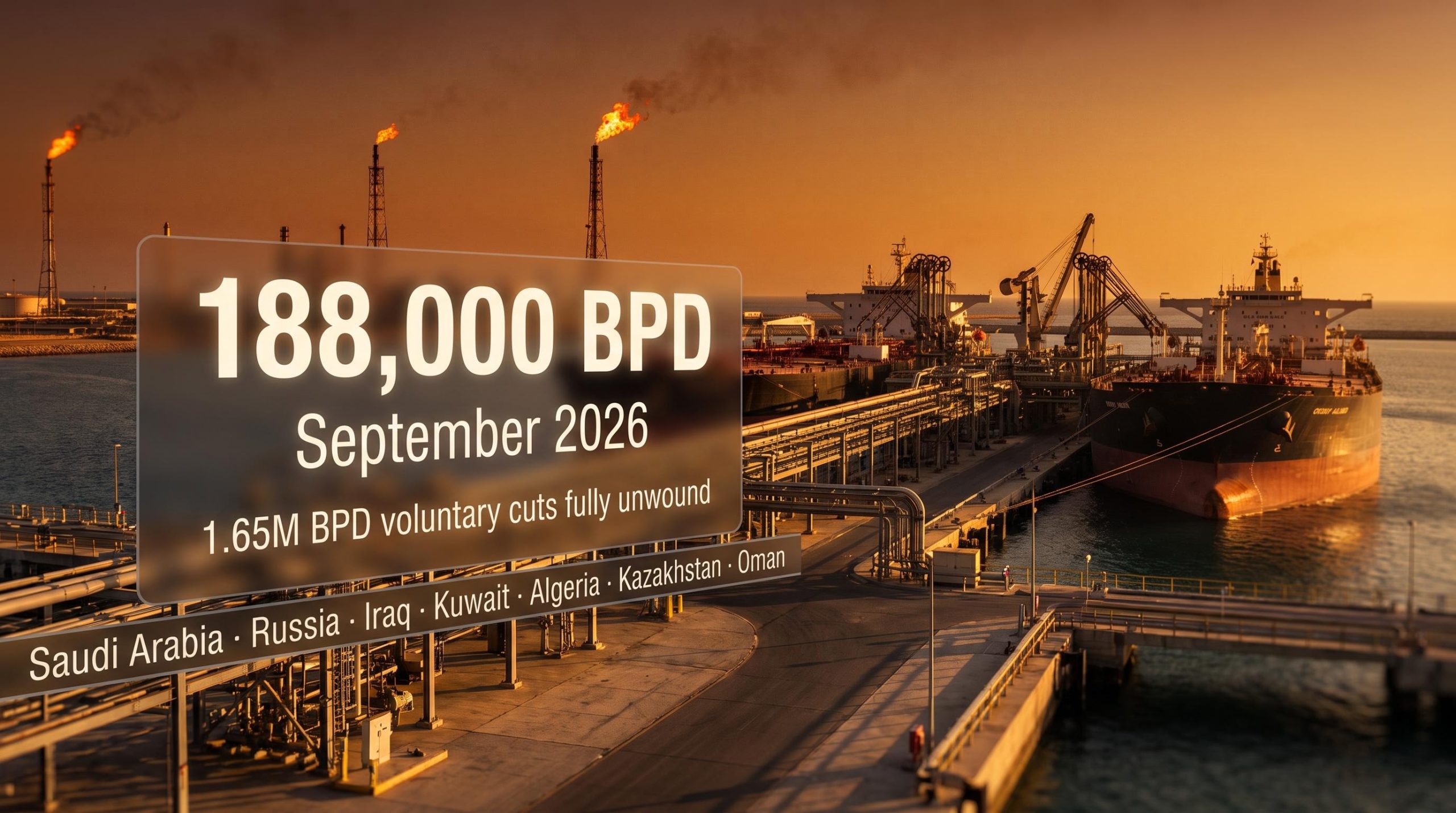
Seven OPEC+ producers agreed today, 2 August 2026, to add 188,000 barrels per day (BPD) to their output targets starting in September. This is not a routine monthly adjustment. It is the final step in unwinding a voluntary supply cut that has shaped oil markets since April 2023.
With the September increase, the full 1.65 million BPD in voluntary cuts introduced nearly three years ago has now been wound back, closing a supply management cycle that weathered banking-sector stress, shifting demand forecasts, and more recent shipping disruptions tied to Hormuz tensions. The quota number lands cleanly. The supply picture behind it is more complicated.
Here is what the 188,000 BPD decision closes off, what it leaves open, and what energy-exposed investors should actually be watching through the rest of 2026.
What OPEC+ actually decided on August 2, and why this one is different
The agreement covers seven specific members:
- Saudi Arabia
- Russia
- Iraq
- Kuwait
- Algeria
- Kazakhstan
- Oman
All seven convened virtually on 2 August 2026 and confirmed a 188,000 BPD increase effective September. The figure was trimmed from the earlier monthly hike of 206,000 BPD after the UAE’s departure from OPEC reduced the group’s collective share.
188,000 BPD effective September 2026, completing the staged unwinding of voluntary cuts first introduced in April 2023.
The distinction that matters here is scope. This hike applies only to the additional voluntary production cuts layer, not to the broader, long-standing OPEC+ quota framework. In a separate ministerial meeting held the same day, OPEC+ ministers made no changes to alliance-wide output policy through end-2026.
| Decision Item | Detail |
|---|---|
| September hike volume | 188,000 BPD |
| Hike scope | Voluntary additional cuts layer only (not broader OPEC+ framework) |
| Broader policy status | Unchanged through end-2026 |
| Meeting date | 2 August 2026 |
| Participating members | Saudi Arabia, Russia, Iraq, Kuwait, Algeria, Kazakhstan, Oman |
That means two decisions were made simultaneously today: one completing a specific cut cycle, and one leaving the broader supply architecture untouched. For investors reading the headline, the first matters. The second is what prevents it from signalling something larger.
When big ASX news breaks, our subscribers know first
The close of a three-year supply management cycle
The voluntary cuts were introduced in April 2023, when demand forecasts were softening and banking-sector stress had rattled confidence across commodity markets. Seven producers pulled 1.65 million BPD off the table in a single coordinated move, layered on top of existing OPEC+ quotas.
What followed was a careful, staged reversal. Each monthly step added barrels back into the quota ceiling, and the September increase completes that process.
The supply management cycle being closed today originated partly in a period of acute disruption: the Saudi output collapse to 6.316 million barrels per day in April 2026, driven by the Iran conflict, created the kind of market dislocation that makes a voluntary-cut unwind far more consequential than the quota numbers alone convey.
From 2023 voluntary cuts to September 2026: the full timeline
- April 2023: Seven OPEC+ members announce voluntary cuts totalling 1.65 million BPD to support prices amid demand uncertainty and banking-sector instability.
- Late 2025 to mid-2026: Staged monthly increases begin restoring quota capacity, adding approximately 940,000 BPD across several steps (estimate, not independently confirmed).
- September 2026: Final increase of 188,000 BPD completes the unwinding. According to Reuters estimates, roughly 567,000 BPD remained to be restored from July, and the August and September hikes effectively close the gap.
No additional quota hikes are planned through end-2026, according to delegate and analyst commentary. The signal from all seven producers is that they see current prices and fundamentals as compatible with removing the extra-layer restraint.
For anyone tracking energy markets, the supply narrative now shifts. For nearly three years, the story was ongoing cut management. After September, the story becomes pause and reassessment, a meaningfully different backdrop against which to read oil price movements through year-end.
How OPEC+ compliance works, and where it tends to break down
The formal architecture looks reassuring. The Joint Ministerial Monitoring Committee (JMMC), the body responsible for tracking whether members produce within their agreed targets, oversees compliance. Each of the seven participating nations has committed to making up any surplus output above agreed ceilings since January 2024 by running below target in future periods.
That compensation framework covers more than two years of accumulated divergence between what members promised and what they actually pumped. The commitment is real. The enforcement mechanism behind it is not.
OPEC+ compliance is voluntary and self-enforced. There are no formal sanctions. The incentives to comply run on peer scrutiny and reputational cost, which are meaningful but inconsistent. Historically, actual supply has not always matched stated targets across prior OPEC+ cycles.
The compensation pledge covers overproduction since January 2024, highlighting more than two years of accumulated divergence the mechanism is designed to correct.
Whether the 188,000 BPD increase translates into 188,000 additional physical barrels reaching the market depends on three things:
- Whether over-producing members genuinely cut back to compensate for past excess
- Logistics and conflict constraints, including Hormuz disruptions and war-related shipping risks
- Operational capacity and domestic priorities in each member state
The gap between quota and reality is one of the most important variables to track after any OPEC+ announcement. It has moved prices before, and the conditions for it to do so again remain in place.
The gap between quota and physical supply has been a persistent feature of the 2026 disruption period: a 12.8 million barrel per day cumulative removal since February 2026 still did not push Brent past $118, because demand destruction and reopening probabilities were simultaneously priced into the futures curve.
The UAE’s departure from OPEC and what it means for the quota arithmetic
The UAE formally left OPEC on 1 May 2026. It remains inside the broader OPEC+ coalition that includes Russia and other non-OPEC producers, but it no longer sits within OPEC’s traditional institutional structure.
The UAE’s departure from OPEC in May 2026 followed years of unresolved quota disputes and positions ADNOC to target 5 million barrels per day independently, a capacity expansion that will operate outside the collective discipline the seven remaining members are trying to maintain.
The immediate arithmetic consequence is straightforward. The monthly hike was trimmed from 206,000 BPD to 188,000 BPD to reflect the removal of the UAE’s share from the collective adjustment.
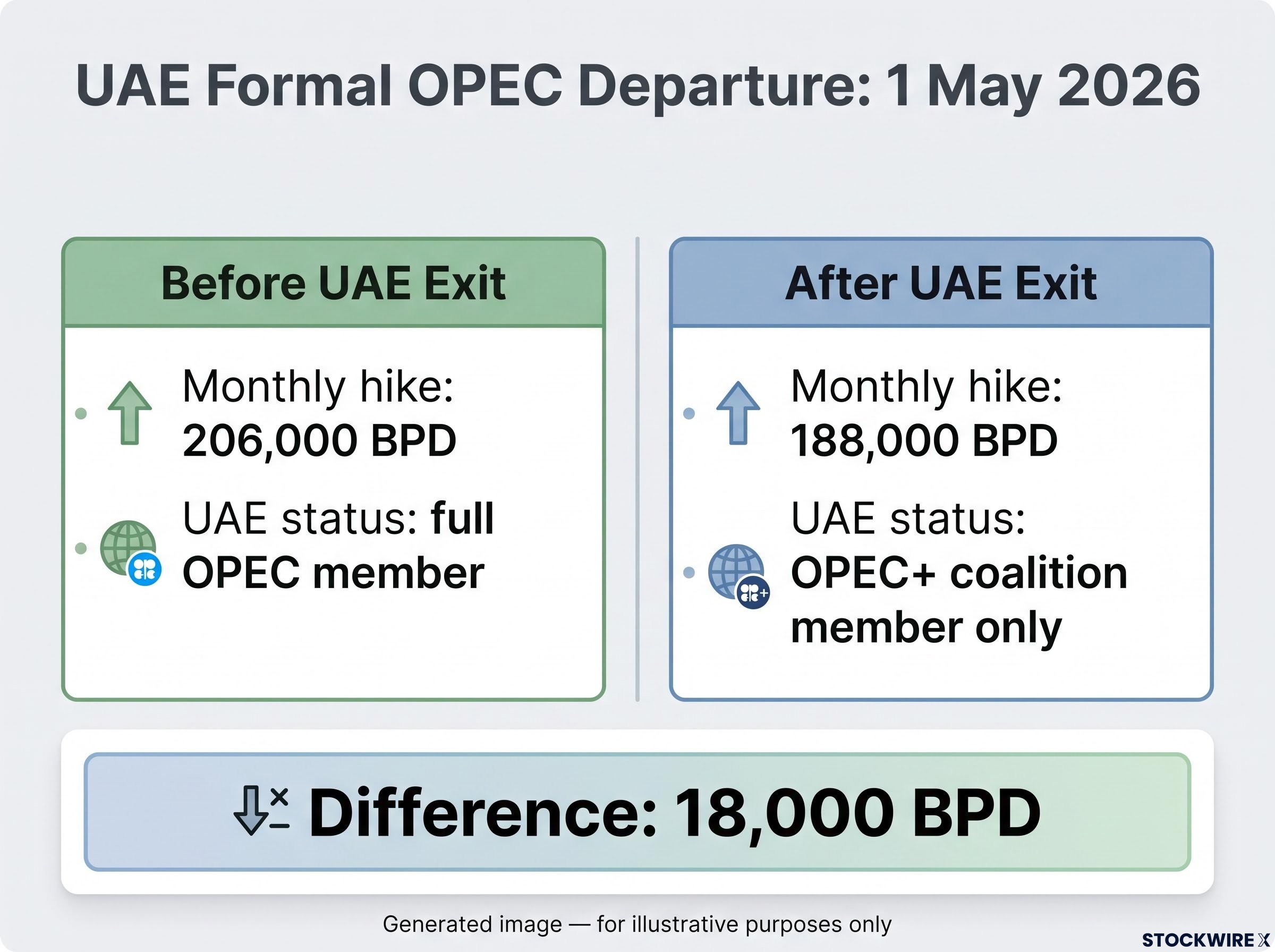
| Before UAE Exit | After UAE Exit |
|---|---|
| Monthly hike: 206,000 BPD | Monthly hike: 188,000 BPD |
| UAE: full OPEC member | UAE: OPEC+ coalition member only |
The 18,000 BPD difference is a small number. What it represents is not. The UAE has historically pushed for higher individual production ceilings given its expanding capacity. From its new position, it can still materially alter supply volumes, but it operates with slightly more detachment from OPEC’s traditional collective discipline.
That changes how future bargaining over quotas unfolds. It changes how much pressure OPEC’s central institutions can exert. For investors who track OPEC+ dynamics as a pricing signal, the internal architecture of the group is shifting in ways the old model did not anticipate, and the UAE’s evolving role is one variable worth monitoring beyond the September headline.
What investors should actually watch after September
The near-term supply risk from OPEC+ policy is bounded. No additional quota hikes are planned through end-2026, which means the formal policy layer is effectively on pause.
The real information arrives through execution. Whether the September hike represents genuine supply normalisation or a paper increase that gets absorbed by compliance gaps, logistics constraints, and demand shifts depends on what happens next.
Four specific indicators will tell you more than any quota announcement:
- JMMC compliance updates and compensation evidence: Watch for data showing whether over-producing members are genuinely offsetting past excess through below-target output.
- Seaborne export and loading schedules from the Gulf and Russia: These reveal whether quota increases translate into actual shipments reaching buyers.
- Demand trajectory in China, India, and Europe: The three largest importing regions will determine whether additional barrels find willing buyers or build inventory.
- Any shift in OPEC+ post-September guidance: If prices weaken materially, look for language signalling potential re-introduction of voluntary cuts.
The conditional reversal scenario: what could bring cuts back
The pause after September is the base case, not a guarantee. If demand disappoints meaningfully across major importing economies while compliance gaps simultaneously narrow and physical barrels actually reach the market, prices could soften enough to prompt a reversal. OPEC+ has shown repeatedly that it will re-introduce voluntary restraint when it judges the market requires it. A sustained period of price weakness combined with deteriorating demand conditions is the most likely trigger for that shift.
For energy-exposed portfolios, the most informative signal in Q4 2026 is not any new OPEC+ quota announcement. It is whether compliance data and export volumes confirm or contradict the narrative of supply normalisation that the September decision is meant to represent.
For investors wanting to understand how diplomatic developments have already moved crude prices sharply in both directions, our full explainer on Iran diplomacy and oil price risk covers the June 2026 Brent collapse below $80 and the cross-asset transmission effects that extend well beyond crude into credit and equity markets.
A milestone, not a turning point: reading the September decision correctly
The 188,000 BPD September increase closes a defined policy chapter. Seven producers have fully unwound the voluntary cuts introduced in April 2023, returning toward pre-crisis production baselines. That is significant as a milestone in OPEC+’s strategic cycle.
It is not an open-ended expansion. No further quota hikes are planned through year-end. The compliance mechanism, however voluntary, still governs how many of those barrels actually reach the market. The UAE’s evolving position within the coalition introduces a structural variable that did not exist a year ago. And the demand trajectory across China, India, and Europe remains the single largest determinant of whether the supply picture tightens or loosens.
The action for investors is not to react to the quota number itself. It is to watch the compliance and export data over the coming weeks, because that is where the real story of the September decision will be written.
This article is for informational purposes only and should not be considered financial advice. Investors should conduct their own research and consult with financial professionals before making investment decisions.
—