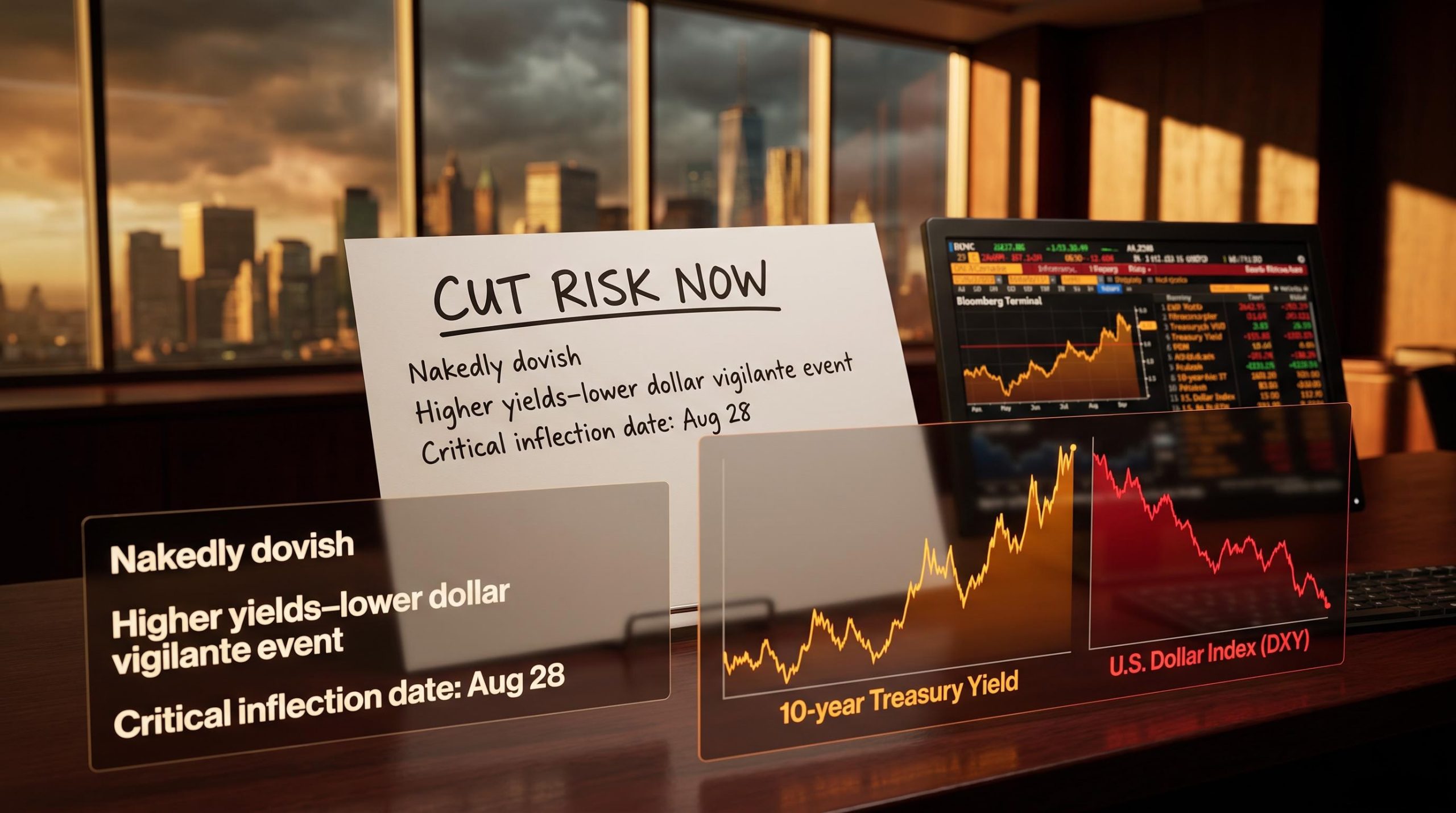
Bank of America strategist Michael Hartnett issued a clear directive to investors this morning: cut risk exposure now, and do not reload until one of two specific conditions is met.
The instruction, published in a research note on 1 August 2026, arrives with the Federal Reserve’s credibility under active market scrutiny and the Jackson Hole Economic Symposium just four weeks away. Hartnett’s central argument is that the Fed’s current stance is, paradoxically, making financial conditions tighter, not easier. Markets, he contends, are beginning to do the tightening themselves, and that dynamic changes what the next month demands from a portfolio.
Here is what Hartnett’s two catalysts actually are, what a bond-vigilante episode looks like when it hits real borrowing costs, what to watch on and around 28 August, and how to position for the four-week window ahead.
Hartnett’s risk call explained: why patience is the position now
Hartnett is one of the most closely tracked strategists on Wall Street, and this morning’s note carries a directional recommendation with unusual specificity. His instruction: step back from risk assets and rotate elsewhere, rather than adding exposure at current levels. The call is conditional, and his note does not attach any particular index levels or yield thresholds to the recommendation. It is a posture, not a price target.
At its centre is a phrase worth sitting with. Hartnett describes the Fed as “nakedly dovish”, and argues that the posture is backfiring. An accommodative Fed that markets no longer trust on inflation does not ease financial conditions. It erodes confidence, and markets respond by tightening conditions on their own. The mechanisms are already visible:
- Higher Treasury yields, as investors demand more compensation for holding government debt they view as mispriced
- Wider credit spreads, as corporate borrowing costs rise alongside falling confidence in the policy backdrop
- Risk-off pressure across equities and speculative assets, as capital rotates toward safety
This is not a crash call. It is a credibility diagnosis. Hartnett sees a Fed whose dovishness is producing the opposite of its intended effect, and until something breaks that loop, his stance is that patience is the active position.
The Fed credibility gap that Hartnett’s framework describes is already visible in the yield curve: long-term Treasury yields rose after the July 29 FOMC meeting while short-term rates fell, a steepening that signals investors are pricing a credibility tax into the long end rather than trusting the committee’s stated patience.
When big ASX news breaks, our subscribers know first
Two conditions that would change the calculus
Hartnett’s caution is not open-ended. He has specified exactly two conditions that would prompt him to turn constructive on risk again, and neither has materialised as of today.
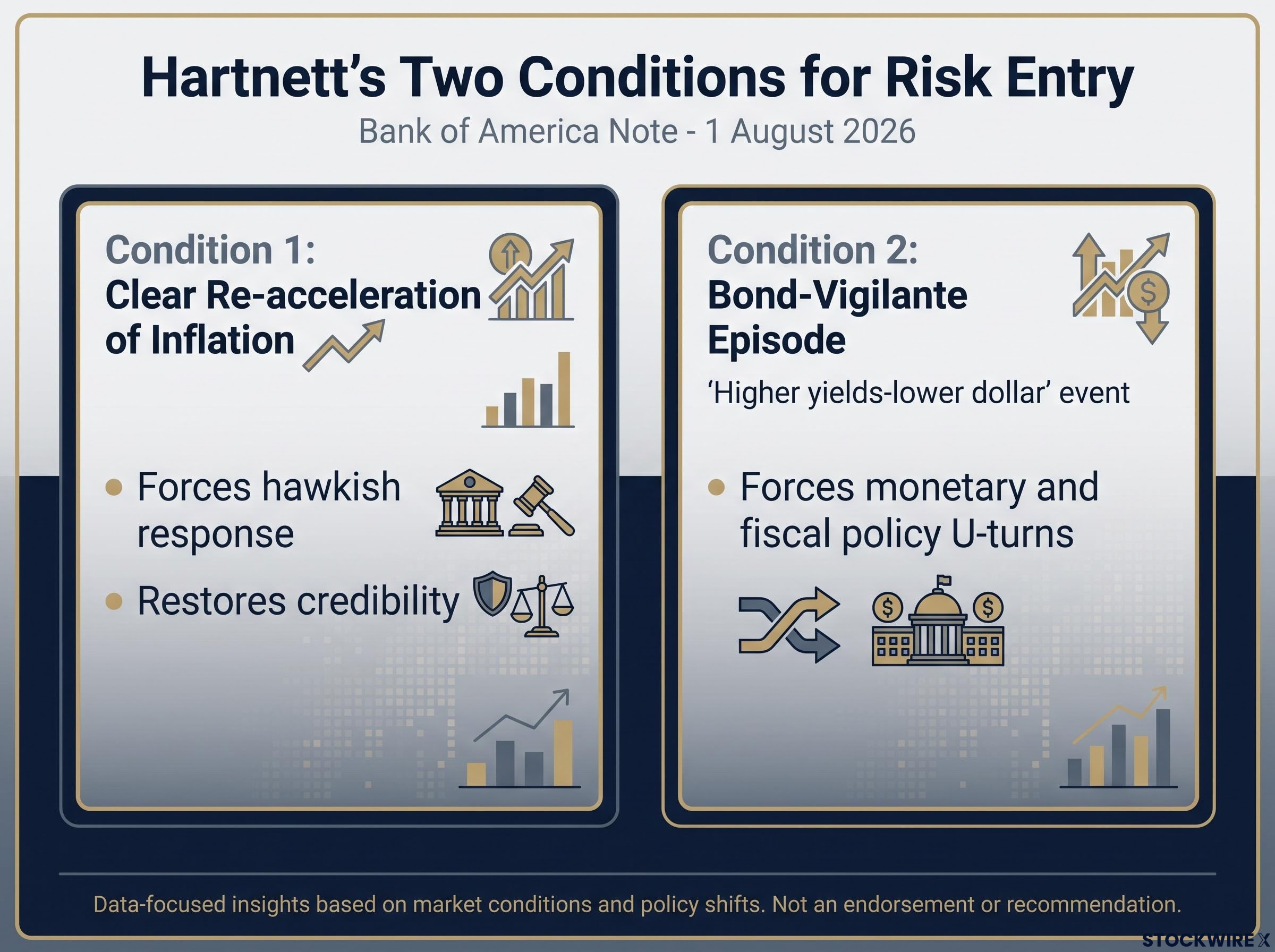
- A clear re-acceleration of inflation. If inflation visibly picks up again, it forces the Fed into an unambiguous hawkish response. That sounds painful, but in Hartnett’s logic it actually restores something markets are currently missing: policy credibility. A Fed that is clearly fighting inflation gives investors a stable pricing foundation, even if the near-term path is tighter. The clarity itself is the catalyst.
- A bond-vigilante episode: higher yields paired with a lower dollar. Hartnett describes this as a “nasty ‘higher yields-lower dollar’ vigilante event”, and both halves of the pairing must appear together. A sharp, market-driven Treasury sell-off sending yields significantly higher, occurring simultaneously with a meaningful fall in the U.S. dollar, would signal fading global confidence in American fiscal and monetary discipline. The severity threshold is high: Hartnett says such an episode would need to be forceful enough to “force both monetary and fiscal policy U-turns”, not merely rhetorical adjustments.
“Nasty ‘higher yields-lower dollar’ vigilante event.” — Michael Hartnett, Bank of America, 1 August 2026
Until one of these two conditions arrives, the cautious stance holds. That is the framework, and it gives you something concrete to watch for rather than reacting to each day’s price action.
What bond vigilantes actually do to your money
Bond vigilantes are investors who sell government bonds aggressively when they believe policy is too loose or fiscally irresponsible. By dumping bonds, they drive yields higher, effectively forcing policymakers to respond. The term has been around since the 1980s, but the mechanism is as relevant now as it has ever been.
From bond market to mortgage rate: how the shock travels
When Treasury yields spike, the cost of borrowing rises across three channels simultaneously: government debt becomes more expensive to service, corporate bond yields climb (making it costlier for companies to fund operations and growth), and household borrowing costs, including mortgage rates and consumer credit, follow yields higher.
The 30-year yield to 2007 highs seen after the July 29 decision, driven by a 9-3 hawkish dissent inside the FOMC, is the most recent quantitative marker of the tightening dynamic Hartnett describes: markets are already demanding a term premium that the Fed’s stated posture has not explicitly sanctioned.
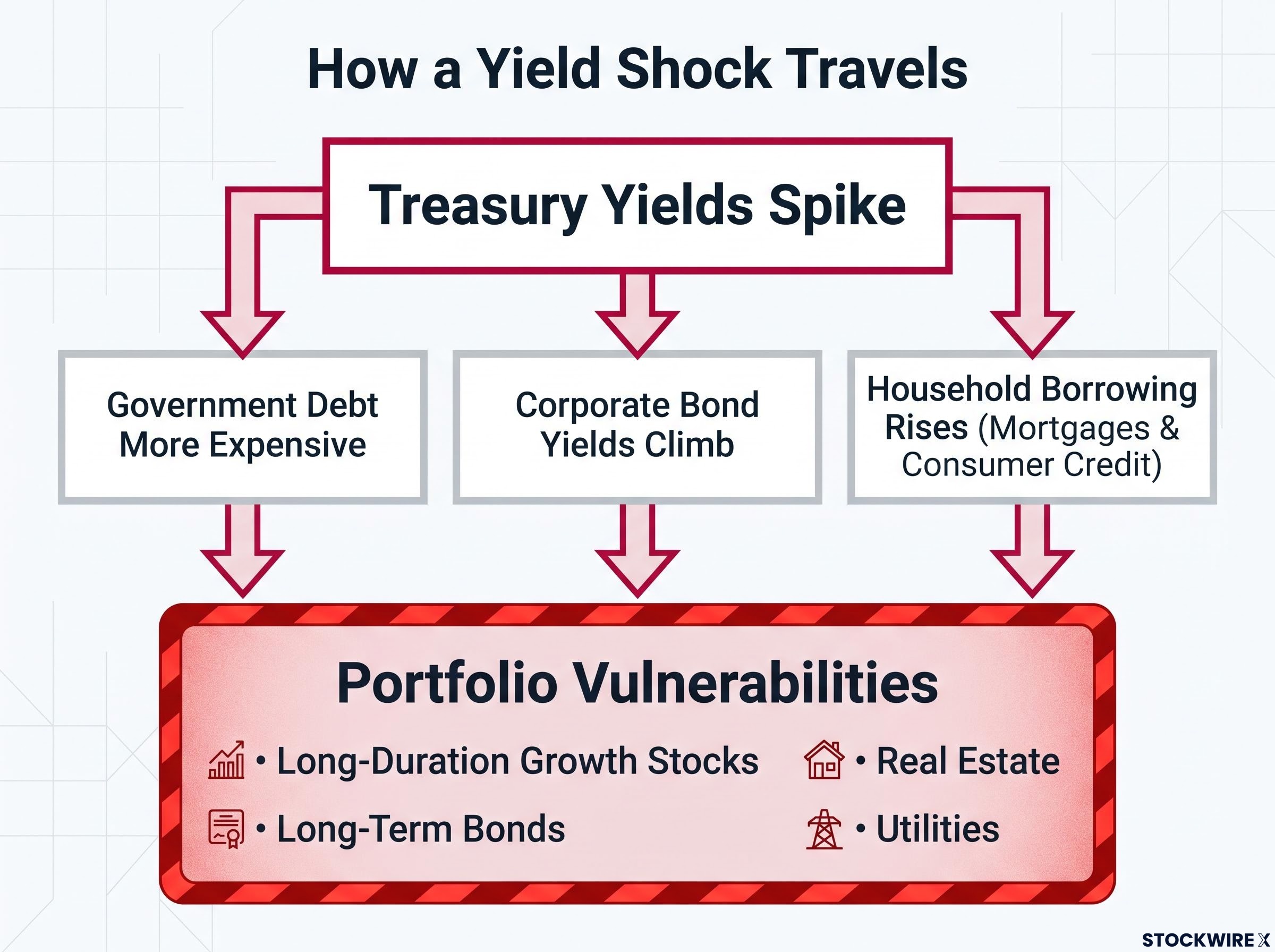
For your portfolio, the transmission is direct. As yields rise, future corporate earnings are discounted more heavily. That compression hits hardest in the parts of the market that depend most on distant future cash flows:
- Long-duration growth stocks, where valuations rely on earnings years out
- Long-term bonds, which lose value as yields climb
- Real estate, where higher mortgage rates slow activity and compress property valuations
- Utilities, where steady but modest returns become less attractive relative to rising risk-free yields
If a vigilante episode unfolds, these are the positions in a typical retail portfolio most likely to take the first and sharpest hit. Defensive holdings tend to fare better, at least initially.
Why August 28 is the date Hartnett is watching
The Jackson Hole Economic Symposium, scheduled for 27-29 August 2026, is the venue where Fed officials have historically signalled major policy shifts. Markets routinely price in and react to speeches there in real time, making it one of the few calendar events that genuinely moves positioning.
The Jackson Hole Economic Symposium, hosted annually by the Federal Reserve Bank of Kansas City, has served as the venue for some of the most consequential Fed policy signals in modern history, making the 2026 gathering an unusually high-stakes event given the credibility questions Hartnett has placed at the centre of his framework.
In his note, Hartnett singles out 28 August as a “critical inflection date”. A key reason is the anticipated presence of former Fed official Kevin Warsh at the symposium, whose attendance Hartnett connects to the trajectory of yields, positioning the event as a potential flashpoint for the broader credibility question his framework has centred on.
“Critical inflection date.” — Michael Hartnett on August 28
Three outcomes are plausible, and each carries different implications:
- Jackson Hole validates the vigilante thesis if yields move meaningfully higher in a way that reflects markets demanding more credible policy commitments
- The Fed restores credibility through clear, conviction-carrying communication, without requiring a market-forced crisis
- Markets do not challenge the Fed at all, and Hartnett’s cautious stance simply remains the active posture heading into the next policy window
Related Bank of America commentary has flagged a further risk: if Jackson Hole messaging skews too dovish after a significant equity rally, the result could be a “buy the rumour, sell the fact” correction as investors take profits once expected dovishness is confirmed. For you, Jackson Hole is not a guaranteed catalyst. It is a real-time stress test of whether the Fed can reclaim credibility without the market-forced crisis Hartnett describes.
Four signals to track between now and the symposium
Hartnett’s framework points toward specific instruments, not general sentiment. The two indicators that matter most for confirming or ruling out his scenario are the 10-year Treasury yield and the U.S. dollar, not the equity index level. Watching equities first would mean watching the lagging indicator.
Treasury yields as a policy lever have displaced equity prices as Washington’s primary pressure signal in 2026, a structural shift that aligns directly with Hartnett’s instruction to watch the 10-year and the dollar first, rather than the S&P 500, when assessing whether the Fed’s credibility question is being resolved or deepened.
| Signal | What to watch | What it means in Hartnett’s framework |
|---|---|---|
| 10-year Treasury yield | Sharp, persistent multi-session move higher (not normal daily drift) | The beginning of a bond-vigilante episode; markets tightening conditions themselves |
| U.S. Dollar Index (DXY) | Meaningful sustained decline occurring alongside rising yields | The full vigilante trigger: “higher yields-lower dollar” signals fading confidence in U.S. policy |
| Fed and Jackson Hole messaging | Commitment to inflation target, willingness to hold policy tight if growth slows, any reference to yield-curve control | Determines whether the credibility gap narrows or widens |
| Risk-asset behaviour | Directional trend across equities, high-yield credit, emerging market assets, crypto | Post-Jackson Hole sell-off suggests dovishness was priced in; rally on clarity suggests credibility restored |
The pairing matters. Rising yields alone could reflect healthy repricing. A falling dollar alone could reflect trade dynamics. Both moving together, simultaneously and persistently, is the specific combination Hartnett has flagged as the signal that would force a policy response.
What the next four weeks actually call for in a portfolio
Hartnett’s framework asks you to do something genuinely difficult: stay patient and monitor rather than act. That patience is the active strategic choice, not passivity.
The signal to reload on risk has not arrived as of 1 August 2026. Until one of the two catalysts materialises, the posture implied by his note breaks down into three orientations:
- Avoid front-running an all-clear rally. Buying aggressively before either catalyst appears means accepting unresolved policy uncertainty as a background condition; Hartnett’s note explicitly argues the re-entry signal has not been given
- Audit your interest-rate sensitivity before 28 August. The most vulnerable holdings in a vigilante scenario are long-duration growth stocks, long-term bonds, and rate-sensitive sectors including real estate and utilities
- Treat Jackson Hole as event risk to be monitored, not a guaranteed inflection. Pre-emptive repositioning in either direction ahead of the symposium is, within this framework, premature
The monitoring priority is clear: fixed income and currency markets signal the macro setup before equities reflect it. Watching the 10-year yield and the DXY daily gives you an earlier read than watching the S&P 500.
For investors wanting a practical framework to act on Hartnett’s audit recommendation before 28 August, our dedicated guide to portfolio risk management covers beta-weighted position sizing and volatility targeting, the two tools that make interest-rate sensitivity visible at the position level rather than the portfolio-average level.
This article is for informational purposes only and should not be considered financial advice. Investors should conduct their own research and consult with financial professionals before making investment decisions.
After Jackson Hole, the real test begins
Hartnett’s conditional framework does not expire on 28 August. The symposium will either begin to resolve the Fed’s credibility question or extend the uncertainty into the next policy window. Either way, the two catalysts, renewed inflation or the “higher yields-lower dollar” vigilante episode, remain the governing conditions. The cautious stance resets only when one of them materialises.
The four weeks after Jackson Hole will determine whether markets do the tightening themselves, as Hartnett expects, or the Fed retakes the initiative and restores the trust that has quietly eroded. If you understand the framework, you will be positioned to read that signal as it arrives rather than reacting after it has already moved prices.
This analysis reflects the views of Michael Hartnett, published in a Bank of America research note on 1 August 2026. It represents the perspective of a named strategist at a single institution and does not constitute personalised investment advice. These statements are speculative and subject to change based on market developments and policy decisions.