Most investors treat a bond sell-off in one country as that country’s problem. The 10-year French government bond (OAT) yield closed at 4.87% on 5 October, according to TradingEconomics, an 18-year high by several outlets’ count, and the euro began the week as the weakest G10 currency.
That mismatch matters for anyone with euro exposure, whether through travel, trade, investments or currency trading. The gap between French yields and German Bund yields (the OAT-Bund spread) sits in a 140-152bp range, the widest since 2011-2012. EUR/USD trades just above 1.12, and ING sees room for a move toward 1.1100 or 1.1000.
French bond turbulence reaches the euro by two routes, and the second is more powerful than the first. Here is how each works, which levels ING is watching, and which dated events could change the picture.
Why is a French bond sell-off showing up in the currency market?
Start with the screen. The 10-year OAT yield has risen more than one percentage point since June, and PrimeXBT noted it was heading for a fifth straight weekly rise. Other reports put it at 4.93-4.96%, so treat 4.87% as the lower end of the readings.
The spread tells the same story, though sources disagree on the exact figure.
| Metric | Earlier reading | Latest reading | Source |
|---|---|---|---|
| OAT 10-year yield | Up more than 1 percentage point since June | **4.87%** (5 October) | TradingEconomics |
| OAT-Bund spread | About **110bp** (25 September) | **146.9bp** (2 October); **152bp** (1 October); “past 140bp” | Ideal-Investisseur; TradingEconomics; Reuters |
| Deficit target | **5.4%** of GDP expected in 2026 | **5.0%** of GDP for 2027 | Draft budget |
Context helps. The all-time high for the 10-year yield was 11.85% in October 1987, so today’s level is notable but not extreme in absolute terms.
The speed is what unsettles markets, and the cause is political and fiscal. What this tells you is that investors are pricing the absence of a credible consolidation plan, not a default scare, and that distinction shapes everything that follows.
The rating calendar adds event risk. Moody’s rates France Aa3 with a negative outlook and reviews on 23 October; S&P holds A+ stable with a review in November; Fitch is A+ stable.
What the draft budget does and does not fix
The 2027 draft budget targets a deficit of 5.0% of GDP and contains a €54bn adjustment, €43bn of it new measures. Investors gave it a cool reception, with yields lingering near 4.96%.
ING says the budget “buys some time but fails to solve structural deficit issues”. No party has yet presented a sufficiently detailed spending-cut plan, so markets have little incentive to price the fiscal premium out of French bonds.
The political cause runs deep: minority government dependence on opposition support makes passage of an intact budget uncertain, and some analysts see a rollover as more likely than a full deal, with a wider 2027 deficit as the cost.
When big ASX news breaks, our subscribers know first
How does bond stress in one country weigh on the euro?
The intuition is simple: if investors fear a government’s finances, its currency should suffer. In the euro area the mechanism is subtler, and it matters more than the headline suggests.
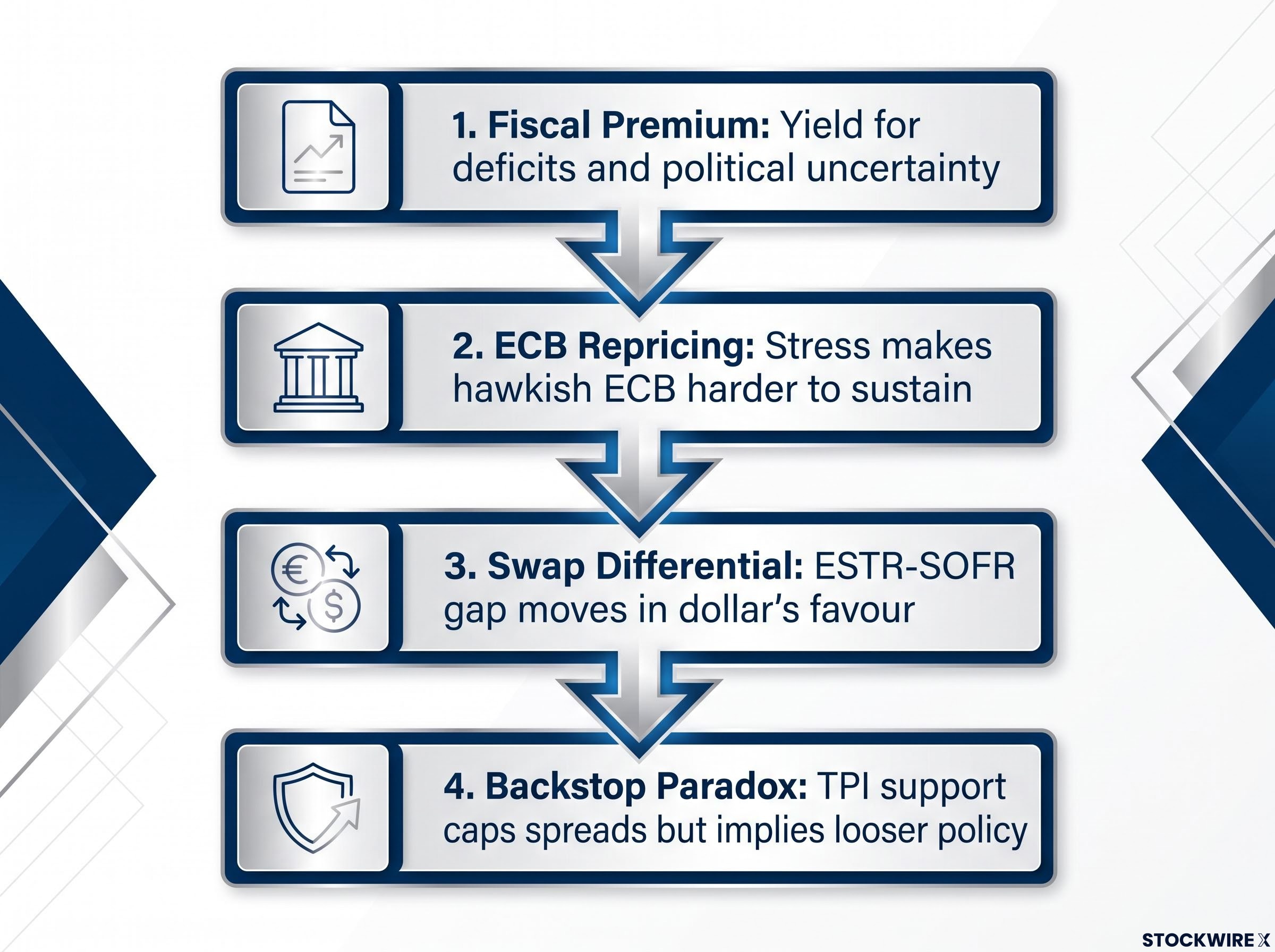
Emerging-market blow-outs tend to trigger capital flight and forced rate rises. The euro area has a common central bank and a bond-buying backstop, the Transmission Protection Instrument (TPI), so stress travels differently. The chain runs in four steps:
- Fiscal premium: investors demand more yield for deficits and political uncertainty.
- ECB repricing: stress makes a hawkish European Central Bank (ECB) harder to sustain, trimming the euro’s yield advantage.
- Swap differential: the gap between euro and dollar interest-rate swap rates moves in the dollar’s favour.
- Backstop paradox: TPI support caps spreads but implies looser policy.
Channel one: the fiscal risk premium
The first channel is the extra return investors demand to hold French debt given deficits and political uncertainty. ING’s Francesco Pesole describes this premium as fairly limited so far, not yet extreme.
That leaves room for the effect to grow, but it is not what is doing most of the damage today.
Channel two: ECB rate expectations and the swap differential
The second channel is where the pressure sits. Market pricing for ECB easing at the March meeting fell from 80bp on 24 September to 45bp now, according to ING, with the deposit facility rate at 2.50%.
The EUR:USD two-year swap differential (ESTR-SOFR, the euro and dollar overnight benchmark rates) stands at -167bp, last seen in August 2025. A lower euro rate path relative to the dollar’s reduces the incentive to hold euros.
The swap differential matters because central bank divergence moves currencies through expected rate paths rather than single decisions; markets reprice the whole future gap between Frankfurt and Washington well before any meeting takes place.
ING’s Chris Turner says the sell-off has “broken the narrative of ever-higher short-term market interest rates”. He sees the ECB’s options as both euro-negative:
“Either involves much less or no tightening of policy (euro bearish) or, in extremis, the use of the Transmission Protection Instrument to buy bonds (very euro bearish).”
That is the backstop paradox: the tool that calms French bonds weakens the currency. For you, rate expectations tell you more about the euro than the French yield alone.
Where could EUR/USD go, and which levels is ING watching?
EUR/USD rebounded to just above 1.1200 after dipping to 1.1160, within a recent range of roughly 1.116-1.133. Investing.com reported on 2 October that the pair broke to new lows for the year.
Pesole had flagged 1.1320-1.1330 as key support on 25 September. That level has been breached.
| Level | Role | Trigger or condition | Source |
|---|---|---|---|
| 1.1320-1.1330 | Earlier support, breached | Spot now near 1.12 | ING (Pesole) |
| 1.1160 | Recent low | Test of the dip | ING (Pesole) |
| 1.1100-1.1120 | Near-term bias | Bond stress intensifies; risk premium builds | ING (Turner, Pesole) |
| 1.1000 | Bearish extension | Fiscal and ECB-policy risks both materialise | ING (Pesole, Turner) |
ING’s views differ in tone. Pesole is measured: tests of 1.1100 or 1.1000 if bond stress intensifies. Turner is sharper, calling the pair on 2 October:
“Biased to 1.1100/1.1120, if not closer to 1.10.”
ING’s rates team adds that a 3% risk-premium build-up could plausibly drive EUR/USD toward 1.110, with the OAT-Bund spread widening toward 150bp. Relief rallies in French bonds have lifted the pair only slightly, and ING doubts they will last.
Read 1.1100 as a scenario that needs bond stress to deepen, and 1.1000 as a bearish extension. Neither is a base case, so size any view accordingly.
What to watch next, and what could limit the euro’s downside?
The picture is conditional, which means it can be checked against dated events.
The watch list
In rough order of timing:
- Budget details and any parliamentary movement
- Marine Le Pen’s counter-budget, with €25bn a year in spending cuts planned, per Reuters on 6 October
- Moody’s review on 23 October
- S&P review in November
- ECB pricing for March, now 45bp
- The -167bp swap differential
Earlier reports that Le Pen might back the budget offered little relief, in Pesole’s view. Treat any relief rally before these dates with caution.
For readers wanting to prepare for the rating reviews and ECB meetings, our comprehensive walkthrough of reading macro events before currency moves explains how to check OIS pricing and positioning first.
What could limit the downside
Several forces could cap the euro’s slide:
- Repatriation or safe-haven flows by European investors
- A Fed repricing lower, shrinking the dollar’s yield advantage
- ECB backstops that prevent disorderly fragmentation
- A budget compromise: ING argues premia could be priced out over time if a credible plan emerges, but none exists yet
Caps cut both ways. Turner views intervention as euro-negative in the medium term, and global factors, especially the Fed, may dominate EUR/USD.
Precedents, which are not independently confirmed, suggest caution about extremes. Italy in 2018 and the 2011-2012 crisis reportedly brought moderate euro weakness alongside policy responses, while the 2022 UK gilt crisis, without a supranational backstop, reportedly saw sterling fall quickly.
Past performance does not guarantee future results, and these projections are speculative and subject to change with market developments.
What the French bond stress changes for the euro, and what it does not
French stress reaches the euro through a modest fiscal premium and, more powerfully, through softer ECB expectations and a swap differential tilted toward the dollar. ING sees 1.1100 and 1.1000 as conditional downside, not a forecast of collapse.
What to check next is the budget detail, Le Pen’s counter-budget and the 23 October and November rating reviews. Global factors such as the Fed can override the French story entirely.
This article is for informational purposes only and should not be considered financial advice. Investors should conduct their own research and consult with financial professionals before making investment decisions.