Every time speculation about a Tesla-SpaceX combination surfaces, most investors process it as fresh news. It is not. Elon Musk has consolidated companies before, more than once, following a pattern that is documented, litigated, and increasingly predictable. The instinct to treat each episode as a novelty is the cognitive trap that costs you analytical clarity.
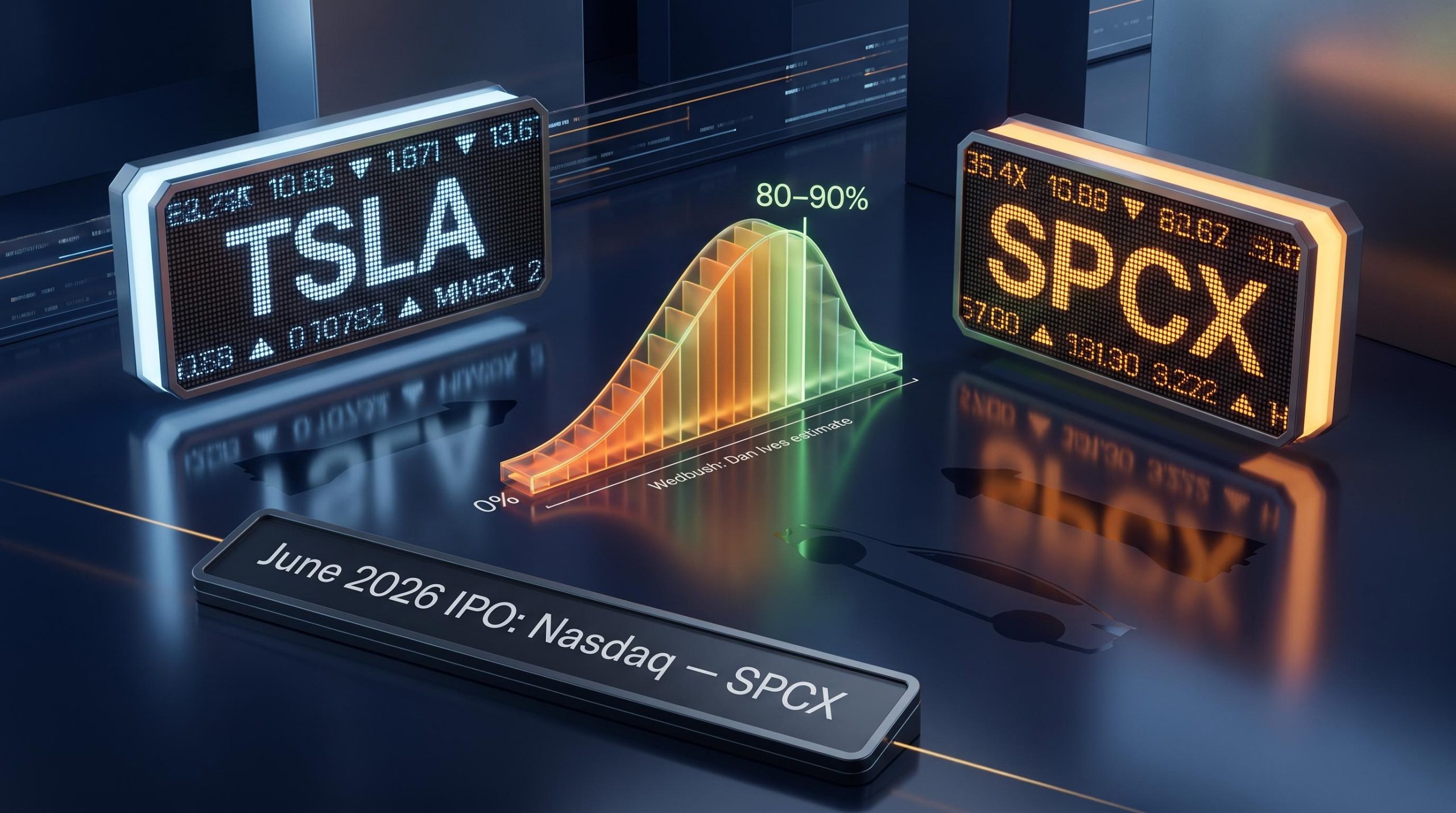
What changed this time is structural. SpaceX listed on the Nasdaq in June 2026 under the ticker SPCX, removing the single largest practical barrier to a deal. On Tesla’s Q2 2026 earnings call, Musk cited “more and more overlap” with SpaceX while carefully declining to rule out a combination. Earlier in 2026, xAI was folded into SpaceX, giving investors a fresh, directly relevant precedent to study.
Here is a framework for evaluating whether this merger is strategically coherent, executionally credible, and close enough to warrant positioning attention now or whether the evidence says to wait 12-24 months for concrete signals. This is a decision-point analysis, not a summary of headlines.
How Musk has folded companies before, and what the pattern reveals
The 2016 absorption of SolarCity into Tesla remains the foundational precedent. Musk framed it as vertical integration: solar generation, battery storage, and electric vehicles under one corporate roof. The market and the courts framed it differently. A Delaware lawsuit challenged the deal as a conflict-ridden rescue of a financially strained company in which Musk held a personal stake. Years of litigation and reputational fallout followed.
That deal established three patterns that apply directly to any Tesla-SpaceX discussion: a strategic narrative built around vertical integration, intense governance scrutiny over Musk’s dual roles, and the use of Tesla as the consolidating vehicle for Musk-linked assets.
The second precedent is more recent. Earlier in 2026, xAI was integrated into SpaceX, a completed transaction that compressed the timeline between strategic overlap and formal corporate action. The xAI episode confirmed that the SolarCity playbook was not a one-off.
| Company Absorbed | Year | Strategic Rationale Stated | Key Complication |
|---|---|---|---|
| SolarCity | 2016 | Vertical integration of energy generation and storage with EVs | Delaware conflict-of-interest litigation; years of legal and reputational fallout |
| xAI | 2026 | AI capability consolidation within SpaceX’s operational infrastructure | Conflicting public reporting on deal status and timeline |
The modular stack thesis in plain terms
Musk does not treat company boundaries as permanent when he believes the technical case for integration is stronger than the case for independence. His companies operate as modules in a broader technology platform: energy, transport, connectivity, AI, space. When governance or market structures create friction between those modules, he has shown a willingness to resolve it through formal corporate consolidation rather than arms-length contracts.
This thesis is what makes the Tesla-SpaceX discussion analytically different from standard merger speculation. When Musk says “more and more overlap,” that is not casual language. It is a phrase with a documented operational history attached to it.
When big ASX news breaks, our subscribers know first
Why the SpaceX IPO is the single most important structural development
Before June 2026, a Tesla-SpaceX merger faced a concrete problem that had nothing to do with strategy or willingness. Merging a public company with a private one at the scale of SpaceX requires complex private valuation negotiations with no external benchmark. There is no market price to anchor exchange ratios, no SEC-mandated disclosures to standardise due diligence, and no traded equity to use as currency. That problem has now been solved.
The Nasdaq listing of SpaceX under the ticker SPCX changed the calculus in three specific ways:
SpaceX’s four revenue segments, launch services, Starlink broadband, Direct-to-Cell infrastructure, and AI compute, each carry different maturity profiles and valuation methodologies, a distinction that matters when evaluating any exchange ratio in a stock-for-stock deal because the combined entity’s implied value shifts significantly depending on how early-stage compute ambitions are weighted against recurring broadband revenue.
- It created a traded equity currency with a visible market capitalisation and share price, enabling any deal to be structured as a stock-for-stock transaction rather than requiring opaque private valuation negotiations.
- It gave Tesla’s board and shareholders a market benchmark to evaluate exchange ratios, replacing reliance on private estimates with independently priced public data.
- It placed SpaceX under SEC reporting and governance frameworks, making cross-company due diligence and disclosure standardised rather than bespoke.
Morningstar explicitly characterises completing the SpaceX IPO as a practical prerequisite for a Tesla-SpaceX merger, noting that once public, “the market will begin setting the company’s share price and market capitalisation, which would help the Tesla board evaluate what a fair price for their potential merger would be.”
SPCX shares declined 0.30% on 30 July 2026, the trading day on which merger speculation was being widely reported. That muted reaction tells you the market is treating this as a possibility worth monitoring, not an imminent event worth pricing in aggressively.
The strategic case that makes analysts call this “inevitable”
The operational integration between Tesla and SpaceX is not hypothetical. Tesla holds an equity stake in SpaceX. The two companies signed a framework agreement in 2026 governing broader collaboration. On the Q2 2026 earnings call, Musk cited “many collaborations on so many fronts with SpaceX,” specifically naming Terafab, Starlink connectivity, AI, and robotics as areas of active overlap. Shared engineering resources already flow between the two companies.
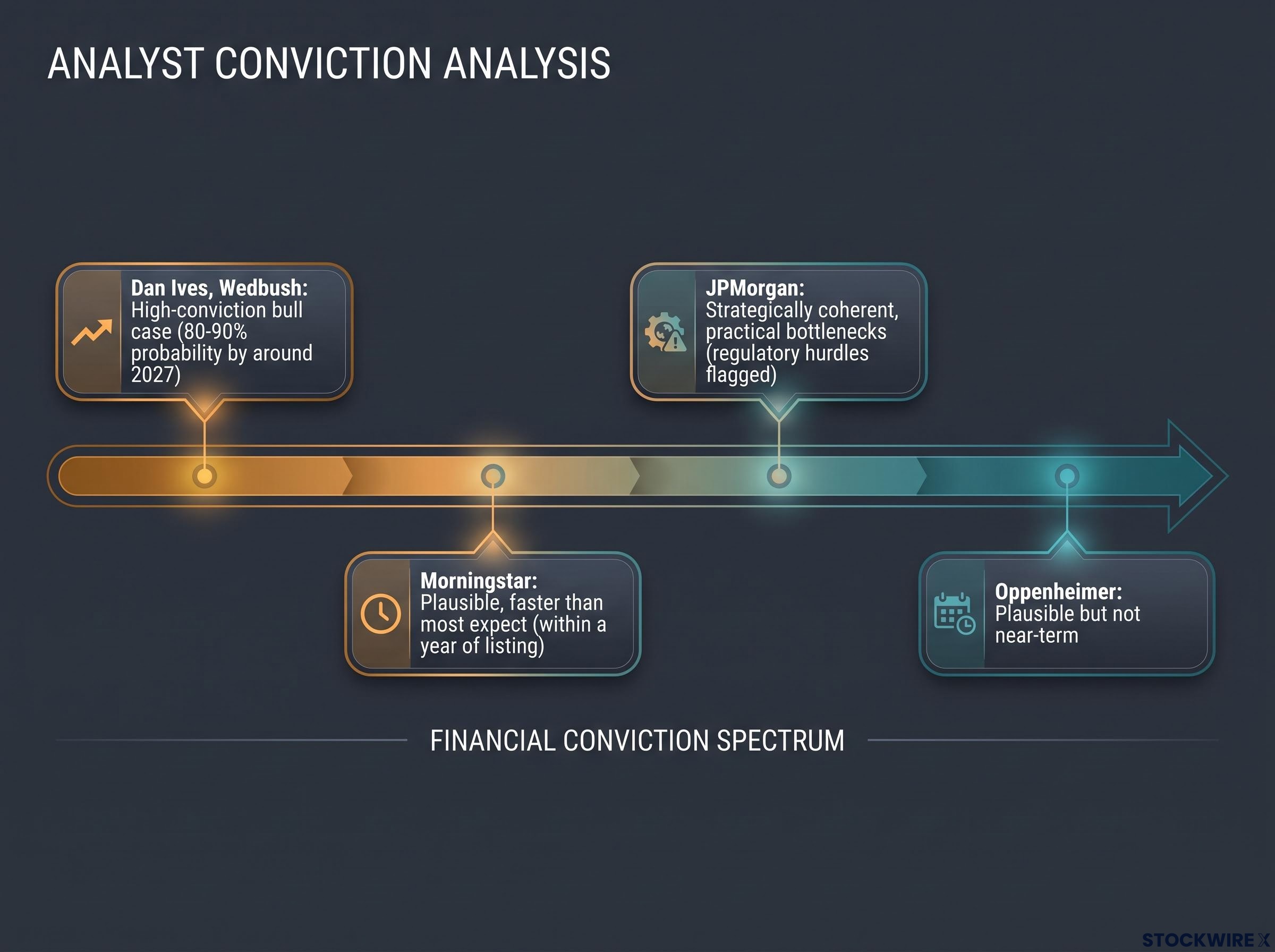
The analyst community is not uniformly bullish, but the bullish end of the spectrum is striking in its conviction.
| Analyst / Firm | Position | Probability or Timeframe Stated |
|---|---|---|
| Dan Ives, Wedbush | High-conviction bull case | 80-90% probability by around 2027 |
| Morningstar | Plausible, faster than most expect | “Wouldn’t be surprised” within a year of listing |
| JPMorgan | Strategically coherent, practical bottlenecks | No specific timeline; regulatory hurdles flagged |
| Oppenheimer | Plausible but not near-term | No specific timeline |
The combined entity would span EVs, energy generation and storage, Starlink satellite internet, launch services, and AI and robotics. JPMorgan frames shared AI infrastructure as the “strategic glue,” enabling shared models across autonomous driving, robotics, spacecraft operations, and network optimisation. The New York Times has described the potential combination as a “$4 trillion Elon Inc.” entity, though that framing has not been independently verified.
The spread from Dan Ives’s 80-90% probability to Oppenheimer’s “plausible but not near-term” tells you this is not a consensus call. That divergence is itself useful information: it maps the range of uncertainty the market is still working through.
Oppenheimer’s counterargument is worth holding alongside the bullish end of the spectrum: two separate public companies, the firm contends, actually provide more flexible independent capital-raising capacity than a combined entity would, and that logic explains why Oppenheimer upgraded Tesla’s FY 2026 revenue estimate to $97.2 billion while simultaneously arguing against the merger thesis.
What makes this deal harder than SolarCity by an order of magnitude
The SolarCity deal happened in the context of financial strain. SolarCity needed a rescuer, and Tesla was willing. That distress dynamic created urgency that compressed timelines and forced acceptance of difficult terms. Neither Tesla nor SpaceX is in distress today. Both are large, high-growth companies capable of raising capital independently. The absence of urgency historically extends deal timelines and increases the probability of collapse.
The governance complexity is severe. Any merger would require dual-board approvals, independent fairness opinions, and special committees at both companies to manage Musk’s conflict of interest as a major shareholder and executive of both entities. The post-SolarCity environment means institutional investors and proxy advisors are highly attuned to Musk-related party transactions. SpaceX president Gwynne Shotwell said on IPO day that a merger “may not happen in the near term,” a statement that carries weight precisely because of her operational proximity to the decision.
SolarCity, with a far simpler business and strategic narrative, still generated years of litigation and reputational fallout. A Tesla-SpaceX deal would need to navigate a regulatory landscape that SolarCity never tested.
The merger obstacles identified by Wolfe Research, including dilution risk, stacked capital intensity, conflicting governance roles, and overlapping geopolitical exposure, add granularity to the practical bottleneck framing that JPMorgan also flagged, and Wolfe’s mid-2027 floor for realistic completion aligns closely with the Morningstar one-year-from-IPO window.
The China exposure problem
Combining a major U.S. defence contractor with a company deeply embedded in Chinese manufacturing and sales creates a geopolitical complication that has no SolarCity parallel. SpaceX holds sensitive defence contracts and operates Starlink, which has strategic military significance. Tesla operates major manufacturing facilities in Shanghai and generates substantial revenue from Chinese sales.
The Committee on Foreign Investment in the United States (CFIUS), the federal body that reviews transactions for national security implications, would almost certainly scrutinise a combined entity’s data flows, supply chains, and foreign manufacturing footprints. The reported potential separation of Tesla’s China business may be understood in this context as groundwork for creating a more structurally clean merger candidate.
The US-China geopolitical architecture that CFIUS would need to evaluate is itself in flux: the May 2026 summit produced preliminary consensus on tariffs and procurement but left AI chip export controls and semiconductor supply chain restrictions entirely unresolved, meaning the regulatory environment surrounding Tesla’s Shanghai operations is not stable ground on which to build a structural separation plan.
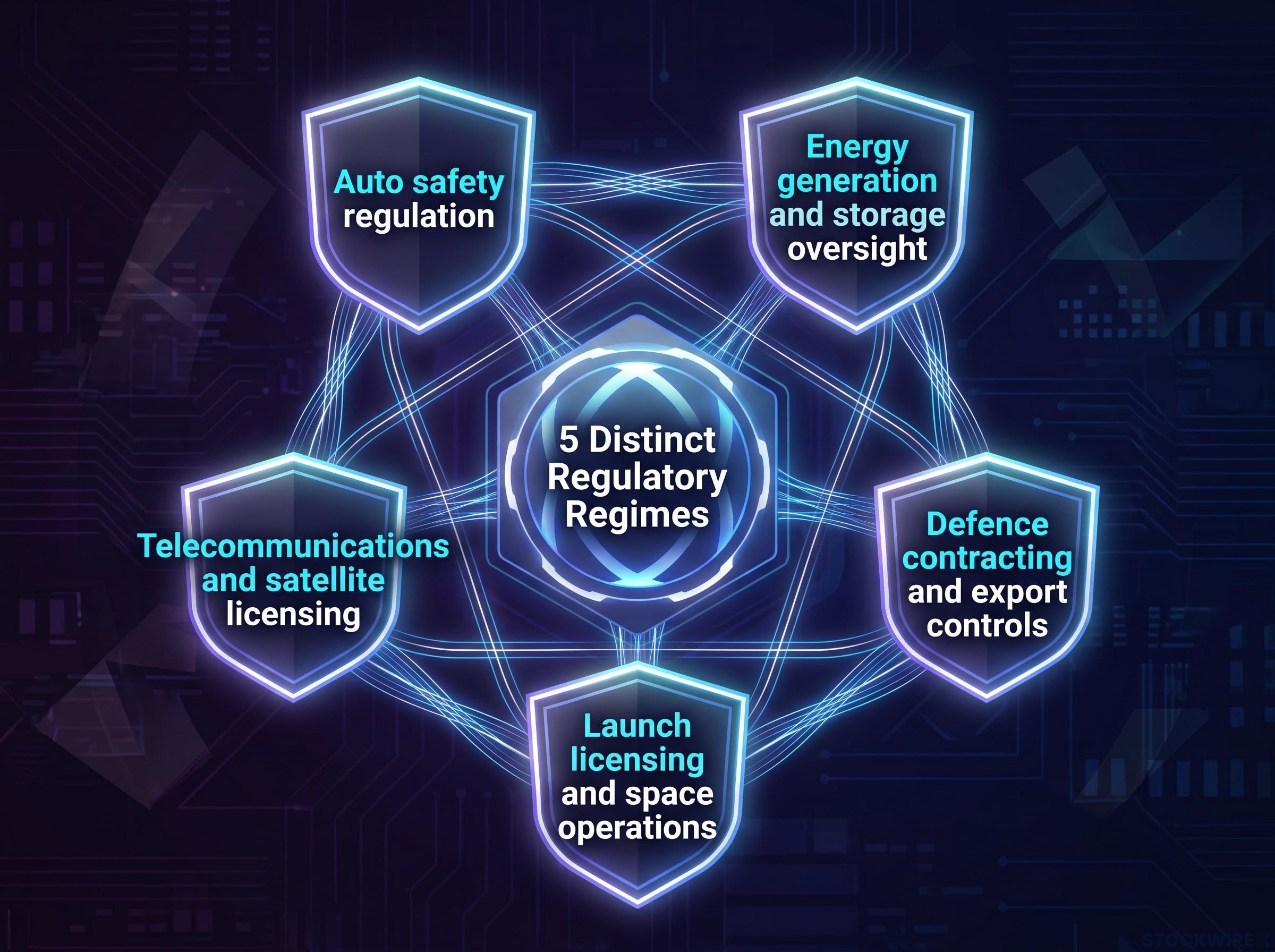
A combined entity would need to integrate or navigate at least five distinct regulatory regimes:
- Auto safety regulation
- Energy generation and storage oversight
- Telecommunications and satellite licensing
- Defence contracting and export controls
- Launch licensing and space operations
Even if both boards wanted to move quickly, the geopolitical architecture of a combined entity would require structural solutions, such as ring-fencing or divestiture, that take time and create their own shareholder value questions.
Understanding Musk’s consolidation logic as an investor framework
When Musk controls multiple companies with deep technical interdependencies, corporate separation creates coordination costs and governance friction that he is historically willing to resolve through formal consolidation. This is not standard conglomerate logic. Most corporate executives seek growth through acquisitions of complementary businesses. Musk’s instinct is different: he treats existing companies he already controls as platform modules and merges them when the technical case for integration outweighs the case for independence.
“More and more overlap, especially with Terafab.”
— Elon Musk, Tesla Q2 2026 earnings call
This framing matters because it carries embedded investor risk. Consolidation decisions can be made on Musk’s perceived technical logic rather than purely on shareholder value optimisation. The SolarCity governance conflict is not an anomaly; it is a structural feature of how deals in this universe get made. CNBC reports that Tesla employees discuss a merger frequently and many have long anticipated it. Bloomberg and Reuters report that some investors are actively pushing for a tie-up.
Prediction market estimates for a merger before 2027 have swung from roughly one-third to three-quarters probability in short windows. That volatility is not just noise. It reflects that this decision sits primarily with one person whose stated reasoning is not always legible in conventional financial terms, a category of risk that investors in Musk-led companies need to price explicitly.
The practical distinction for positioning is between signal and noise:
- Signal indicators: Special committee formation, framework agreement expansions with shared capital commitments, regulatory positioning statements, structural changes to Tesla’s China operations, Musk’s language shifting from process-framing to timeline-framing.
- Noise indicators: Analyst probability estimate revisions, prediction market swings, earnings call hedging language, media coverage cycles.
The signals that would separate real process from continued speculation
The five governance and regulatory signals below, ranked in descending order of significance, are what would indicate a real merger process is forming rather than continued strategic positioning:
- Special committee formation at either Tesla or SpaceX focused on strategic alternatives or inter-company collaboration.
- Amendment of the framework agreement to include shared capital commitments, expanded IP sharing, or joint AI infrastructure beyond the current scope.
- Regulatory or defence authority signals, whether public comfort or formal concern, about deeper corporate integration of a defence contractor and an automaker with Chinese manufacturing exposure.
- Meaningful structural changes around Tesla’s China operations, including ring-fencing, divestiture, or operational separation that would reduce national security complications.
- A language shift from Musk moving from process-framing (“we can’t talk about combining companies on an earnings call”) to timeline-framing (references to shareholder approvals, specific steps, or sequencing).
What “no formal process yet” actually means for positioning
As of late July 2026, none of these signals have appeared in the public record. No special committees have been formed. No formal governance process has been disclosed. Morningstar has flagged a window of roughly one year from the June 2026 IPO as a plausible timeframe for observable developments, but that window has barely opened.
The current evidence state tells you something specific if you hold Tesla (TSLA) or SpaceX (SPCX): the strategic case is real, the primary structural barrier has been removed, but no execution clock has started. Positioning ahead of a potential announcement carries genuine upside, but it also carries the risk of extended wait periods with no catalyst, during which both stocks trade on their standalone fundamentals rather than merger premium.
This article is for informational purposes only and should not be considered financial advice. Investors should conduct their own research and consult with financial professionals before making investment decisions. These statements are speculative and subject to change based on market developments and company performance.
A serious possibility in a framework that rewards patience, not speculation
Musk’s consolidation history is real and documented. The SpaceX IPO removed the primary structural barrier. The strategic logic is coherent and taken seriously by credible analysts ranging from Dan Ives’s 80-90% probability estimate to JPMorgan’s characterisation of the deal as “strategically coherent.” But no formal process has started, and the execution complexity, spanning dual-board governance, CFIUS review, and five distinct regulatory regimes, exceeds anything Musk has attempted in corporate terms.
The rational assessment: this is a serious possibility, not a foregone conclusion. The evidence does not yet support treating it as an imminent transaction. The five signal categories outlined above are what to monitor, with the Morningstar one-year-from-IPO window, running from June 2026, as the near-term evaluation horizon. The investors who will navigate this best are the ones tracking governance steps rather than reacting to headlines.