Oppenheimer analysts published a note on 11 June 2026 concluding that a Tesla-SpaceX merger would work against Elon Musk’s artificial intelligence ambitions, not advance them. The finding inverts an assumption that has animated a significant portion of Tesla bull-case thinking for the better part of two years. With SpaceX reportedly preparing for a Nasdaq debut as soon as 12 June, and Tesla’s valuation partly buoyed by merger speculation, the timing forces a reassessment. What follows is a breakdown of Oppenheimer’s separation thesis, the specific cooperation arrangements the firm expects to grow, the raised $97.2 billion FY 2026 revenue estimate that anchors the valuation, and the capital rotation risk that complicates the near-term picture.
Why keeping Tesla and SpaceX apart serves Musk’s AI strategy better than a merger would
The counterintuitive core of Oppenheimer’s note is that two public companies give Musk more firepower than one combined entity ever could. The firm’s logic is structural, not sentimental: separate tickers mean separate balance sheets, separate investor bases, and separate capital-raising windows, all of which can be tapped independently as AI investment demands scale.
Oppenheimer concluded that Musk’s “longer-term vision of AI is best served by diversified, flexible access to capital.”
A merged company would inherit a single governance framework, a blended investor mandate, and the regulatory scrutiny that accompanies mega-mergers across aerospace, automotive, and telecommunications jurisdictions. Those frictions would slow capital deployment at precisely the moment both companies need to accelerate it.
Oppenheimer did not dismiss the idea entirely. The firm characterised a combination as conceivable in the abstract but saw “little strategic case” for one at this stage. The distinction matters: strategic alignment between the two companies is real, but corporate integration is a different proposition, one that would impose costs the current structure avoids.
The Tesla-SpaceX merger thesis has shifted from retail speculation into a mainstream institutional narrative, with Wolfe Research identifying four concrete structural obstacles: dilution risk, stacked capital intensity, conflicts of interest, and overlapping regulatory exposure, placing the earliest realistic completion date at mid-2027.
For investors who have treated a merger as a near-term catalyst embedded in Tesla’s multiple, the Oppenheimer note reframes the question. The bull case is not weaker because a merger is unlikely; it is weaker if a merger was the only reason to own the stock.
When big ASX news breaks, our subscribers know first
What Tesla and SpaceX will actually build together, and why it matters more than a deal
Oppenheimer’s note shifts the value story from corporate structure to commercial activity. The firm identifies three cooperation tracks that are expected to deepen, each tied to business lines already generating or growing revenue for Tesla:
- Energy storage: SpaceX’s Starlink ground infrastructure and expanding data-centre footprint make it a natural customer for Tesla’s Megapack systems, supporting one of Tesla’s fastest-growing segments.
- Shared AI compute procurement: Both companies are scaling AI workloads, Tesla for autonomous driving and robotics, SpaceX for Starlink optimisation and autonomous mission operations, creating scope for coordinated server and compute purchasing.
- Data and connectivity services: As both organisations scale AI capabilities, Starlink-based connectivity for Tesla assets and shared data-handling infrastructure offer further commercial overlap.
Oppenheimer framed this as cooperation that would likely deepen “prior to any possible merger transaction.” The thesis is that a tightening strategic alliance delivers much of the economic benefit investors associate with a merger, procurement leverage, shared infrastructure, cross-selling, without sacrificing the capital flexibility of two separate tickers.
Each track gives investors a tangible data point to monitor: Megapack deployment disclosures, server procurement announcements, and any Starlink-Tesla integration references in earnings calls.
What Oppenheimer’s raised revenue forecast tells us about where Tesla’s value actually sits
The headline figure is $97.2 billion: Oppenheimer’s revised FY 2026 revenue estimate for Tesla, up from approximately $94.5 billion previously. The size of the upgrade is less revealing than its composition.
Stationary storage and automobile sales drove the revision. AI and robotics did not. When a sell-side firm raises a revenue forecast, the specific business lines behind the upgrade signal which parts of a company the analyst believes will actually generate cash in the near term, as opposed to which parts carry longer-dated optionality. In this case, the message is clear: Tesla’s valuation today rests on storage and vehicles.
Tesla’s forward valuation already reflects AI and robotics ambitions the company has not yet monetised at scale: a 188x forward P/E on Q1 2026 results means the automotive and storage beats that drove Oppenheimer’s revised revenue estimate do not independently justify the share price.
| Metric | Prior Estimate | Revised Estimate | Primary Driver |
|---|---|---|---|
| FY 2026 Revenue | ~$94.5 billion | $97.2 billion | Stationary storage and auto sales |
| FY 2026 Adjusted EPS | $2.00 | $2.03 | Revenue scale; modest margin expansion |
The gap between the revenue upgrade and the modest EPS move (from $2.00 to $2.03) implies that Oppenheimer does not expect the incremental revenue to flow through at significantly higher margins. Growth is accelerating, but profitability per dollar of revenue is not expanding at the same rate.
Separately, Oppenheimer analyst Colin Rusch has reportedly cautioned that Tesla may lack a clear new financial growth driver until approximately 2028 without a lower-cost EV platform. That context reinforces why the current estimate is anchored conservatively in storage and vehicles rather than in AI or robotics revenue that has yet to materialise at scale.
The SpaceX IPO and the capital rotation risk Tesla investors should not ignore
Here is the tension Oppenheimer holds simultaneously: the same event that makes the cooperation story more visible, SpaceX entering public markets, also creates a near-term headwind for Tesla’s stock support.
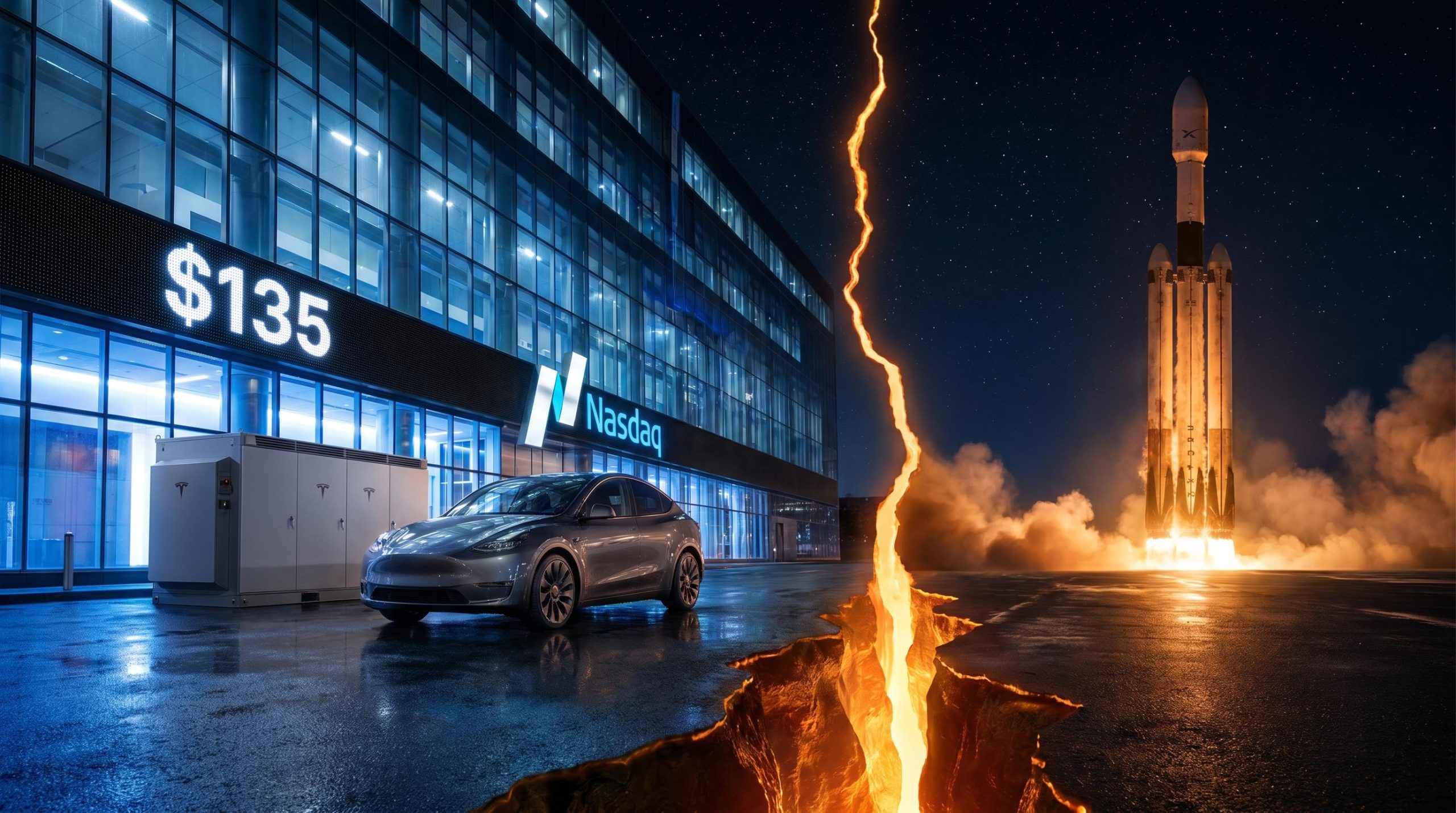
Capital rotation risk, in this context, describes a specific mechanism. Retail and institutional investors who allocate capital based on exposure to Elon Musk’s ecosystem may redirect incremental dollars into the newly public SpaceX rather than adding to Tesla positions. Reports indicate SpaceX has priced its offering at $135 per share, targeting a raise of approximately $75 billion, with a Nasdaq debut reportedly scheduled for 12 June 2026. These figures have not been independently verified at the time of publication.
Findex reporting on the SpaceX IPO, published on June 10, 2026, confirms the $135 per share pricing and the $75 billion raise target, figures that underscore the scale of capital competing for Musk-ecosystem allocation in the days immediately surrounding the Nasdaq debut.
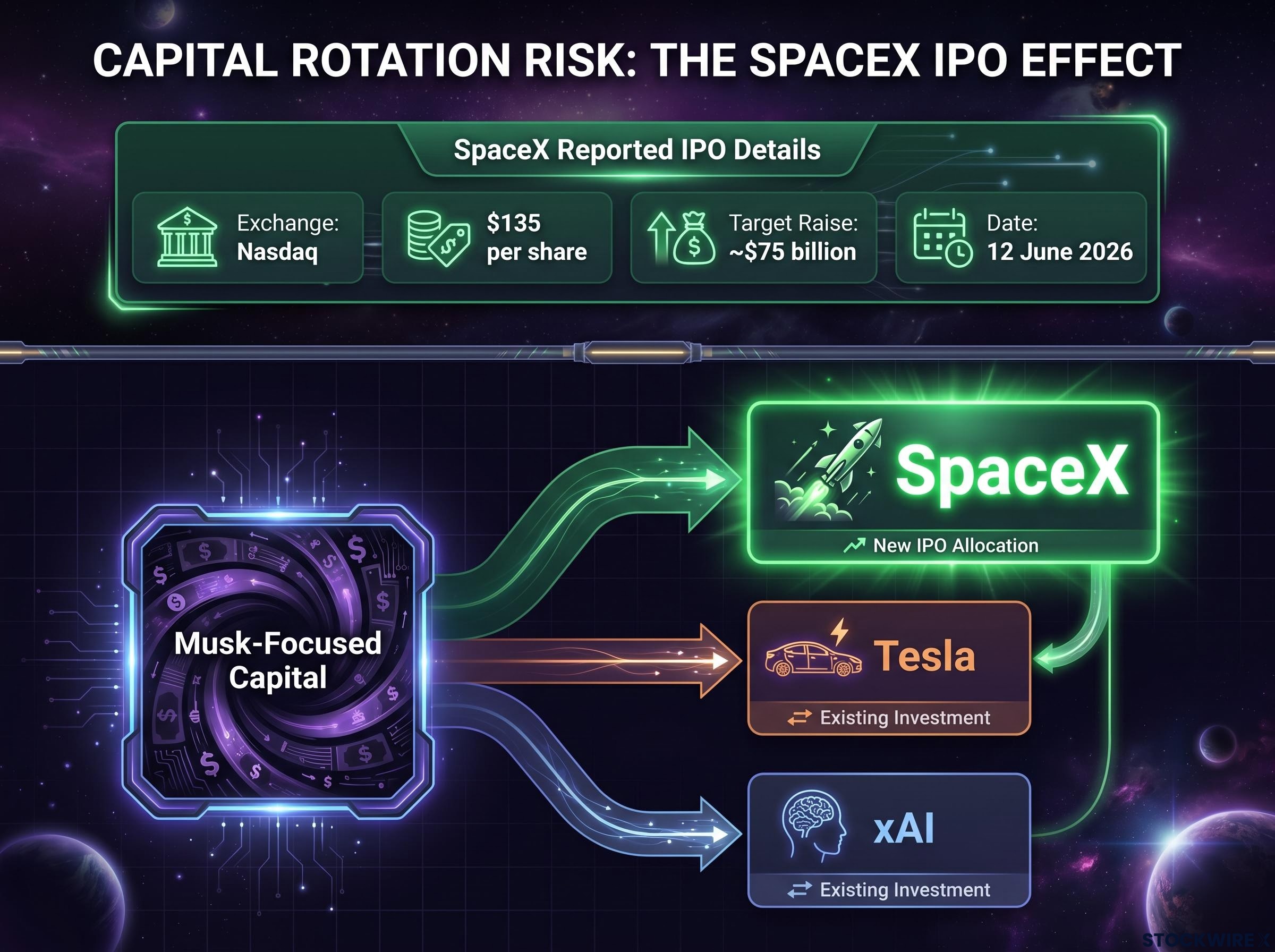
The scale of that offering, arriving one day after Oppenheimer published its note, amplifies the short-term pressure. Musk-focused capital that was previously concentrated in Tesla (and, to a lesser extent, xAI) now has a third public-market vehicle competing for allocation.
Record IPO supply pressure was already flagged by Barclays in late May 2026 as one of three converging risks for crowded equity positions, with 63 deals raising $28.8 billion through late May tracking as the heaviest issuance since 2021; the SpaceX offering, at a $75 billion target raise, lands as the single largest addition to that supply dynamic.
Oppenheimer’s stance is simultaneously strategically constructive on Tesla’s long-term AI and infrastructure position while more cautious near term on the stock’s support, given the capital competition a SpaceX listing introduces.
Both positions can be true at once. A cooperation story that takes years to compound in revenue does not offset a rotation dynamic that can compress a multiple in weeks.
The bull case Oppenheimer is actually making for TSLA, and how to evaluate it
Oppenheimer’s integrated message is narrower than a blanket buy recommendation and more specific than a generic “long-term bullish” stance. The firm is asking investors to do three things: stop treating a merger as the core bull case, model Tesla on stationary storage fundamentals and incremental cooperation revenue, and treat AI and robotics as medium-term optionality rather than near-term cash flow.
The practical question is what to watch. Four data points would validate or challenge the cooperation thesis in the quarters ahead:
- Megapack deployment disclosures that reference SpaceX or Starlink-related installations
- Server and compute procurement announcements indicating coordinated purchasing between the two companies
- Starlink-Tesla integration references in earnings calls or product updates
- SpaceX capital rotation signals, specifically, whether Tesla trading volumes and institutional positioning shift measurably around the SpaceX listing
The $97.2 billion FY 2026 revenue estimate is built on storage and autos, not on any of those cooperation items generating material revenue yet. That is precisely why they function as a watchlist: if cooperation revenue begins appearing in segment disclosures, the valuation framework changes. If it does not, the current estimate is the ceiling.
Separation over synergy, for now
Oppenheimer’s note delivers a three-part argument. Separation maximises AI capital flexibility. Cooperation delivers commercial value without integration friction. Near-term caution is warranted given SpaceX capital rotation risk.
The raised $97.2 billion revenue estimate reflects a storage-and-autos-first valuation, not a merger premium. Investors pricing Tesla on the expectation of a SpaceX combination are modelling a company that Oppenheimer’s own analysis suggests is better off staying separate.
The forward-looking question is whether the market reprices Tesla’s multiple upward as cooperation arrangements become visible in earnings disclosures, or whether capital rotation into SpaceX dilutes that benefit before it compounds. The next four quarters of earnings calls will carry the answer.
Momentum factor pressure on high-beta equities adds a second layer of near-term headwind on top of the rotation dynamic: in early June 2026, momentum names suffered a single-session decline of approximately 9.5%-10%, the worst one-day loss for the factor since COVID, with BTIG estimating a further 11%-12% of downside risk remaining from residual positioning.
This article is for informational purposes only and should not be considered financial advice. Investors should conduct their own research and consult with financial professionals before making investment decisions. Financial projections referenced are subject to market conditions and various risk factors. SpaceX IPO pricing and timeline details cited above were sourced from reports that have not been independently verified.