Nvidia shed roughly 5% in a single session on 27 July 2026, wiping billions from its market capitalisation on reports that a Chinese chipmaker most investors had never heard of was closing the gap on AI-critical memory technology faster than anyone expected.
The timing made the move harder to dismiss. The four mega-cap technology companies scheduled to report that week, Microsoft, Meta Platforms, Apple, and Amazon, had already put Wall Street on edge over whether years of heavy AI infrastructure investment was beginning to show up in actual financial results. A credible new competitor surfacing at exactly that moment added a second axis of pressure on the AI investment thesis.
Here is a clear picture of what CXMT actually is, how real the threat is on a concrete timeline, and what signals will tell you whether this week’s selloff is noise or the beginning of a structural re-rating.
Why Nvidia fell 5% and what triggered the move
Nvidia ended the 27 July 2026 session at $196.51, a decline of close to 5% on the day. The Philadelphia Semiconductor Index dropped around 2.2% over the same period.
The session’s selling pressure originated in a series of reports documenting the speed of progress at ChangXin Memory Technologies (CXMT), China’s foremost DRAM producer, whose advances in memory chips central to AI workloads caught the market’s attention. CXMT’s advances centre on memory chips that are critical to AI workloads, specifically the high-bandwidth memory (HBM) that feeds data to the GPUs powering generative AI training and inference.
CXMT’s IPO debut on 27 July 2026 added a second dimension to the session’s selling pressure: the company raised $8.6 billion on the Shanghai STAR Market and surged 466% on its first trading day, reaching a market capitalisation of approximately $487 billion and signalling a level of state-backed capital access that export controls had been designed to prevent.
A 5% single-session drop in Nvidia tells you more about how much optimism is already priced into the stock than it does about CXMT’s actual near-term impact on Nvidia’s business. Crowded positioning and stretched valuations across AI winners mean any credible threat, even one operating on a multi-year timeline, gets repriced in minutes. The magnitude of the move was a sentiment event layered on top of a structural question.
When big ASX news breaks, our subscribers know first
What CXMT is and how far it has actually come
CXMT is China’s largest DRAM manufacturer and is narrowing the gap with global incumbents Samsung, SK Hynix, and Micron. DRAM (dynamic random-access memory) is the fast, temporary storage that processors rely on to handle active workloads. In AI, the speed and volume of this memory is often the bottleneck.
CXMT’s current capabilities cover more ground than most investors realise:
- DDR5 production at 16 nm process node, confirmed by TechInsights analysis, after progressing rapidly from earlier 23 nm and 18 nm nodes
- DDR5 yield improvement from approximately 20% to approximately 80%, crossing the threshold from laboratory demonstration to commercially viable manufacturing
- LPDDR5X mobile memory in production, targeting smartphones and edge devices
- Sub-15 nm DRAM R&D underway without extreme ultraviolet (EUV) lithography, using buried wordline architecture inherited from German chipmaker Qimonda
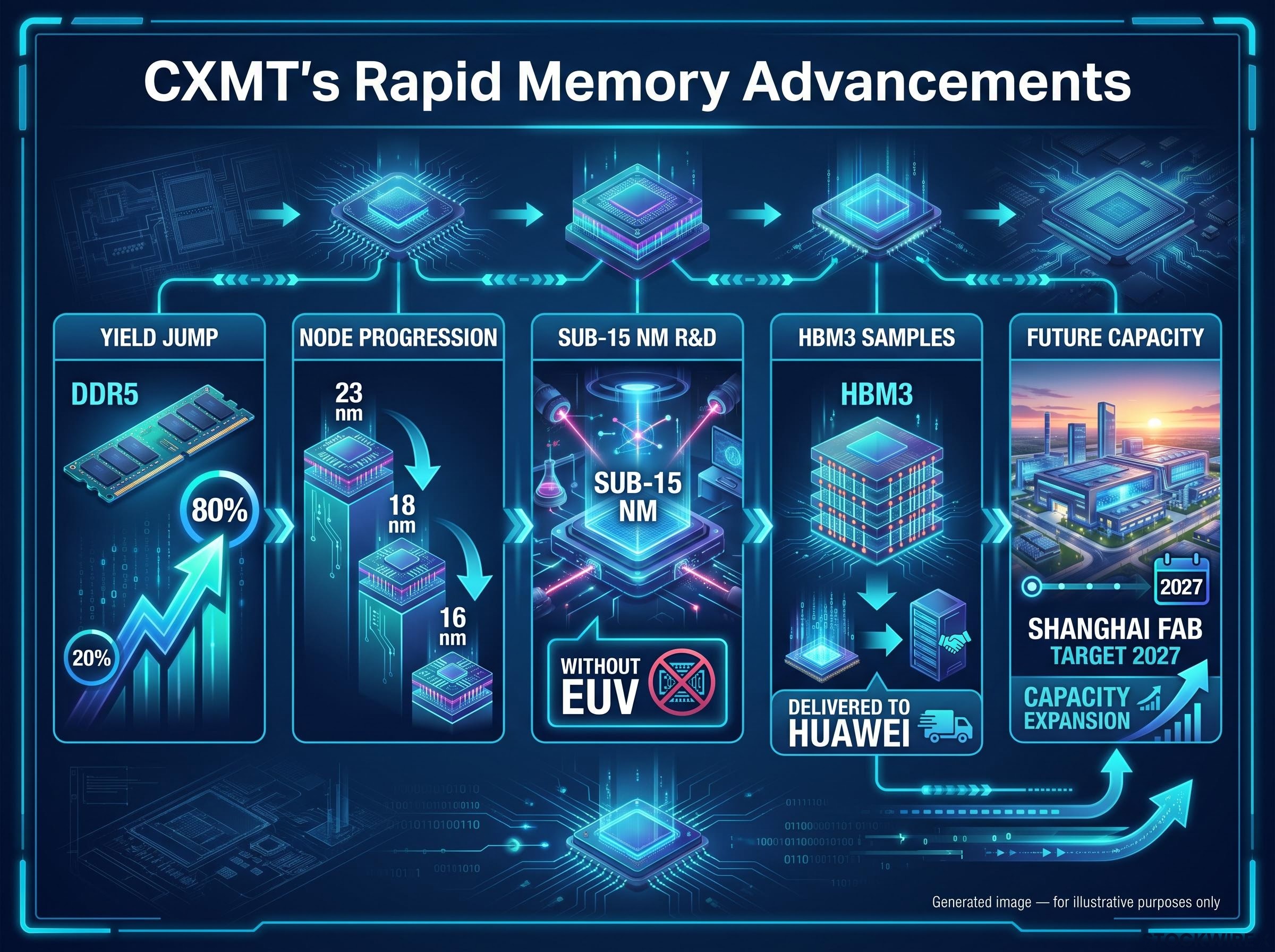
The yield jump from 20% to 80% is the number that matters most. Yield measures how many chips on a wafer actually work. At 20%, you have a research project. At 80%, you have a manufacturer that can put chips into products at scale.
Memory chip supply constraints reinforce why CXMT’s Shanghai facility matters beyond China’s domestic market: HBM capacity at SK Hynix and Micron is sold out through 2026-2027, new fab lines require 18-24 months minimum from investment to volume production, and hyperscalers are signing 3-5 year deposit-backed contracts that treat memory as strategic infrastructure rather than a commodity.
The HBM push: samples, scale, and the 2027 target
HBM (high-bandwidth memory) is a specialised, vertically stacked memory technology designed to feed data to AI accelerators like Nvidia’s GPUs at speeds conventional DRAM cannot match. It is one of the scarcest and most strategically important components in AI infrastructure.
CXMT has delivered HBM3 samples to domestic AI customers including Huawei and other Chinese AI accelerator firms. A new Shanghai DRAM facility, expected to be 2-3 times larger than CXMT’s existing Hefei base, is targeting volume HBM production around 2027. That capacity is earmarked primarily for China’s domestic AI accelerator ecosystem, not global export.
What this actually means for Nvidia’s competitive position
The threat is real, directionally significant, and still operating on a multi-year timeline that does not change Nvidia’s demand equation this quarter.
CXMT is not currently a global HBM supplier to Nvidia’s own supply chain. Nvidia depends on SK Hynix, Samsung, and Micron for the memory inside its GPUs. CXMT’s HBM output is aimed at domestic Chinese customers building alternatives.
The competitive pathway is indirect. CXMT’s memory enables more capable domestic Chinese AI accelerators, from Huawei and others, making those alternatives more credible to Chinese buyers over time. That gradually reduces Nvidia’s addressable market in China.
| Timeframe | Competitive mechanism | Nvidia impact |
|---|---|---|
| Near term (2026-2027) | CXMT reinforces China’s domestic AI hardware stack with DDR5 and early HBM3 | Minimal direct supply chain impact; sentiment-driven volatility |
| Medium term (2027-2029) | Shanghai fab ramps HBM volume; domestic accelerators become more competitive | Gradual addressable market erosion in China; potential memory pricing pressure |
| Long term (2029+) | CXMT adds global DRAM/HBM capacity; price competition intensifies across memory | Margin pressure on AI hardware economics as HBM moves toward commoditisation |
The competitive threat to Nvidia flows through China’s ability to build a self-sufficient AI hardware stack over several years, not through any change to Nvidia’s GPU supply chain that investors need to reprice this week.
The earnings backdrop that made this week’s selloff worse
CXMT did not land in a vacuum. It landed into a market already holding its breath.
The week of 28 July 2026 brings quarterly results from Microsoft, Meta Platforms, Apple, and Amazon, reports that markets had already flagged as a key test for AI spending conviction. The preceding week, Tesla and Alphabet both drew attention to rising AI-related costs in their results, bringing into sharper focus a concern investors had been carrying for some time.
AI infrastructure spending scale provides the backdrop that makes hyperscaler earnings results so consequential: US IT hardware and software spending reached a record 4.9% of GDP in Q1 2026, surpassing every prior technology investment peak, and combined hyperscaler capex commitments for 2026 sit in the $600-$805 billion range, raising the stakes for any signal of delayed returns.
At what point does substantial AI infrastructure spending begin to produce clear gains in revenue and profitability, rather than simply expanding the cost base while returns remain on the horizon?
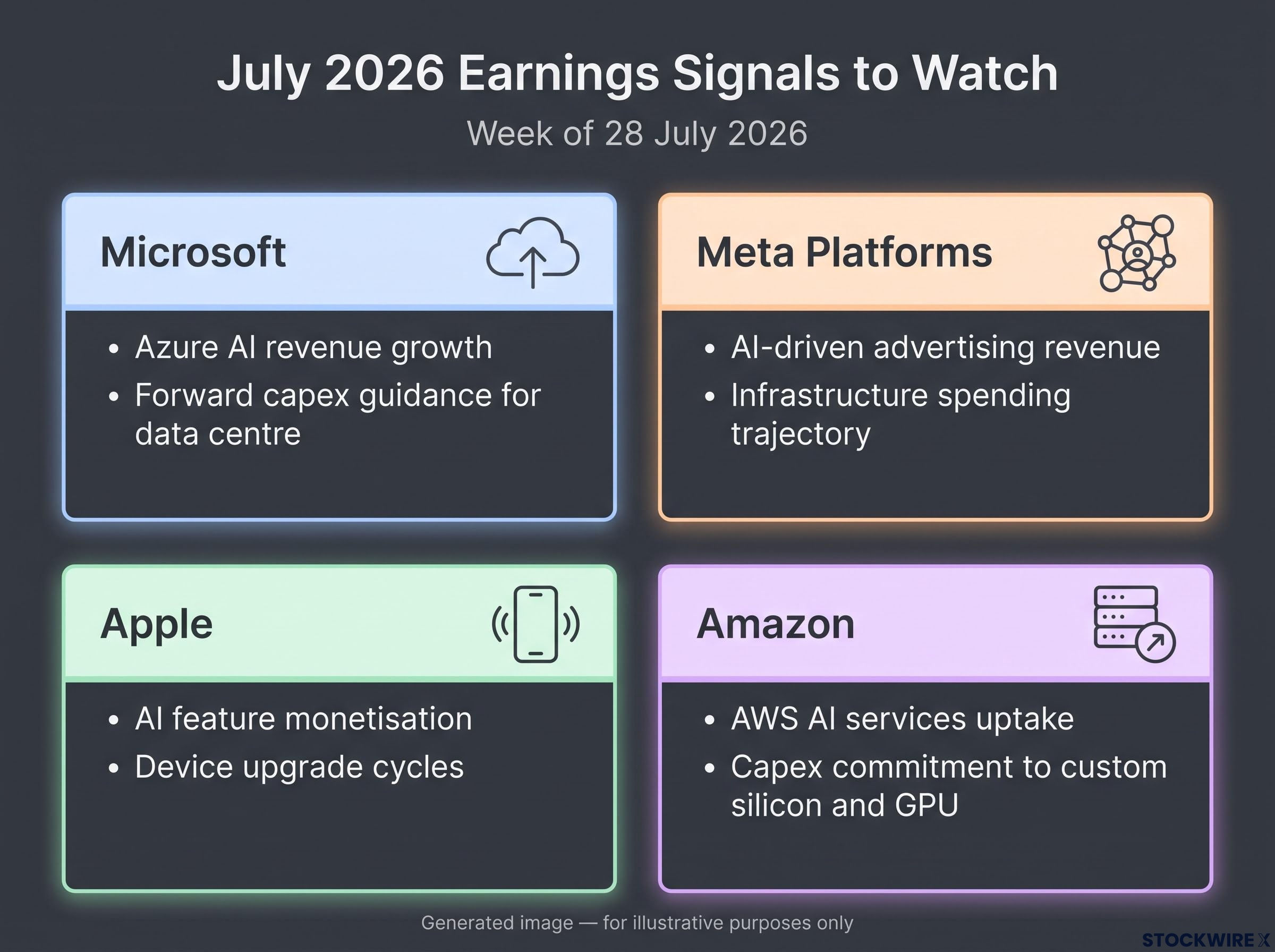
Investors already nervous about AI capex return on investment are more sensitive to any signal that the competitive landscape could compress margins or erode pricing power. CXMT intensified that anxiety rather than creating it. Key signals to watch from each reporter this week:
- Microsoft: Azure AI revenue growth and forward capex guidance for data centre infrastructure
- Meta Platforms: AI-driven advertising revenue attribution and infrastructure spending trajectory
- Apple: AI feature monetisation in services and device upgrade cycles
- Amazon: AWS AI services uptake, capex commitment to custom silicon and GPU procurement
If hyperscalers sustain or increase AI capex guidance with clear revenue traction this earnings season, the CXMT-driven selloff will look like an overreaction. If they signal delayed returns, it will look like it was early.
The geopolitical dimension: what export controls can and cannot do
U.S. export controls were designed to limit China’s access to leading-edge semiconductor technology. CXMT’s DDR5 achievement at 16 nm, confirmed by TechInsights, demonstrates that restrictions have slowed rather than stopped indigenous capability-building.
CXMT’s workaround approach is instructive. The company is developing sub-15 nm DRAM without EUV lithography, using buried wordline architecture. Bloomberg analysis confirmed CXMT used manufacturing techniques not previously seen in China to reach this milestone. YMTC represents a parallel case in NAND flash memory, suggesting this is a pattern across Chinese semiconductor segments, not a one-off.
For investors, the takeaway is that export controls create a time advantage for Western chipmakers rather than a permanent barrier, and that time advantage is being consumed faster than the market had assumed.
That recalibration matters. It changes how much pricing and margin protection Western semiconductor firms can attribute to geopolitical policy over a five-to-ten-year horizon.
For investors wanting to model the policy durability behind export controls, our full explainer on US-China semiconductor fault lines examines how AI chip restrictions are grounded in national-security law with bipartisan backing, placing them outside trade negotiators’ jurisdiction and making them structurally distinct from tariff agreements.
What to watch now: the signals that will separate noise from structural shift
Investors who track CXMT’s HBM yield data and hyperscaler capex guidance in parallel will have a far better read on whether Nvidia’s premium valuation is compressing structurally or simply resetting from a sentiment overshoot. Three categories of signal, in order of near-term priority:
- Hyperscaler earnings signals: Forward capex guidance tied to AI infrastructure, and evidence that AI spend is generating measurable revenue uplift in cloud services, advertising, and productivity tools. This is the more immediate Nvidia demand driver.
- CXMT technology metrics: HBM3/3E performance data (bandwidth, capacity, stack height) and yield figures once the Shanghai facility ramps around 2027. Watch the output mix between commodity DRAM and HBM.
- Portfolio construction considerations: The AI infrastructure opportunity spans memory, GPUs, interconnect, power and cooling, and software. Concentration in any single name amplifies exposure to exactly the kind of idiosyncratic headline risk that hit Nvidia on 27 July.
| Signal category | What to watch |
|---|---|
| CXMT HBM progress | HBM3/3E bandwidth, stack height, and yield data from Shanghai fab ramp (target ~2027) |
| Hyperscaler capex guidance | Microsoft, Meta, Amazon, Apple forward AI infrastructure spending commitments |
| AI revenue conversion | Cloud AI services revenue, ad targeting uplift, productivity tool monetisation |
| DRAM pricing trends | Gross margin trajectories for Samsung, SK Hynix, Micron as CXMT capacity ramps |
A 5% drop does not rewrite the AI thesis, but it does sharpen the questions investors need to answer
The distinction is between the tactical selloff and the structural signal. Nvidia’s 5% decline to $196.51 on 27 July reflected sentiment and valuation sensitivity, not a fundamental change to near-term demand. CXMT is a credible, accelerating competitor, but its HBM capacity operates on a multi-year timeline with the Shanghai fab targeting volume production around 2027.
The more immediate test is this week’s earnings. Results from Microsoft, Meta, Apple, and Amazon will show whether the vast sums being directed into AI infrastructure are beginning to generate the kind of earnings growth that justifies the spend. That answer matters more to Nvidia’s near-term trajectory than CXMT’s technology roadmap.
The appropriate response is neither dismissal nor panic. It is to sharpen two specific questions: are hyperscalers getting financial returns from AI spending right now, and how quickly is CXMT closing the HBM gap? The first question gets answered this week. The second plays out over the next 12-18 months.
This article is for informational purposes only and should not be considered financial advice. Investors should conduct their own research and consult with financial professionals before making investment decisions.