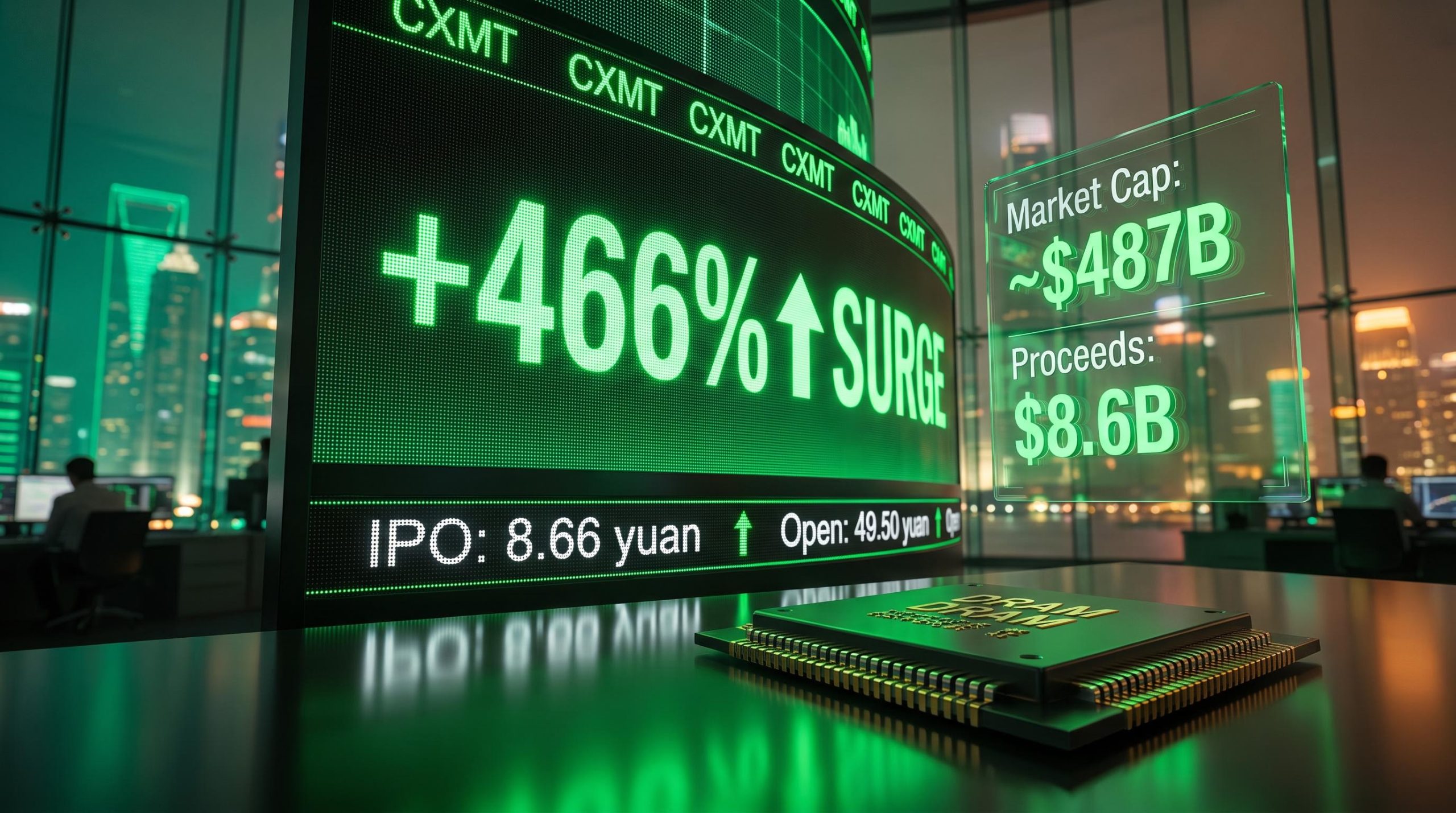
CXMT listed on the Shanghai STAR Market on 27 July 2026, and on its first trading day shares surged 466%, briefly making it China’s most valuable listed company and placing its market capitalisation at approximately half that of Micron.
The headline number is extraordinary. But the story underneath it is more consequential: a state-backed DRAM manufacturer has just obtained the public capital access and market valuation of a global tier-one chipmaker, at precisely the moment U.S.-led export controls were supposed to contain China’s semiconductor ambitions. The tension between those two facts is what makes this more than a record-breaking float.
Here is what the debut actually tells you about the competitive variable CXMT has become for the memory chip industry, and what it changes for anyone with exposure to semiconductor equities.
A 466% surge and a record debut: what CXMT’s first trading day actually looked like
The numbers, taken in sequence, tell the story of scale.
- IPO price: 8.66 yuan per share
- Proceeds raised: 57.92 billion yuan (~$8.6 billion)
- First-day surge: 466-472% above the offer price
- Opening price on debut day: 49.50 yuan
- Post-surge market capitalisation: approximately 3.3 trillion yuan (~$487 billion)
At the offer price, CXMT’s implied valuation was approximately 579 billion yuan (~$85.5 billion). By the close of its first session, that figure had multiplied nearly sixfold. The company briefly surpassed Industrial and Commercial Bank of China to become China’s most valuable listed company. The listing is both Asia’s largest IPO of 2026 and the largest A-share semiconductor IPO on record.
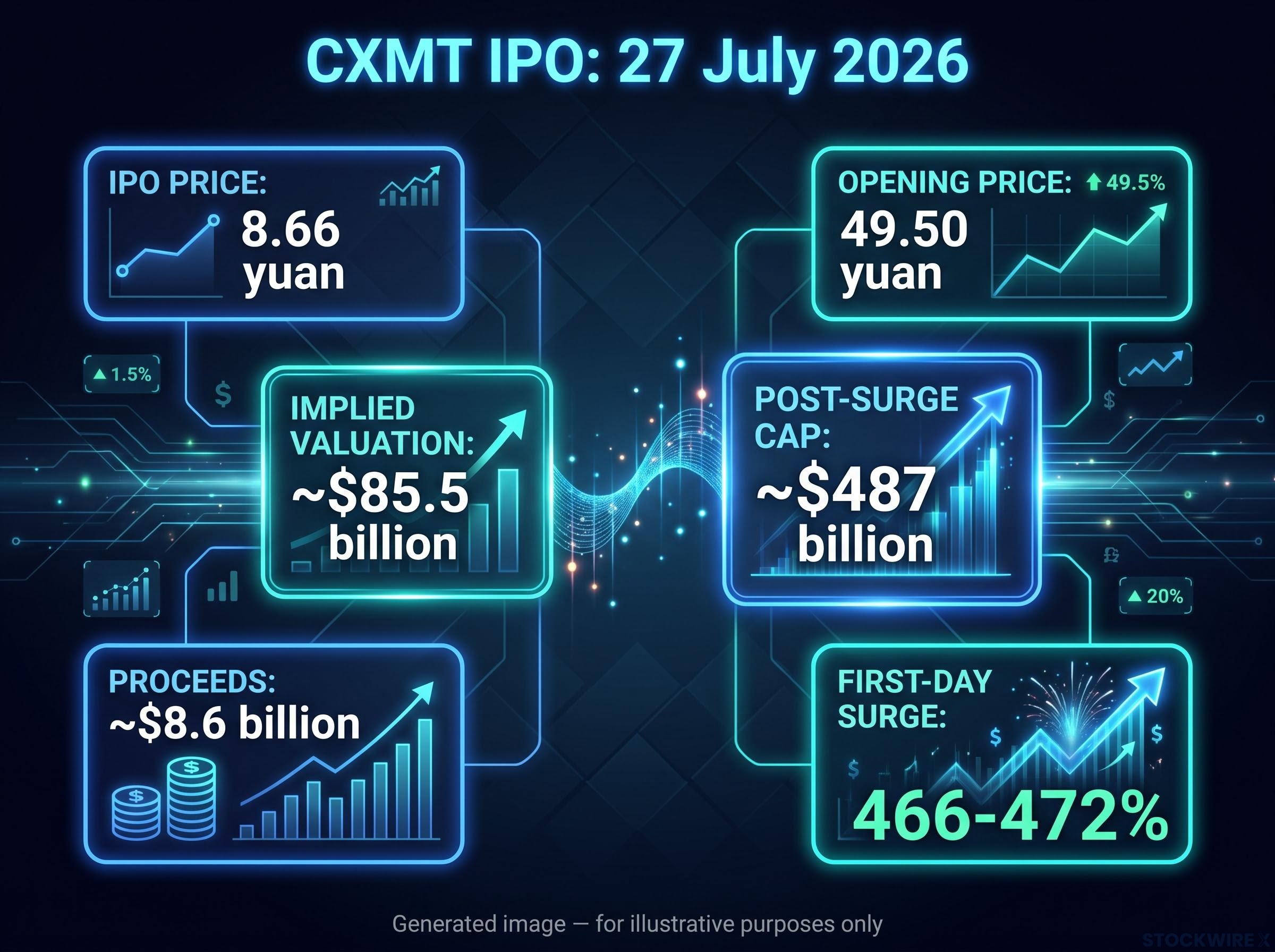
The anchor number for international readers: CXMT’s post-surge market capitalisation of ~$487 billion places it at approximately half of Micron’s valuation, a ratio that would have seemed implausible twelve months ago.
The sheer scale of the first-day move reflects something specific about domestic investor appetite. This was not measured institutional price discovery. It was a speculative rush into a float so small that even modest demand could produce enormous headline numbers.
When big ASX news breaks, our subscribers know first
Why the free float structure made a 466% move possible
A 466% first-day surge sounds like a market declaring absolute conviction. The float mechanics tell a different story.
Only 6.73% of CXMT’s enlarged share capital was freely tradable at listing. The vast majority of shares remained under lock-up. When intense domestic enthusiasm for AI-linked semiconductor names meets a structurally limited supply of tradable shares, the percentage move amplifies far beyond what a normal float would produce.
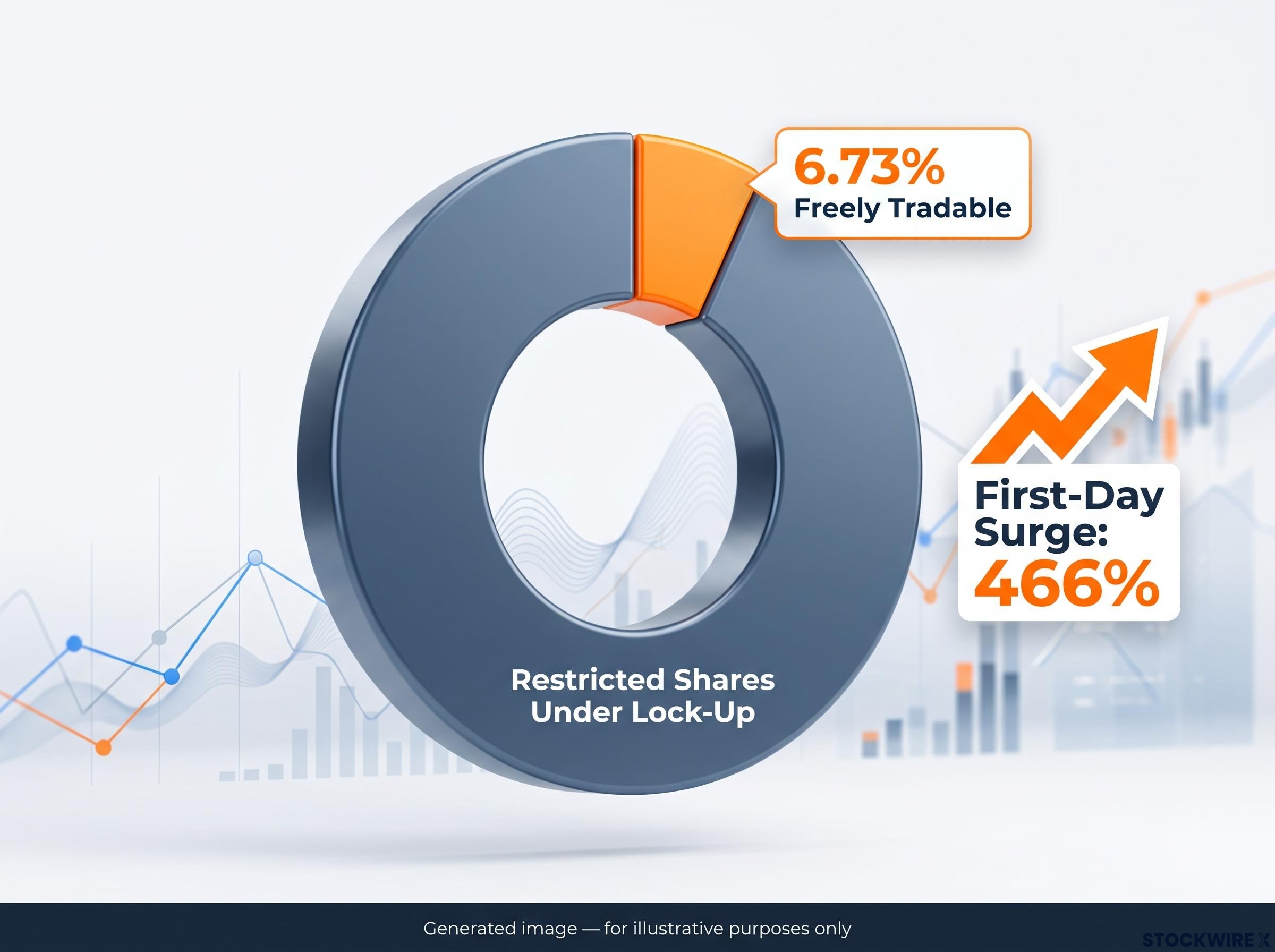
Bloomberg flagged that CXMT’s listing “revives memories of past market tops,” a sobering reminder of what thin-float momentum can produce when sentiment eventually turns. Three specific risks sit beneath the headline valuation:
- Thin liquidity: a small tradable float means price moves in either direction are exaggerated
- Sentiment vulnerability: any shift in appetite for Chinese tech assets could trigger sharp reversals
- Lock-up expiry exposure: as restricted shares become eligible for sale, supply increases and the price discovery process restarts on very different terms
For anyone assessing CXMT’s competitive standing, the ~$487 billion figure is a thin-float price signal, not a fully price-discovered market capitalisation. Treating it as directly comparable to Micron’s valuation without that caveat would be a category error.
What CXMT actually makes and where it sits in China’s chip strategy
CXMT, formally ChangXin Memory Technologies, is China’s largest manufacturer of DRAM (dynamic random-access memory), the workhorse memory chip used in everything from smartphones and laptops to AI servers and cloud data centres. If a device processes data in real time, it almost certainly relies on DRAM to do it.
The company recently launched DDR5 DRAM products, the current high-performance standard, positioning itself against South Korean and U.S. competitors in more advanced segments of the memory market. That is not commodity production; it is a direct statement of frontier ambition.
IPO proceeds are earmarked for three priorities:
- Expanding production capacity through new fabrication lines
- Upgrading process technology and advancing DRAM R&D
- Strengthening working capital for operations and supply chain resilience
These targets address the bottlenecks that have historically constrained Chinese chipmakers: scale, yield, equipment access, and engineering talent.
| Enabling pillar | Strategic significance |
|---|---|
| State capital (National IC Industry Investment Fund) | Provided foundational capitalisation before CXMT could access public markets |
| Market capital (post-IPO) | Adds ~$8.6 billion in proceeds and ongoing access to equity financing |
| DDR5 product roadmap | Signals competitive intent at the technology frontier, not just commodity DRAM |
| Domestic buyer preference | Government, telecom, and cloud buyers face strong incentives to source from CXMT over foreign suppliers |
The combination of state support, market-based capital, and a DDR5 product roadmap tells you that CXMT is no longer a protected domestic project evaluated on a different standard. It is building the profile of a global-scale competitor, and that changes how incumbents must respond.
How CXMT changes the competitive maths for Micron, Samsung, and SK Hynix
For roughly a decade, Micron, Samsung Electronics, and SK Hynix have controlled global DRAM output. That triopoly set the pricing cycles, dictated capacity discipline, and captured the margins that come with concentrated supply. CXMT introduces a fourth player with structural state support and fresh market capital, a combination none of the incumbents faced when the market consolidated around them.
DRAM supply constraints were already acute before CXMT’s listing, with SK Hynix projecting a shortage extending through 2030 and HBM inventory sitting at just 3-4 weeks industry-wide, a backdrop that makes fresh Chinese capacity both a competitive threat to incumbents and a partial structural release valve for tight markets.
The pressure comes through three channels simultaneously.
First, supply. As CXMT ramps commodity DRAM output (PC, mobile, standard server memory), additional Chinese capacity compresses average selling prices and narrows incumbent margins. In a cyclical market where prices respond sharply to marginal supply, even mid-range additions carry weight.
Every percentage point of domestic DRAM share CXMT captures is revenue not going to incumbents, particularly in state-linked and security-sensitive applications where Micron is already constrained.
Second, domestic substitution. CXMT is positioned to absorb the market access that Micron lost following China’s regulatory restrictions on foreign suppliers in “critical information infrastructure.” That is not a hypothetical; it is incremental revenue shifting from incumbents to CXMT quarter by quarter.
Third, technology trajectory. The DDR5 launch signals movement toward the frontier, and the rate of catch-up, not just the absolute gap, is now the variable that matters for incumbent planning. The market is treating CXMT as a credible long-term contender, which improves its ability to recruit engineers, negotiate with equipment suppliers, and win design-ins from customers seeking supply diversification.
| Factor | CXMT | Micron | Samsung / SK Hynix |
|---|---|---|---|
| Primary demand geography | China domestic (government, telecom, cloud) | Global, with reduced China access | Global, including China but subject to geopolitical friction |
| Technology frontier position (mid-2026) | DDR5 capable; limited HBM access | Leading-edge HBM and advanced DRAM | Leading-edge HBM and advanced DRAM |
| Structural advantage or constraint | State backing, captive domestic market, fresh IPO capital | Process maturity, global customer base; constrained in China | Scale, yield leadership; exposed to Chinese supply additions on ASPs |
The competitive pressure CXMT introduces is not a future risk to be modelled as a tail scenario. It is a present structural reality that already affects how the three incumbents must plan capacity, price, and R&D allocation.
The real constraints: export controls, yield gaps, and valuation risk
The structural shift is real. So are the friction points that define its speed and ceiling.
U.S.-led export restrictions limit CXMT’s access to advanced semiconductor manufacturing tools and design IP. That constraint likely keeps it concentrated in mid-range DRAM segments rather than cutting-edge high-bandwidth memory (HBM) for leading AI accelerators in the near term. Any tightening or easing of those restrictions directly affects CXMT’s technology advancement trajectory.
Domestic DUV deployment at Chinese fabs adds a further layer to CXMT’s expansion story: approximately five domestic immersion lithography tools are targeted for 2026 delivery, planned for CXMT among other fabs, a development that partially reduces the equipment dependency that has historically capped China’s DRAM technology progression.
Execution risk on rapid expansion is material. Memory manufacturing is extraordinarily capital- and know-how-intensive, and scaling quickly raises three specific challenges:
- Yield optimisation at advanced nodes, where Korean and U.S. peers hold decades of learning-curve advantage
- Cost competitiveness against incumbents whose per-unit economics reflect mature processes
- Talent retention in a globally competitive engineering labour market
The valuation question introduced by the 6.73% free float remains unresolved. The ~$487 billion market capitalisation is exposed to sharp reversal as lock-up periods approach and if broader sentiment toward Chinese technology assets shifts.
These constraints do not cancel out the structural shift CXMT represents. But they define the timeline. The competitive pressure is real; the pace at which it reshapes global memory dynamics is bounded by factors CXMT cannot fully control.
What to watch now that CXMT is a publicly listed competitor
Six variables will determine how far CXMT’s competitive threat reshapes global memory over the next three to ten years:
- Capacity additions and product mix: how quickly new fabs come online and whether output concentrates on commodity DRAM, server DRAM, or specialised memory for AI workloads
- Technology roadmap progress: any measurable narrowing of the gap with Korean and U.S. leaders beyond DDR5, particularly in HBM
- Domestic market share shifts: changes in CXMT’s share of China’s PC, mobile, server, and cloud memory markets, especially in segments where incumbents were previously dominant
- Export control evolution: any tightening or easing of U.S. and allied restrictions on DRAM-related equipment and IP, which sets the hard ceiling on technology advancement
- Follow-on Chinese semiconductor IPOs: CXMT’s blockbuster listing may encourage further large Chinese chip floats, compounding the competitive dynamic across segments beyond DRAM
- Lock-up expiry and float expansion: how the stock trades as restricted shares become eligible for sale will test whether the valuation reflects durable conviction or thin-float momentum
AI-driven demand could keep the memory market tight even as CXMT ramps output. But the balance between AI server growth and Chinese DRAM expansion is now a core determinant of margins for incumbents, not a peripheral factor.
Memory supercycle dynamics complicate any straightforward read of CXMT as a margin headwind for incumbents: with AI data centre operators accounting for an estimated 70% of total memory shipments and hyperscaler capex projected at $725 billion in 2026, demand growth may absorb CXMT’s ramp without triggering the price compression that commodity supply additions normally produce.
On its Shanghai debut day, Nvidia dropped 5% in New York after The Wall Street Journal reported the company was involved in talks over a ~$250 billion data centre financing arrangement tied to OpenAI, a development that allowed Apple to claim the title of the world’s most valuable listed company. The geography of semiconductor value creation is in active flux across both memory and logic simultaneously.
This article is for informational purposes only and should not be considered financial advice. Investors should conduct their own research and consult with financial professionals before making investment decisions.
A fourth column in the DRAM model: what the CXMT debut changes permanently
CXMT’s debut is not simply a record IPO or a speculative price surge. It is the institutionalisation of China’s DRAM champion as a systemic variable in global memory supply, pricing, and technology competition. DRAM sector models that treat the market as a function of Micron, Samsung, and SK Hynix alone are now structurally incomplete. CXMT’s capacity plans, policy backing, and pricing behaviour must enter the model as core inputs.
The thin float, export control ceiling, and execution risks define the pace and limits of CXMT’s competitive ascent. They do not reverse the directional shift.
The question for semiconductor investors is no longer whether CXMT matters. It is how fast it matters, and in which memory segments first.
The ASML selloff on 27 July unfolded simultaneously with CXMT’s debut, as a single anonymously sourced report claiming domestic Chinese DUV lithography production sent ASML down nearly 7% and dragged Applied Materials, Lam Research, and KLA sharply lower, illustrating how quickly sentiment around China’s semiconductor progress can move equipment maker valuations independent of verified capability data.
Past performance does not guarantee future results. Forward-looking statements about CXMT’s competitive trajectory are subject to change based on market developments, regulatory actions, and company performance.