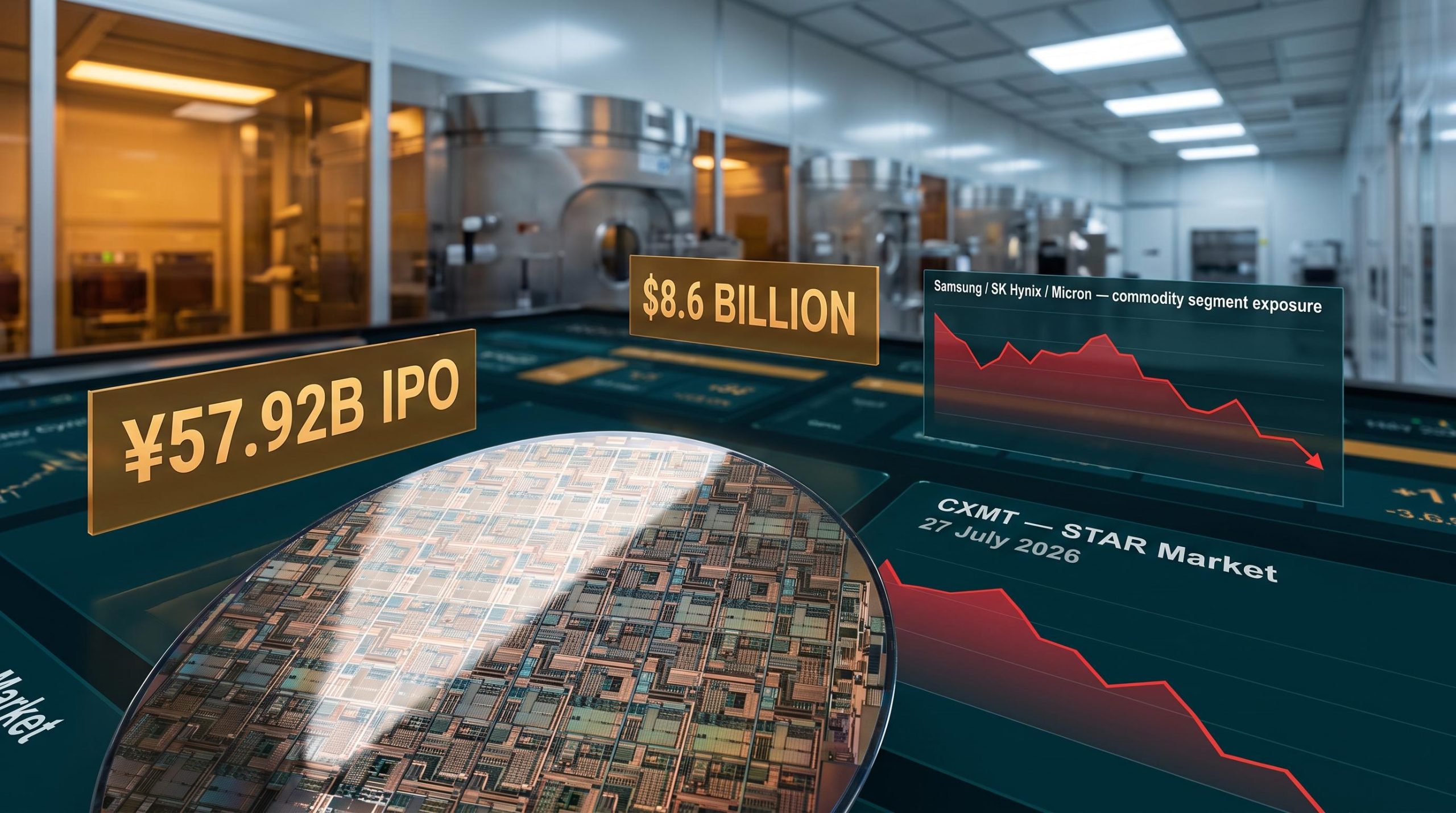
Two events landed in the same week, and together they have done more to rattle the assumptions underlying global memory chip investment than any single export control announcement in the past year. One was a manufacturing milestone. The other was a stock market debut. Neither, on its own, rewrites the competitive map overnight. Together, they tell a different story.
China’s domestic immersion DUV lithography production has entered initial deployment at leading fabs. In the same week, ChangXin Memory Technologies (CXMT) listed on Shanghai’s STAR Market, raising approximately $8.6 billion in Asia’s largest IPO of the year. These are not isolated developments. They are mutually reinforcing signals that a strategy built on semiconductor self-sufficiency has reached an inflection point.
Here is a clear-eyed breakdown of what is technically real, what is strategically significant, and what the forward-looking evidence trail looks like for investors tracking the global memory chip market, covering the technical capability, the capital formation signal, the incumbent risk horizon, and the operational indicators that will separate structural shift from headline noise.
Two events, one week, one structural shift accelerating
The timeline matters. On 27 July 2026, CXMT completed its public listing on the STAR Market. In the same period, reports surfaced that a state-backed Shanghai firm had begun mass production of immersion DUV lithography machines for commercial chip fabrication. Around the same time, the broader semiconductor sentiment was already under pressure from multiple directions:
- CXMT’s IPO: 57.92 billion yuan ($8.6 billion) raised, Asia’s largest IPO of the year, making CXMT one of China’s most valuable listed companies on debut
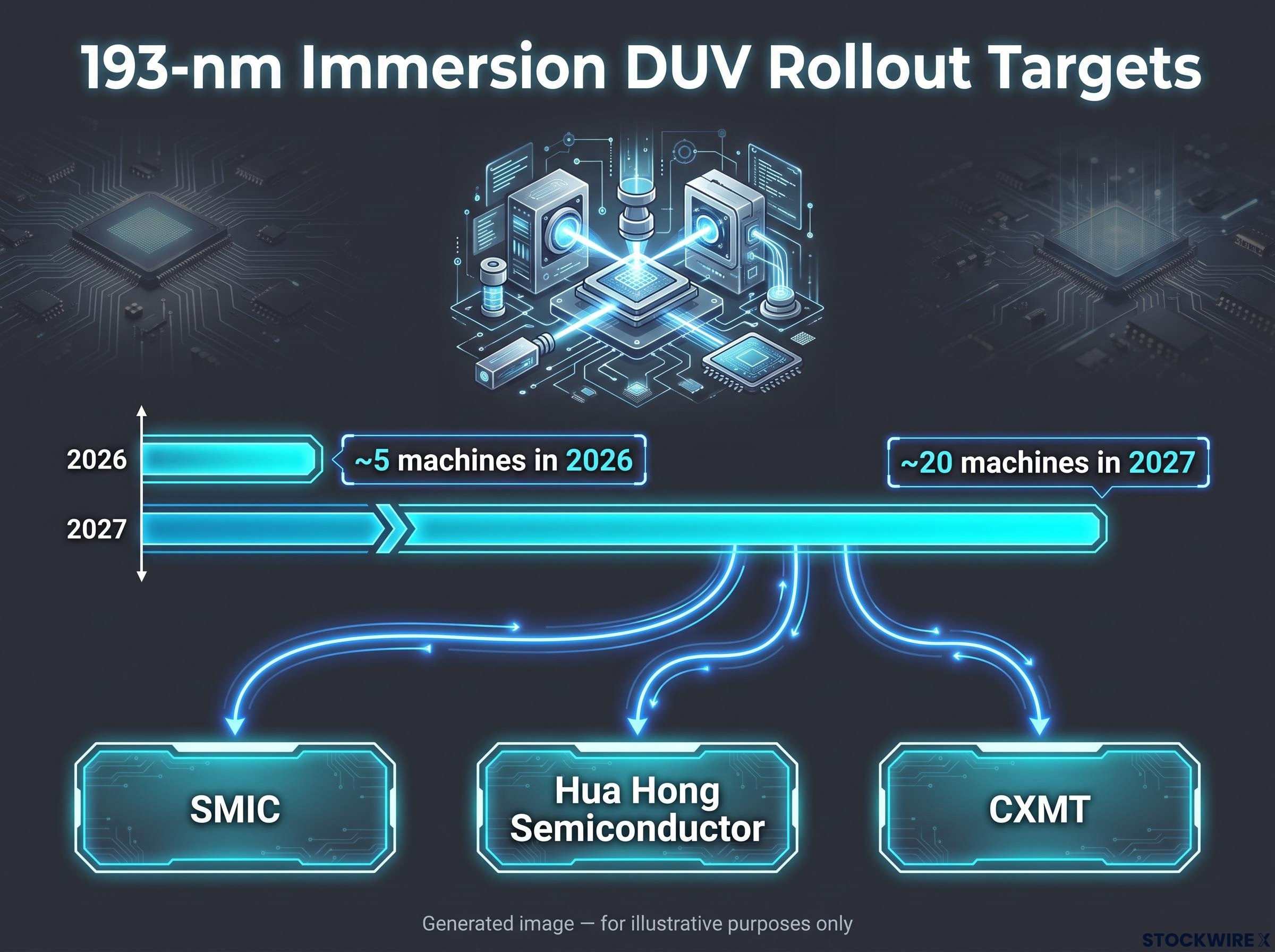
- Domestic DUV deployment: Initial mass production of 193-nm immersion DUV lithography tools, with planned deliveries to SMIC, Hua Hong Semiconductor, and CXMT
- Low-cost Chinese AI models: Models such as Kimi K3 drew scrutiny over whether coming AI workloads could turn out to be less computationally demanding than the market had assumed, which would weigh on forward demand projections for advanced memory
- Apple’s chip lobbying: Reports emerged that Apple had sought permission from the Trump administration to incorporate Chinese-produced chips into certain product lines, adding to investor unease about the breadth of China’s technological ambitions
Han Ji-young, analyst at Kiwoom Securities, observed that the DUV breakthrough reports had rekindled concerns about Chinese memory makers accelerating capacity expansion, and that the CXMT listing amplified those worries at a moment when the broader investment case for semiconductor stocks had already lost momentum, leaving market participants to treat the two developments as part of a single narrative rather than separate events.
The ASML selloff dynamics that played out on 27 July 2026 illustrate how a single unverified report can reprice an entire equipment sector; Applied Materials, Lam Research, and KLA Corp all fell sharply despite making no lithography equipment that competes with the domestically produced tools.
The combined effect is not simply additive. Public capital formation meeting growing equipment self-sufficiency means investors can no longer treat China’s memory ambitions as a long-run theoretical risk. The capital is real, the equipment pathway is real, and the market is pricing in the possibility that the structural shift has already begun.
When big ASX news breaks, our subscribers know first
What China’s DUV machines can and cannot do
The tools entering production are immersion DUV systems operating at the 193-nm wavelength, the same general technology class used globally to manufacture memory chips and mature-node logic. Immersion DUV is the workhorse of high-volume DRAM and NAND production worldwide; it is not a legacy system being superseded in memory the way it is in leading-edge logic.
Initial output targets are modest: approximately five machines in 2026 and around twenty in 2027. Planned recipients include SMIC, Hua Hong Semiconductor, and CXMT, all strategic priorities in China’s semiconductor programme. For commodity DRAM and NAND production at mid-range nodes, these tools do not need to match ASML at the frontier to be commercially meaningful. They need to be good enough, and for the segments where CXMT competes, that bar is lower than the headline comparison implies.
Where the tools fall short
The performance gap is real, and a sceptical reading requires acknowledging it clearly:
- Overlay precision: Domestic systems reportedly trail ASML’s tools in the alignment accuracy needed for tighter geometries and higher yields
- Throughput: Fewer wafers processed per hour reduces the commercial viability of running these tools at aggressive production volumes
- Reliability: Uptime and consistency across sustained production runs remain unproven at scale
- Ecosystem dependencies: Lithography is only one piece. China still faces gaps in photoresists, metrology equipment, advanced deposition and etch tools, and deep process integration
Yield optimisation across generations, where Samsung, SK Hynix, and Micron hold decades of accumulated advantage, is a non-equipment factor that also constrains rapid catch-up. Experimental domestic EUV efforts exist, but these remain at prototype stage, assembled from second-hand parts, and are not close to producing working chips at scale.
The gaps are substantial. But the question is not whether these tools match ASML today. It is whether they can serve the volume segments where Chinese producers are already competing, and the answer to that is increasingly yes.
Why memory is the segment where domestic DUV hits hardest
Most of the world’s DRAM and NAND flash is still manufactured using 193-nm immersion DUV, often combined with multi-patterning and advanced process engineering. This is not a legacy technology in memory; it is the dominant production method. That makes China’s DUV breakthrough more strategically targeted than it might appear to readers who associate semiconductor progress only with leading-edge logic.
Domestic DUV capability strengthens Chinese memory makers through three specific mechanisms:
- Supply-chain resilience for existing fleets. Export controls increasingly target not just new equipment sales but servicing and upgrades of installed DUV tools. Chinese fabs operate several hundred imported DUV immersion tools. Having a domestic supplier reduces the leverage foreign vendors hold via maintenance, spare parts, and incremental upgrades, making it harder for controls to degrade Chinese capacity over time.
- Scaling new capacity at competitive nodes. New domestic DUV tools, even if less capable than ASML’s latest systems, can be dedicated to mature nodes suitable for commodity DRAM and NAND volume production. CXMT competes in mid-range DRAM, which is precisely the segment these tools can serve. The match between tool capability and market position is strategically coherent.
- Erosion of the chokepoint logic. U.S. strategy has explicitly treated high-end lithography as a chokepoint: if China cannot buy or service advanced DUV and EUV, it cannot scale advanced chip production. Once China can build and maintain its own immersion DUV tools, that chokepoint is partially bypassed for memory and mature-node logic, even if a frontier gap remains.
The BIS export controls on DUV lithography equipment, expanded under the December 2024 interim final rule, explicitly target less-advanced DUV photolithography tools and their servicing, which is precisely why domestic Chinese production capability reduces the leverage those controls were designed to maintain.
DUV self-sufficiency does not need to reach the frontier to change the competitive dynamics. It needs only to support the volume segments where Chinese producers are already competing, which changes the durability of incumbent pricing power in those segments.
For investors, this is where the connection between a manufacturing equipment story and a memory market investment story becomes explicit. Lithography equipment policy sits at the centre of the global semiconductor competition narrative because memory is the segment where DUV capability matters most.
Commodity DRAM pricing dynamics in early 2026 explain why the competitive pressure CXMT represents is felt most acutely in incumbents’ mid-range segments; contract prices surged 90-95% in Q1 2026 and a further 58-63% in Q2 2026, creating the elevated margins that additional Chinese supply could directly compress.
CXMT’s IPO and what public capital means for the competitive race
The facts of the listing are straightforward: CXMT raised 57.92 billion yuan ($8.6 billion) on Shanghai’s STAR Market on 27 July 2026, in what became Asia’s largest IPO of the year. The interpretation is where the value sits.
Public equity access is structurally different from state or private financing. It opens CXMT to sustained capital formation across market cycles, funding capacity build-out through mechanisms that scale with market confidence rather than depending solely on government allocation. That changes the durability of the investment behind China’s DRAM ambitions.
Public listing also forces granular disclosure on technology roadmaps, yields, and cost structures, making CXMT’s competitive position more transparent to the global investment community and, importantly, to rivals. And a strong IPO reception at this scale functions as a market endorsement: institutional capital has made a forward bet that China’s DRAM industry is commercially viable at scale, not merely strategically subsidised.
| Dimension | CXMT | Incumbents (Samsung, SK Hynix, Micron) |
|---|---|---|
| Node capability | Mid-range DRAM; not yet competing at frontier HBM nodes | Leading-edge DRAM and HBM; multi-generational process advantage |
| Market segment focus | Commodity and mid-range DRAM for domestic and aligned markets | Full spectrum from commodity to AI-optimised high-bandwidth memory |
| Financing model | Now public equity plus state backing; $8.6B IPO capital | Established public equity with decades of retained earnings and global capital access |
The combined effect of public financing and growing equipment self-sufficiency means the Chinese memory challenge is now backed by both state strategy and market conviction. That combination is harder to reverse through policy alone than either factor in isolation.
What the timeline looks like for Samsung, SK Hynix, and Micron
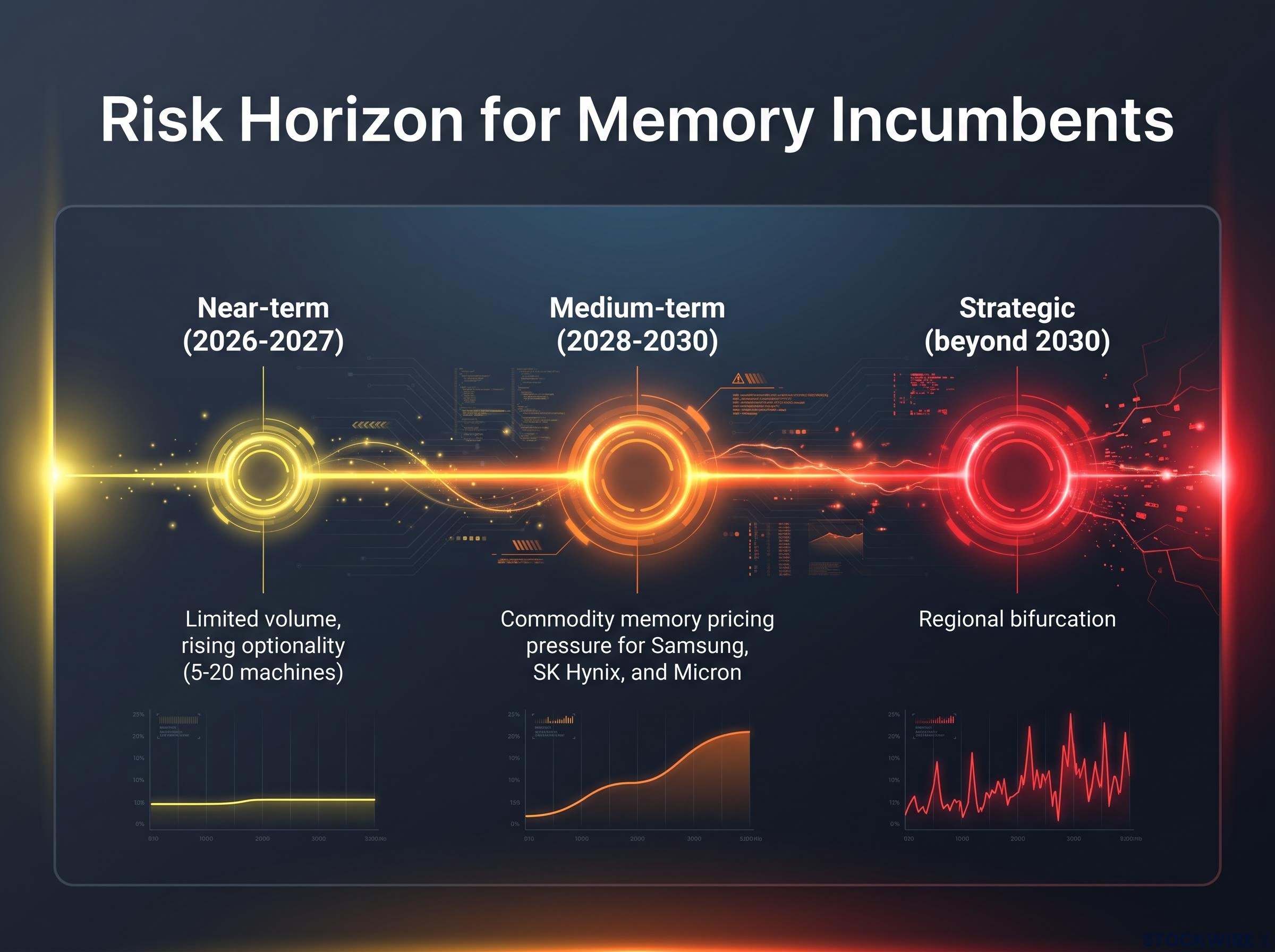
The risk picture for incumbent memory producers is best understood across three time horizons, each with a sharper implication than the last.
- Near-term (2026-2027): Limited volume, rising optionality. With approximately five to twenty domestic DUV machines entering deployment, the immediate capacity addition is modest relative to global installed lithography fleets. Technical gaps limit these tools to mature nodes and less complex products. This phase is more about risk reduction for Chinese fabs than direct displacement, but it establishes the production foundation for what follows.
- Medium-term (2028-2030): Commodity memory pricing pressure. As domestic DUV tools mature and volumes rise, China gains the ability to add DRAM and NAND capacity without relying on ASML or other foreign suppliers. If this capacity concentrates on commodity and mid-range memory, it could compress margins for incumbents in those segments even as they retain an edge at the frontier. Samsung and SK Hynix, with heavy exposure to commodity DRAM, face the most direct pressure. Micron may be partially shielded by U.S. policy but is more entangled in geopolitical response dynamics.
- Strategic (beyond 2030): Regional bifurcation. The longer-term risk is structural, not cyclical. Each generation of domestic DUV deployment reduces the external leverage that has historically constrained Chinese memory expansion.
The bifurcation scenario
The outcome that would most durably compress incumbent margins and market share is a bifurcated memory market: Chinese vendors serving domestically and politically aligned demand at aggressive prices, while incumbents retreat toward premium segments and geographies resistant to Chinese chips. U.S. and allied policy is already moving to tighten controls on older-generation DUV tools and their servicing, which suggests this competition is being treated as existential at the policy level.
This scenario does not require China to close the frontier technology gap. It requires only that domestic DUV capability supports the volume segments where pricing power and market share are won and lost, and that is precisely the trajectory now underway.
The evidence trail that will confirm or complicate this thesis
The structural logic is clear. What remains uncertain is pace and scale, and the most informative signals over the coming years will be operational, not rhetorical. Four indicators will tell you whether the thesis is materialising or stalling:
- Deployment data. Look for evidence that domestic DUV tools are operating at scale in SMIC, Hua Hong, and CXMT fabs, not just being delivered or tested. Throughput, uptime, and successful fab integration matter more than delivery announcements.
- Product mix. Track whether Chinese memory makers begin shipping meaningful volumes of commodity DRAM and NAND produced on lines predominantly using domestic lithography. That would indicate genuine independence from foreign tool chains.
- Yield and cost trends. Any credible disclosure or analyst work showing competitive yields or cost structures for memory made with domestic DUV would signal a more serious challenge to incumbents than equipment delivery alone can convey.
- Policy evolution. Watch U.S. and allied moves to further restrict older-generation DUV tools and servicing, and Chinese counter-responses or accelerated domestic tool investment. The policy feedback loop will shape how quickly the structural shift accelerates or is constrained.
Monitoring these four operational signals is what separates a well-timed investment decision from a reaction to noise. The headline announcements will keep coming. The deployment, yield, and product mix data will tell you what is actually changing.
Structural memory demand drivers extending beyond hyperscalers into agentic AI, AI-capable smartphones, and automotive ADAS systems complicate the CXMT displacement thesis; even aggressive Chinese commodity DRAM capacity additions would be entering a market where total demand is itself growing faster than historical cycles would predict.
What the calibrated view looks like from here
The gap between Chinese DUV tools and ASML’s systems remains real and will take years to close. That is not in dispute. What has changed is the trajectory: it now favours growing Chinese memory independence in the commodity and mid-range segments that generate the bulk of volume revenue globally.
Domestic DUV entering deployment and $8.6 billion in public capital raised in a single week are not proof that the structural shift is complete. They are proof that it is underway, backed by both state strategy and institutional market conviction, and harder to reverse through export controls alone than it was twelve months ago.
The investment implication is direct. This is a structural risk to incumbent margins in commodity DRAM and NAND, not a near-term displacement event. Samsung and SK Hynix carry the most direct exposure in commodity segments. Micron is partially shielded but exposed to the policy friction that any competitive response will generate. The appropriate response is not panic but portfolio-level awareness: understanding where your memory chip exposure sits across the time horizons outlined, and tracking the operational signals that will confirm or complicate the thesis.
For investors wanting a structured framework for adjusting exposure across the time horizons outlined above, our dedicated guide to semiconductor cycle positioning covers the five-indicator de-risking sequence, including which memory sub-segments to reduce first as supply capacity builds through 2027-2029.
Waiting for certainty before adjusting how you think about global memory chip exposure is itself a form of risk management failure. The structural shift does not need to be fully realised to compress valuations. It only needs to be credible enough for capital to reprice the forward outlook, and this week’s events suggest that repricing is already underway.
This article is for informational purposes only and should not be considered financial advice. Investors should conduct their own research and consult with financial professionals before making investment decisions. Forward-looking statements regarding China’s DUV capability, CXMT’s competitive trajectory, and incumbent margin compression are speculative and subject to change based on technological developments, policy actions, and market conditions.