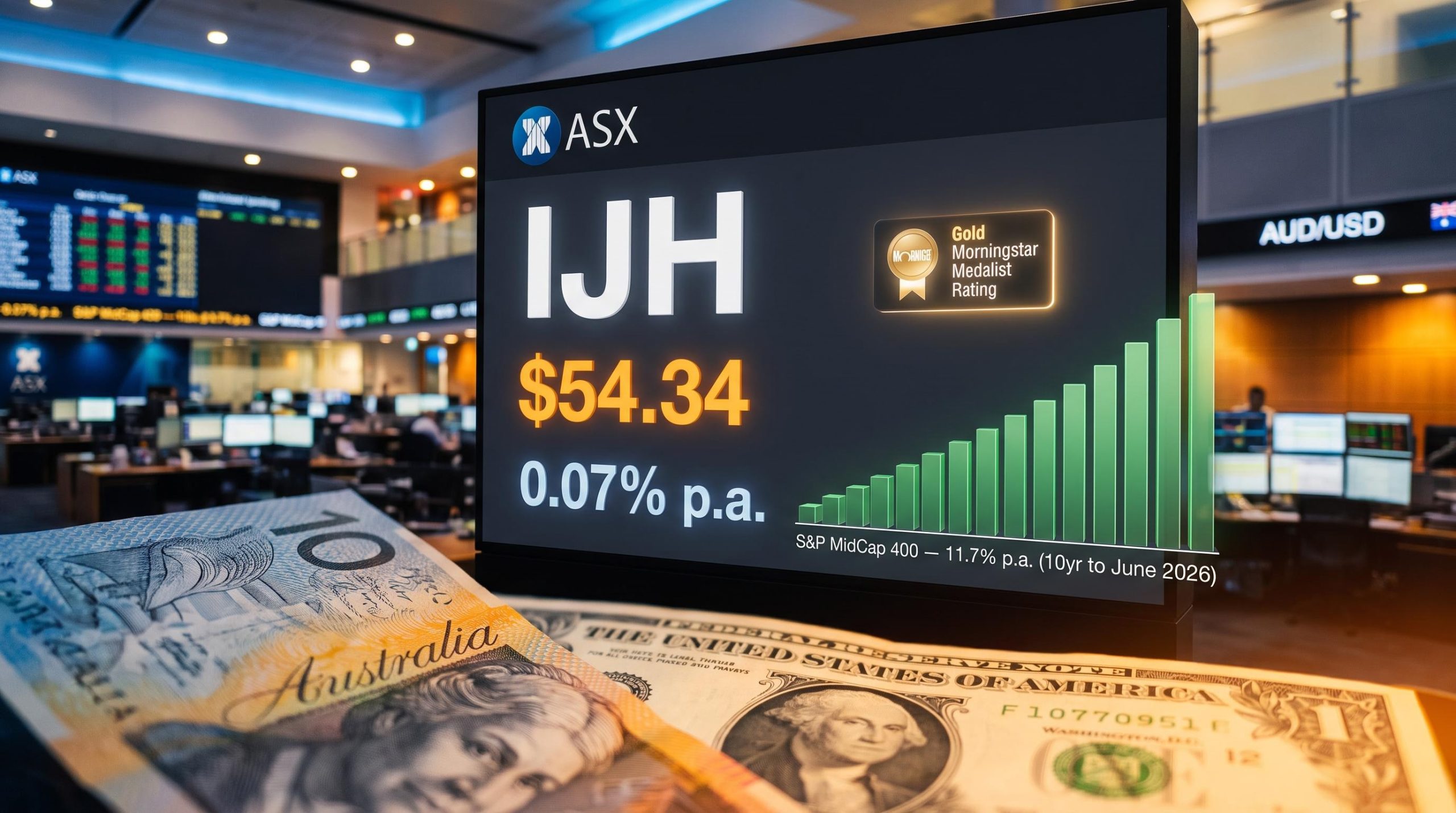
Australian investors searching for US mid-cap exposure face a cluttered product shelf, and the label “mid-cap ETF” tells you almost nothing about what you are actually buying. The iShares S&P Mid-Cap ETF (IJH), which received a Gold Morningstar Medalist Rating on 27 July 2026, is one of the most recognised names in the category. But a rating is a starting point, not an answer.
Mid-cap exposure is a structurally distinct decision from adding another large-cap US ETF. The companies in this segment sit beyond the mega-cap growth phase but still carry meaningful expansion potential, and their sensitivity to domestic US economic conditions, credit cycles, and currency movements creates a return profile that behaves differently from the S&P 500 names most Australian investors already own.
Here is what the data, the index methodology, and the fund’s cost structure actually tell you about whether IJH belongs in your portfolio, and the three specific risks you need to price in before you buy.
Understanding IJH’s recent top rating and its implications
Morningstar awarded IJH a Gold Medalist Rating alongside a High Process Pillar rating, both published on 27 July 2026 and authored by Brendan McCann CFA, Senior Associate Analyst at Morningstar Australasia. The fund currently manages approximately $499 million in assets and traded at $54.34 on the ASX as of the same date.
High Process Pillar rationale: The High Process rating was awarded because the strategy faithfully captures its target segment of the mid-cap market while keeping turnover low, two qualities that together support reliable and cost-efficient index replication over the long term.
A Gold rating signals lasting competitive advantage through cost efficiency and broad diversification. It does not predict short-term outperformance, and it is not a buy recommendation for any specific portfolio.
The Morningstar Medalist Rating methodology was updated in April 2026 to weight fees at up to 40% of the overall score for passive funds, a structural shift that partly explains why IJH’s 0.07% fee profile anchors its Gold designation rather than merely contributing to it.
That distinction matters. The rating confirms IJH is well-constructed and competitively priced relative to peers. What it does not resolve is whether unhedged USD exposure fits your currency strategy, whether the fund’s smaller-end mid-cap tilt matches your risk tolerance, or whether it overlaps with US equity positions you already hold. Those are portfolio-fit questions, and they are the ones this analysis is designed to answer.
When big ASX news breaks, our subscribers know first
The index underneath IJH: how the S&P MidCap 400 is built
The S&P MidCap 400 is not a generic “middle of the market” slice. It is a specifically screened, committee-maintained index with design choices that meaningfully shape what you own.
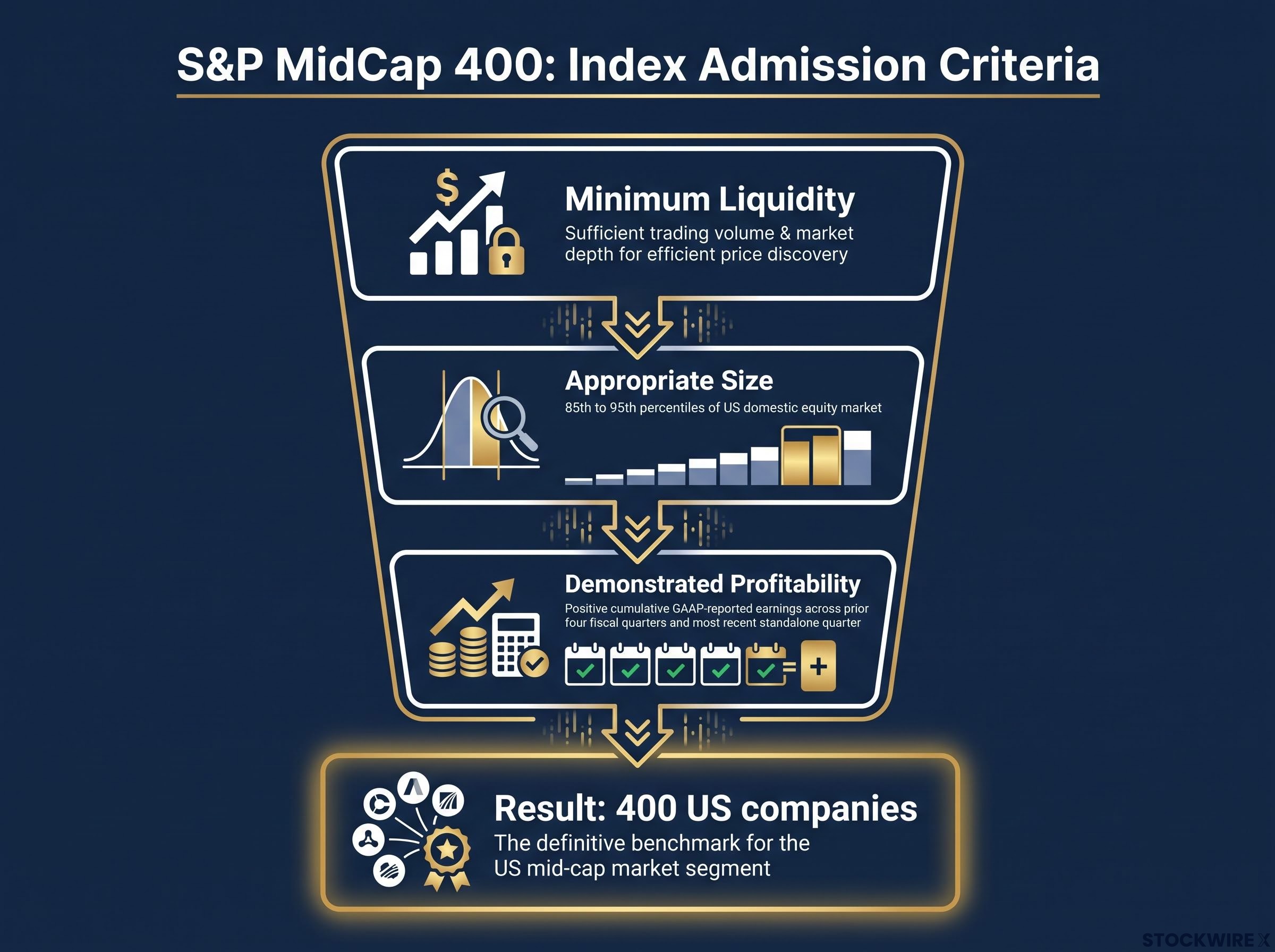
The index targets 400 US companies occupying the 85th to 95th percentiles of the US domestic equity market by float-adjusted market capitalisation. Relative to most peer mid-cap benchmarks, this places IJH’s constituents lower in the capitalisation range, so the typical holding is meaningfully smaller than those found in competing mid-cap products.
Before a stock can enter the index, it must meet three admission criteria:
- Minimum liquidity: sufficient trading volume to ensure market access
- Appropriate size: market capitalisation within the 85th to 95th percentile band
- Demonstrated profitability: cumulative GAAP-reported earnings across the prior four fiscal quarters must be positive, and earnings for the most recent standalone quarter must also be positive
The index is maintained by a committee that exercises discretion when adding or removing constituents, rather than relying on purely mechanical reconstitution rules. That discretionary latitude means the committee can sidestep forced changes that would otherwise generate unnecessary trading costs. Rebalancing occurs quarterly.
The S&P MidCap 400 index methodology published by S&P Dow Jones Indices sets out the full eligibility criteria, including the GAAP profitability screen, the float-adjusted weighting rules, and the committee discretion framework that governs constituent changes between quarterly rebalances.
Weights are float-adjusted and market-cap based, meaning prices move and weights adjust automatically, limiting the need for frequent trading.
How the profitability screen shapes the portfolio
The profitability requirement is the detail most investors miss. By demanding positive GAAP earnings over four quarters and the most recent quarter, the index excludes very speculative, loss-making businesses from the portfolio.
This acts as a quality filter. It does not eliminate mid-cap volatility, but it can modestly reduce it relative to an unscreened mid-cap index. The practical result is that IJH gives you the profitable subset of mid-cap America, not the entire mid-cap universe. That is a meaningful quality tilt that partially offsets the additional risk you take on by investing in smaller-end mid-cap stocks.
Portfolio construction and what you are actually buying
Knowing the index rules is one thing. Seeing what 400 holdings actually look like in practice is where the portfolio picture sharpens.
| Portfolio Feature | Metric | What It Means for the Investor |
|---|---|---|
| Number of holdings | 400 | Broad diversification; single-stock risk is limited |
| Top 10 concentration | Under 10% of total assets | No mega-position dominance |
| Sector deviation vs benchmark | Within 6 percentage points | Not a sector-tilted product |
| Cash position | Minimal | Full market participation, up and down |
The fund carries meaningful weight across four key sectors:
- Industrials
- Technology
- Financial services
- Healthcare
Sector weightings across the portfolio have consistently tracked within 6 percentage points of the Morningstar US Mid Cap Index, confirming IJH is not a thematic or sector-biased product. It gives you broad exposure to the profitable mid-cap segment, not a concentrated bet on any single industry.
The characteristic most likely to surprise investors is the smaller-end tilt within the mid-cap range. IJH sits toward the lower end compared to many peer funds, which increases sensitivity to US domestic economic conditions, credit availability, and business investment cycles. If you bought IJH expecting a straightforward “middle of the market” exposure, the cyclical sensitivity may be greater than the label implied.
Because IJH holds minimal cash, its returns track the underlying equity market closely in both directions. In a rising market that is an advantage, but when prices fall there is no cash cushion to soften the drawdown.
Costs, fees, and the Australian-domiciled structure
The ASX-listed IJH charges a management fee of 0.07% per annum. That is competitive for diversified US equity exposure available on the ASX, and the fee gap between IJH and a typical actively managed fund is where the real cost advantage sits.
A 0.07% annual fee versus a representative active manager charging 0.50%-1.00%+ compounds into a substantial return difference over a 10-20 year horizon. On a $100,000 allocation, that spread saves you hundreds to thousands of dollars annually, and the gap widens as the portfolio grows.
For a passive index fund tracking the same benchmark, cost is the primary differentiator. Lower fees translate directly into higher retained returns over time.
A rigorous total cost comparison between IJH and competing mid-cap products extends beyond the 0.07% management fee to include bid-ask spreads, tracking difference, and securities lending income, metrics that can shift the effective cost ranking among funds with near-identical stated expense ratios.
ASX-listed vs US-listed: what changes and what does not
Australian investors should be aware that a US-domiciled version of IJH (the iShares Core S&P Mid-Cap ETF) exists with a slightly lower fee of 0.05% and assets of approximately US$123 billion. That is not what you are buying on the ASX.
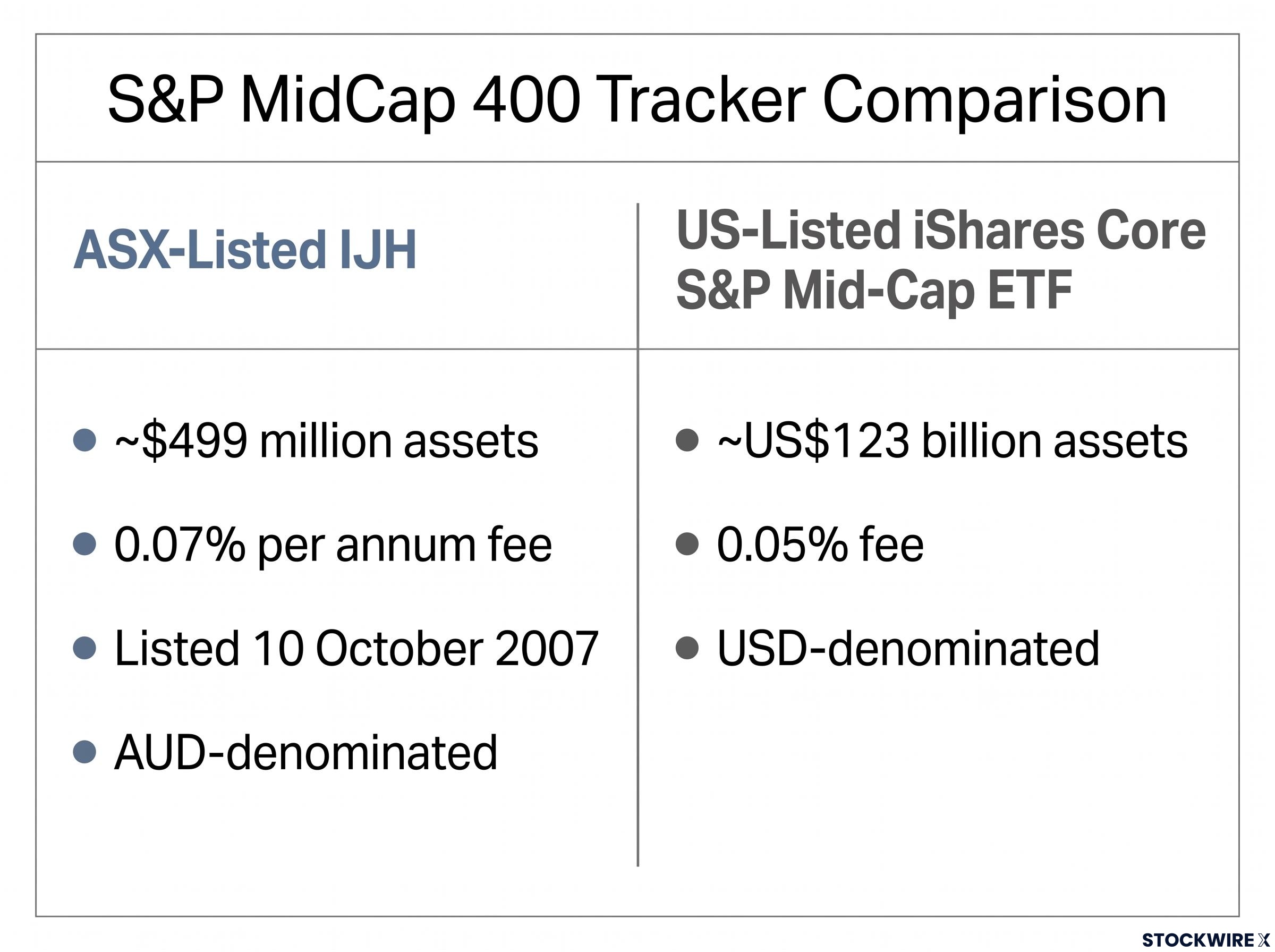
Both versions track the same underlying index, the S&P MidCap 400, and hold the same types of stocks. The underlying equity exposure and index methodology are identical. What differs is the wrapper: domicile, fee, AUM scale, and currency denomination.
The ASX-listed fund, with approximately $499 million in assets and listed since 10 October 2007, offers AUD-denominated trading, quarterly dividends paid in AUD, and simpler tax and administration compared to accessing the US-listed fund directly. The 2-basis-point fee difference is real but small. Australian investors are not getting an inferior product; they are getting a differently structured wrapper that removes the practical friction of US brokerage accounts and foreign tax obligations.
The risks Australian investors need to price in before buying
Product quality is one question. Portfolio risk is another. Three specific risks are most likely to surprise IJH holders in a downturn, and they are worth working through in priority order before you buy.
- Unhedged currency exposure. IJH holds USD-denominated equities and trades in AUD, with no built-in hedging mechanism. AUD/USD movements pass through directly to your returns in both directions.
The hedged vs unhedged ETF decision has produced return gaps as large as 13 percentage points in a single year for Australian investors in identical underlying strategies, a reminder that currency structure is not a secondary consideration but a primary driver of AUD-denominated outcomes.
- Mid-cap and smaller-end volatility. The fund is fully invested with minimal cash, offering no defensive buffer in drawdowns. Its smaller-end tilt within mid-cap amplifies sensitivity to US economic cycles and credit conditions relative to large-cap peers, and relative to some mid-cap competitors that sit higher in the capitalisation range.
- Index family mismatch. Mixing IJH with US large-cap or small-cap ETFs drawn from a different index family (such as Russell or CRSP) can leave you with unintended gaps or overlaps in your US market-cap coverage. Each index provider draws its own boundaries around what counts as mid-cap, producing notably different portfolios. Building your US equity sleeve entirely within the S&P family (S&P 500, S&P MidCap 400, S&P SmallCap 600) is a more reliable way to achieve seamless coverage across the size spectrum.
Currency risk in practice: If the AUD strengthens against the USD, your AUD-denominated returns fall even if the underlying US stocks rise. The reverse also holds: a weakening AUD enhances returns. There is no mechanism within the fund to neutralise this effect.
The profitability screen partially mitigates the volatility risk by excluding speculative, loss-making companies. But it does not eliminate the cyclical sensitivity, the currency exposure, or the mismatch risk. These are structural features of the product, not flaws, and the question is whether they sit within your tolerance.
For an Australian investor who already holds a large-cap US ETF denominated in AUD, adding IJH compounds two effects: amplified AUD/USD currency sensitivity across a larger share of the portfolio, and the possibility of unintentional size-segment overlap if the indices do not share a methodology.
Whether IJH earns a place in your Australian portfolio
IJH is structurally robust: Gold-rated, charging 0.07% per annum, holding 400 profitable US mid-cap companies with sub-10% top-10 concentration, and offering the administrative simplicity of Australian domicile. The product quality question is settled. The portfolio-fit question is not.
The S&P MidCap 400 delivered an annualised return of 11.7% per annum over the decade to June 2026, with a trailing 12-month dividend yield of approximately 1.15%. Income is modest; total return is capital-growth driven. Those figures provide useful historical context, but the more important number for you is what your after-FX, after-fee, after-tax return looks like relative to your alternatives, a calculation only you can complete with your own currency assumptions and tax position.
The ATO guidance on ETF tax treatment covers how Australian residents must report foreign-sourced distributions, handle US withholding tax, and claim a foreign income tax offset, making it the primary reference for calculating your actual after-tax return from an AUD-denominated fund holding USD-denominated equities.
Before buying, work through four specific questions:
- Does your portfolio already have significant US large-cap exposure, and are you deliberately adding size diversification?
- Are you comfortable with unhedged USD as part of your currency mix?
- Does IJH’s smaller-end mid-cap tilt align with your risk tolerance and investment horizon?
- Are you mixing index families across your US equity holdings, and have you mapped potential coverage gaps?
The fund’s key strengths, taken together, make a clear case for the product itself:
- Broad diversification: 400 holdings, sub-10% top-10 concentration
- Low fee: 0.07% per annum
- Profitability quality tilt via GAAP earnings screen
- Australian domicile simplicity: AUD trading, quarterly AUD distributions
- Gold Morningstar Medalist Rating
The decision is not whether IJH is a good fund. It is whether unhedged US mid-cap equity exposure, tilted toward the smaller end of the capitalisation range, fits the portfolio you already have and the risk you are willing to carry. That is a question only you can answer.
For investors wanting to map how IJH fits alongside large-cap and emerging market exposure, our dedicated guide to building a diversified international ETF sleeve walks through the structural gaps in ASX-only portfolios and how IVV, VAE, and comparable products address them across different size and geographic segments.
This article is for informational purposes only and should not be considered financial advice. Past performance does not guarantee future results. Investors should conduct their own research and consult with a licensed financial adviser before making investment decisions.
—