Brent crude fell more than 5.5% in a single session on 26 July 2026, the moment markets learned that U.S. and Iranian forces had mutually stood down. But the barrels driving that price did not move. Only the fear did.
The price drop reflects a recalibration of perceived geopolitical risk, not a confirmed improvement in the physical supply balance. The shipping lanes that carry roughly a fifth of the world’s daily oil consumption through the Strait of Hormuz remain constrained. The buffers that absorbed earlier disruptions, from strategic reserve drawdowns to Chinese import cuts, are increasingly stretched. The relief rally may be pricing in a peace that has not yet arrived.
Here is exactly how geopolitical risk premiums work in commodity markets, why this one may be unwinding faster than the underlying facts justify, and which signals will tell you whether crude oil prices have further to fall or are about to snap back toward $100.
Brent drops 5.5% as markets reprice the U.S.-Iran military pause
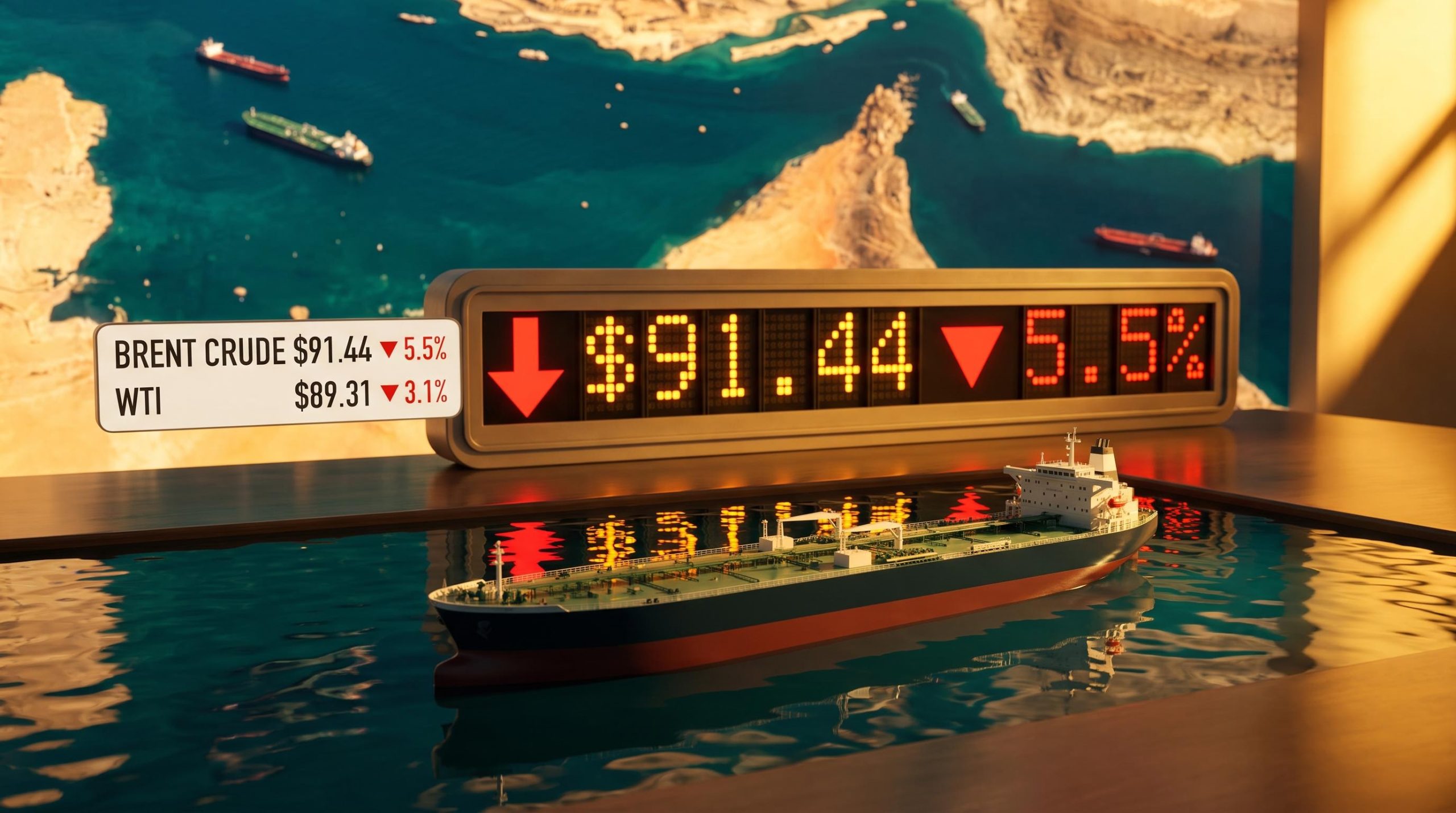
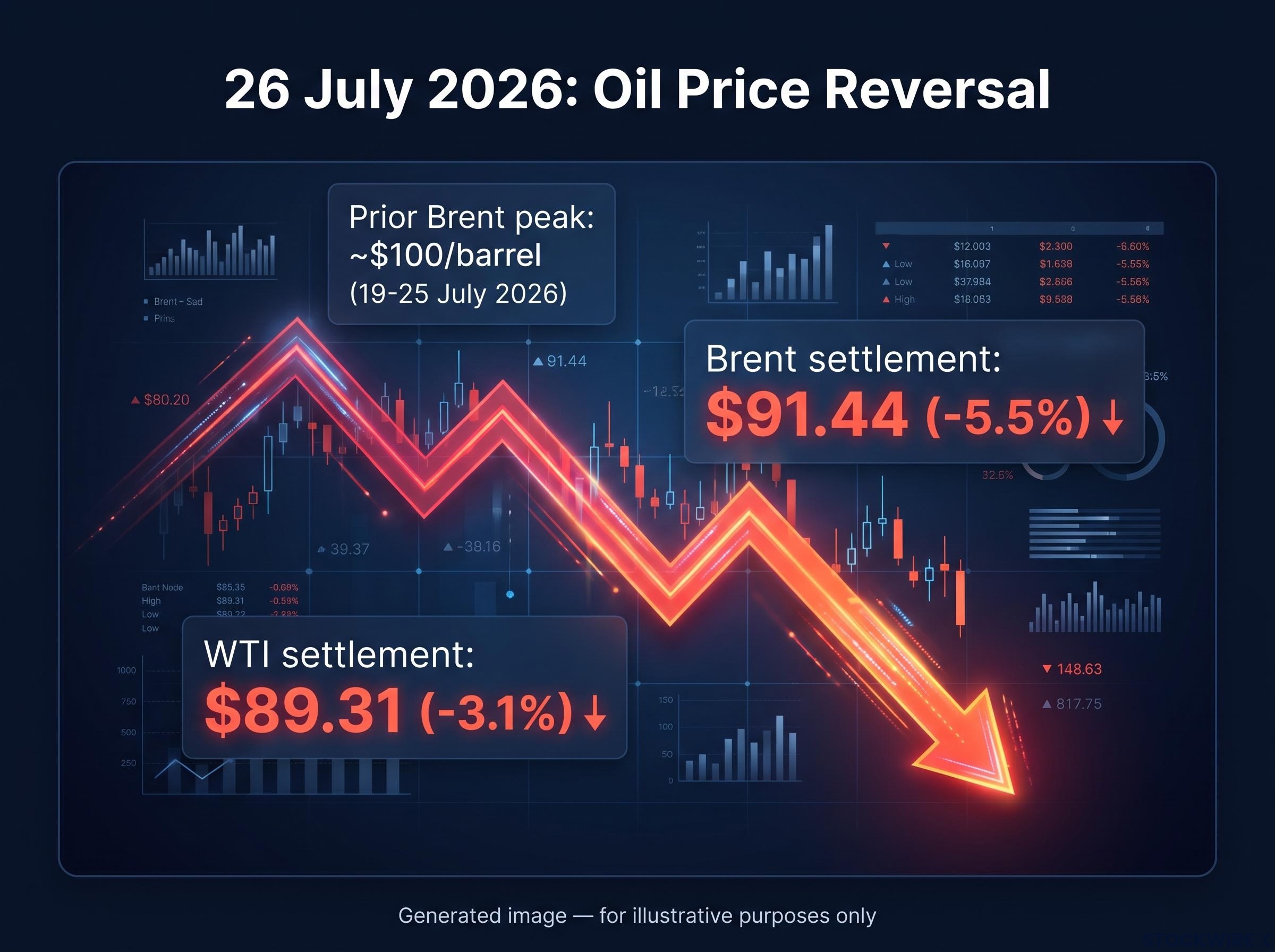
Brent crude settled at $91.44 per barrel by 20:19 ET on 26 July 2026, down approximately 5.5% on the session, after dipping beneath the $90 level at points during the day. The prior week, Brent had peaked near $100 after the conflict widened from the Strait of Hormuz to encompass the Red Sea. That was the peak. This was the reversal.
Iran’s ceasefire rejection on 23 July, which centred specifically on Hormuz control rather than broader security terms, removed the only formal diplomatic off-ramp that had been on the table before the subsequent pause was negotiated.
- Brent crude: ~5.5% decline to $91.44/barrel
- Brent intraday low: below $90/barrel
- WTI crude: ~3.1% decline to $89.31/barrel
- Prior Brent peak: ~$100/barrel (week of 19-25 July 2026)
The trigger was specific: after calling a halt to its air campaign, which had run for 13 straight nights, Washington indicated it was creating space for diplomacy to proceed. Tehran responded in kind, with an Iranian official indicating that retaliatory strikes would be put on hold for as long as Washington’s pause continued. Separately, reports emerged that China had stepped in to try to restart faltering peace talks between the two capitals, lifting broader investor sentiment.
Tony Sycamore, senior market analyst at IG, observed that better prospects for a diplomatic resolution, among them the possibility of reviving a previously negotiated agreement on Strait of Hormuz passage, had prompted investors to pare back the risk premium that had built up in crude prices.
A 5.5% single-session decline on a ceasefire signal, before any barrels have actually moved, tells you that a meaningful share of the recent price spike was fear, not fundamentals. That fear can reverse just as fast if the diplomatic signals deteriorate.
When big ASX news breaks, our subscribers know first
What a geopolitical risk premium actually is, and why it vanishes overnight
Oil prices incorporate not just current supply and demand, but expected risks to future supply. A geopolitical risk premium is the extra cost the market adds to each barrel for the probability and potential severity of a disruption. When conflict threatens a chokepoint like the Strait of Hormuz, which carries approximately one-fifth of the world’s daily oil consumption, that premium can become a substantial share of the headline price.
The asymmetry is what matters. A risk premium can be removed in a single session when perceived risk falls, even when no additional barrels have entered the market and no physical conditions have changed. When the premium disappears before the risk does, the market may be one negative headline away from re-adding everything it just removed.
How the July 26 session fits the pattern
The 26 July session is a textbook application of this mechanism. The ceasefire announcement, China’s mediation efforts, and investor optimism combined to reduce the perceived probability of near-term disruption. Sentiment improved materially. The structural supply balance did not.
According to analysis from Investing.com and ANZ Bank, the 5-5.5% Brent decline represents a repricing of perceived risk, not a confirmed supply improvement. No additional barrels reached the market. No tanker routes were secured. Only the mood changed.
Three structural vulnerabilities the price drop is ignoring
The sell-off is outpacing the actual improvement in supply risk. Three specific vulnerabilities remain in place, and together they leave the market with less cushion to absorb a renewed escalation than it had at the start of the conflict.
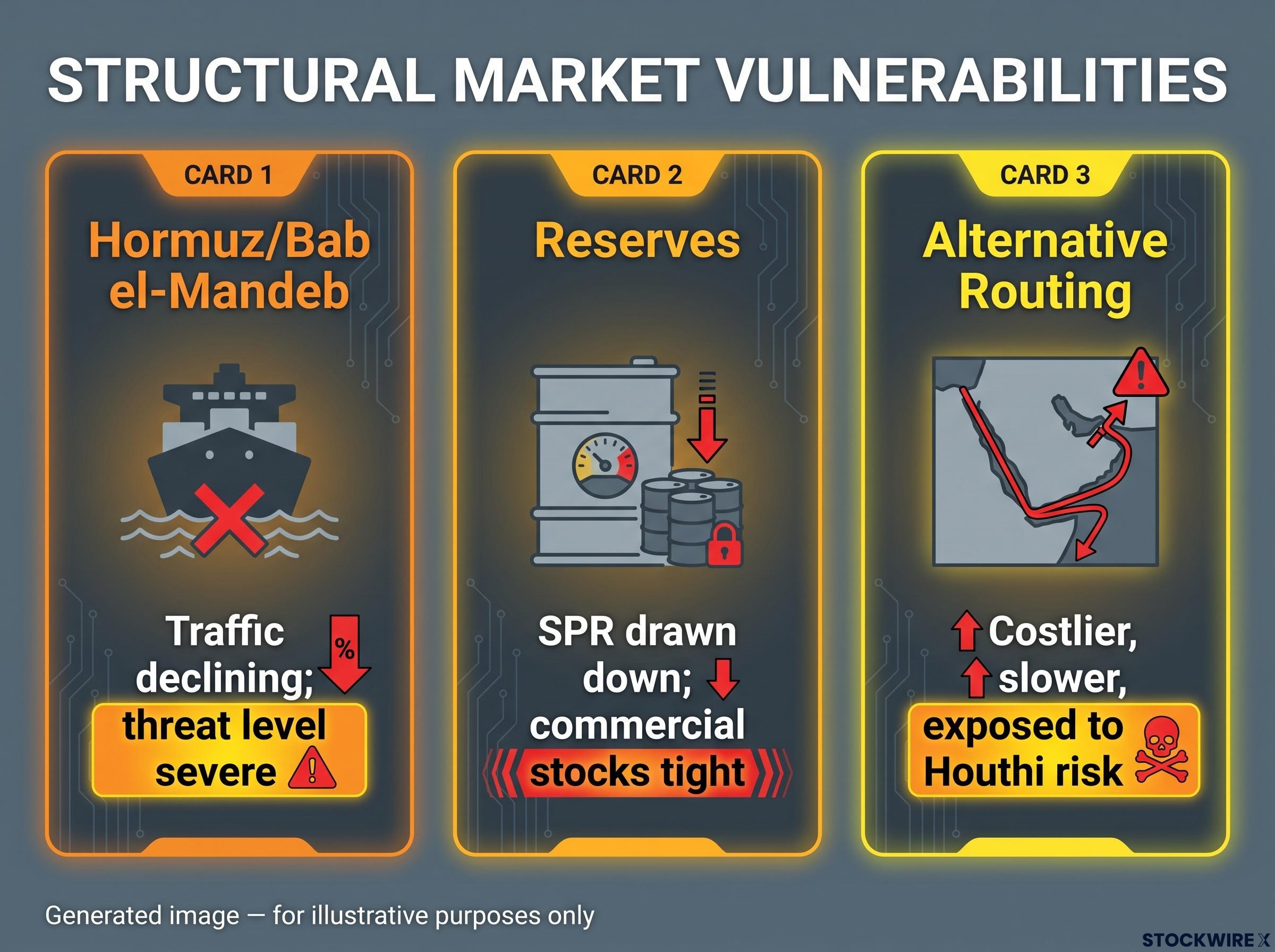
- Strait of Hormuz and Red Sea shipping lanes remain constrained. Vessel numbers passing through the Strait of Hormuz each day fell over the weekend, and Bab el-Mandeb Strait flows dropped off as well in the wake of Houthi strikes on Saudi oil infrastructure. Threat levels in the Strait of Hormuz were raised to “severe” following tanker incidents in July. Shipowners and insurers remain cautious, keeping logistics costs elevated and flows restricted.
- The buffers that absorbed prior disruptions are thinning. Prior drawdowns on strategic petroleum reserves have left major consuming nations with considerably reduced headroom for further significant releases before domestic energy security starts to become a concern. Commercial inventories have come under similar pressure in parallel.
Prior emergency releases of strategic petroleum reserves totalling approximately 280 million barrels failed to halt the inventory drawdown during earlier phases of the conflict, leaving consuming nations with materially less headroom than they held at the crisis outset.
- Alternative routing is more expensive and still exposed. Some Gulf exports can bypass Hormuz via pipelines and Red Sea alternatives, but this routing is slower, costlier, and still vulnerable to regional risks, particularly given ongoing Houthi activity.
ANZ Bank warned that crude remains highly vulnerable to renewed upside if regional disruptions worsen or diplomacy breaks down.
| Vulnerability | Current Status | Supply Risk Implication |
|---|---|---|
| Hormuz/Bab el-Mandeb shipping | Traffic declining; threat level “severe” | Physical flows still constrained despite ceasefire |
| Strategic and commercial reserves | SPR drawn down; commercial stocks tight | Less capacity to cushion any renewed disruption |
| Alternative routing capacity | Costlier, slower, exposed to Houthi risk | Bypass options cannot fully replace Hormuz throughput |
Each of these vulnerabilities individually is manageable. Together, they mean the current price decline is more fragile than it appears.
Three scenarios for where oil prices go from here
The market is effectively trading around three broad outcomes, and the current $91.44 Brent price sits in a zone where both directions carry meaningful magnitude. These ranges are illustrative, not forecasts, but they are broadly consistent with bank and trading desk analysis circulating in late July 2026.
| Scenario | Trigger Condition | Brent Price Range | Key Driver |
|---|---|---|---|
| Diplomatic resolution | Substantive framework restores Hormuz confidence; vessel traffic normalises | Mid-$80s | Risk premium bleeds out; soft Chinese demand accelerates decline |
| Pause holds, normalisation slow | No active strikes but shipowners remain cautious; re-routings persist | High-$80s to mid-$90s | Incremental shipping and inventory data drive oscillation |
| Talks fail, hostilities resume | Either side restarts strikes, particularly against energy infrastructure or tankers | $100-$110+ | Hormuz or Red Sea disruptions force rapid repricing |
The asymmetry worth noting is that the upside in the escalation scenario ($100 to $110+) is larger in absolute dollar terms than the downside in the diplomatic scenario (current $91 to mid-$80s). For anyone holding commodity exposure, whether through direct positions, oil-sensitive equities, or simply fuel costs, the risk distribution is not neutral. It tilts toward upside surprise.
The oil price move carries consequences beyond crude benchmarks; sustained elevated Brent levels feed into inflation and bond market transmission channels, with Goldman Sachs estimating that a $10-$20 per barrel crude increase adds several tenths of a percentage point to US headline CPI over 12 months.
Past performance does not guarantee future results. These price ranges are illustrative scenarios, not forecasts, and are subject to market conditions and geopolitical developments.
The five indicators that will tell you what happens next
Rather than reacting to each headline, these five indicators, ranked by immediacy and accessibility, give you a structured way to track whether the ceasefire translates into genuine supply normalisation or remains a sentiment-only event.
- Maritime traffic through Hormuz and Bab el-Mandeb (trackable via AIS-based vessel tracking services). Sustained normalisation supports a lower premium. Persistent diversions argue for a stickier one. This is the most real-time signal available.
- Strategic petroleum reserve levels in U.S. and IEA member nations (reported by the U.S. Department of Energy and IEA). Lower levels mean less capacity to cushion new shocks, making any fresh disruption more price-sensitive than pre-crisis conditions.
- Weekly EIA U.S. crude and products inventory data (published at EIA.gov). Draws alongside elevated geopolitical risk support higher prices. Unexpected builds can partially offset the premium.
- Diplomatic signalling from Washington, Tehran, and Beijing. Any announcement of a binding arrangement covering Hormuz passage rights, including a formal security accord of the kind referenced by Tony Sycamore at IG, would carry significant weight as a price-moderating development.
- Broader macro and demand indicators (Chinese PMIs, OECD demand data). These modulate how much premium the market is willing to tolerate at any given price level. Soft demand caps the upside; strengthening demand amplifies it.
If tanker traffic through Hormuz normalises and a formal framework for the strait’s security is announced, that represents structural, not just sentimental, improvement in supply risk. The absence of both keeps the current price fragile.
What the price drop confirms, and what it does not
The 26 July session confirmed one thing clearly: the geopolitical risk premium embedded in crude was real and substantial. A measurable share of the $100 peak was fear of disruption, not disruption itself. Sentiment can shift rapidly on credible diplomatic signals, and it did.
What the session did not confirm is more important. Hormuz and Bab el-Mandeb security has not been restored. Buffer capacity remains constrained. Neither Washington nor Tehran has formally committed to a durable framework, and both parties explicitly signalled readiness to restart military action if negotiations collapse.
The 5.5% Brent decline represents a sentiment shift, not a structural supply improvement. The physical balance of risk has not materially changed.
The market is trading on the probability of a diplomatic outcome rather than the confirmation of one. The current Brent level of $91.44 sits within the base-case scenario range, leaving meaningful risk on either side. For any decision influenced by oil prices, the relevant question is not whether to trust the ceasefire. It is whether the specific indicators of structural normalisation, tanker traffic, reserve levels, formal diplomatic frameworks, are moving in the right direction. That is where the signal lives.
For investors wanting to understand how rapidly sentiment-driven crude moves reverse when diplomatic signals deteriorate, our full explainer on how talk collapses reprice crude examines the June 2026 episode when Brent fell below $80 after Geneva talks were cancelled, mapping the exact price path and cross-asset transmission that followed.
This article is for informational purposes only and should not be considered financial advice. Investors should conduct their own research and consult with financial professionals before making investment decisions.