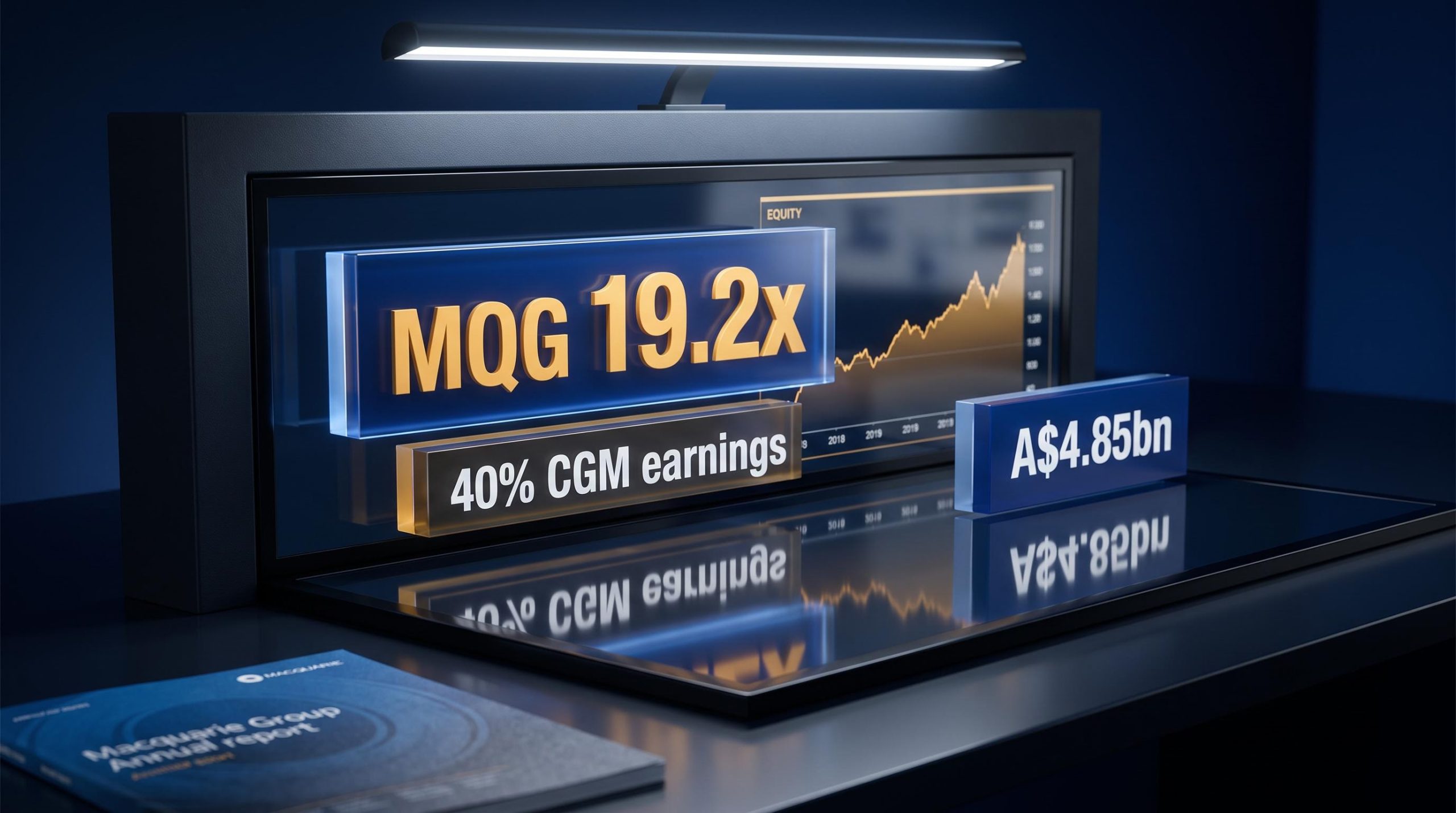
Macquarie Group announced its next chief executive from a position most companies never reach: record profits, a share price that has more than doubled since 2018, and a board confident enough to hand the role to a 30-year insider. The market absorbed the news without flinching. MQG shares continued to trade near all-time highs.
That tells you the succession itself is not the story. The story is what Greg Ward inherits at a price that already bakes in nearly everything going right. A 19.2x earnings multiple, 40% of group earnings concentrated in commodities, and qualified growth guidance in the banking division create a specific set of pressures that exist independently of who sits in the corner office.
Here is a structured basis for deciding whether the new leadership era supports holding MQG at its current price, or whether the risk profile has shifted enough to warrant closer scrutiny of what the valuation actually demands.
What the board’s choice of Greg Ward actually signals
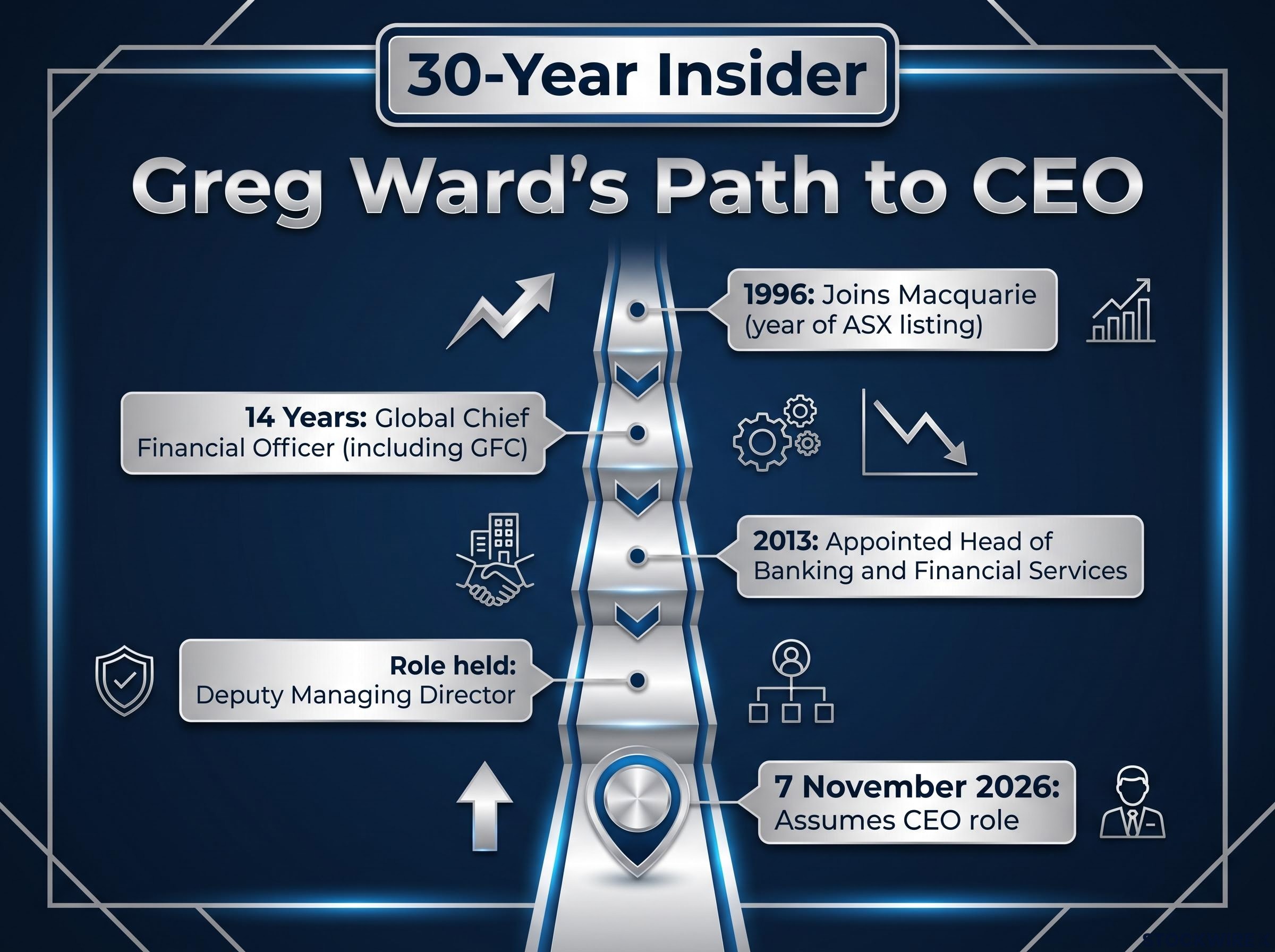
Ward joined Macquarie in 1996, the year the firm listed on the ASX. He has spent approximately 30 years inside the institution, and the three roles that matter most tell you exactly what kind of appointment this is:
- Global Chief Financial Officer for 14 years, including through the Global Financial Crisis, when Macquarie’s balance sheet and risk frameworks faced their most direct institutional test.
- Deputy Managing Director of Macquarie Group, a role that placed him across every operating division.
- Head of Banking and Financial Services since 2013, overseeing the retail banking, business banking, and wealth management operations for more than a decade.
An internal appointment following a record result is not a search for a new direction. It is a ratification of the existing one. The board’s message is explicit: Macquarie is “in a strong position, with sustained growth across each of our diverse businesses and a highly capable senior team.” When a board says that and then promotes from within, it is telling investors that the strategy stays.
Ward’s deep familiarity with Macquarie’s risk and remuneration frameworks is the strongest reassurance the board can offer existing shareholders. It is also a structural constraint. Investors expecting radical strategic pivots should calibrate accordingly: this is a stewardship appointment, not a transformation mandate. Continuity is only valuable, though, if the strategy being continued can sustain the expectations the market has priced in.
Shemara Wikramanayake steps down on 6 November 2026. Ward assumes the CEO role on 7 November 2026, subject to regulatory approval.
When big ASX news breaks, our subscribers know first
How Macquarie’s earnings engine actually works (and why it matters now)
Understanding the next section of this analysis requires a clear view of how Macquarie actually makes money, because the dual-engine structure is not background information. It is the lens that determines whether early Ward-era results are genuinely strong or merely following a predictable seasonal pattern.
The earnings model pairs two distinct income streams:
- Stable, recurring income: Asset management fees, banking net interest margin (the spread Macquarie earns between what it pays depositors and charges borrowers), and advisory fees. These are relatively predictable and less sensitive to quarter-to-quarter market swings.
- Volatile, markets-facing income: Commodities trading revenue, client hedging activity (where corporate clients pay Macquarie to protect against price swings in energy, metals, or agricultural commodities), and broader markets activity. These can surge during dislocated markets and compress when conditions normalise.
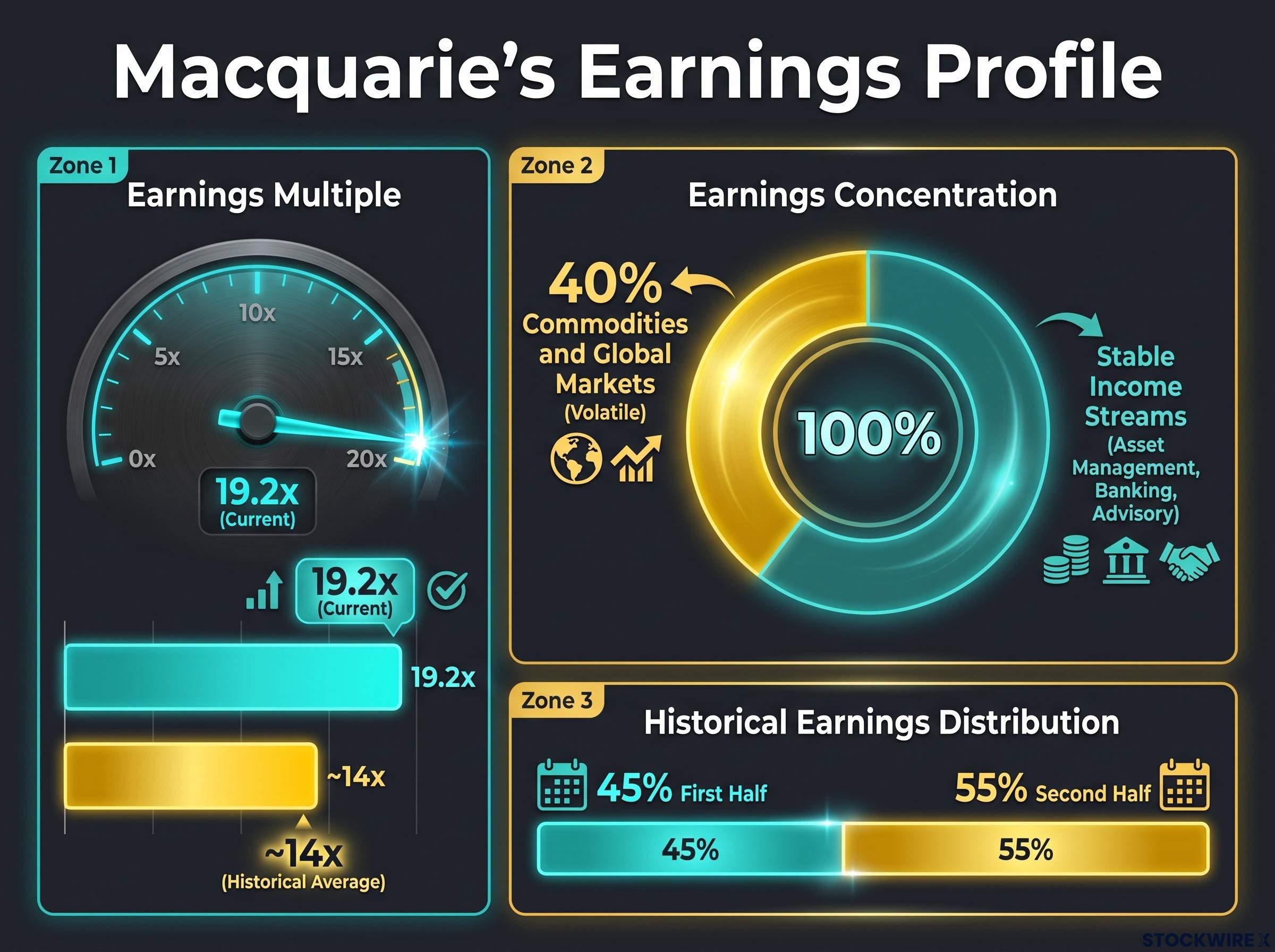
Commodities and Global Markets represents approximately 40% of Macquarie’s total group earnings, making it the single largest contributor to group profitability.
This structure is not accidental. It has been built over decades and has served investors well through multiple market dislocations including the GFC and COVID-19. Under Wikramanayake’s tenure, annual profit rose approximately 30% to A$4.85 billion, and MQG shares had climbed around 25% in the year to late July 2026, with the stock sitting at record levels.
The FY26 earnings composition that Ward inherits tells the full story of how the record profit was built: revenue grew 13% while operating costs rose only 5%, and Commodities and Global Markets alone surged 49%, generating the earnings density that now supports the current valuation multiple.
One structural feature long-term holders should expect to persist: the group’s full-year earnings have historically been weighted toward the second half, with the first half accounting for around 45% and the second half for around 55% of the annual total. That means the 1H FY27 result, the first major data point spanning Ward’s handover period, will structurally show a lighter first half. Any deviation from that pattern in the mix between stable and volatile earnings will be a significant early signal worth watching closely.
Three risks Ward inherits that the share price does not forgive
The risks that matter most for long-term MQG holders are not about Ward’s competence. They are about the interaction between an elevated valuation, concentrated earnings, and uncertain banking growth. Each compounds the others.
- Commodities concentration carries structural asymmetry. The 40% earnings weight from Commodities and Global Markets delivers outsized upside during periods of energy market dislocation and active client hedging. That same weight creates a disproportionate drag when volatility normalises. If commodities income softens, the stable income streams from asset management and banking may not fully offset the gap. The risk is structural, not cyclical: it persists regardless of who leads the firm.
- The valuation leaves almost no room for disappointment. At approximately 19.2x earnings versus a long-run historical average of roughly 14x, the share price already assumes continued strong performance across every division. A modest commodities softening does not just reduce earnings proportionally; it can trigger a multiple re-rating. When a stock trades at a premium, the market punishes misses more than it rewards meets.
The premium valuation Macquarie carries relative to its Big Four bank peers and global investment banking comparables is anchored primarily in the asset management franchise, which contributed 36% of group profit in FY25 and provides recurring fee income that partially offsets the volatility embedded in the commodities division.
MQG’s current earnings multiple of roughly 19.2x sits well above the long-run historical average of around 14x, a premium that reflects the market’s expectation that Macquarie can continue delivering exceptional results under its incoming leadership.
- Banking growth guidance now comes with qualifications. The Banking and Financial Services division’s loan and deposit growth outlook carries an explicit qualification tied to market conditions and customer demand. Analysts have linked this to the potential dampening effect of fiscal policy on investor mortgage activity, precisely the segment where Macquarie has been gaining share. Loan and deposit growth under Ben Perham, Ward’s successor at BFS, had been running ahead of system benchmarks. Whether that continues in a potentially more challenging rate and policy environment is an open question.
The combination of a premium multiple and concentrated earnings tells you that MQG at current prices requires more to go right than MQG at historical average multiples did. Ward’s ability to diversify the earnings mix will be the clearest test of whether the premium is justified.
| Risk | Trigger condition | Potential impact |
|---|---|---|
| Commodities concentration | Energy market volatility normalises; client hedging volumes decline | Group earnings fall disproportionately; stable income may not fully offset |
| Premium valuation | Modest earnings miss or guidance downgrade | Multiple re-rates toward ~14x historical average, amplifying share price decline |
| Banking headwinds | Fiscal policy dampens investor mortgage activity; competitive dynamics shift | BFS growth slows below system benchmarks, removing an assumed earnings pillar |
What Macquarie’s structural strengths actually protect against
The risk profile is real, but so are the institutional characteristics that have allowed Macquarie to navigate worse environments than a CEO transition during record profits.
- Diversified earnings base: The combination of asset management, infrastructure investment, banking, and markets activity provides multiple engines. When one division underperforms cyclically, others have historically absorbed the impact. That diversification does not eliminate concentration risk in commodities, but it does reduce the probability that a single-division downturn becomes an existential problem.
- Crisis-management track record: Both Wikramanayake and Ward were central to Macquarie’s navigation of the GFC (Ward as CFO), the COVID-19 pandemic, and recent energy market shocks. This is an institution-level characteristic, not dependent on a single leader.
- Surplus capital and financial flexibility: Surplus capital is accumulating ahead of schedule, and private markets assets continue to expand within the asset management franchise. That gives Ward genuine financial latitude in the early quarters, reducing the probability of an earnings disappointment driven by capital constraints rather than operational underperformance.
- Cultural and institutional continuity: A 30-year insider succeeding a 39-year insider preserves the risk and remuneration frameworks that institutional investors cite as the core reason for maintaining exposure.
UBS analysts characterised Wikramanayake’s departure as occurring “at a high point” with “solid underlying operational momentum.” That framing matters: the structural positives genuinely protect against governance disruption and short-term execution risk. What they do not protect against is a sustained normalisation in commodities volatility or a re-rating of the earnings multiple. Investors should be specific about which risks these strengths address and which they leave fully exposed.
The signals to watch as Ward’s era begins
The analysis above gives you a framework. These are the specific observation points that convert it into something actionable across the next two to three result cycles.
- 1H FY27 earnings mix: This result, expected later in calendar 2026, is the first major data point spanning the handover period. It will reveal the opening composition of earnings under Ward. The headline number matters less than what sits inside it.
- Commodities contribution trend: If commodities contributes well below 40% of group earnings without a compensating lift from asset management or banking, treat that as an early warning signal for the valuation multiple, not just a cyclical quarter.
- BFS growth relative to system: Loan and deposit growth under Perham had been running ahead of system benchmarks. Whether that persists in a potentially more challenging mortgage and policy environment will indicate whether BFS can serve as a genuine counterweight to any commodities softening.
- Capital deployment signals: How Ward allocates surplus capital in his first year, whether toward buybacks, dividends, or investment in growth, will reveal his personal priorities and risk appetite relative to Wikramanayake’s approach.
The group’s earnings have historically been distributed with roughly 45% falling in the first half and 55% in the second. On that basis, a softer 1H FY27 headline is structurally anticipated. What matters to long-term holders is not the total but the composition within that first half, specifically how much of it comes from stable versus volatile sources.
The 1H FY27 result is not a verdict on Ward’s leadership. It is the first empirical checkpoint, and knowing what to look for inside it is more valuable than reacting to the number on the day.
A staged entry approach, accumulating on pullbacks of 8-12% rather than committing at record multiples, becomes especially relevant when the earnings distribution is structurally weighted toward the second half and the first major checkpoint under new leadership will by design show a lighter headline number.
The real question for MQG holders in the Ward era
The succession is resolved and, by every reasonable measure, well executed. It is orderly, internal, timed from a position of institutional strength, and removes a succession overhang that had lingered over the stock. As a governance event, it is genuinely positive.
The question that remains is not about Ward’s credentials. It is about earnings quality over time. Can Macquarie under Ward deliver the consistency that a 19.2x earnings multiple implies, when 40% of group earnings come from a structurally volatile division? The gap between that multiple and the roughly 14x historical average is the market’s expression of confidence in Macquarie’s institutional quality. Whether Ward validates or tests that confidence over the first 12-18 months will matter more to long-term returns than the succession announcement itself.
UBS characterised the conditions Wikramanayake is leaving behind as representing a genuine high point for the business, with strong operational momentum carrying into the transition. That same starting point defines both the environment Ward steps into and the benchmark against which his early tenure will be assessed.
The condition under which the premium remains justified is straightforward: Ward sustains earnings breadth across divisions, keeps the commodities contribution productive without increasing its dominance, and demonstrates that BFS can grow through a tougher policy environment. The condition under which it does not is equally clear: commodities normalises, banking stalls, and the stable income base proves insufficient to support a multiple that was built on the back of exceptional years.
The succession story is priced in. The earnings story is not. That is where long-term holders should focus from here.
Investors wanting to cross-check the PE-based framing used throughout this analysis against other valuation approaches will find our full explainer on ASX share valuation methods covers how DCF, EV/EBITDA, and DDM each produce different intrinsic value estimates, and why the gap between methods matters when a stock is trading near record multiples.
This article is for informational purposes only and should not be considered financial advice. Investors should conduct their own research and consult with financial professionals before making investment decisions. Past performance does not guarantee future results. Financial projections are subject to market conditions and various risk factors.