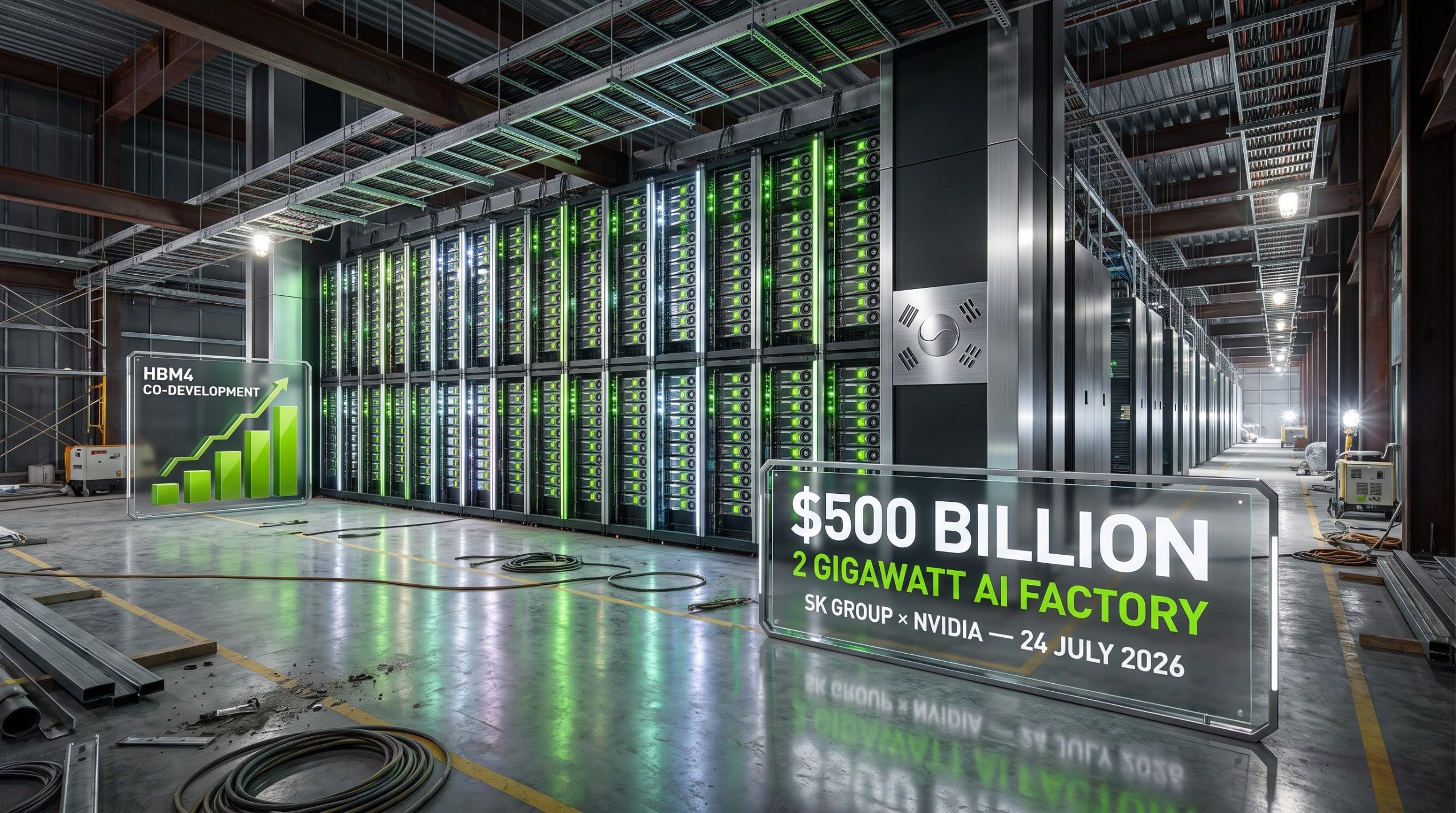
On 24 July 2026, SK Group and Nvidia signed letters of intent on a collaboration valued at more than $500 billion, covering a 2-gigawatt AI factory in South Korea and a long-term HBM4 memory co-development agreement. That headline number is large enough to stop any investor mid-scroll.
The partnership touches three publicly traded companies simultaneously: Nvidia (NVDA), SK Hynix (KRX: 000660), and SK Telecom (KRX: 017670). Each faces a different mix of opportunity and uncertainty from the same announcement, and the investment implications diverge in ways the headline figure does not reveal.
Here is what investors in each of these three companies actually need to know: what the deal involves, what it means for shareholders of each entity, and what still needs to happen before the $500 billion framework translates into tangible financial results.
What the deal actually covers
The collaboration rests on two structural pillars:
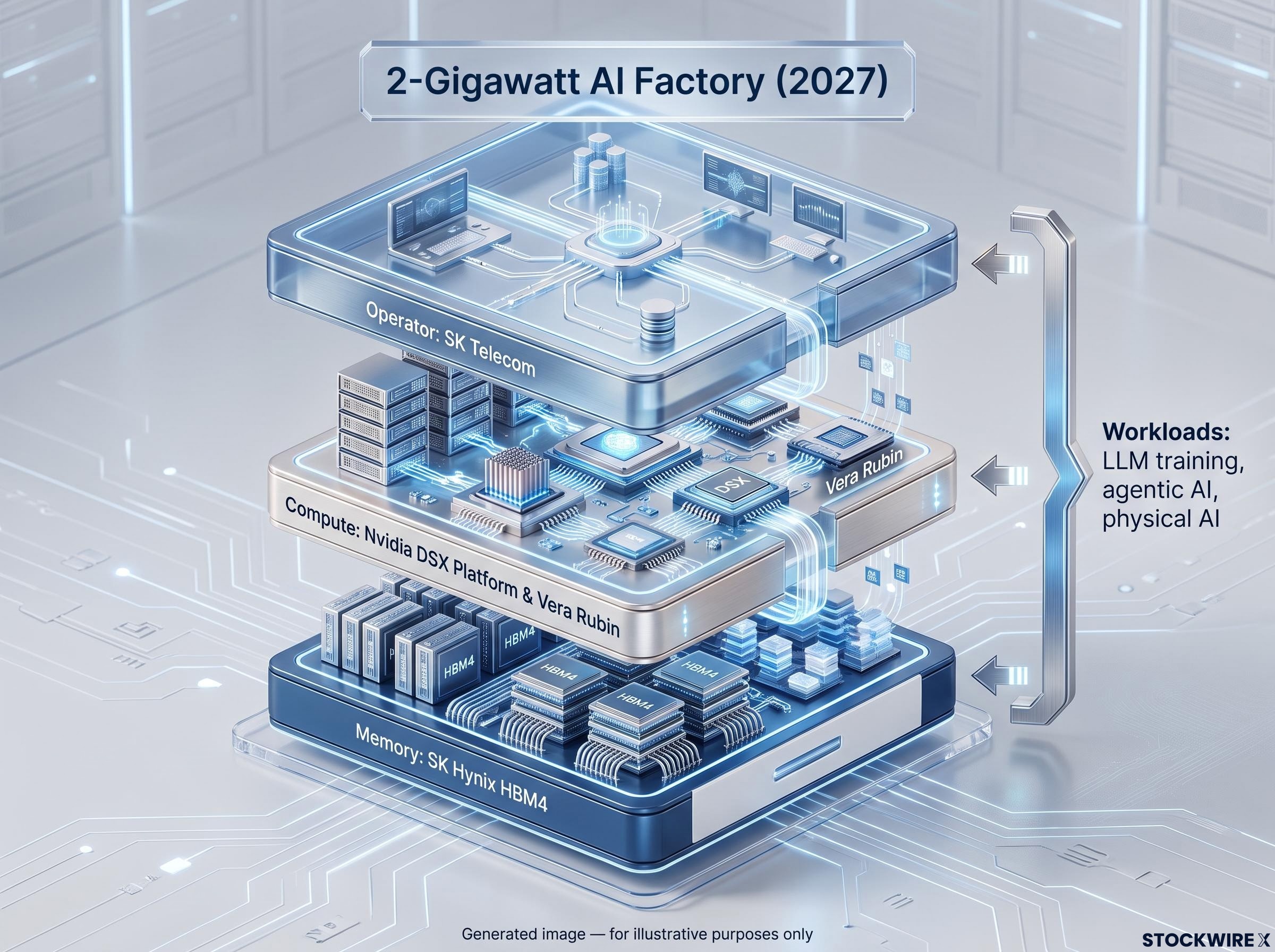
- AI factory in South Korea: A 2-gigawatt AI cloud facility will be constructed and run by SK Telecom, drawing on Nvidia’s DSX full-stack AI factory platform alongside Vera Rubin accelerated computing, with SK Hynix HBM4 high-bandwidth memory providing the underlying memory layer. The facility is scheduled to begin operations in 2027, serving workloads spanning large language model training, agentic AI, and physical AI.
- Next-generation memory co-development: A long-term joint agreement between Nvidia and SK Hynix will see both companies work together to develop and optimise HBM4 and subsequent generations of AI memory, with aligned product roadmaps spanning supercomputers, CPUs, consumer PCs, and robotics platforms.
Nvidia CEO Jensen Huang identified South Korea as possessing the attributes needed to become a global AI leader, citing its “advanced networks, data centre infrastructure, semiconductor expertise, and broad industrial scale.”
The $500 billion figure represents aggregate planned investment across all partners over multiple years. These are letters of intent signed on 24 July 2026, not binding contracts or firm purchase orders. Detailed commercial terms and confirmed volumes will follow. For investors, the distinction matters: treat this as a strategic signal with strong directional force rather than a confirmed order book entry that shifts near-term earnings.
When big ASX news breaks, our subscribers know first
Why SK Hynix is the most directly affected company
The co-development agreement puts SK Hynix engineers inside Nvidia’s product development cycle. Rather than simply manufacturing memory chips to a specification sheet handed down by a customer, SK Hynix will jointly develop and optimise HBM4 and future-generation memory specifically tailored for Nvidia’s AI platforms.
That means SK Hynix memory will serve:
- Vera Rubin supercomputers
- Vera CPUs
- RTX Spark PCs
- Jetson Thor robotics platforms
The scope matters. HBM supply is already identified as a key bottleneck in global AI infrastructure, and this agreement gives SK Hynix early visibility into Nvidia’s roadmap ahead of competitors. Joint development creates technical switching costs: once memory architecture is co-designed for specific workloads (large language models, agentic AI, physical AI), replacing that partner at the next product cycle becomes slower and more expensive for Nvidia. For SK Hynix shareholders, the co-development structure is more strategically valuable than a standard supply contract because it supports long-term HBM market share and pricing power.
HBM4 supplier qualification for the Vera Rubin platform was confirmed across all three major memory producers in June 2026, with SK Hynix estimated to hold 60-70% of initial volume allocations, reflecting its earlier entry into the certification process and its established position as Nvidia’s primary HBM partner.
SK Hynix’s AI memory market forecast projects 30% annual growth through 2030, underpinning the commercial logic of a co-development structure that locks in roadmap alignment across successive HBM generations rather than relying on spot supply agreements.
Risks SK Hynix shareholders should not overlook
Advanced HBM4 requires complex fabrication and packaging. Yield risk is real, and Nvidia itself has flagged that supply for advanced memory must accommodate extended development cycles and heavy capital expenditure. Scaling HBM4 volume will weigh on near-term free cash flow.
HBM pricing dynamics add a second dimension to the yield and capex risks SK Hynix faces: Bernstein projects a 2-2.5x contract price increase for 2027, with cost increases amplifying approximately fourfold at the hyperscaler purchase level once GPU vendors apply margin preservation, a cascade that affects the economics of every party in the AI factory stack.
Deeper alignment with Nvidia also increases customer concentration risk. If Nvidia’s AI cycle slows or a competitor gains ground, SK Hynix’s most valuable revenue stream becomes more exposed.
What the announcement means for Nvidia investors
The less obvious angle is geographic diversification. South Korea becomes a sovereign-scale AI infrastructure node for Nvidia, alongside simultaneous collaborations with:
- Naver: AI data centres and services
- Hyundai and Doosan: autonomous driving and industrial AI
- LG: AI applications
- Samsung: semiconductor design
That breadth reduces the risk that Nvidia’s AI revenue cycle stalls if one or two large U.S. cloud providers pull back on spending. Sovereign-scale demand from Korea validates the thesis that high-end AI compute demand is structurally global, not concentrated in a handful of hyperscalers.
SK Group Chairman Chey Tae-won framed the partnership in competitive terms, stating that AI-era competitiveness hinges on the volume of intelligence that can be produced, not merely effective AI utilisation.
The DSX full-stack platform creates its own economics once embedded at 2-gigawatt scale. Hardware, systems, and software are integrated to minimise token cost and maximise energy efficiency. Switching away from that architecture becomes costly in both operations and software, supporting ongoing revenue beyond the initial hardware sale.
Revenue timing requires realistic expectations. GPU and systems deliveries will be phased during construction ahead of the 2027 go-live. The $500 billion figure encompasses total infrastructure and memory investment across all partners over many years. Only a portion accrues as Nvidia revenue. The key near-term watchpoint is whether LOIs convert into signed supply contracts with disclosed volumes.
What the deal means for SK Telecom and why the picture is less clear
The 2-gigawatt AI factory repositions SK Telecom as an AI infrastructure operator, a meaningful shift for a company historically viewed as a mature telecoms business. Nvidia describes the model as GPU-as-a-service, serving SK subsidiaries and external organisations across Asia-Pacific. Alignment with South Korea’s national AI strategy and Nvidia’s planned AI Frontier Lab in Korea suggests potential public-sector demand and regulatory support that could improve utilisation rates and financing terms.
The strategic attractiveness is genuine. The financial clarity is not yet there.
The open questions SK Telecom investors need answered
Until SK Telecom discloses its capex plans and ownership structure for the AI factory, investors cannot reliably model the impact on leverage, dividend sustainability, or return on invested capital.
| Question | Why it matters to investors |
|---|---|
| How much capital will SK Telecom commit directly? | Determines the leverage impact and whether the balance sheet can absorb the build without dilution or elevated debt |
| What is the ownership structure (wholly owned, JV, or consortium)? | Defines how much of the facility’s economics flow through to SK Telecom’s earnings versus being shared with partners |
| What is the commercial pricing model? | Reserved capacity, on-demand cloud, or sovereign contracts each carry different margin and utilisation profiles |
| How does the AI factory investment affect dividend policy? | Income-focused shareholders need visibility on whether capex commitments compress near-term distributions |
Q3-Q4 2026 earnings calls are the logical venue for management to begin addressing these questions. Until then, this is a story to track rather than act on with conviction.
South Korea’s emergence as a global AI infrastructure node
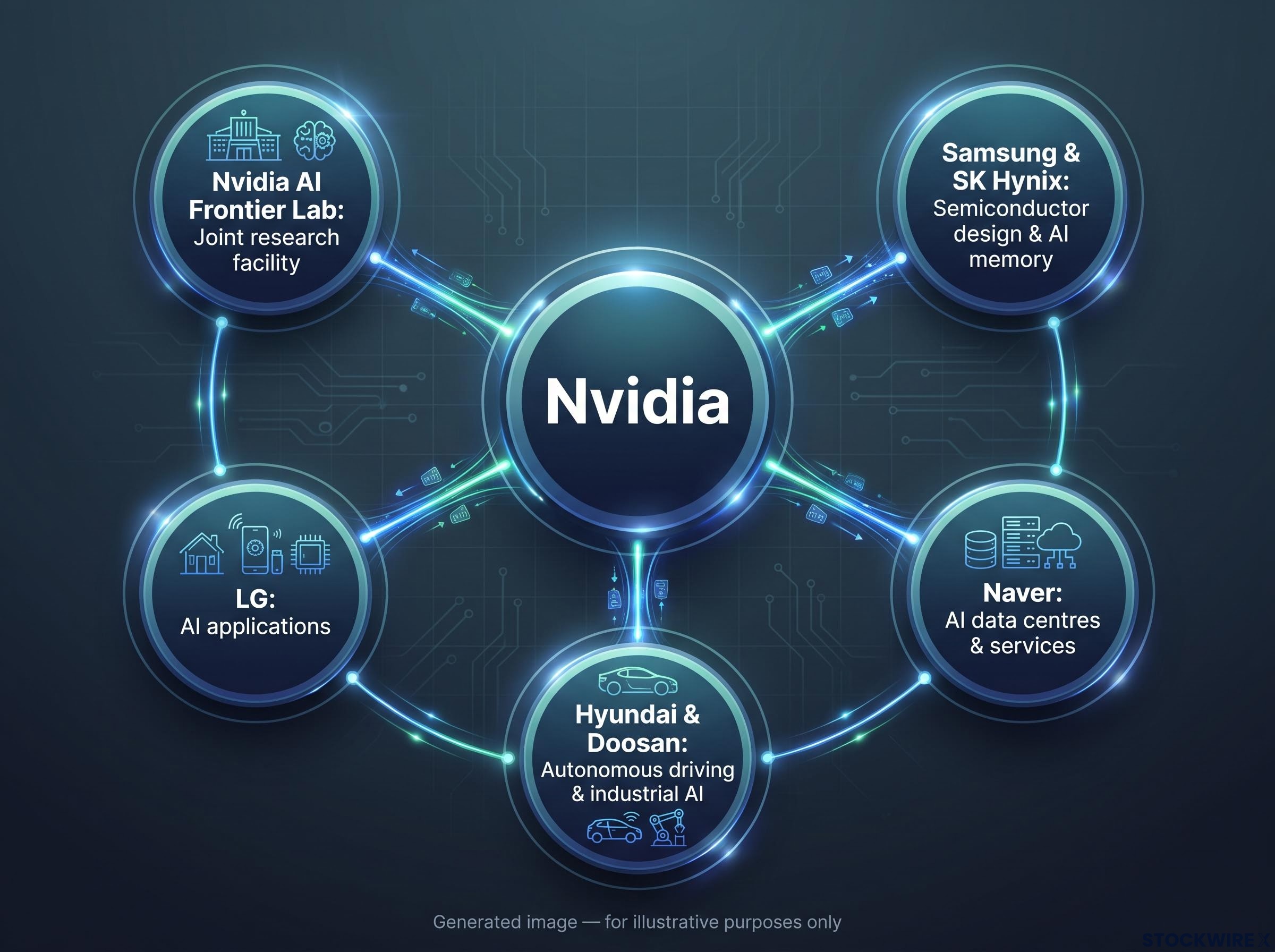
Zoom out from the three companies and a broader pattern becomes visible. Nvidia is not signing a single deal in South Korea. It is assembling an ecosystem.
- Samsung and SK Hynix: semiconductor design and AI memory
- Naver: AI data centres and services
- Hyundai and Doosan: autonomous driving and industrial AI
- LG: AI applications
- Nvidia AI Frontier Lab: planned joint research facility in Korea
Jensen Huang has stated explicitly why South Korea qualifies: advanced networks, data centre infrastructure, semiconductor expertise, and industrial scale at a national level. South Korean government plans to procure Nvidia Vera Rubin GPUs for state AI projects have been reported, though these figures remain unverified.
For globally positioned investors, the Korea cluster signals that AI infrastructure capex is no longer a story that plays out primarily in the U.S. Exposure to Korean semiconductor and AI infrastructure names now carries a different strategic weight than it did twelve months ago, with potential halo effects for adjacent sectors including semiconductor equipment makers and advanced packaging specialists.
Korean AI infrastructure stocks have already repriced significantly ahead of this announcement: South Korea’s Kospi gained approximately 57% in the first four months of 2026 against roughly 5.6% for the S&P 500, driven by concentrated AI hardware demand flowing to Korean chipmakers trading at roughly half the valuation multiple of their American peers.
What converts this framework into shareholder value
The $500 billion headline represents a strong directional signal. Actual value accretion depends on execution milestones that are now clearly defined and trackable.
| Company | Key watchpoint | Timeline |
|---|---|---|
| Nvidia | LOI-to-contract conversion with disclosed volumes; Vera Rubin product mix and margins in Korean deals | Q3-Q4 2026 earnings calls and filings |
| SK Hynix | HBM4 mass production ramp, yields, and capacity plans; disclosed terms of long-term supply agreement | Q3-Q4 2026 quarterly results; ongoing through 2027 |
| SK Telecom | Capex plans, ownership structure, compute-as-a-service pricing, dividend policy guidance | Q3-Q4 2026 earnings calls; pre-2027 go-live disclosures |
These are not generic risk disclosures. They are the specific information gaps that currently prevent investors from sizing positions with confidence. Closing them through upcoming earnings calls and regulatory filings is what will determine whether the partnership delivers on its scale, and when to weight each company’s investment case accordingly.
For investors wanting a framework to position across all three companies simultaneously, our dedicated guide to AI supply chain layers maps the seven structurally distinct layers from semiconductor design to application software, explaining how moat type, bottleneck exposure, and margin profile differ depending on which layer a company occupies.
This article is for informational purposes only and should not be considered financial advice. Investors should conduct their own research and consult with financial professionals before making investment decisions. The LOIs described are not binding contracts, and financial projections are subject to market conditions and various risk factors.