Macquarie Group delivered its Q1 FY27 trading update at yesterday’s annual general meeting, and the headline figure that matters most is this: its commodities division, which analysts estimate accounts for roughly 40% of group earnings, came in substantially ahead of the prior year.
The update arrives at a moment when the market was already pricing significant strength into Macquarie Group stock, with the shares trading near historically elevated multiples. That makes the Q1 read-through consequential: it either validates the premium or raises the stakes for any future disappointment.
Here is the divisional breakdown, the guidance language, how seven brokers revised their targets within 24 hours, and where the genuine fault lines in the investment case sit heading into FY27.
The divisions that moved the needle in Q1 FY27
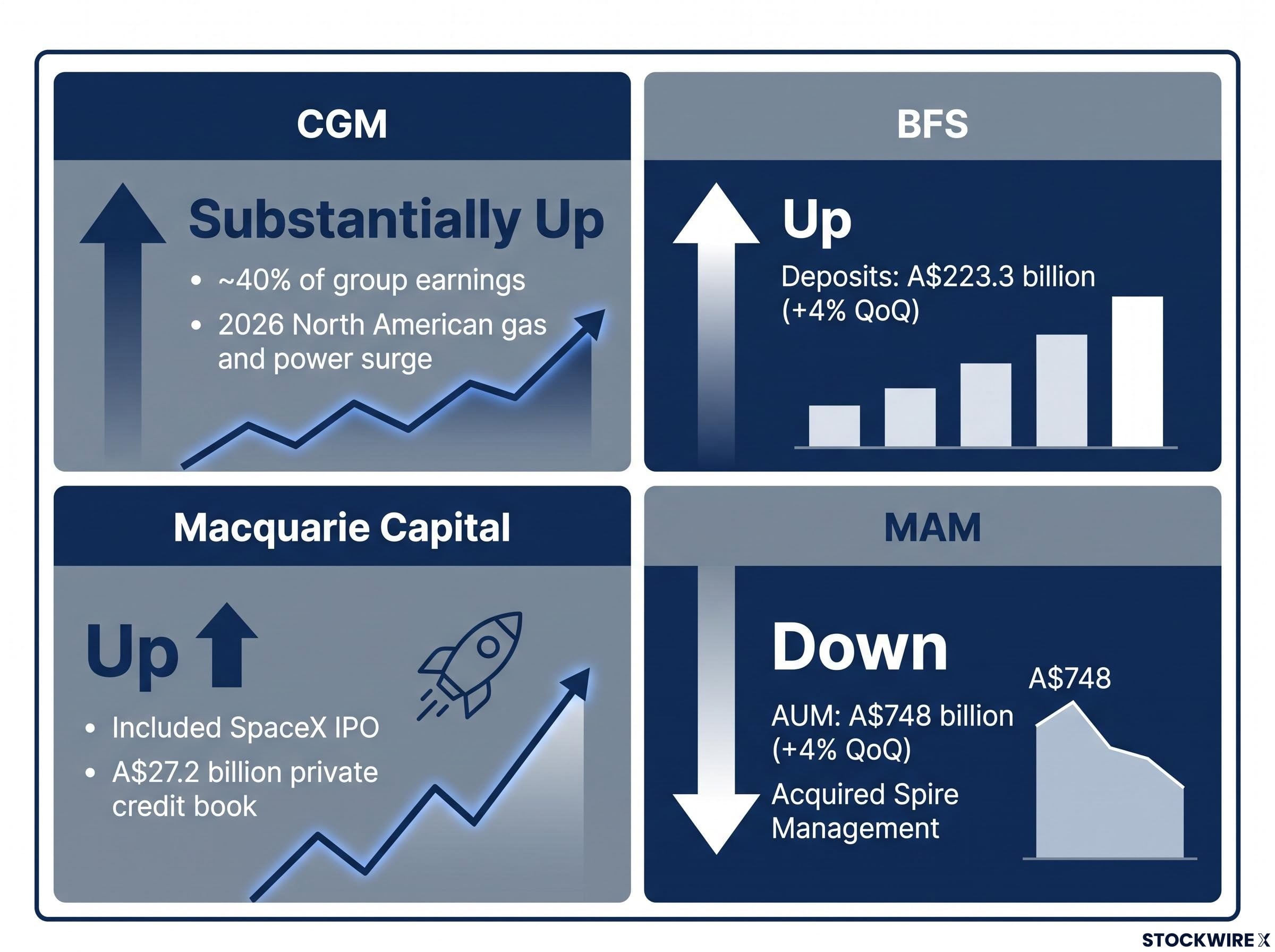
Commodities and Global Markets (CGM), Macquarie’s trading arm, posted a profit contribution described as “substantially up” on the prior corresponding period. The result was underpinned by unusually strong activity in North American gas and power markets, itself a consequence of the cold-weather energy demand surge that hit in early 2026. For a division that accounts for an estimated 40% of group earnings, a strong Q1 materially de-risks the full-year outlook.
Banking and Financial Services (BFS) came in next. Profit was up on the prior corresponding period, with deposit balances expanding to A$223.3 billion, representing a 4% quarter-on-quarter increase. The margin pressure that accompanied the growth was a product mix issue rather than structural deterioration, a distinction worth noting.
Macquarie Capital also beat the prior year, with income from brokerage and investment activities leading the way, including a role in the SpaceX IPO. Advisory revenues were lower, though this reflected a tough prior-year comparison rather than any deterioration in the pipeline. The private credit book remained broadly stable at around A$27.2 billion, pointing to consolidation rather than contraction.
Three of four divisions beating the prior corresponding period tells you that Macquarie’s FY27 earnings base is wider and more resilient than a single-segment story, though how much weight to place on CGM’s outsized contribution is precisely the question brokers are divided on.
The FY26 full-year result, which delivered a 30% earnings surge to A$4.85 billion with all four divisions posting double-digit growth, is the baseline against which Q1 FY27 strength is being measured; the prior corresponding period for CGM was already elevated, making the ‘substantially up’ language in the Q1 update more meaningful than it might appear.
| Division | Q1 FY27 vs PCP | Key Driver | Notable Caveat |
|---|---|---|---|
| CGM | Substantially up | North American gas and power trading | Event-driven; durability uncertain |
| BFS | Up | Deposit and loan volume growth | Margin pressure from product mix |
| Macquarie Capital | Up | Brokerage income incl. SpaceX IPO | Advisory fees down on strong pcp |
| MAM | Down | Divestment of public investments | AUM up 4% QoQ to A$748B |
MAM’s profit dip in context
Macquarie Asset Management (MAM) was the one division to move in the opposite direction, recording a profit contribution below the prior corresponding period. The explanation is structural rather than operational: selling down North American and European public investment assets reduced near-term income without signalling any weakness in the core business.
The platform is expanding. AUM (assets under management, the total value of investments Macquarie manages on behalf of clients) reached A$748 billion after a 4% quarter-on-quarter increase, reflecting both net inflows and the completed acquisition of European CLO manager Spire Management. The recurring fee base that scales with AUM is growing; the current-period profit softness is a transition artefact.
When big ASX news breaks, our subscribers know first
What management’s guidance language actually signals
Management characterised overall trading conditions as “satisfactory”, despite three of four divisions beating the prior corresponding period.
That gap between the word and the divisional reality is worth understanding. “Satisfactory” is standard AGM conservatism from Macquarie’s leadership, not a negative signal. The company has a long history of understating quarterly strength in public commentary.
BFS volume growth guidance now carries a caveat tied to market conditions and customer activity, a qualification that most analysts read as prudence on the rate and credit outlook rather than a retreat from the broader FY27 plan. Full-year guidance was broadly maintained. Against the Visible Alpha full-year earnings consensus of approximately A$4.9 billion, the guidance reaffirmation after a strong Q1 means earnings risk has shifted modestly to the upside, not the other way around.
How seven brokers responded in 24 hours
Broker targets moved higher, but the aggregate shift was measured. The average 12-month price target lifted 2.8% to reach A$263.15, which translates to roughly 3.7% potential upside relative to the 23 July closing price. The broker consensus rating held at 0.63, which sits firmly in Buy-leaning territory.
Of the eight tracked brokers, all but one had published revised views within a single trading day, itself a signal of how closely the market is watching Macquarie at current valuations.
| Broker | Analyst | New Target | Previous Target | Stance |
|---|---|---|---|---|
| Jefferies | Andrew Lyons | A$284.03 | A$253.73 | Buy (largest upgrade, ~12%) |
| JPMorgan | Andrew Triggs | A$275.00 | A$265.00 | Buy |
| Morgan Stanley | Richard Wiles | A$273.00 | A$263.00 | Buy |
| CLSA | Ed Henning | A$272.40 | A$272.40 | Outperform (unchanged) |
The rationale differed by broker, but the themes clustered:
- JPMorgan’s Andrew Triggs argued that the robust CGM result meaningfully lowers the likelihood of a FY27 guidance miss, with the balance of full-year earnings risk now pointing higher rather than lower
- Morgan Stanley’s Richard Wiles focused on the pace of capital accumulation running ahead of what the market had modelled, incorporating capital management optionality into valuation
- Jefferies’ Andrew Lyons delivered the most bullish call at A$284.03, viewing Q1 as more positive than consensus had priced in
- CLSA’s Ed Henning held his target but flagged the confirmed leadership transition as a positive development that resolves a question mark that had been hanging over the stock
All broker commentary dated July 2026 via FactSet StreetAccount as cited by Market Index.
The 3.7% consensus-implied upside is modest relative to the upgrade activity. That tells you most of the good news is already in the price, and the constructive broker tone reflects a maintenance of conviction rather than a discovery of new value.
The case for caution: why UBS sits apart from the pack
UBS has maintained its Neutral stance with a A$250.00 price target, standing as the clear dissenting voice among the coverage group. The bear case rests on two pillars.
The first is earnings concentration. According to UBS, CGM is responsible for something in the region of 40% of total group profit, a division that is inherently event-driven. If North American gas and power volatility normalises, the earnings impact on the group is disproportionate. You cannot diversify away from a segment that large.
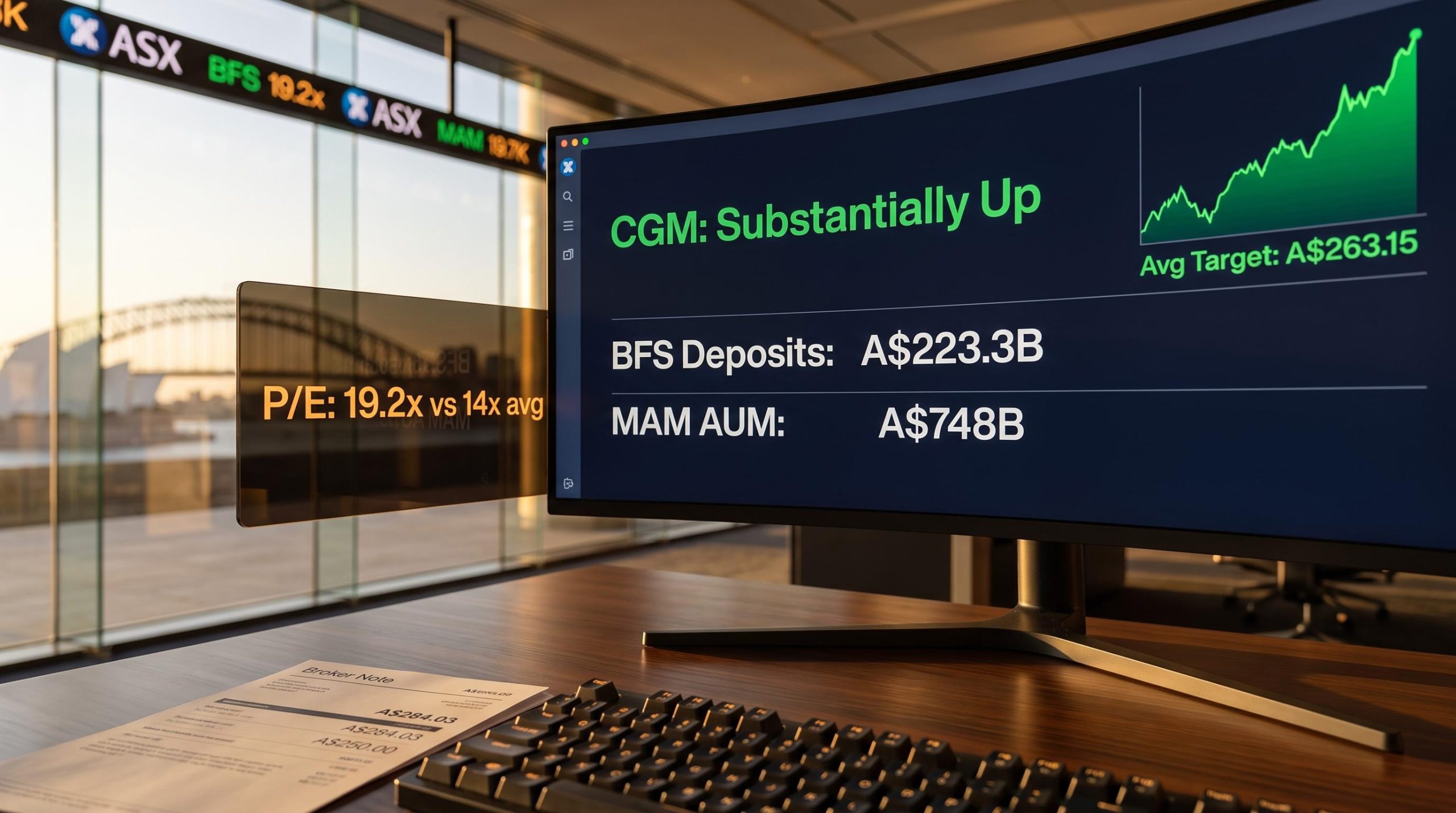
The second is valuation. Macquarie currently trades at approximately 19.2x earnings.
Current P/E: approximately 19.2x versus a long-run historical average of approximately 14x. The gap implies the market is pricing sustained elevated earnings, not a temporary commodities spike.
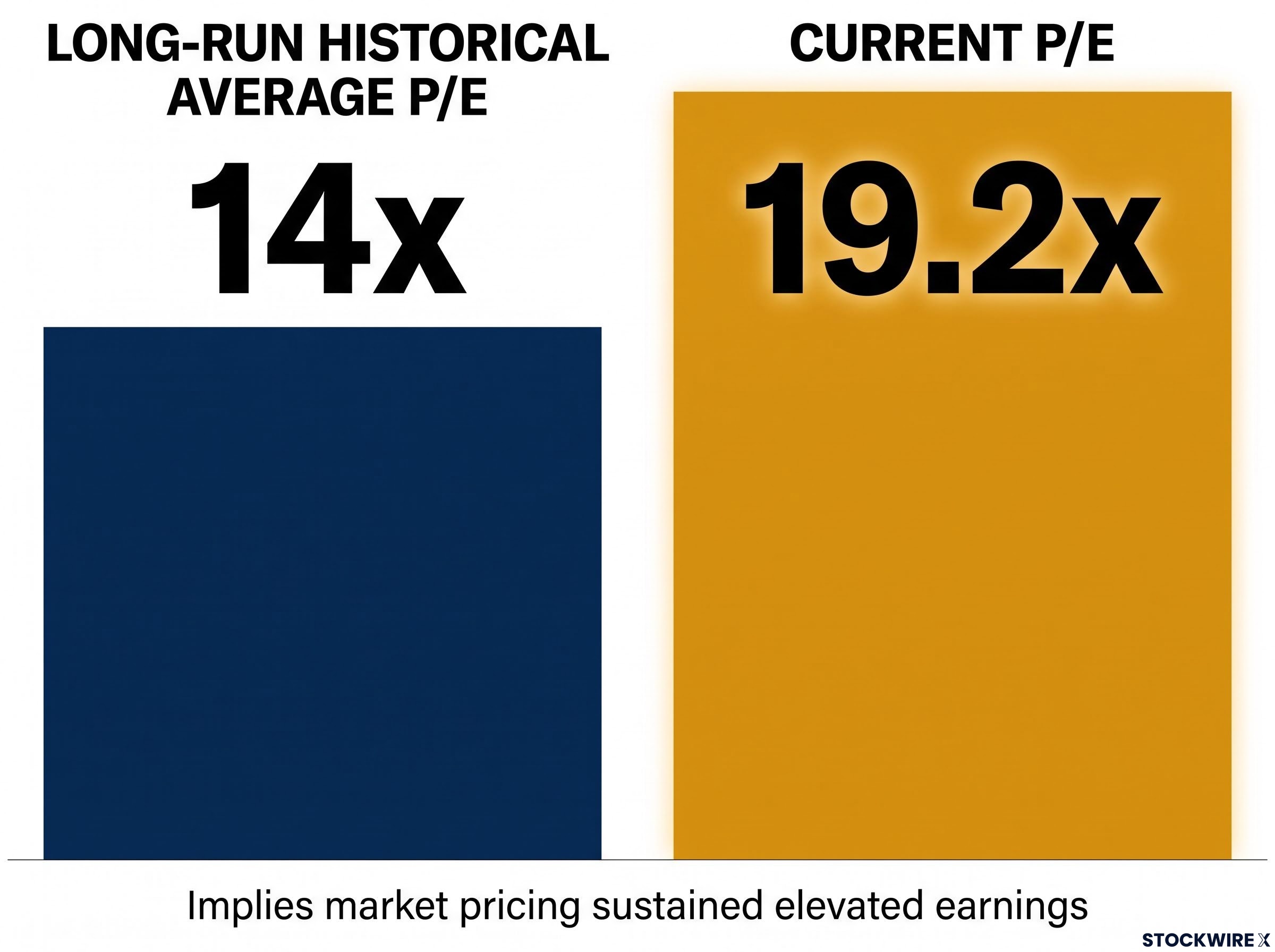
That is not a minor rounding difference. At 19.2x, the market is implicitly betting that CGM’s current earnings power is structural, and UBS’s central point is that this bet is difficult to sustain if energy market conditions normalise. UBS’s internal FY27 forecast comes in around 6% short of the Visible Alpha consensus figure of A$4.9 billion.
Macquarie’s valuation premium relative to traditional banks has been a recurring debate through the 2025-2026 rally, with the debt-to-equity ratio of 258.5% making earnings and equity value materially sensitive to any shift in interest rate conditions or credit availability.
For anyone considering Macquarie Group stock at current levels, this is the valuation argument to stress-test your own position against.
Understanding Macquarie’s four-division business model
Macquarie operates across four distinct segments, and the interaction between them explains why a single-division beat can move the group earnings needle so significantly:
- CGM (Commodities and Global Markets): Commodities and financial markets trading; cyclical, market-linked, the largest single earnings contributor
- Macquarie Capital: Investment banking and private credit; cyclical, tied to deal flow and capital markets activity
The annuity-style floor: BFS and MAM
- BFS (Banking and Financial Services): Retail banking and wealth; recurring, volume-driven income that compounds with the balance sheet (A$223.3 billion in deposits)
- MAM (Macquarie Asset Management): Asset management; recurring fee income that scales with AUM (A$748 billion), less volatile than trading revenue
This structural diversity is a deliberate design choice and a key reason the stock trades at a premium to traditional banks. BFS’s loan and deposit growth running above system growth provides earnings that compound steadily, while MAM’s management fee revenue scales with AUM rather than fluctuating with market activity.
The current concentration in CGM (at approximately 40% of group earnings) means the diversification benefit is not perfectly balanced, which feeds directly into the UBS concern. A reader who understands this architecture can make a more informed judgment about whether that concentration is a structural feature or a temporary phase that will normalise as BFS and MAM continue to grow.
Where the risk-reward sits after a strong Q1
The bull case is specific:
- Three of four divisions beat the prior corresponding period
- FY27 guidance largely reaffirmed at the A$4.9 billion consensus level
- Surplus capital accumulating at a faster rate than the market anticipated, per Morgan Stanley, supporting buyback or special distribution optionality
- CEO succession resolved, removing a sentiment overhang
The bear case is equally specific:
- 3.7% consensus-implied upside is modest for the risk being taken
- The 19.2x P/E premium embeds an assumption of sustained CGM strength against a 14x long-run average
- A normalisation in North American energy volatility would disproportionately reduce group earnings
- UBS’s FY27 estimate sits 6% below consensus, suggesting the bull case has limited margin for error
The price target range: A$250.00 (UBS, Neutral) to A$284.03 (Jefferies, Buy).
That A$34 spread is unusually wide for a large-cap ASX stock, and the width itself tells you the investment case is genuinely contested rather than settled.
The single variable to track through FY27 is whether North American gas and power trading conditions remain elevated or normalise toward historical levels. That is the swing factor that separates the Jefferies target from the UBS target, and it is the question no broker can answer with certainty.
For readers wanting broader context on where Macquarie sits within the ASX financials sector, our deep-dive into Macquarie’s position among ASX financial 52-week highs examines how its four distinct earnings engines compare with Challenger and QBE, covering what the divergent risk profiles mean for investors holding multiple financial names.
This article is for informational purposes only and should not be considered financial advice. Investors should conduct their own research and consult with financial professionals before making investment decisions. Past performance does not guarantee future results, and financial projections are subject to market conditions and various risk factors.