
Macquarie posts $4.85 billion full-year profit as record second half drives 30% earnings surge
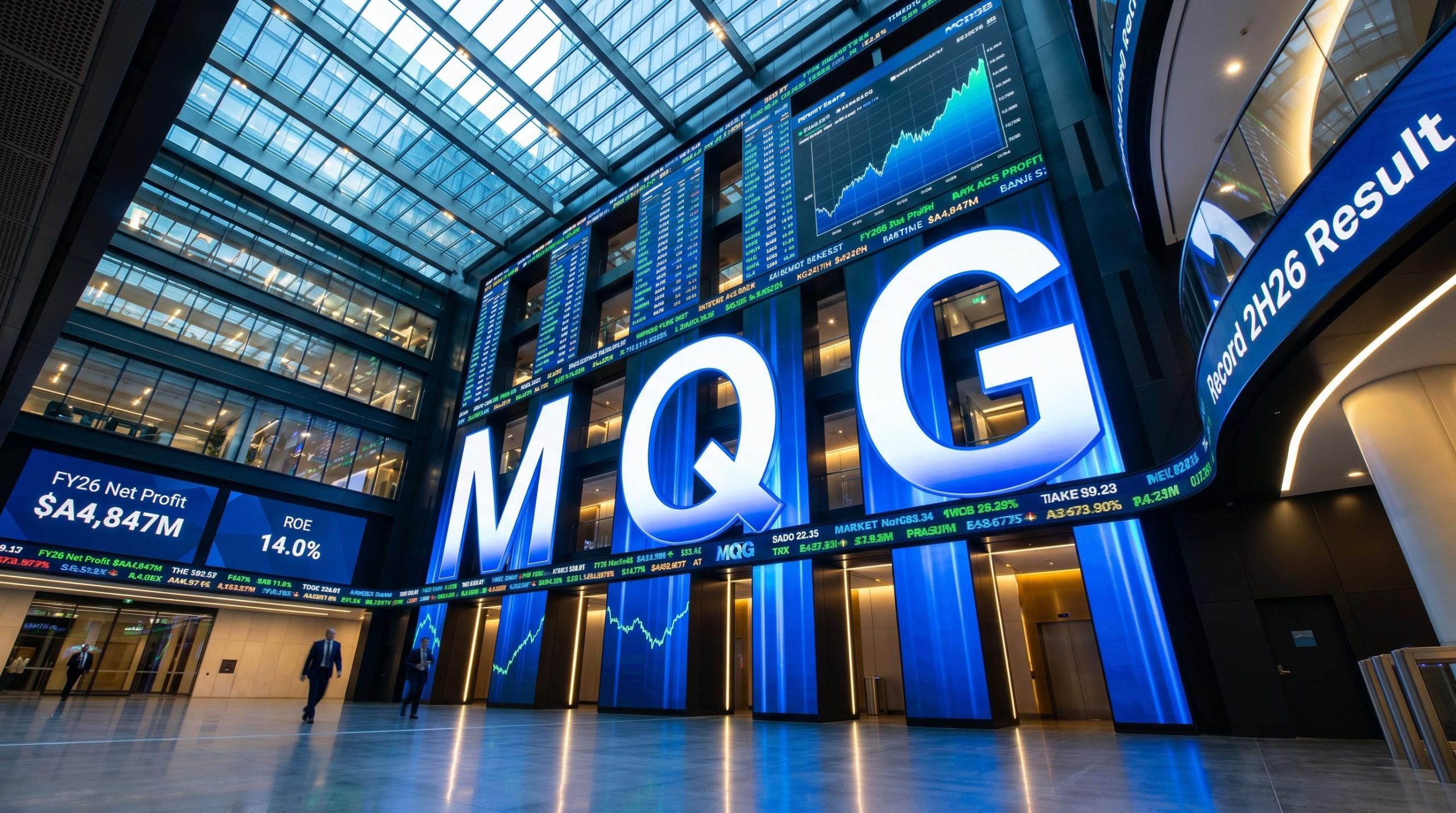
Macquarie Group (ASX: MQG) has reported a net profit after tax attributable to ordinary shareholders of $A4,847 million for FY26, up 30% on FY25, with the second half delivering a record $A3,192 million, up 93% on 1H26. Earnings per share came in at $A12.77 (up 30%), while return on equity improved from 11.2% to 14.0%. The result was broad-based, with all four operating groups reporting material increases in net profit contribution across a complex global environment.
FY26 at a glance
| Metric | FY26 Result | FY25 Comparison | Change | Notes |
|---|---|---|---|---|
| Net profit after tax | $A4,847m | $A3,728m (implied) | +30% | Full year ended 31 March 2026 |
| 2H26 net profit | $A3,192m | 1H26: $A1,655m | +93% | Record half-year result |
| Earnings per share | $A12.77 | FY25 EPS | +30% | Attributable to ordinary shareholders |
| Return on equity | 14.0% | 11.2% | +2.8pp | Significant improvement year-on-year |
| Net operating income | $A19,477m | FY25 | +13% | Operating expenses up 5% to $A12,748m |
| International income | 68% of total | FY25 | — | Reflects diversified global operations |
When big ASX news breaks, our subscribers know first
All four divisions deliver — the engine room behind FY26 earnings
Each of Macquarie’s operating groups contributed to the FY26 result, with three of the four divisions posting profit contribution growth above 40%. The breakdown by division is as follows:
-
Macquarie Asset Management (MAM) delivered a net profit contribution of $A2,602 million, up 27% on FY25 from $A2,049 million. The result was primarily driven by higher performance fees. MAM also completed the sale of its public investments business in North America and Europe during 2H26.
-
Banking and Financial Services (BFS) delivered a net profit contribution of $A1,610 million, up 17% on FY25 from $A1,380 million. Growth in the loan portfolio and BFS deposits were the primary drivers. These gains were partially offset by lower margins reflecting changes in portfolio mix, lending and deposit competition, and higher technology expenses to support business growth and scalable operations.
-
Commodities and Global Markets (CGM) delivered a net profit contribution of $A4,221 million, up 49% on FY25 from $A2,829 million, making it the largest contributor. Key drivers included a significantly higher Asset Finance contribution from the gain on sale related to the divestment of the OnStream meters platform, increased risk management income from client hedging activity across Global Gas and Power and Global Oil, and higher inventory management and trading income from supply and demand imbalances in North American Gas and Power and oil trading. These gains were partially offset by timing of income recognition on gas storage and transport contracts.
-
Macquarie Capital delivered a net profit contribution of $A1,491 million, up 43% on FY25 from $A1,043 million. Drivers included higher income from equity investments, mergers and acquisitions fees, brokerage, and the private credit portfolio. This was partially offset by higher impairment charges and an increased share of net losses from associates and joint ventures.
Shemara Wikramanayake, Managing Director and Chief Executive Officer
“Each of our businesses used its specialist expertise in navigating the current environment, identifying opportunities that support long-term growth and delivering positive outcomes for our clients and communities.”
Capital strength, dividends and what investors need to know
Dividend details
- FY26 final ordinary dividend: $A4.20 per share (35% franked)
- Total FY26 ordinary dividend: $A7.00 per share (35% franked)
- FY26 payout ratio: 55%; 2H26 payout ratio: 50%
- Dividend policy range: 50–70% annual payout ratio (unchanged)
- Record date: 19 May 2026 | Payment date: 2 July 2026
- Dividend Reinvestment Plan (DRP) available at a 1.5% discount to the prevailing market price
Balance sheet and capital position
Macquarie’s financial position exceeds APRA’s Basel III regulatory minimums across all key metrics: Bank Level 2 CET1 ratio of 12.8% (Harmonised: 17.5%), Leverage ratio of 4.7% (Harmonised: 5.3%), Liquidity Coverage Ratio (LCR) of 173%, and Net Stable Funding Ratio (NSFR) of 116%. Total deposits grew to $A221.5 billion at 31 March 2026, up 25% on the prior year, with $A29.9 billion in term funding raised during FY26.
On the buyback, $A1,013 million of ordinary shares had been acquired at an average price of $A189.80 per share. The Board has resolved to conclude the on-market share buyback, citing significant business growth priorities and prevailing market conditions.
Understanding Macquarie’s “annuity vs. markets-facing” business model and why it matters for investors
Macquarie’s four operating groups split broadly into two categories. MAM and BFS generate more stable, fee-based and interest-driven earnings, providing a relatively predictable earnings base. CGM and Macquarie Capital are more markets-facing, meaning their results are driven by transaction activity, commodity flows, and market conditions.
This structural mix is significant for investors. When markets-facing divisions perform strongly, as CGM did in FY26 with a 49% increase in net profit contribution, the group’s overall result can accelerate materially. When those divisions face headwinds, the annuity-style businesses provide a degree of earnings support.
The 68% international income share further reduces concentration risk tied to the Australian economy alone, spreading exposure across major global markets. Macquarie’s conservative capital stance, with ratios comfortably above APRA minimums, provides an additional buffer against periods of volatility.
Shemara Wikramanayake, Managing Director and Chief Executive Officer
“Macquarie remains well-positioned to deliver superior performance in the medium term with established, diverse income streams; deep expertise across diverse sectors in major markets with structural growth tailwinds.”
On the near-term outlook, management flagged a cautious stance. Factors that could influence short-term results include global economic conditions, inflation, interest rates, geopolitical events, foreign exchange movements, and potential regulatory or tax changes. These are standard considerations for a globally diversified financial group of Macquarie’s scale, and management’s conservative approach to capital, funding, and liquidity is intended to provide flexibility in responding to whatever conditions may emerge.
Stay Ahead on ASX Finance News
Big News Blast delivers FREE breaking ASX financial sector news directly to your inbox within minutes of release, complete with in-depth analysis already done. Join 20,000+ subscribers who never miss a market-moving announcement. Click the “Free Alerts” button at StockWire X to get the next major finance story the moment it breaks.