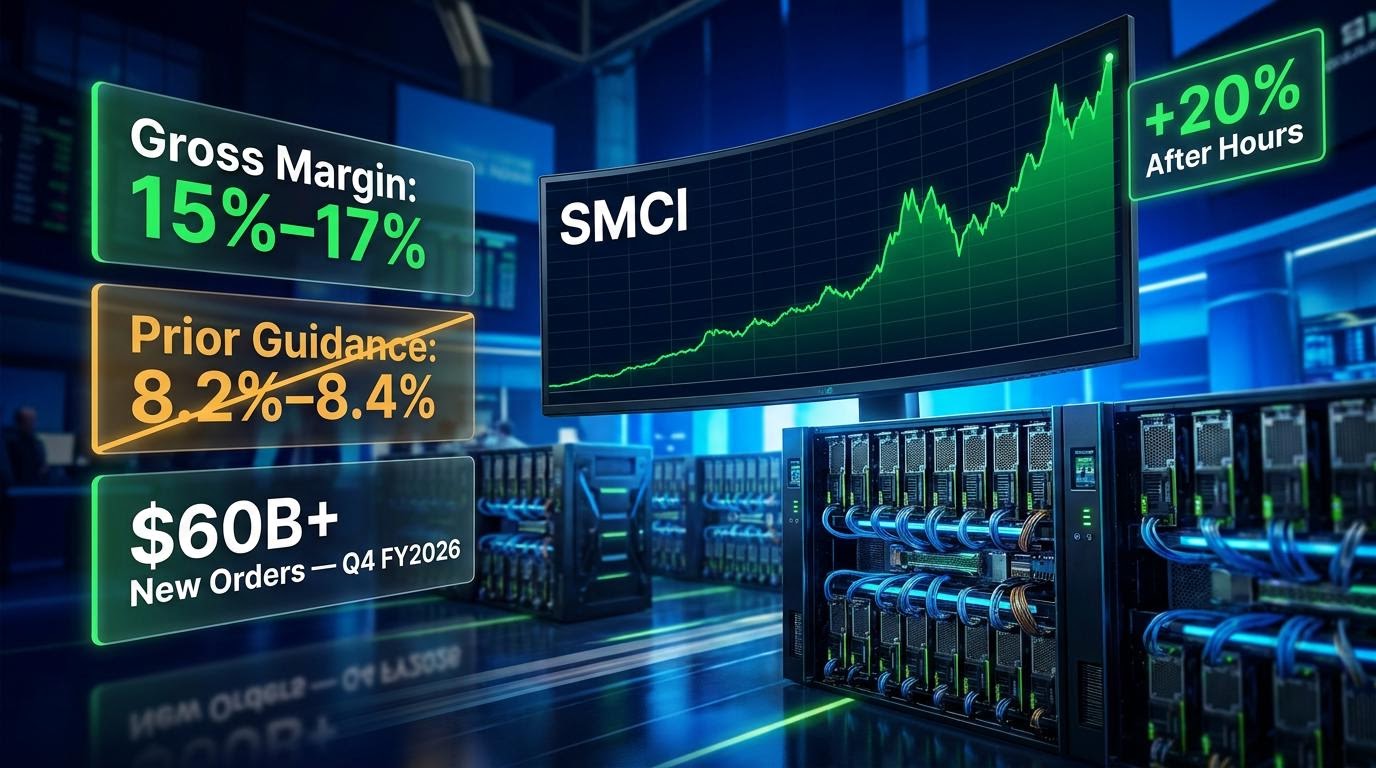
Super Micro Computer stock surged roughly 20% in after-hours trading on 21 July 2026, after the company reported estimated gross margins of 15% to 17% for its fiscal fourth quarter. That figure is nearly double what management had guided investors to expect just weeks earlier.
The move was not driven by a revenue blowout. Revenue for the quarter landed near the lower boundary of guidance. The stock’s after-hours jump reflected the strength of profitability execution and a record order backlog, both of which pointed to AI infrastructure demand that is broadening rather than plateauing. The gap between what was guided and what was delivered on the margin line is one of the widest the company has ever reported.
Here is what actually moved the stock, what the record backlog tells you about the next several quarters, and the three specific variables that will determine whether this re-rating holds when full results land on 11 August 2026.
Why the market cheered a soft revenue quarter
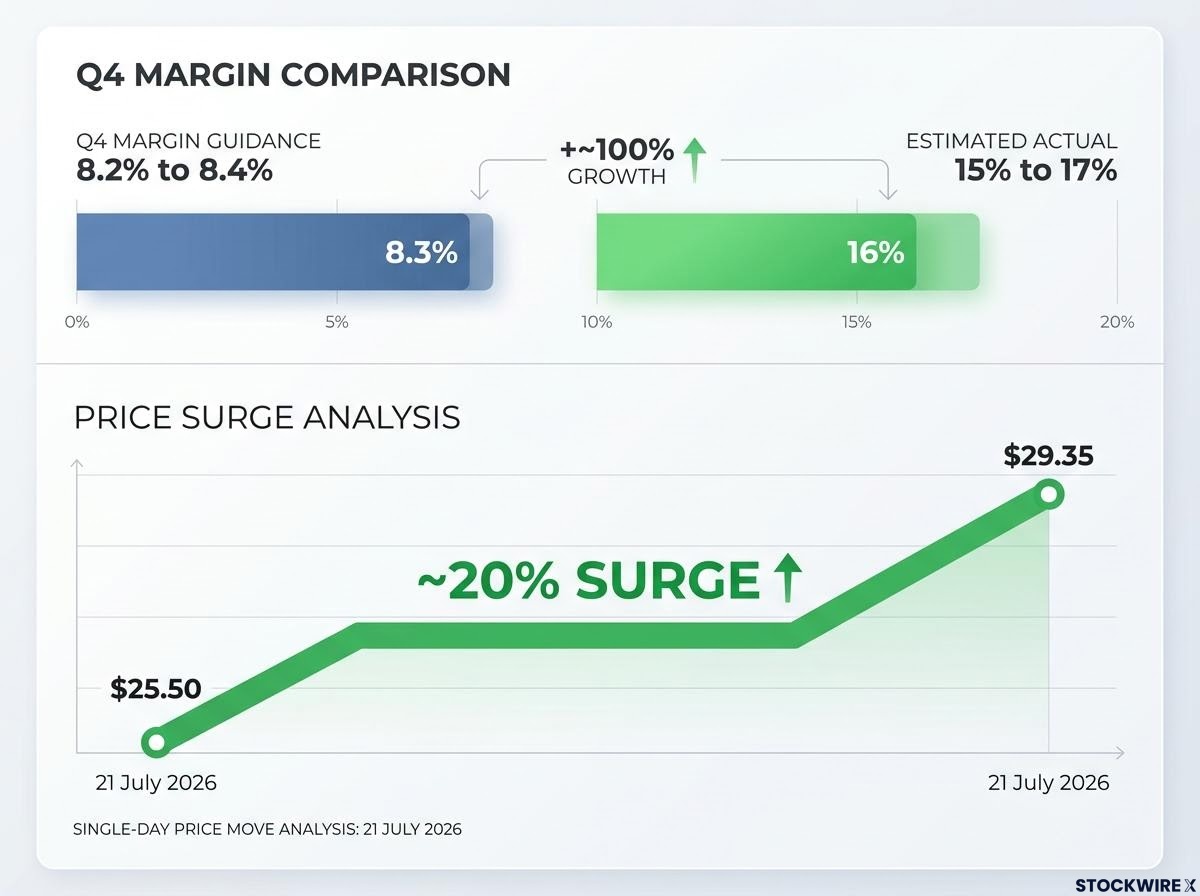
The headline numbers looked contradictory. Revenue came in near the low end of the $11.0 billion to $12.5 billion guidance range for the quarter ended 30 June 2026, a result that would ordinarily weigh on sentiment. Instead, the stock jumped approximately 20%, from roughly $25.50 in regular hours to around $29.35 after the bell.
The explanation sits in one line item. Both GAAP and non-GAAP gross margin for the quarter is estimated at 15% to 17%, well ahead of the prior guidance figure of 8.2% to 8.4%.
- Guided revenue range: $11.0 billion to $12.5 billion (actual near the low end)
- Guided gross margin: 8.2% to 8.4%
- Estimated actual gross margin: 15% to 17%
The gap between an 8% margin expectation and a 17% result tells you the market had been pricing in a fundamentally less profitable business than what this quarter delivered, which is why the stock move was so large. Revenue softness looked like a timing and capacity issue, not a demand signal, once investors saw the backlog figures. Profitability displaced revenue as the primary lens for this print, and the re-rating followed.
When big ASX news breaks, our subscribers know first
What the margin doubling actually means
According to management, the margin improvement was driven by a particularly favourable mix of products shipped and customers served during the quarter. In practice, that means Super Micro shipped higher-value AI server configurations to a more profitable mix of buyers during the quarter.
Prior guidance: 8.2% to 8.4%. Q4 estimate: 15% to 17%.
The question this leaves unresolved is whether the improvement reflects a structural shift in the business or a one-off batch effect, where a temporarily rich set of orders skewed the quarter’s margin profile upward. That distinction is the core debate heading into the full earnings report.
The structural vs cycle-peak debate is not unique to Super Micro: Micron’s fiscal Q3 FY2026 delivered non-GAAP gross margins near 85%, and analysts are applying the same framework to determine whether those figures represent a durable shift in memory economics or a pricing peak that will revert when new capacity arrives.
| Metric | Q4 FY2026 Figure |
|---|---|
| Prior gross margin guidance | 8.2% to 8.4% |
| Revised gross margin estimate | 15% to 17% (GAAP and non-GAAP) |
| Revenue guidance range | $11.0B to $12.5B (actual near low end) |
A gross margin that is nearly double prior guidance forces a rethink of what this business can earn at scale. If you have been modelling Super Micro as a low-margin hardware assembler, that rethink needs to happen before 11 August, when confirmed results land. If analysts treat this margin range as repeatable, forward earnings estimates move materially higher. If they treat it as a one-quarter anomaly, the re-rating stalls.
The $60 billion backlog and what it signals about AI infrastructure demand
During Q4 FY2026, Super Micro took in over $60 billion worth of new orders, a figure representing that single quarter’s intake rather than any running total, and the result was a total order backlog that reached its highest level at the close of fiscal year 2026.
The scale needs context. Hyperscalers and enterprises are committing to server and data-centre build-outs at a pace that exceeds near-term production capacity across the industry. Building out AI infrastructure requires substantial capital outlay and is subject to long manufacturing lead times, which has shifted how investors read results, with margin execution and order book depth carrying more weight than any individual quarter’s revenue line.
Three implications follow from a record backlog of this size:
- Revenue visibility extends across multiple quarters. The backlog provides a clearer forward revenue picture than most hardware companies can offer.
- Demand is structural, not transient. A $60 billion single-quarter order intake is consistent with multi-year capital expenditure commitments from buyers, not short-term procurement cycles.
- The constraint has shifted from demand to production capacity. The revenue question is no longer whether customers want to buy; it is how fast Super Micro can build and ship.
The shift from a demand question to a capacity question mirrors the broader dynamic across AI infrastructure binding constraints, where power availability, cooling density, and manufacturing lead times have replaced buyer appetite as the primary governors of how quickly the buildout can proceed.
The backlog conversion question also connects to a structural working-capital challenge Super Micro has navigated before: the SMCI capital raise completed in June 2026 raised $7 billion specifically to fund component procurement against a then-$39 billion order book, because GPU costs must be paid before customer revenue is recognised.
That kind of backlog tells you the customers buying AI server infrastructure are making multi-quarter capital commitments, which provides the sort of forward visibility most hardware companies simply do not have.
Understanding the AI server market Super Micro operates in
AI server hardware has historically been a low-margin business. The economics are dominated by component pass-through, where the cost of GPUs, memory, and networking hardware flows directly to the customer with limited markup. That is why an 8% gross margin guidance range was itself considered normalised for Super Micro, not an outlier.
Super Micro occupies a specific position in this market: a direct-liquid-cooling and customised AI server provider competing with large original equipment manufacturers (OEMs) and original design manufacturers (ODMs) for hyperscaler and enterprise data-centre contracts.
Not all servers carry the same margin. AI configurations with liquid cooling, custom rack design, and GPU-dense builds command materially higher margins than commodity server shipments. When product mix skews toward these higher-value configurations, gross margin can shift dramatically, which is exactly what management described.
Three characteristics define the AI server hardware market:
- Intense competition among OEMs and ODMs for hyperscaler and enterprise contracts
- Thin margins driven by component economics and cost pass-through pricing
- Growing differentiation through liquid cooling and custom GPU-dense configurations for AI workloads
For investors who assumed Super Micro was a low-margin assembler with limited pricing power, the Q4 margin result challenges that assumption directly. It changes what questions you should be asking about the business, specifically whether the company’s mix is shifting durably toward higher-margin configurations or whether this quarter was an exception.
Three things to watch before the August 11 earnings call
The preliminary figures released on 21 July 2026 are unaudited estimates. Confirmed results arrive on 11 August, along with the first formal FY2027 guidance. That call is more consequential for the stock’s trajectory than the Q4 results themselves, because it will tell investors whether the 15% to 17% margin range is a run-rate expectation or a one-quarter event.
Full Q4 FY2026 results and FY2027 guidance: 11 August 2026 at 5:00 p.m. EDT.
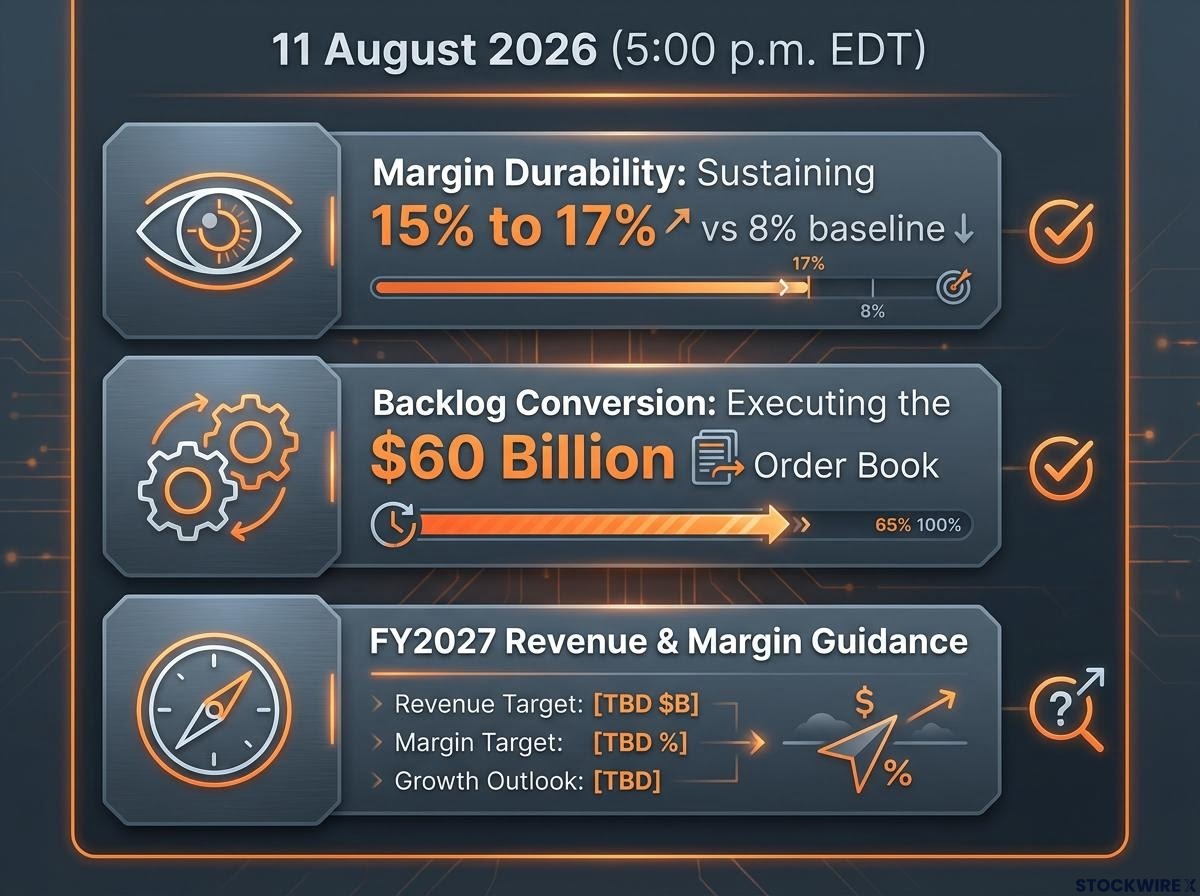
Three variables will determine whether this re-rating holds:
- Gross margin durability. Listen for whether management frames the 15% to 17% range as reflective of ongoing product and customer mix, or as a favourable quarter that may not repeat. The language here is everything.
- Backlog conversion and capacity commentary. A $60 billion order book only matters if it converts to shipped revenue. Production ramp details, supply chain commentary, and lead-time estimates will show how quickly the backlog translates into recognised revenue.
- FY2027 revenue and margin guidance. The forward guidance range is the single most important output of the call. If management guides to margins materially above the prior 8% baseline, the re-rating has legs. If guidance reverts, expect the stock to give back a portion of the after-hours move.
What the preliminary update changes, and what it does not
The preliminary update confirmed three things: gross margins of 15% to 17% versus 8.2% to 8.4% guidance, new orders exceeding $60 billion in Q4, and a record total order backlog. The stock’s 20% after-hours re-rating reflects a higher baseline expectation for profitability.
What remains unresolved is whether any of it holds.
| What the preliminary update confirmed | What remains unresolved ahead of 11 August |
|---|---|
| Gross margins of 15% to 17%, nearly double guidance | Whether margin expansion is durable or a one-quarter mix effect |
| Record order backlog driven by $60B+ in Q4 orders | Whether backlog converts efficiently into revenue and cash flow |
| Stock re-rated ~20% on profitability execution | FY2027 guidance range and management’s margin outlook |
The investment thesis has shifted. Before this print, Super Micro was a margin-recovery story: could the company get margins back to respectable levels after a difficult stretch? Now it is a margin-durability story: can it sustain them? 11 August is where that thesis is tested.
AI infrastructure stocks across the broader supply chain, including optical networking and power generation suppliers, have outpaced the Nasdaq-100 by wide margins in 2026, suggesting the market has been repricing the entire physical layer of AI deployment rather than individual company execution.
Investors who act on this preliminary print before management has confirmed the numbers on 11 August are taking a position on margin durability before the company itself has validated it. That is the specific risk to weigh.
This article is for informational purposes only and should not be considered financial advice. Investors should conduct their own research and consult with financial professionals before making investment decisions. All preliminary Q4 FY2026 figures are unaudited estimates released on 21 July 2026, subject to revision upon completion of final closing procedures and audit. Past performance does not guarantee future results.