
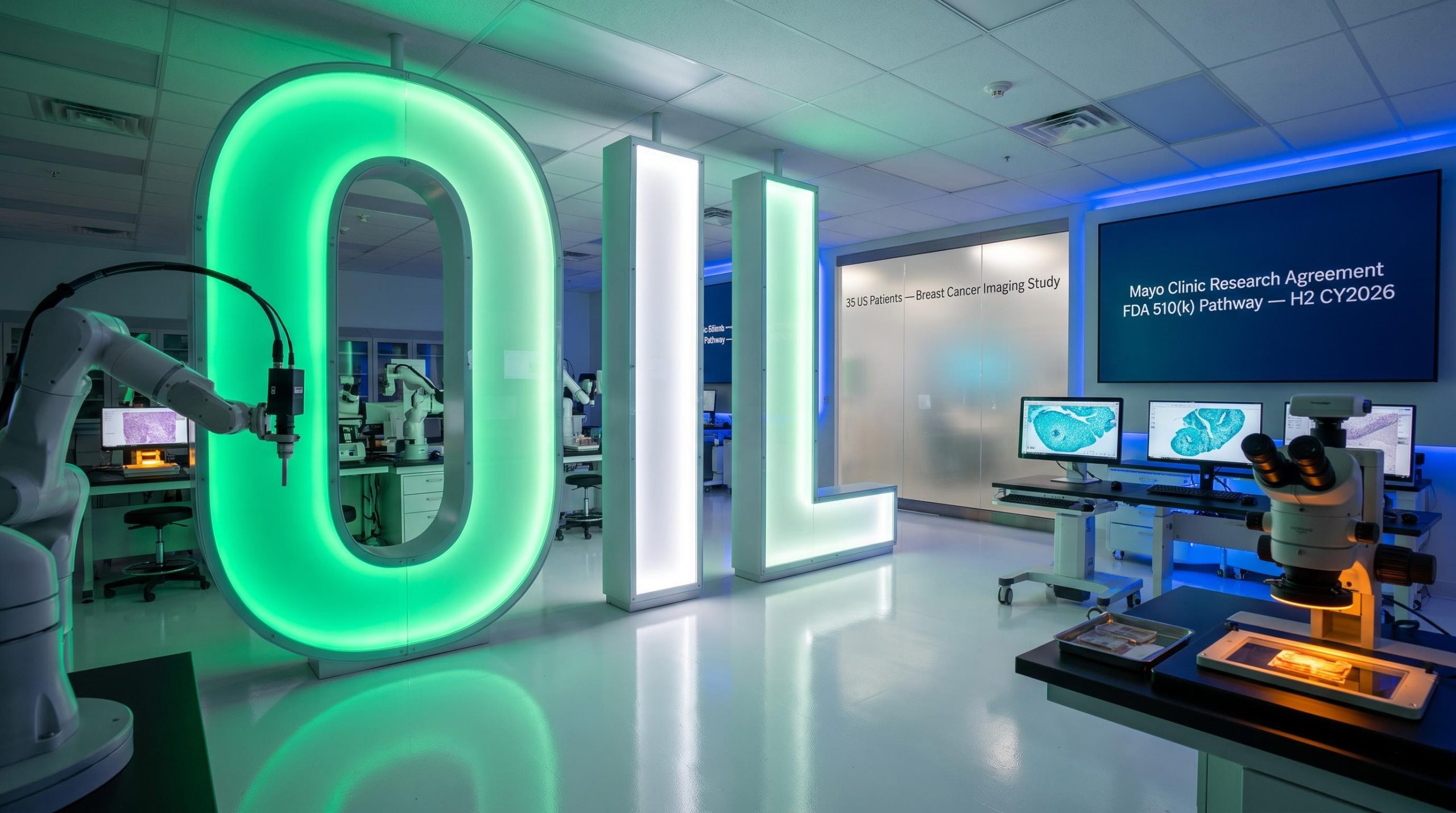
Optiscan launches US breast cancer imaging study with Mayo Clinic
Optiscan Imaging (ASX: OIL) has signed a Research Agreement with Mayo Clinic to commence a US breast cancer imaging study. Site initiation has been completed, and recruitment is now open for 35 US patients undergoing breast-conserving surgery (lumpectomy).
The study is designed to potentially generate clinical evidence for planned US FDA 510(k) submissions in H2 CY2026 for two of the company’s imaging devices, InVue™ and InForm™. It seeks to validate an integrated surgical-pathology workflow for US market entry and broader clinical expansion.
When big ASX news breaks, our subscribers know first
Two devices, one surgical workflow
The study will assess the safety, performance and workflow utility of both devices in patients undergoing lumpectomy. InVue™ is used for in vivo surgical imaging, capturing microscopic images inside the surgical cavity, while InForm™ is used for ex vivo digital pathology imaging of tissue removed during surgery.
The US study will be led by Mayo Clinic Principal Investigator Jeffrey Johnson M.D., Surgical Oncologist, and Co-Principal Investigator Judy Boughey M.D., Surgical Oncologist.
Each device relies on a distinct contrast agent. During surgery, InVue™ will use intravenous fluorescein sodium AK-FLUOR 10%, supplied by Long Grove Pharmaceuticals, to assess tissue differentiation and real-time imaging dynamics. Resected tissue will then be assessed with InForm™ using topical Acridine Orange to support digital pathology imaging and workflow evaluation.
The workflow step-by-step
The planned surgical workflow proceeds as follows:
-
Lumpectomy surgery
-
Real-time in vivo cellular imaging with InVue™ following tumour resection
-
Immediate visual feedback on tumour clearance
-
Resected tissue assessed ex vivo with InForm™
-
Potential improved margin clearance and reduced recurrence risk
Testing both devices within a single workflow reinforces Optiscan’s end-to-end platform strategy across surgery and pathology, combining intraoperative imaging with downstream tissue assessment in one continuous process.
Why surgical margins matter — the clinical opportunity
Breast cancer is the most commonly diagnosed cancer among women worldwide and remains a major global health challenge, with millions of new cases reported each year. Lumpectomy is a widely used treatment that seeks to remove the tumour while preserving as much healthy tissue as possible.
Achieving clear surgical margins, where no cancer cells remain at the edge of the excised tissue, continues to be one of the most significant challenges in surgical outcomes. Incomplete margins can drive the need for repeat surgeries.
According to the World Health Organization, breast cancer is the most common cancer in women in 157 countries around the world, with no specific risk factors other than sex and age for most women who develop the disease.
For investors, the clinical rationale is straightforward. The ability to visualise tissue in vivo and in real time has the potential to improve surgical precision, support more complete tumour removal, and reduce the need for re-operations, which could enhance both patient outcomes and healthcare efficiency.
| Clinical Challenge | Current Limitation | Optiscan’s Potential Solution |
|---|---|---|
| Surgical margin assessment | Difficulty confirming clear margins during surgery | Real-time in vivo imaging with InVue™ at cellular level |
| Repeat surgeries | Incomplete margins can require follow-up operations | Improved tumour clearance may reduce re-operations |
| Intraoperative decision-making | Limited immediate visual feedback on tumour clearance | Immediate feedback plus ex vivo pathology with InForm™ |
The regulatory and commercial pathway
Data from the study could support planned US FDA 510(k) premarket submissions for both InVue™ and InForm™ by generating evidence on device performance, workflow integration and imaging outcomes in a real-world surgical setting. The company describes this as a key regulatory step toward US market clearance for both platforms.
Beyond regulatory evidence, the study could also support AI and machine learning development for breast cancer tissue assessment, adding a potential data-driven dimension to the company’s imaging platforms.
Building a connected digital ecosystem
Optiscan frames breast cancer as a high-value initial indication to demonstrate its potential to improve intraoperative decision-making and surgical outcomes, given the scale of the market and the clinical need. The study is designed to potentially generate the evidence needed for regulatory clearance while supporting clinician adoption and commercial positioning in the US.
Evaluating both devices in one workflow reinforces the company’s end-to-end platform strategy across surgery and pathology, creating a potential pathway for expansion into additional procedures, clinical settings and commercial applications beyond breast cancer.
Per the source, Optiscan’s FDA milestone progression for InVue™ and InForm™ runs as follows:
-
Technical development
-
Preclinical validation
-
Ethical clearance
-
Clinical Validation (“We are here”)
-
Regulatory Dossier Preparation
-
FDA submission
-
Regulatory clearance
-
Commercial deployment
The company’s current position sits at the Clinical Validation stage, indicating that regulatory submission and clearance remain future steps subject to study outcomes.
What management said
Dr Camile Farah, CEO and Managing Director
“Patient recruitment in the US is a major milestone in generating high-quality clinical evidence and refining our technologies for demanding surgical and pathology workflows. By evaluating both devices within one clinical workflow, we are building evidence for a potentially integrated surgical-pathology solution that could support faster intraoperative decisions and extend point-of-care tissue assessment into digital pathology. Breast cancer surgery is an important first commercial application given the scale of the market and the clinical need for better intraoperative margin assessment.”
What comes next for Optiscan
With site initiation complete, recruitment of 35 patients is now underway. The resulting data is intended to form the clinical evidence package supporting planned FDA 510(k) submissions for both devices in H2 CY2026.
For investors, successful validation could underpin US market entry and broader clinical and commercial expansion across surgery and pathology. The integrated evaluation of InVue™ and InForm™ positions the study as a defined step within Optiscan’s stated regulatory and commercial pathway, with outcomes still dependent on the clinical evidence generated.
Don’t Miss the Next Healthcare Breakthrough on ASX
Big News Blast delivers FREE breaking ASX healthcare news directly to your inbox within minutes of release, complete with in-depth analysis already done. Join 20,000+ subscribers staying ahead of market-moving announcements. Click the “Free Alerts” button at Big News Blast to make sure the next major healthcare update reaches you before the market moves.