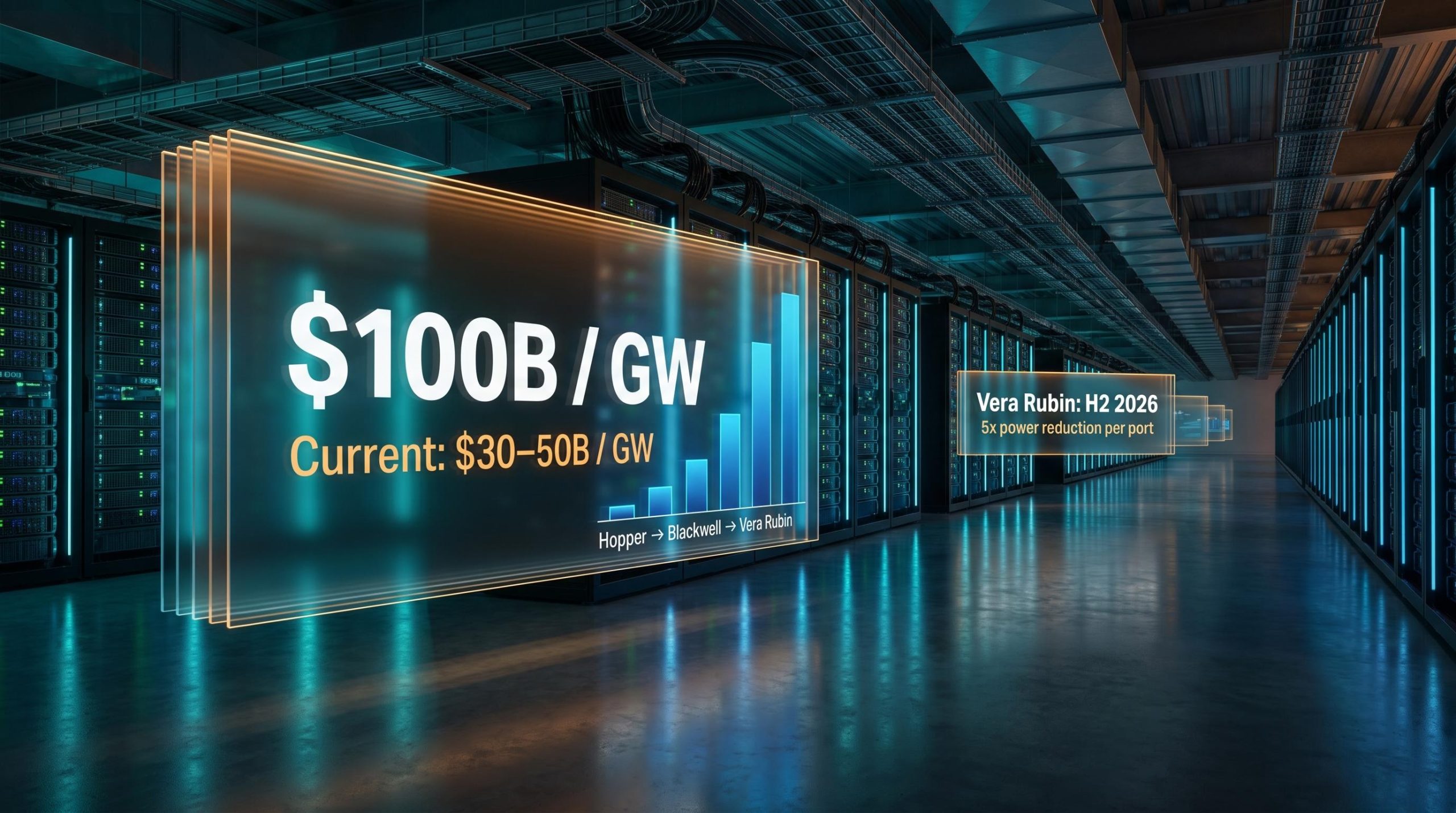
Jensen Huang said $100 billion of compute can be delivered per gigawatt of power. That number has been quoted, misquoted, and conflated with at least two other “$100 billion” figures circulating around Nvidia’s AI infrastructure story in 2026. Before you can evaluate what it means for data centre economics or Nvidia’s competitive position, the first step is understanding what the number actually refers to, and what it does not.
The $100 billion per gigawatt figure is a forward-looking efficiency target. It is not a description of what one gigawatt of AI compute costs or generates today. Getting that distinction wrong leads to materially inflated expectations, and it is easy to see why it happens: multiple “$100B” figures exist simultaneously in Nvidia’s public narrative, each referring to something different.
Here is how to separate the three claims, understand why power efficiency has become a financial metric rather than a technical specification, and know which numbers to track as the GPU upgrade cycle accelerates through the second half of 2026 and beyond.
Why the $100 billion figure is so easy to misread
At least three separate “$100 billion” narratives exist in Nvidia’s public communications and analyst coverage right now. They sound similar. They are not. Conflating them produces meaningfully different conclusions about what Nvidia’s AI infrastructure business is actually worth per unit of power.
The first strand is the forward-looking cost of a next-generation 1-GW AI factory. Huang has projected that a future facility at that scale could cost on the order of $100 billion in total, with Nvidia capturing roughly half through its compute and networking stack. Nvidia management has explicitly confirmed this is a forward-looking projection, not a description of current economics.
The second strand is what analysts model today. According to Nvidia management, current deployments produce approximately $30-40 billion in compute revenue for each gigawatt of power, with analyst models that capture broader networking revenue placing the figure closer to $40-50 billion. The precise figure depends on what you include, but the range is consistent: tens of billions, not a hundred.
The third strand is the Nvidia-OpenAI partnership. Nvidia committed up to $100 billion progressively as OpenAI deploys at least 10 GW of Nvidia-based AI data centres, beginning with the Vera Rubin platform in H2 2026. That $100 billion is spread across 10 GW, not per GW.
The Nvidia-OpenAI partnership press release confirms that Nvidia’s $100 billion commitment is structured progressively across at least 10 GW of deployments, with the first gigawatt on the Vera Rubin platform targeted for H2 2026, making the per-GW math in any single-facility comparison materially different from the total figure.
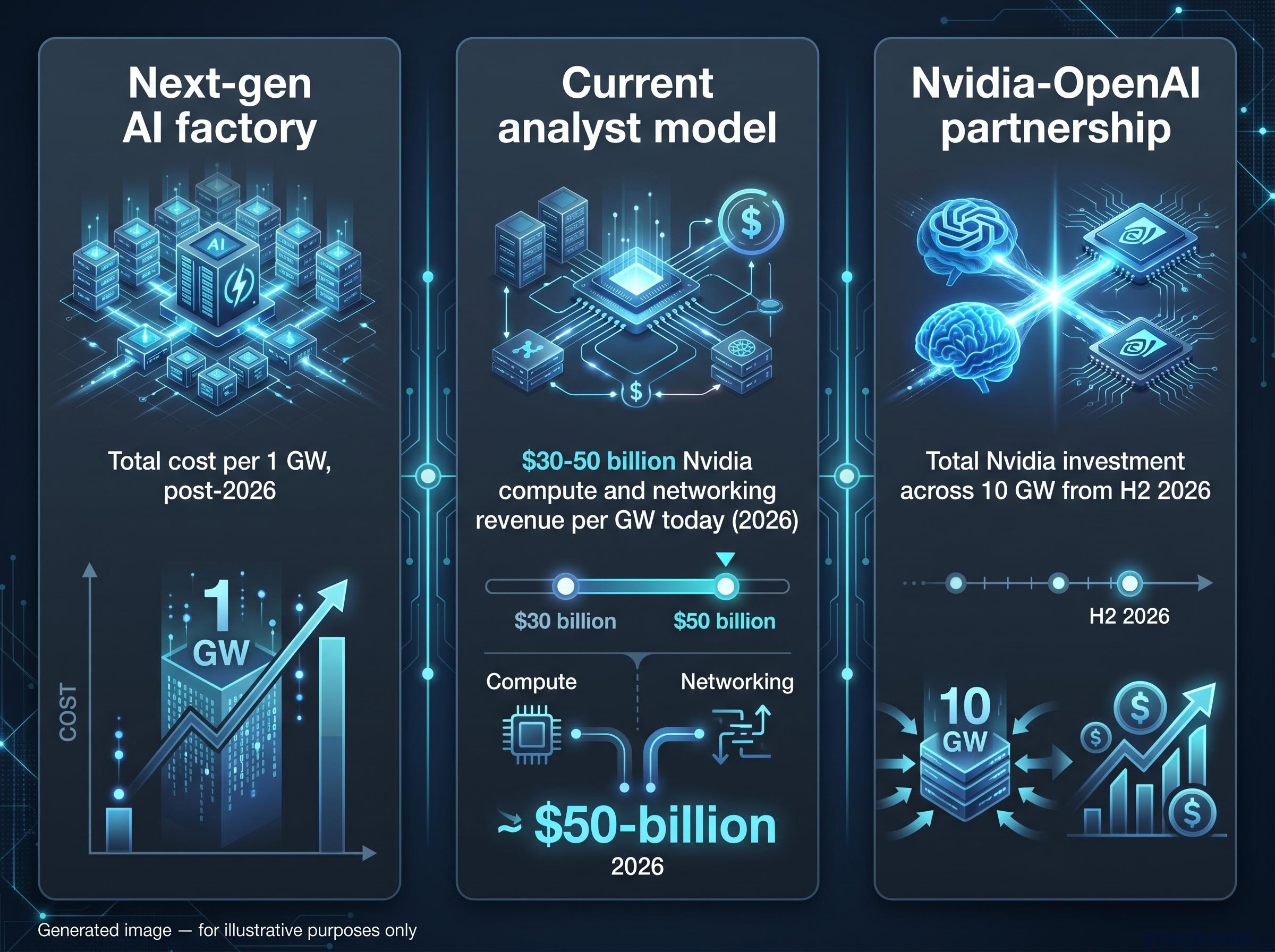
Nvidia management has confirmed that the $100B/GW figure is a forward-looking estimate, tied to expected gains in energy efficiency as new architectures roll out. It does not describe what current infrastructure costs or generates today.
| Narrative | What $100B refers to | GW scale | Timeframe |
|---|---|---|---|
| Next-gen AI factory projection | Total cost per 1 GW, future-state | 1 GW | Forward-looking, post-2026 |
| Current analyst model | Nvidia compute and networking revenue per GW today | 1 GW | Current, 2026 |
| Nvidia-OpenAI partnership | Total Nvidia investment across 10 GW | 10 GW | Deployments from H2 2026 |
Treating the forward projection as today’s benchmark overstates current economics by roughly two to three times. For any valuation or capital expenditure analysis built on that assumption, the distinction is material.
When big ASX news breaks, our subscribers know first
What makes a gigawatt the unit that matters
Power, not floor space or headcount, is now the binding constraint in large-scale AI data centres. Huang and the major hyperscalers increasingly describe their AI infrastructure in megawatts and gigawatts because available electricity and cooling capacity have become the rate-limiter for expanding AI compute. When you cannot get more power, the question shifts from “how big is your data centre” to “how much useful work can you extract from each watt.”
AI electricity demand at the grid level explains why power has become the binding constraint in the first place: the IEA projects combined data centre and AI consumption will exceed 1,000 TWh in 2026, more than double 2022 levels, which is why every discussion of AI infrastructure has shifted from floor space to gigawatts.
That is what the compute-revenue-per-GW ratio captures. It measures how much AI workload, and how much monetisable service, can be run on a fixed power envelope. If you are already familiar with capital efficiency ratios in other sectors, this framing is immediately legible:
- Revenue per employee in services: how much economic output each unit of your scarcest human capital produces
- Revenue per square foot in retail: how effectively you monetise your most constrained physical space
- Output per barrel in energy production: how much value you extract from each unit of your primary input
In AI infrastructure, the scarcest input is power. When a new GPU architecture improves how much useful compute can be extracted from each watt, it directly lifts margins and capital efficiency without requiring more land, more power contracts, or more cooling infrastructure. The same gigawatt simply earns more. That is why this ratio has migrated from engineering documentation into earnings calls and analyst models.
How GPU generations drive the revenue-per-gigawatt ratio upward
Each successive GPU platform improves the compute-revenue-per-GW ratio, and the progression from Hopper to Blackwell to Vera Rubin illustrates the pattern concretely:

- Hopper-class systems represent the current baseline. Dense AI deployments built on Hopper hardware support tens of billions in Nvidia compute revenue per GW. This is where the $30-50 billion current-state estimates originate.
- Blackwell delivers substantially better power efficiency compared to Hopper. Nvidia has confirmed the generational improvement. For a data centre operator, that means the same power envelope running Blackwell hardware supports more paying AI workloads than it did with Hopper.
- Vera Rubin, with initial deployment targeted for H2 2026, pushes further through advances in core GPU design, memory, interconnects, and networking. Each improvement aims to extract more useful AI work per watt consumed.
The economic logic connecting these steps is straightforward. If a new platform delivers more training and inference per watt, then a fixed gigawatt of power supports more paying workloads. That lifts revenue per GW even if the physical footprint and power contract stay constant.
The same gigawatt of power, occupied by a newer GPU generation, generates more monetisable compute. That is the financial core of Nvidia’s upgrade cycle argument.
This changes how hyperscaler customers think about hardware refreshes. The financial payoff of upgrading is now expressed in better GW monetisation, not just faster processing speeds. Nvidia’s pricing power is supported because customers pay not only for speed but for better monetisation of their most constrained resource: power. When you read Nvidia’s next GPU platform announcement, the most financially significant claim is not the performance headline but what the new architecture does to the revenue-per-GW ratio at customer facilities.
System-level efficiency: where the rest of the gains come from
Chip-level efficiency gains alone are not sufficient to reach the $100 billion per GW forward projection. The rest of the gains come from interconnects, networking, and system architecture, each contributing meaningfully to the ratio. Nvidia has structured its roadmap to optimise across the full stack, not just the GPU itself.
Three layers matter:
- GPU architecture: Each generation (Blackwell, Vera Rubin) improves compute-per-watt at the chip level, the foundation of the ratio.
- NVLink interconnects: High-bandwidth links between GPUs reduce the proportion of power consumed by moving data rather than performing useful computation. Every watt shifted from communication to compute improves total economic output per GW.
- Spectrum-X Ethernet Photonics: Co-packaged optics deliver up to 5x power reduction per port in relevant configurations. As of July 2026, this technology has moved into active production and is seeing strong uptake across the customer base. That 5x improvement is not a footnote in a technical specification; it represents a direct improvement in how many billable AI workloads can run per GW of power committed to a cluster’s networking layer.
Nvidia’s co-packaged optics technical documentation details how integrating optical engines directly onto the switch ASIC reduces power consumption by up to 3.5x per port, the underlying mechanism that supports the efficiency improvements cited in Nvidia’s architecture roadmap and referenced in earnings-call discussions of the revenue-per-GW ratio.
The underlying principle is consistent across all three layers. Every watt that can be shifted from moving bits to doing useful compute improves total economic output per gigawatt. Nvidia’s confirmed product roadmap, fully on schedule as of 12 July 2026, including the Rubin Ultra timeline and NVLink domain architecture disclosed at Computex, reflects this full-stack approach.
What the Feynman platform adds
From the Feynman platform onwards, due in calendar year 2028, hyperscaler customers will have the option to select between NVLink implementations built on co-packaged optics or copper interconnects. That optionality gives hyperscalers flexibility in how they balance power reduction against cost at very large cluster scales.
Feynman is the furthest confirmed point on Nvidia’s roadmap and serves as evidence that system-level efficiency planning is already embedded in hardware decisions at least two generations forward. If you are assessing how durable Nvidia’s efficiency trajectory is, the fact that 2028 platform decisions are already designed around power optimisation tells you this is a structural priority, not a single-generation improvement.
Four metrics investors should start tracking now
The conceptual framework is useful only if you can apply it to real-world signals. Here are four specific metrics that operationalise the power-efficiency thesis, each framed as an observable signal with a clear interpretation:
- Compute revenue per GW. Current range: approximately $30-50 billion per GW depending on scope. Forward projection: approaching $100 billion for next-generation AI factories. If you see this estimate rising over successive quarters and platform launches, it validates that architectural efficiency gains are translating into real data centre economics. A stagnant or declining figure would challenge the thesis directly.
- GPU architecture at announced GW-scale power deals. When a hyperscaler announces a new multi-hundred-megawatt or GW-scale commitment, the question to ask is: which GPU generation will fill that power? The same 1 GW occupied by Vera Rubin versus a prior generation represents a materially different economic outcome for Nvidia. The architecture named in the deal matters more than the wattage.
- GPU upgrade cycle cadence. If customers accelerate their hardware refresh cycles, it signals they are actively chasing efficiency gains per watt rather than simply adding raw capacity. Faster refreshes validate that Nvidia’s generational improvements are compelling enough to justify the capital expenditure of swapping hardware before it reaches end-of-life.
- Competitive compute-per-watt benchmarks. AMD, Intel, and custom hyperscaler silicon are all competing on performance per watt. Whether Nvidia’s efficiency advantage is expanding, holding, or being closed by competitors determines whether the $100B/GW ambition is durable or vulnerable. A widening lead supports pricing power. A narrowing gap pressures it.
Custom silicon competition from Alphabet, Amazon, and Microsoft is most acute in inference workloads, which are projected to represent approximately 80% of the AI accelerator market by 2030, meaning the competitive compute-per-watt benchmark you track matters most in the segment where hyperscaler in-house chips are already purpose-built to compete.
Watching these four metrics together is more revealing than any single GW announcement or quarterly revenue figure in isolation. When they move in the same direction, rising compute revenue per GW, next-generation architectures named in new power deals, faster refresh cycles, and a widening efficiency lead, that would constitute strong evidence that the $100B/GW projection is tracking as a realistic medium-term outcome rather than a marketing aspiration.
What the $100B/GW target actually tells you about Nvidia’s long-term positioning
The $100 billion per gigawatt figure is most useful not as a present-day benchmark but as a directional signal. It tells you where Nvidia believes AI data centre economics are heading, and it tells you that the company is making a strategic bet that power efficiency will be the axis on which competition is fought.
The current gap is clear. Today’s dense AI deployments support approximately $30-50 billion of Nvidia compute revenue per GW. The $100 billion target represents roughly a doubling to tripling of economic output from the same power footprint. That gap is where the architectural roadmap does its work: Blackwell, Vera Rubin, and Feynman each move the ratio upward, with Vera Rubin’s initial deployment in H2 2026 serving as the first major step under the current roadmap.
The question to carry forward is not whether Nvidia will hit $100 billion per GW in a specific year. It is whether the compute-revenue-per-GW ratio continues to improve at the pace the architectural roadmap implies. Every future Nvidia announcement related to power, efficiency, or AI factory economics can be read through that single lens: is the ratio moving in the direction the roadmap promises, and at the speed it needs to?
For investors wanting to understand how export control dynamics affect Nvidia’s addressable compute revenue globally, our dedicated guide to Nvidia’s China gray-market pricing covers the mechanics of locked-out demand, why the 2x DGX B300 premium represents upside Nvidia cannot capture, and how policy changes could reprice the China segment faster than any product cycle.
This article is for informational purposes only and should not be considered financial advice. Investors should conduct their own research and consult with financial professionals before making investment decisions. Forward-looking projections, including Nvidia’s $100B/GW target, are subject to market conditions, technological progress, and competitive dynamics.