SK Hynix Raises $26.5B in Nasdaq Debut, Opens 14% Above Offer
5 mins ago

Until last week, most U.S. retail investors had no straightforward way to buy shares in the company that supplies roughly 60% of the world’s high-bandwidth memory chips. SK Hynix, the South Korean semiconductor maker whose memory architecture sits inside virtually every Nvidia GPU cluster powering AI data centres, was confined to the Korean Stock Exchange and out of reach for standard American brokerage accounts.
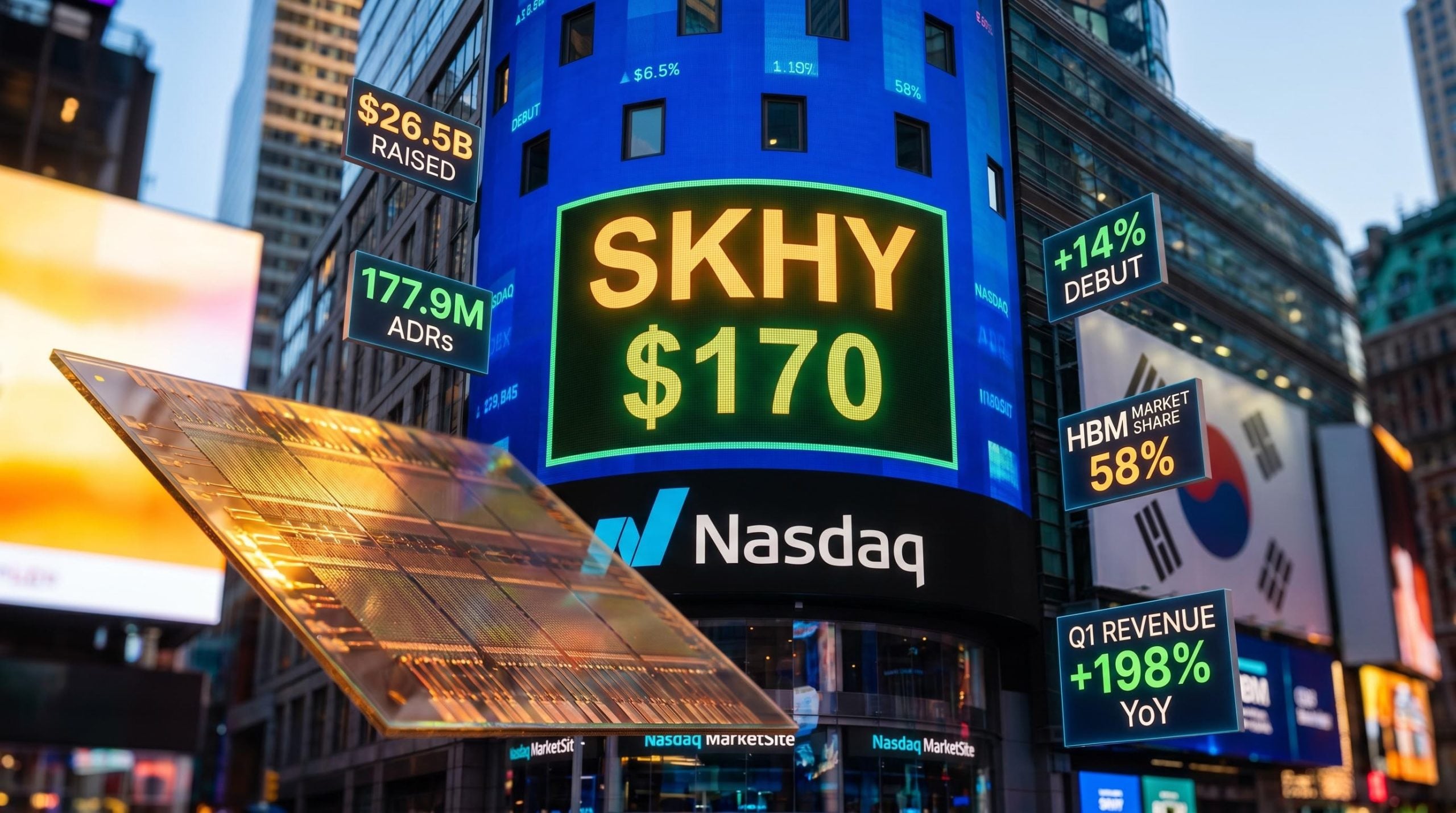
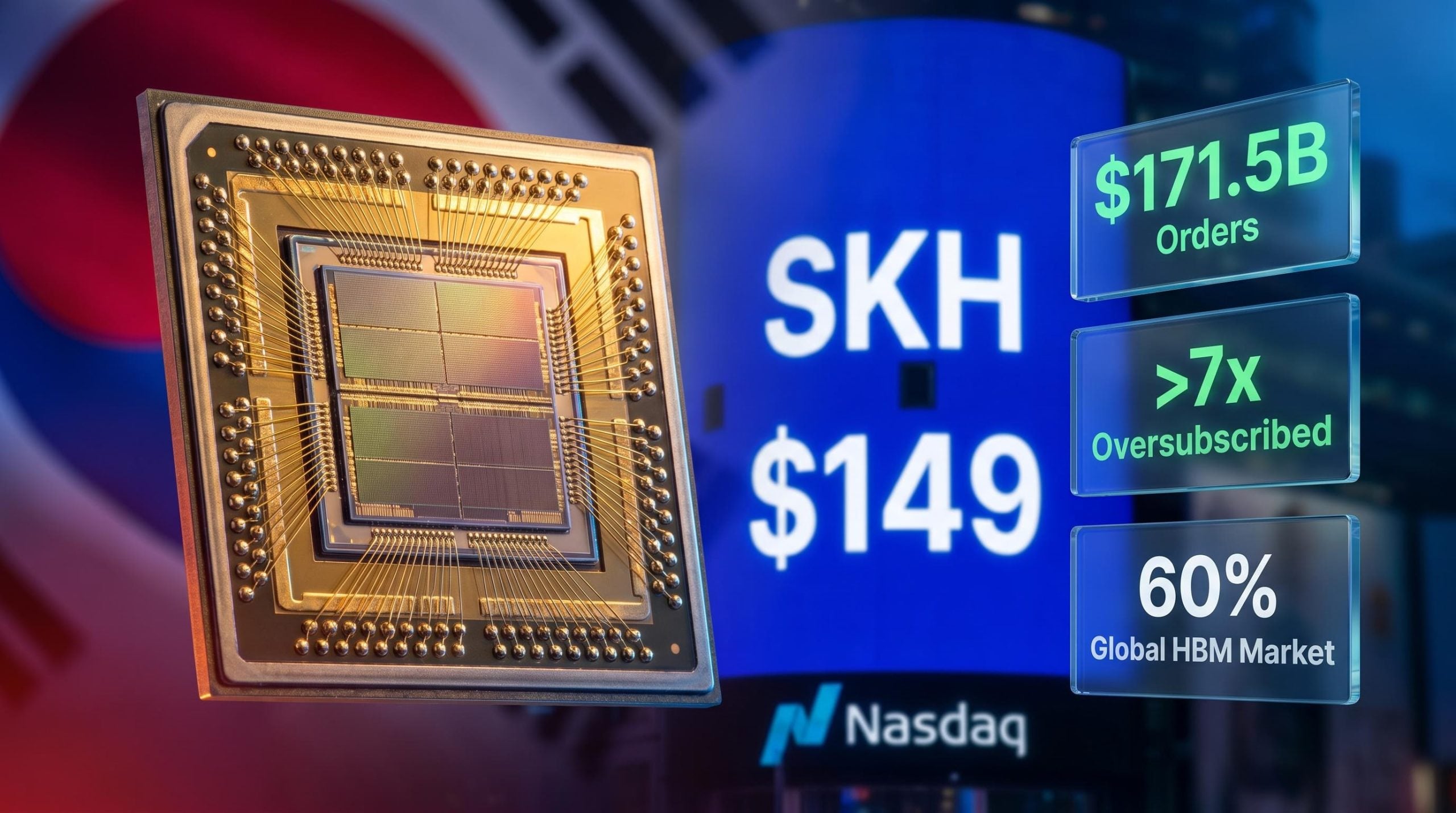
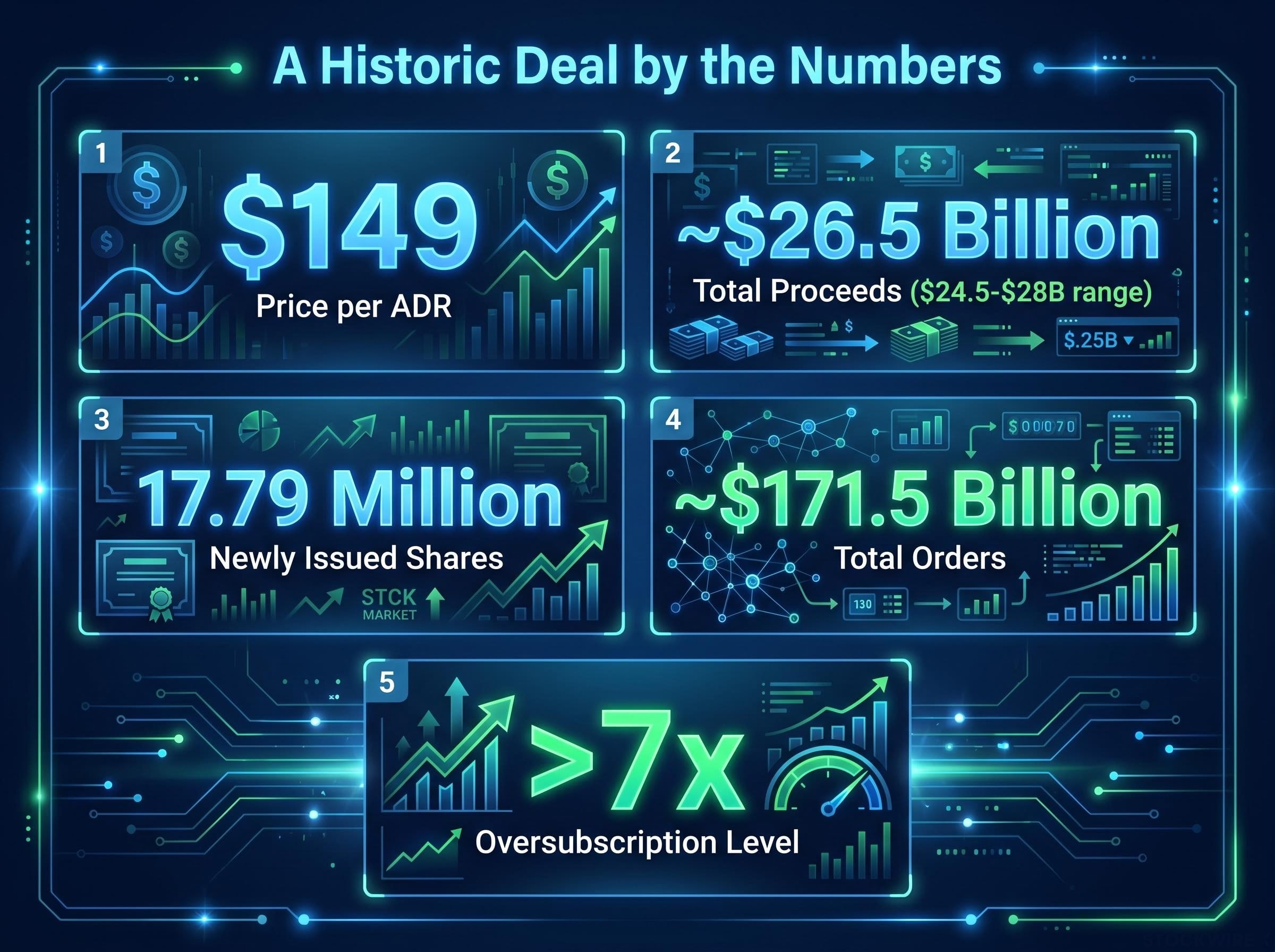
That changed with a Nasdaq listing that generated approximately $171.5 billion in orders for a deal worth roughly $26.5 billion. The demand was more than seven times the shares on offer.
Here is what the listing structure means for you as an investor, what the emerging ETF activity could change about how you access this stock, and what risks arrive bundled with the opportunity.
Can you buy SK Hynix in your Schwab or Fidelity account right now? Yes. That is what this listing accomplished. SK Hynix ADRs trade on Nasdaq and are accessible through any standard U.S. brokerage, just like a domestic stock.
An American Depositary Receipt (ADR) is a certificate issued by a U.S. depositary bank that represents shares in a foreign company. The bank holds the underlying foreign shares; you buy and sell the receipt on a U.S. exchange in U.S. dollars. Here is how the process works in four steps:
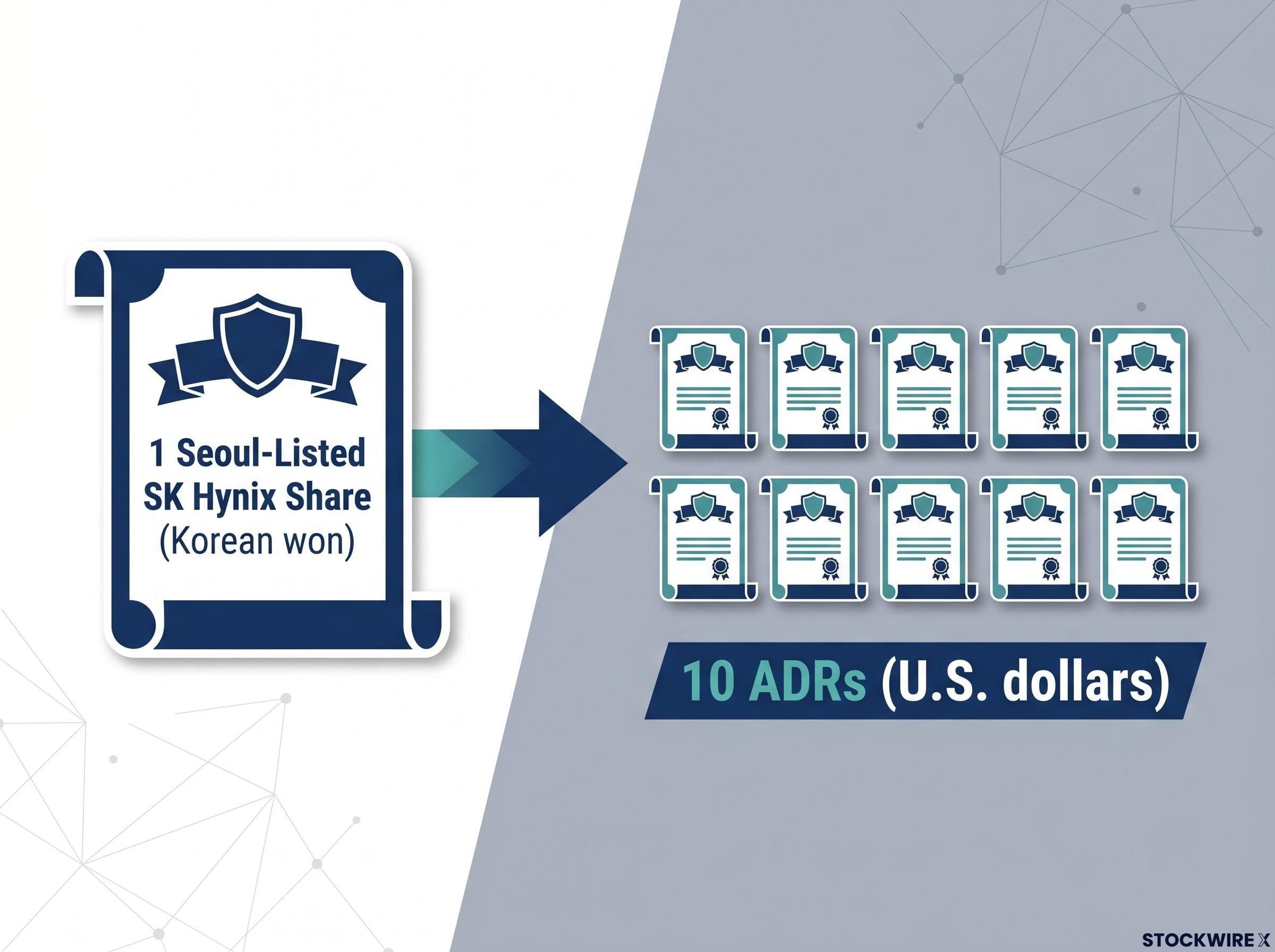
Before this listing, your options for SK Hynix exposure were limited: open a Korean brokerage account, or buy broad semiconductor ETFs that diluted the specific HBM exposure you were after.
Investing in South Korean stocks through channels other than the ADR route, including direct KRX access via an international broker and MSCI Korea ETFs, involves a distinct set of cost and complexity trade-offs, including the exchange’s plus or minus 30% daily price limit that can temporarily block exits during volatile sessions.
The ADR price you see on Nasdaq reflects two things simultaneously: the underlying share price in Korean won, and the won/USD exchange rate. A strengthening Korean won amplifies your dollar return. A weakening won erodes it, even if the Seoul-listed share price holds steady. This means your return as a U.S. investor is never purely a function of SK Hynix’s business performance.
The numbers tell the story before any analysis does. Priced at $149 per ADR, the transaction brought in roughly $26.5 billion across 17.79 million newly issued depositary receipt shares.
How this ranks historically depends on who is doing the framing. Some outlets describe it as the largest U.S. listing by a foreign company. MarketWatch frames it as potentially the second-largest equity offering ever, placing it behind only the SpaceX IPO completed the previous month. Both framings are circulating; neither has become the consensus characterisation.
The ADR ratio and pricing structure directly determine how these shares move relative to fluctuations on the Korean exchange. If you are watching price action in the first trading sessions, understanding that $149 represents one-tenth of a Seoul-listed share, adjusted for currency, is the baseline.
Start with the product. High-bandwidth memory (HBM) is the memory architecture required by AI accelerator chips, including Nvidia’s GPUs. It is not a general-purpose memory product; it is engineered specifically for the data throughput that AI training and inference demand.
SK Hynix holds approximately 60% of the global HBM market, according to Counterpoint Research.
That market share figure is the single most important number in the investment case. It means SK Hynix’s revenue trajectory is closely tied to how aggressively hyperscalers, the companies operating the largest AI data centres, deploy infrastructure. This is a high-beta play on AI spending, not a defensive semiconductor holding.
The company has committed to a 100 trillion won (approximately $64 billion) multi-year capital expenditure programme covering new DRAM and NAND facilities. That is not just maintenance spending; it is a bet that AI infrastructure demand is structural, not cyclical.
The structural demand case for HBM rests on several reinforcing factors:
Hyperscaler capital expenditure at this scale, Goldman Sachs projects approximately $770 billion collectively in 2026, compresses near-term profitability for the buyers while creating structural pricing power for suppliers, a dynamic that explains why semiconductor vendors rather than the cloud operators themselves are capturing the cycle’s most durable margin expansion.
The cyclical risk is real, however. Even with structural HBM demand, semiconductor capital expenditure is subject to hyperscaler spending cycles. The April-May 2026 rally and subsequent pullback in AI-exposed stocks demonstrated that this volatility is not theoretical.
The share price arc heading into this listing tells a story of extraordinary momentum followed by a sharp correction, followed by institutional investors stepping in anyway.
| Metric | Figure | Source |
|---|---|---|
| 12-month share price return | ~650-680% | Original source (~650%); Investing.com (~680%) |
| Year-to-date 2026 return | ~273% | Reuters |
| Pre-listing pullback | ~25% in final two weeks | Investing.com |
| Total order book value | ~$171.5 billion | Multiple outlets |
| Oversubscription level | >7x | Multiple outlets |
The minor discrepancy between the 650% and 680% twelve-month figures reflects slightly different measurement windows across sources. Both tell the same story: this is one of the most dramatic share price rallies in global semiconductor history.
Approximately $171.5 billion in orders were placed against roughly $26.5 billion in available shares, making this one of the most oversubscribed equity offerings on record.
The anchor investor roster adds specificity to the demand picture. Baillie Gifford, Coatue Management, and Situational Awareness Partners jointly indicated willingness to buy up to $7 billion of ADRs. These are not momentum traders; they are institutions with multi-year holding horizons.
A 25% pullback followed by 7x oversubscription tells you that institutional investors treated the dip as an entry point rather than a warning sign. That distinction matters when assessing whether opening-day pricing reflects fair value or premium. Retail investors buying into the ADR in the secondary market are entering at a different risk-reward point than the anchor investors were.
According to regulatory filings as reported by Investing.com, no fewer than 10 fund managers, among them prominent ETF providers Direxion and ProShares, have lodged formal registrations with regulators to introduce single-stock exchange-traded funds tied to SK Hynix in the wake of its Nasdaq debut.
Evidentiary caveat: This ETF filing claim is sourced to one outlet and was not independently confirmed by CNBC, The Wall Street Journal, Reuters, MarketWatch, or broader Investing.com coverage as of the time of publication. Treat this as a reported but unconfirmed development.
Whether or not these specific filings are confirmed, the pattern is worth understanding. Single-stock ETFs are leveraged and inverse products that use daily rebalancing to amplify (or invert) the returns of a single underlying security. If they launch around SK Hynix, they will attract retail traders seeking amplified exposure to AI-memory volatility, which can affect the underlying ADR’s short-term price dynamics.
The risks specific to these instruments are well established:
If you are considering SK Hynix ADRs as a long-term AI-infrastructure position, single-stock ETFs are a fundamentally different product with a fundamentally different risk profile.
Single-stock leveraged ETFs do not hold shares directly; they use total return swap contracts with an investment bank, adding a layer of counterparty risk that is entirely absent from owning the underlying ADR, and a 2x product on a volatile name like SK Hynix can underperform the stock by dozens of percentage points over a multi-month holding period even when the directional call is correct.
The SK Hynix deal establishes one thing clearly: U.S. institutional and retail appetite for direct Asian semiconductor exposure exists at scale. That creates rational incentives for other Asian tech companies with U.S. investor relevance to consider their own Nasdaq listings.
One reported candidate in this space is Japan’s Kioxia Holdings, a significant NAND memory producer whose own share price trajectory has drawn attention.
Evidentiary caveat: The claim that Kioxia is readying itself for a U.S. exchange listing, along with the reported share appreciation of more than 2,900% over the preceding twelve months, derives from a single source and has not been independently corroborated by any major outlet’s reporting. Both the listing preparation and the share performance figure should be treated as unverified until confirmed through independent sources.
If the Kioxia reports prove accurate, U.S. investors could gain direct access to a second major memory-chip supplier within months, meaningfully expanding the investable AI-infrastructure universe on Nasdaq.
The broader incentive structure for Asian tech ADR listings rests on several factors:
The “end of an ADR slowdown” narrative is analytically plausible, but it remains interpretive commentary rather than a documented market trend. What the SK Hynix deal confirms is the demand side of the equation. Whether supply follows depends on individual company decisions that have not yet been announced.
| What the listing confirms | What remains unconfirmed or forward-looking |
|---|---|
| A historically large ADR deal (~$26.5 billion) | Single-stock ETF filings by Direxion, ProShares, and others |
| Exceptional institutional demand (~$171.5 billion in orders, >7x oversubscribed) | Kioxia’s reported U.S. listing preparation |
| ~60% HBM market share (Counterpoint Research) | Whether the broader ADR pipeline from Asian tech is reopening |
| Direct access for U.S. retail investors via standard brokerage accounts | Whether peak AI capex spending has already been priced in |
The confirmed side of the ledger is substantial. The institutional conviction, the structural HBM position, and the new access point for U.S. investors are all real.
The risk side is equally real. The ADR carries embedded Korean won/USD currency exposure. The semiconductor sector remains subject to geopolitical supply-chain risks and trade policy shifts. And the $171.5 billion order book, while extraordinary, was formed at a specific moment in the AI spending cycle. Retail investors entering in the secondary market are buying at a different point in the risk curve than the anchor investors who locked in allocations during the bookbuild.
Investors who enter the SK Hynix ADR with a clear understanding of both columns are positioned to make a deliberate choice rather than one driven by listing-week momentum.
Investors wanting to stress-test the structural demand case against the bear scenario will find our dedicated guide to the capex-to-revenue lag risk in semiconductor stocks, which examines Morningstar’s 18-24 month revenue conversion timeline and quantifies how much of the AI capex cycle may already be priced into current semiconductor valuations.
This article is for informational purposes only and should not be considered financial advice. Investors should conduct their own research and consult with financial professionals before making investment decisions. Past performance does not guarantee future results.
An American Depositary Receipt (ADR) is a certificate issued by a U.S. depositary bank representing shares in a foreign company, allowing U.S. investors to trade them on a domestic exchange in dollars. For SK Hynix, 10 ADRs equal one Seoul-listed share, and the ADRs trade on Nasdaq through any standard U.S. brokerage account.
The SK Hynix Nasdaq listing raised approximately $26.5 billion at $149 per ADR, attracting roughly $171.5 billion in total orders, making it more than 7 times oversubscribed and one of the most demanded equity offerings on record.
High-bandwidth memory (HBM) is a specialised memory architecture required by AI accelerator chips, including Nvidia GPUs, for the data throughput that AI training and inference demand. SK Hynix controls approximately 60% of the global HBM market, making its revenue directly tied to hyperscaler AI infrastructure spending.
The ADR price on Nasdaq reflects both the underlying Seoul share price and the Korean won to U.S. dollar exchange rate simultaneously, meaning a weakening won erodes your dollar return even if SK Hynix's share price holds steady in Korea.
Single-stock leveraged ETFs use daily rebalancing, which causes compounding divergence over time: a 2x product delivers 2x the daily return, not 2x the monthly or quarterly return, and volatility decay can cause these products to significantly underperform the underlying ADR over multi-month holding periods even when the directional call is correct.