
US Patent Office grants composition of matter patents across PYC’s three clinical programs
On 8 July 2026, PYC Therapeutics (ASX:PYC) announced that the US Patent Office has granted composition of matter claims covering all three of its clinical-stage RNA drug candidates. PYC is a precision medicine company dedicated to changing the lives of patients with genetic diseases who have no treatment options available.
The company operates across Perth, Australia and San Francisco, California.
When big ASX news breaks, our subscribers know first
What the patents cover and how long they run
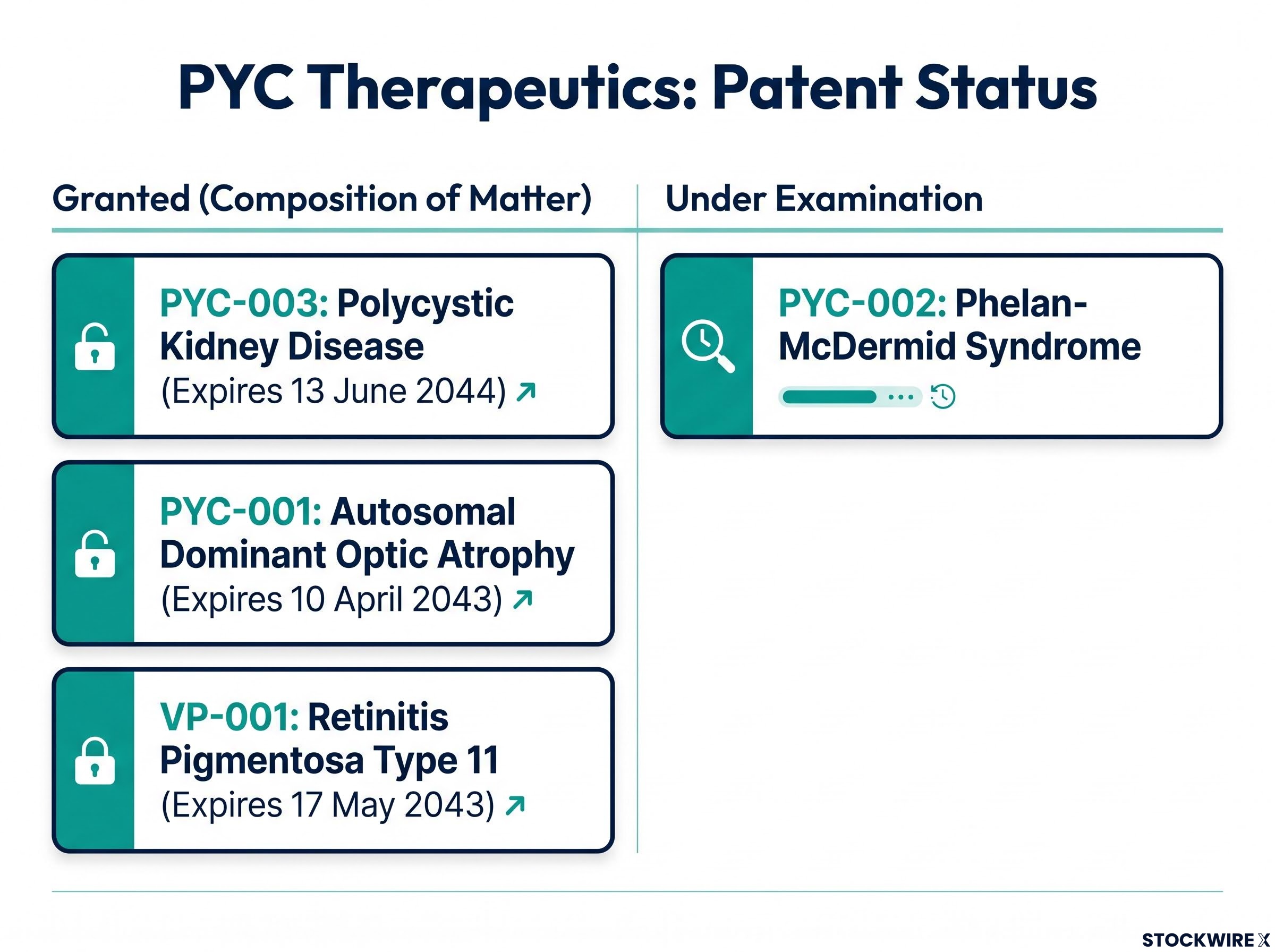
The grant applies to composition of matter claims, the specific legal term used by the company, across three clinical-stage programs. Each patent extends drug candidate protection into the 2040s, as set out below.
| Drug Candidate | Target Disease | Patent Protection Until |
|---|---|---|
| PYC-003 | Polycystic Kidney Disease | 13 June 2044 |
| PYC-001 | Autosomal Dominant Optic Atrophy | 10 April 2043 |
| VP-001 | Retinitis Pigmentosa Type 11 | 17 May 2043 |
The company’s fourth program, PYC-002, which targets Phelan-McDermid Syndrome, is not covered by this grant. According to the announcement, the patent claims for PYC-002 are yet to be examined.

Why composition of matter patents matter for biotech investors
For investors, the significance lies in the length of exclusivity.
PYC’s model centres on a proprietary drug delivery platform designed to enhance the potency of RNA therapies that target monogenic (single-gene) diseases.
What this means for PYC’s pipeline and outlook
With three of its four programs now holding granted composition of matter protection, PYC’s core pipeline IP is secured well into the next two decades. The protected candidates address Polycystic Kidney Disease (PYC-003), Autosomal Dominant Optic Atrophy (PYC-001), and Retinitis Pigmentosa Type 11 (VP-001).
VP-001 and PYC-001 clinical data presented at ARVO 2026 showed VP-001 treated eyes dosed at 30 mcg or more achieving a 21.4% rate of 10-letter or greater vision gain versus 3.1% in natural history controls, while PYC-001 demonstrated low-contrast visual acuity improvements extending beyond 60 weeks.
The patent claims for PYC-002, targeting Phelan-McDermid Syndrome, remain under examination and stand as a forward item for investors to watch. The announcement does not disclose any expected timing or outcome for that examination.
PYC is a precision medicine company dedicated to changing the lives of patients with genetic diseases who have no treatment options available.
PYC’s drug development programs target monogenic diseases, which the company notes are the indications with the highest likelihood of success in clinical development. The company positions its work within the rapidly growing and commercially proven RNA therapeutic class.
For readers wanting to track the PYC-003 safety and dosing timeline in full, our detailed coverage of PYC-003 cohort progression walks through the Safety Review Committee approval process, the efficacy biomarkers being measured across cohorts, and what a successful Phase 1a/1b readout would need to demonstrate to unlock a combined Phase 2/3 registrational trial.
Don’t Miss the Next Biotech Breakthrough on the ASX
Get FREE breaking ASX healthcare and biotech news delivered to your inbox within minutes of release, complete with in-depth analysis already done for you. Join 20,000+ investors who never miss a market-moving announcement. Click the “Free Alerts” button at Big News Blast to stay ahead of the next big biotech move.