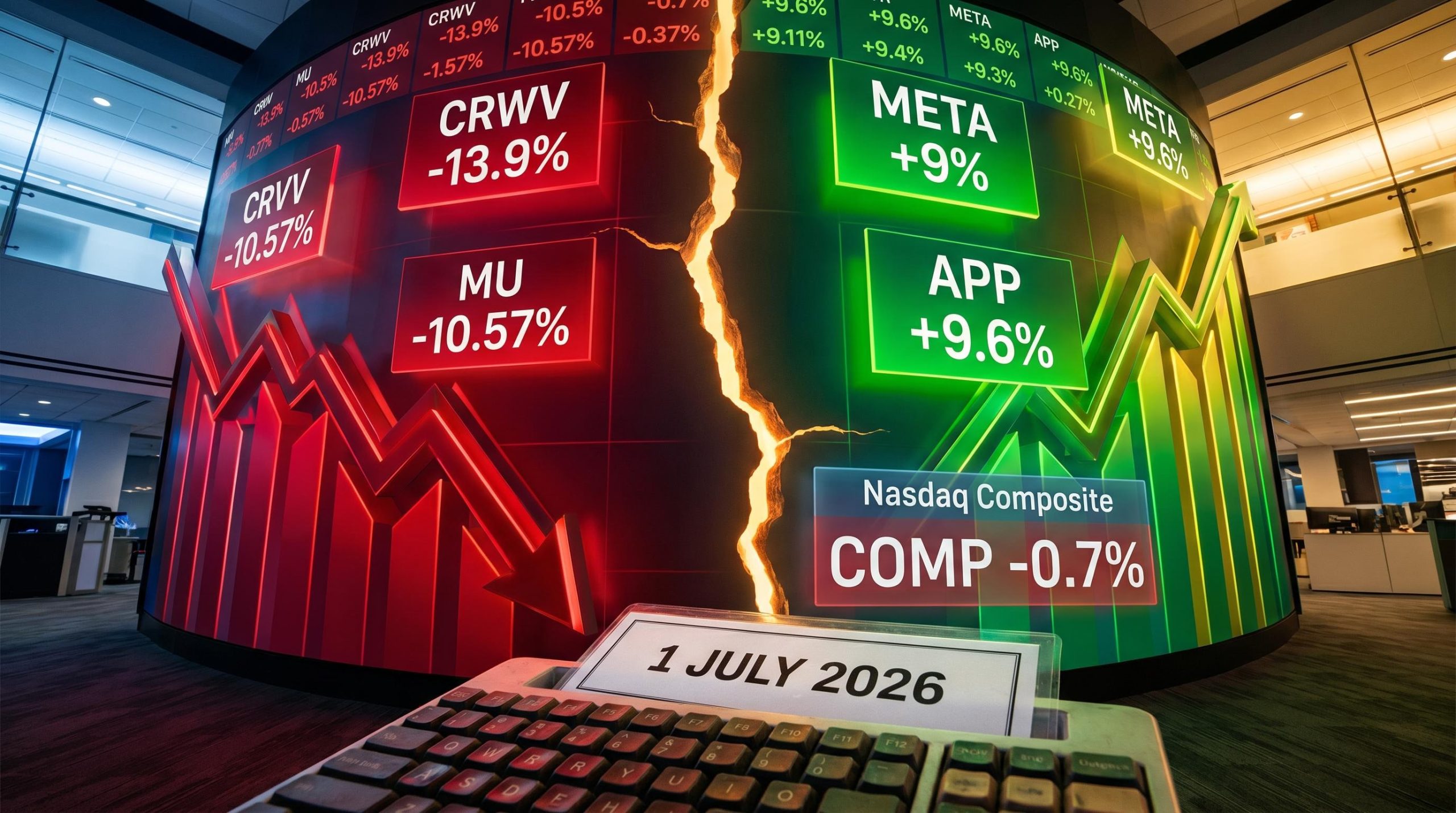
CoreWeave fell nearly 14% on Tuesday. Meta Platforms surged nearly 9%. Both moves happened in the same session, within the same sector, driven by the same theme: artificial intelligence.
That contradiction defined the first trading day of Q3 2026. Investors entered 1 July at historically elevated valuations, coming off Wall Street’s strongest quarter in six years. Positioning in AI hardware names was stretched after multi-hundred-percent appreciation over the prior twelve months. The conditions were set for something to break, and on Tuesday, it did.
Here is what the split between winners and losers tells you about how the AI and semiconductor stocks trade is changing, and which side of that fault line matters more as the new quarter begins.
How the first day of Q3 2026 broke the AI trade in two
The scorecard from 1 July tells the story faster than any index number can.
| Stock | Category | 1 July Move |
|---|---|---|
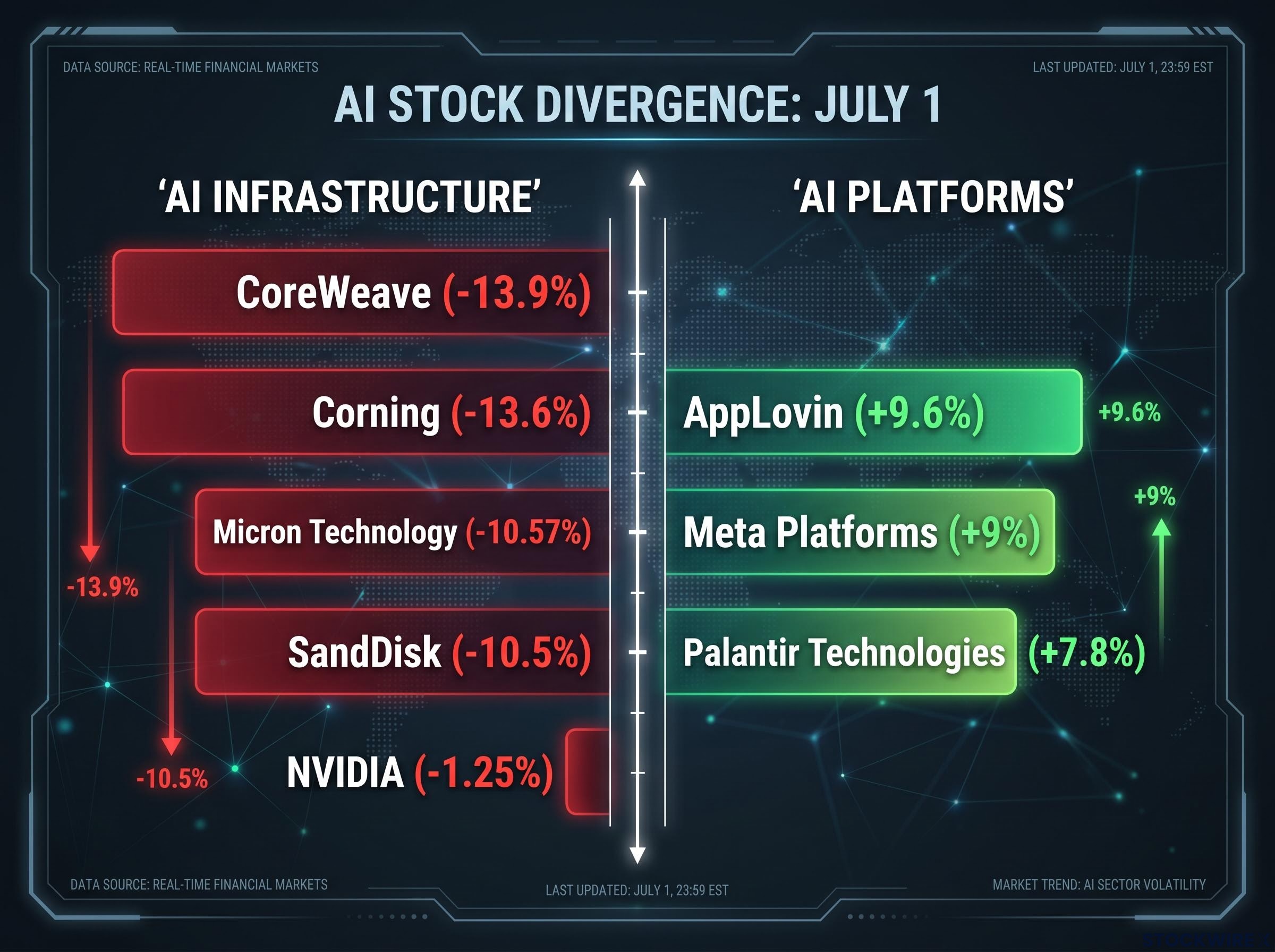
| CoreWeave | AI Infrastructure / GPU Cloud | -13.9% |
| Corning | AI Infrastructure / Optical | -13.6% |
| SandDisk | AI Infrastructure / Storage | -10.5% |
| Micron Technology | AI Infrastructure / Memory | -10.57% |
| NVIDIA | AI Infrastructure / GPU | -1.25% |
| AppLovin | AI Platform / Ad-Tech | +9.6% |
| Meta Platforms | AI Platform / Advertising | +9% |
| Palantir Technologies | AI Platform / Enterprise | +7.8% |
The Nasdaq Composite fell just 0.7% on the session. CoreWeave fell 13.9%. The index barely moved; individual names moved violently. This was not broad selling. It was targeted repricing.
The broader indices held far steadier, with the S&P 500 shedding 0.2% and the Dow closing only marginally lower. Against that backdrop, double-digit moves in opposite directions within the same sector tell you the market is no longer buying “AI exposure” as a single trade. It is now asking a sharper question: which AI companies actually convert infrastructure spending into durable earnings, and which ones simply depend on it?
Low index-level volatility across AI-heavy benchmarks had been masking precisely this type of distributional divergence for months, as large opposing moves by individual winners and losers cancel each other out, leaving investors exposed to single-stock risk they believed they had diversified away.
When big ASX news breaks, our subscribers know first
What separates the winners from the losers in the AI trade
The divergence was not random. It ran along a structural fault line that has been building for months, and it comes down to how these businesses generate revenue.
Why infrastructure names face structural pressure
AI hardware and infrastructure companies share vulnerabilities that the session made visible:
- Hyperscaler capex dependency: Their growth narrative relies on sustained data centre build-outs by a small number of cloud giants. Any moderation in that spending hits demand directly.
- Inventory and oversupply risk: Memory, storage, and optical components trade as commodity-like hardware categories, where supply can overshoot demand faster than pricing can adjust.
- Single-end-market concentration: The AI revenue uplift for these names comes overwhelmingly from one demand driver. There is limited diversification if that driver slows.
- Guidance sensitivity: Even modest disappointments in capex or earnings guidance from hyperscalers disproportionately affect hardware suppliers further down the chain.
Hyperscaler capex commitments for 2026 sit in the $600-$805 billion range, a scale that has made infrastructure suppliers’ revenue narratives almost entirely dependent on continued data centre build-out, and that dependency is exactly what the market began repricing on 1 July.
Why platform names held and gained
Meta, AppLovin, and Palantir represent structurally different AI exposure:
- Existing monetisation engines: Each has large user bases or enterprise contract portfolios generating revenue independent of AI capex cycles. AI enhances what already works.
- AI as enhancement, not thesis: Meta layers AI into its advertising platform. AppLovin uses AI to optimise ad-tech targeting. Palantir deploys AI within existing enterprise software contracts. None depends on AI as the entire revenue story.
- Near-term revenue visibility: Demonstrated monetisation provides clearer forward earnings projections, which supports more stable valuations even in volatile sessions.
- Specific catalyst: Meta’s cloud business expansion announcements on 1 July directly reinforced the narrative of a platform company actively monetising AI capabilities, driving its 9% gain.
The question to ask of any AI holding is not “does this company use AI” but “does this company have a revenue engine that AI makes better, or is AI the entire revenue thesis?” Tuesday’s session answered that question with price.
Micron’s 10% drop tells the story of stretched valuations meeting a reality check
Micron Technology closed at $1,032.28 on 1 July, down 10.57% from its 30 June close of $1,154.29. The decline was the session’s clearest example of what happens when extraordinary appreciation meets even minor positioning shifts.
Micron had appreciated approximately +744% over the prior twelve months and +262% year-to-date as of 1 July. Its 52-week range stretched from $103.38 to $1,255.00. A 10.57% single-day decline, against that backdrop, is arithmetic, not panic.
The business itself was not the problem. Micron’s most recent quarterly results confirmed strong execution:
- Q1 FY2026 revenue: $13.64 billion (versus $11.32 billion the prior quarter and $8.71 billion a year earlier)
- GAAP net income: $5.24 billion ($4.60 diluted EPS)
- Operating cash flow: $8.41 billion (versus $5.73 billion the prior quarter and $3.24 billion a year earlier)
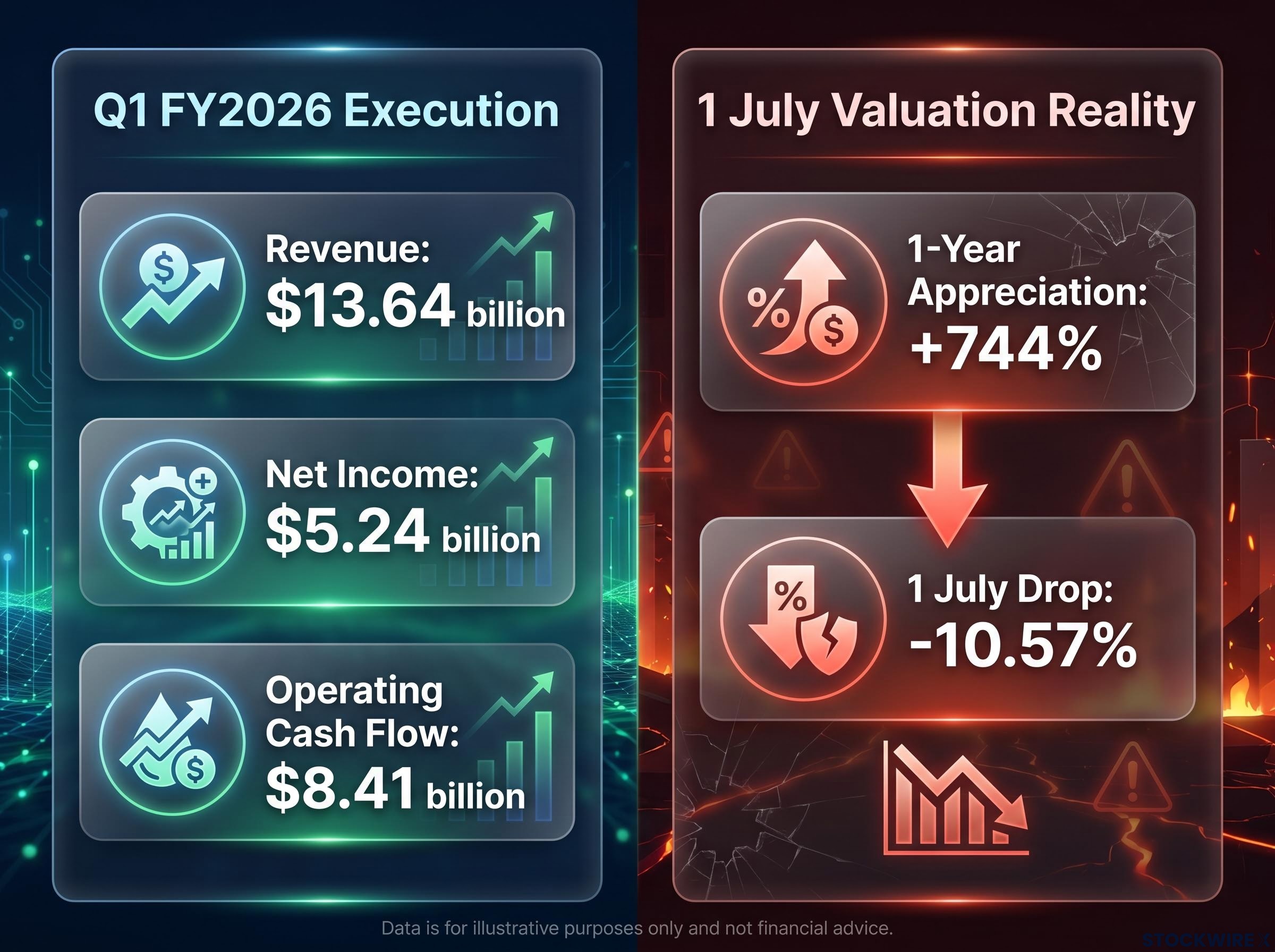
Revenue, earnings, and cash flow were all growing sequentially and year-over-year. The fundamentals were not the trigger. The trigger was starting valuation.
Micron’s forward earnings multiple, at approximately 7.58x-8.9x despite posting record quarterly revenue, placed it far below historical memory-sector valuation peaks, meaning the 10.57% single-day decline was driven by positioning and momentum rather than a genuine fundamental rerating of the business.
When a stock has appreciated +744% in a year, even excellent delivery leaves almost no margin for error. Positioning becomes extended, and any catalyst for profit-taking, however modest, produces outsized moves. That dynamic applies to every AI hardware name that experienced similar multi-hundred-percent appreciation over the past year.
Why the quarter boundary turned a market shift into a market event
The timing was not coincidental. 1 July was the first session of Q3 2026, arriving immediately after what market data characterised as Wall Street’s strongest quarter in six years. That calendar fact matters.
Three specific repositioning dynamics converged at the quarter boundary:
- Rebalancing after extreme outperformance. Portfolio managers who rode AI hardware names to multi-hundred-percent gains in Q2 had a natural institutional incentive to trim and rebalance at the quarter turn.
- Profit-taking in the most extended names. Memory, storage, optical connectivity, and GPU cloud names carried the most stretched valuations, making them the most obvious candidates for position reduction.
- Redeployment toward earnings-visible platforms. Capital freed from hardware names moved toward platform companies with demonstrated AI monetisation and clearer near-term revenue visibility.
After-hours futures on 1 July told a consistent story. S&P 500 futures settled roughly 0.1% lower at 7,536.0. Nasdaq 100 futures lost around 0.1% to close at 30,068.75. Dow futures fell a similarly modest 0.1% to 52,600.0. The stability in broad futures, even as individual AI names moved 10-14%, is consistent with rotation within the AI complex rather than a retreat from the theme entirely.
Understanding this timing distinction matters. What happened on 1 July was an institutionally rational repositioning that the calendar made predictable. That context should shape how you interpret the sessions that follow.
What the infrastructure-versus-platforms split means for how investors read the AI trade now
The prior regime in AI investing was straightforward: anything with GPU exposure or an AI story attracted capital at almost any price. That regime ended on 1 July.
The old regime: AI exposure at any price. The new regime: show demonstrated monetisation and durable cash flow, or face de-rating.
Infrastructure names, the memory makers, GPU cloud providers, and optical connectivity suppliers, are now more likely to trade as what they structurally are: cyclical hardware plays sensitive to hyperscaler capex cycles. The market is no longer granting them permanent AI premium multiples without corresponding earnings visibility. Micron’s +744% one-year appreciation followed by a 10.57% single-day decline on no fundamental deterioration is the anchor example.
The monetisation vs. dependency distinction the market enforced on 1 July echoes BCA Research’s airline analogy for foundation model providers: companies bearing massive capital intensity for interchangeable, commoditised output face structural margin compression regardless of how strong the underlying technology becomes.
Platform names with existing monetisation engines may sustain more stable multiples, provided they continue delivering visible AI-driven revenue and margin gains. Meta’s +9% gain on cloud expansion news is the contrasting anchor.
Three variables will determine whether this shift holds or reverses in Q3:
- Hyperscaler capex guidance: Any moderation in spending plans from the major cloud companies would reinforce the de-rating of infrastructure names.
- Inventory build signals: Signs of oversupply in memory, storage, or optical hardware categories would confirm cyclical risk is reasserting itself.
- Earnings guidance from infrastructure-facing AI names: Forward guidance disappointments, even alongside strong trailing results, would validate the pattern that Tuesday established.
The question you now need to answer for every AI holding is whether the company monetises AI or merely depends on others spending on AI. That distinction is where the next quarter’s returns will separate.
What changes in Q3, and what does not
The AI growth narrative remains intact. Hyperscaler spending is elevated. Enterprise AI adoption is accelerating. The demand signal has not reversed.
What has changed is investor tolerance. Undifferentiated AI exposure at any valuation is no longer being rewarded. Tuesday’s session gave the market two possible interpretations to track through Q3: either this was temporary positioning-driven volatility that reverses if capex stays elevated and supply stays tight, or it was an early signal of a broader de-rating of AI infrastructure valuations as the market begins discriminating between monetisation and dependency.
The data over the coming weeks will determine which reading proves correct. What investors can act on now is the framework the session made visible: the companies that use AI to enhance proven revenue engines and the companies whose revenue depends entirely on others building AI infrastructure are no longer trading as the same bet.
This article is for informational purposes only and should not be considered financial advice. Investors should conduct their own research and consult with financial professionals before making investment decisions. Past performance does not guarantee future results.