The three-month moving average of US unemployment sits at a Sahm Rule reading of 0.10 in May 2026, down from 0.30 in January. That single number tells you more about where the economy actually is right now than most of the recession commentary circulating in financial media.
Heading into the second half of 2026, the macro evidence is not clean. Recession probability estimates from major forecasters cluster in the 30-35% range, high enough to demand attention but not high enough to justify defensive liquidation. The yield curve is positive but compressing. The Conference Board’s Leading Economic Index (LEI), a composite of forward-looking economic signals, is showing a slight uptick while still carrying negative six-month growth rates. Credit spreads are contained.
This is an amber-light environment, and amber lights are harder to navigate than red ones. Here is the framework for reading the actual signal from the noise: what the recession indicators are genuinely saying, what portfolio positioning fits this specific environment, and which three catalysts in early H2 2026 will most directly shape whether the amber light holds or turns red.
What the recession indicators are actually telling you
Start with the yield curve, the spread between the 10-year and 2-year Treasury yields. It spent the better part of two years inverted before moving back into positive territory in late 2024. As of mid-2026, it remains positive but has been compressing again. That configuration sits somewhere between “all-clear” and “recession imminent.” US corporate credit spreads, the premium that bond investors require above government yields to compensate for holding corporate debt, have stayed at relatively modest levels, indicating that markets have not moved to price in meaningful financial stress.
The LEI adds a layer. It rose 0.1% in May 2026 after a 0.2% gain in April, but it is still down 0.3% over the past six months, and both its six- and twelve-month growth rates remain negative.
The Conference Board’s own characterisation: the data “suggest[s] slower economic expansion ahead.”
Then there is the most precise gauge. The Sahm Rule measures whether the three-month moving average of unemployment has risen by at least 0.50 percentage points above its prior 12-month low. At 0.10, the current reading is not close to triggering. It has actually improved from 0.30 at the start of the year.
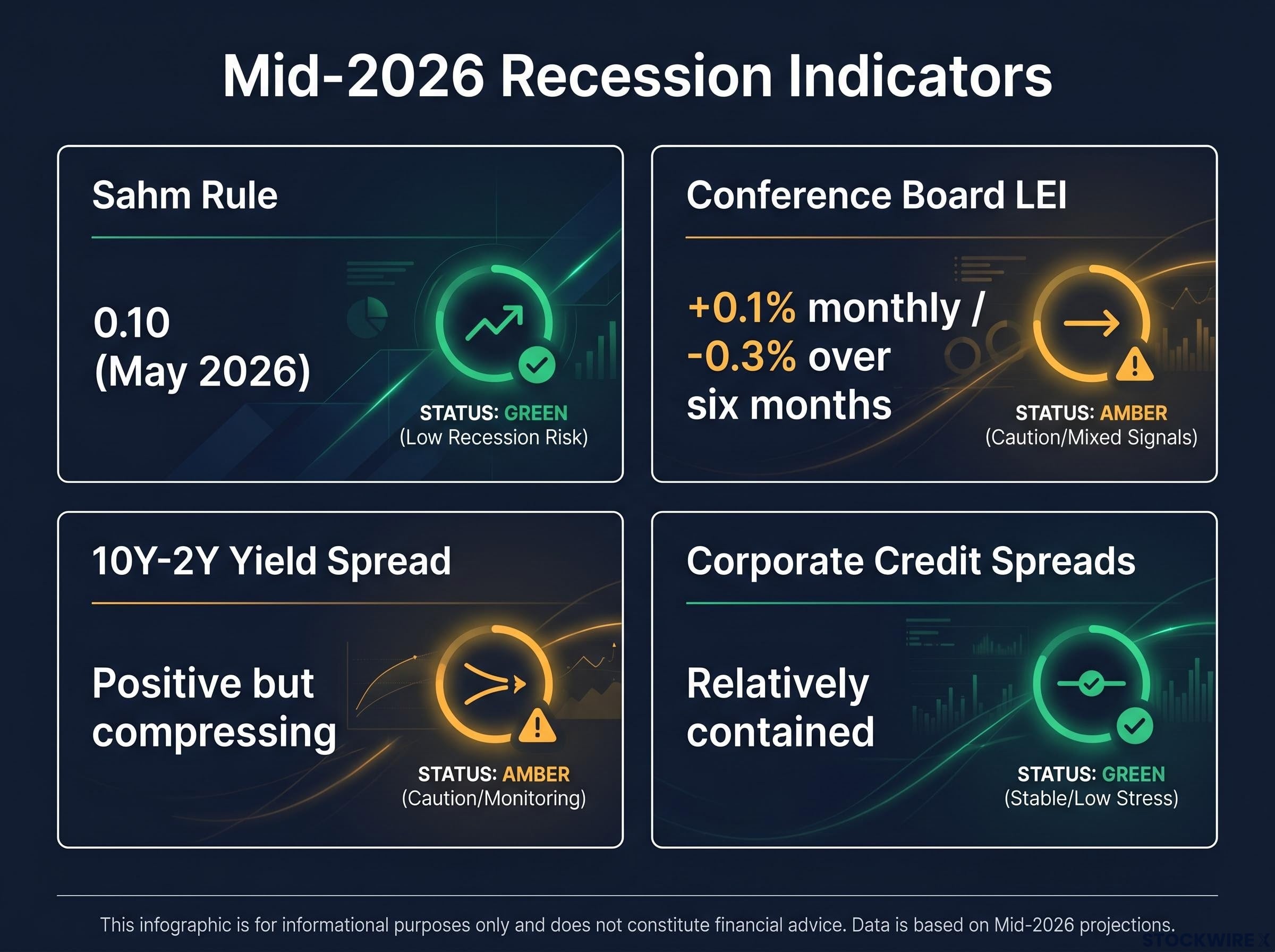
| Indicator | Current Reading | Recession Threshold/Signal | Status |
|---|---|---|---|
| Sahm Rule | 0.10 (May 2026) | 0.50 or above | Green |
| Conference Board LEI | +0.1% monthly; -0.3% over six months | Sustained negative six-month growth | Amber |
| 10Y-2Y Yield Spread | Positive but compressing | Inversion (negative spread) | Amber |
| Corporate Credit Spreads | Relatively contained | Significant widening | Green |
The cumulative read: the indicator stack does not give you permission to stop paying attention. It also does not give you permission to exit equities. Amber is a specific strategic position with its own portfolio logic, not a vague in-between.
When big ASX news breaks, our subscribers know first
Why consensus recession odds of 30-35% are harder to trade than 60%
Three major forecasters have converged on a narrow band:
- RSM US has cut its 12-month recession probability to 30% from 40%, alongside a forecast for 2.2% GDP growth in 2026
- S&P Global’s Q2 2026 outlook places recession risk at 30%, up from around 20% before the onset of Middle East conflict in early 2026
- J.P. Morgan Global Research puts the probability of a US and global recession at approximately 35%
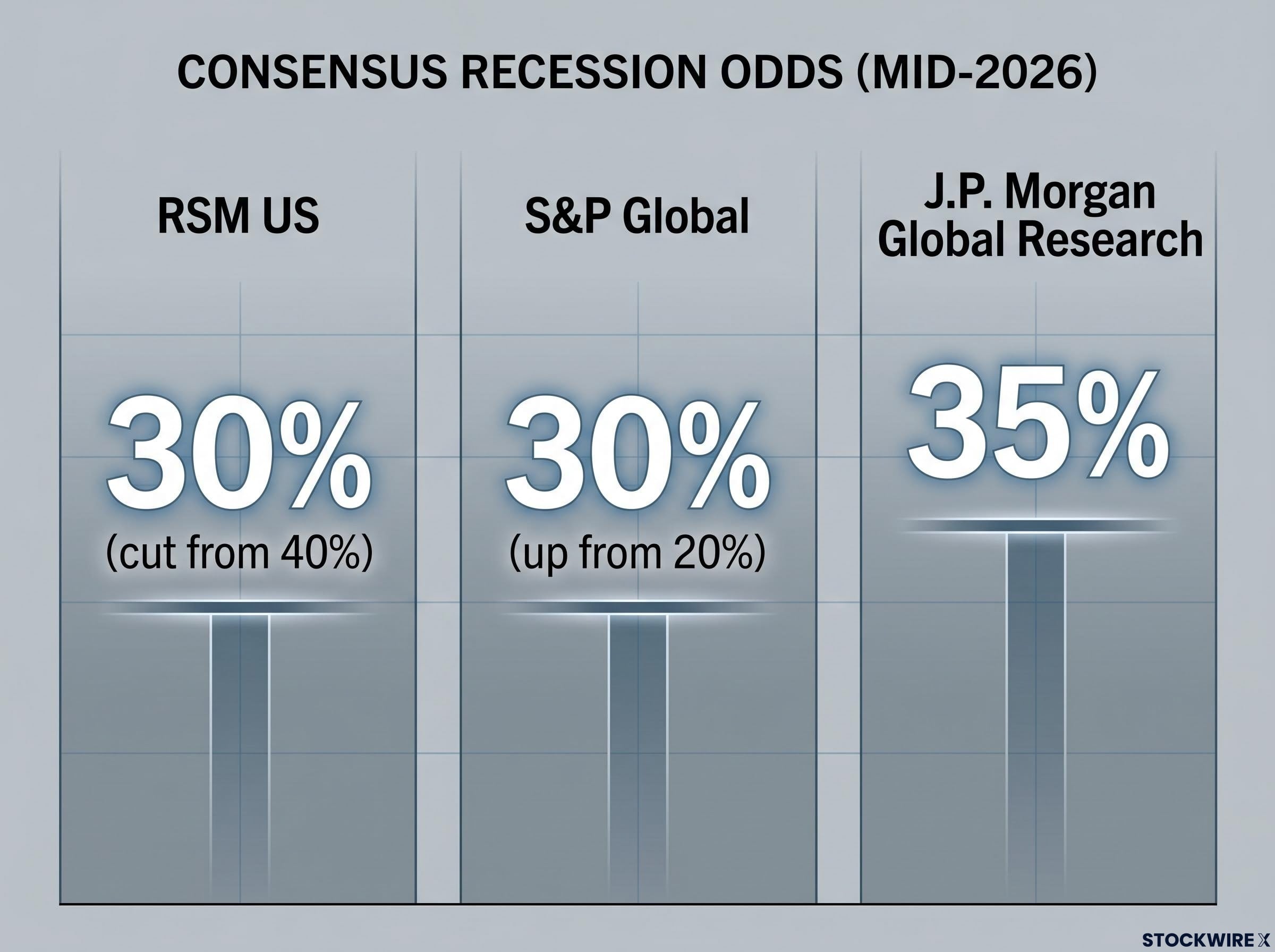
The directional improvement in RSM’s estimate is worth noting. Cutting from 40% to 30% signals the firm sees the trajectory improving, not worsening.
But here is what makes 30-35% operationally harder than a reading of 60% or higher. At 60-70%, the portfolio maths is clear: reduce cyclical exposure, extend duration, raise cash. The decision framework simplifies because the probability overwhelms the cost of acting too early. At 30-35%, you must hold genuine uncertainty in two directions simultaneously. Acting too defensively in a scenario that resolves constructively costs you real returns. Acting too complacently in one that deteriorates costs you more.
Where the more bearish signals live
Some market commentators point to more aggressive warning signs, including certain market-based indicators breaking below long-term moving averages and the energy shock transmission risk flowing from the Middle East conflict that erupted in early 2026. These are not the consensus view, but they represent genuine tail risk that a 30-35% probability range does not fully capture in day-to-day portfolio thinking. The gap between the most bearish and most constructive forecasters is not analytical sloppiness. It is epistemic uncertainty. Positioning for this range means defining your triggers in advance rather than waiting for consensus to resolve.
How the rate environment reshapes the income-versus-growth trade-off
For most of the 2010s, interest rates near zero meant equities were the only meaningful source of return. If you wanted yield, you had to take equity risk to get it. That structural pressure pushed capital into growth stocks, venture-stage names, and high-multiple sectors because there was nowhere else to earn a competitive return.
That world no longer exists. RSM forecasts the Fed funds rate falling toward 3%, with the 10-year Treasury yield hovering at or just above 4%. US Personal Consumption Expenditures (PCE) inflation, the Fed’s preferred inflation measure, is forecast at approximately 2.7% for 2026, above target but not destabilising.
At a 4% 10-year yield, investment-grade bonds and dividend-paying equities can deliver competitive total returns without requiring the market to re-rate higher. You are no longer forced into equities just to obtain yield.
This is not a temporary tactical call. It is a structural change in how balanced portfolios are constructed. A balanced allocation can now achieve reasonable return targets with materially less growth and volatility exposure than was required in the prior decade.
What this means for equity exposure in H2 2026
Equities remain investable, but the upside profile has shifted. In a slow-growth, moderate-inflation regime with a 2.2% GDP forecast, earnings can grow, but cyclicals tied to discretionary demand are more vulnerable. Elevated rates cap multiple expansion, which means the broad market is unlikely to re-rate sharply higher.
Defensive sectors (healthcare, consumer staples, quality utilities) and cash-rich technology and industrial names with demonstrated free cash flow are better positioned than rate-sensitive or highly speculative names. H1 2026 showed wide gaps between sector winners and losers, and that high dispersion is expected to continue. Selection matters more than direction in this environment.
Near-term drivers shaping the H2 2026 outlook
Three catalysts in early H2 2026 map directly to different parts of a typical US investor’s portfolio.
| Catalyst | Key Metric(s) | Bull Reading | Bear Reading | Portfolio Impact |
|---|---|---|---|---|
| June US Employment Report (early July) | Nonfarm payrolls, unemployment rate, average hourly earnings | Stable hiring, contained wage growth supports soft landing | Rising unemployment and softer wages signal labour market deterioration | Fed rate path; rate-sensitive holdings |
| Early July PMI Surveys | Services PMI (above/below 50); manufacturing PMI | Stable or improving readings confirm gradual slowdown, not contraction | Services PMI below 50 corroborates LEI weakness, pushes recession odds higher | Cyclical equity weightings; growth expectations |
| Iran Ceasefire / Strait of Hormuz | Ceasefire compliance, Hormuz shipping volumes, crude oil price | Risk premia fade; energy inflation eases | Disruption spikes crude, re-ignites inflation, raises recession probability | Energy exposure; inflation assumptions |
The June jobs report is the highest-priority catalyst. Stronger data delays rate-cut expectations and supports domestic-demand cyclicals but pressures duration-sensitive holdings. Weaker data increases conviction the Fed is near the end of its cycle and supports Treasuries and high-grade credit.
The Purchasing Managers’ Index (PMI) surveys, which measure business activity levels with readings above 50 signalling expansion and below 50 signalling contraction, offer the first forward-looking read on H2 growth momentum. Given the economy’s services-dominant composition, the services PMI carries more weight than manufacturing.
The Iran ceasefire is asymmetric: its continuation is constructive but not a catalyst in itself. Its failure would be a significant negative shock. The conflict’s outbreak in early 2026 already demonstrated how quickly geopolitical disruption translates into fuel prices and broader inflation, pushing Germany’s Harmonised Index of Consumer Prices (HICP) inflation to 2.9%.
Defining conditions for the full-year 2026 outcome
The near-term catalysts above are data points feeding into three larger questions. Their answers will define the full-year outcome.
- The inflation moderation question. Does PCE continue to glide toward target at approximately 2.7%, enabling the Fed to hold or gradually cut? Or do energy, wages, or supply chain disruptions re-accelerate inflation and extend the period of elevated rates? Euro-area inflation running in the 2.2-2.9% range, with energy as the key swing factor, illustrates how quickly geopolitical transmission can shift the inflation trajectory.
- The geopolitical durability question. If the Iran ceasefire holds and Hormuz risk fades, energy as an inflation driver softens and the constructive scenario gains ground. If it fails, S&P Global’s 30% recession estimate, which already rose from approximately 20% after the conflict’s onset, will look conservative.
Evaluating AI and semiconductor exposure in a rate-plateau environment
- The AI and semiconductor earnings question. Premium valuations in these names rest on near-term earnings delivery. In a higher-rate world, the discount rate applied to future earnings rises, compressing the present value of cash flows expected three to five years out. That means markets demand more near-term evidence to justify premium multiples.
If AI-linked earnings and productivity gains materialise on the timelines baked into consensus, a substantial portion of the equity complex can perform even in slow growth. If they disappoint, index-level repricing is the mechanism. The distinction between broad “AI exposure” as a theme and quality-screened positions based on balance sheet strength, free cash flow, and realistic adoption timelines matters more in H2 2026 than in prior years when multiple expansion could carry most names in the category.
These three conditions are not independent. An energy shock directly undermines inflation moderation and raises discount rates for growth stocks. You are watching an interconnected system, not three separate stories.
Building a portfolio brief for the second half of 2026
The amber-light characterisation is the operating premise. Not a liquidation signal. Not a stay-the-course signal. A deliberate-review signal that requires knowing exactly what you own and why.
Four checks to run through your holdings now:
- Rate sensitivity audit. Which positions benefit from rate cuts, and which depend on them? If the Fed holds longer than expected, do those positions still work?
- Energy exposure assessment. Are you positioned for the ceasefire holding, for it failing, or for neither? What does a sustained oil price spike do to your cost assumptions?
- Growth narrative stress test. Do your AI and technology positions depend on multiple expansion or on earnings delivery? If the latter, is the delivery timeline realistic based on company guidance and cash flow evidence?
- Diversification review. The wide return dispersion in H1 2026 is expected to continue. Concentrated exposure to a single macro narrative increases the risk of being on the wrong side of that dispersion.
Then define your triggers in advance:
- Sahm Rule approaching 0.50 (currently 0.10)
- Services PMI falling below 50
- Sustained directional move in oil prices signalling ceasefire breakdown
The investor who can answer “what would change my positioning and at what level” is in a materially different position than the one waiting to see what happens.
This article is for informational purposes only and should not be considered financial advice. Investors should conduct their own research and consult with financial professionals before making investment decisions. Past performance does not guarantee future results. Financial projections are subject to market conditions and various risk factors.
What stays durable and what remains contingent heading into H2 2026
Two things are structurally durable regardless of the next data print. The income asset opportunity at 4% yields has changed the portfolio construction equation for the foreseeable future. The diversification imperative under high dispersion is not a temporary call; it is the rational response to an environment where sector-level outcomes are diverging sharply.
What remains genuinely contingent: energy exposure hinges on ceasefire durability, AI and semiconductor weighting hinges on earnings evidence arriving on schedule, and cyclical allocation hinges on whether the amber signals in the LEI and PMIs stabilise or deteriorate.
The framework in this piece is designed to update as each catalyst lands. When the June jobs report arrives, when the PMIs print, when the next Hormuz shipping data surfaces, the indicator table above tells you exactly what to compare against. Use it as a living reference, not a one-time read.
These forward-looking statements are speculative and subject to change based on market developments and company performance.
—