What UK Traders Lose When Their CFD Account Goes Offshore
39 mins ago

Australian investors searching for technology exposure through ASX ETFs often land on a choice that looks straightforward: pick a well-known index fund, tick the tech box, move on. The reality is that two funds both carrying the label “technology exposure” can point at almost entirely different parts of the global tech economy.
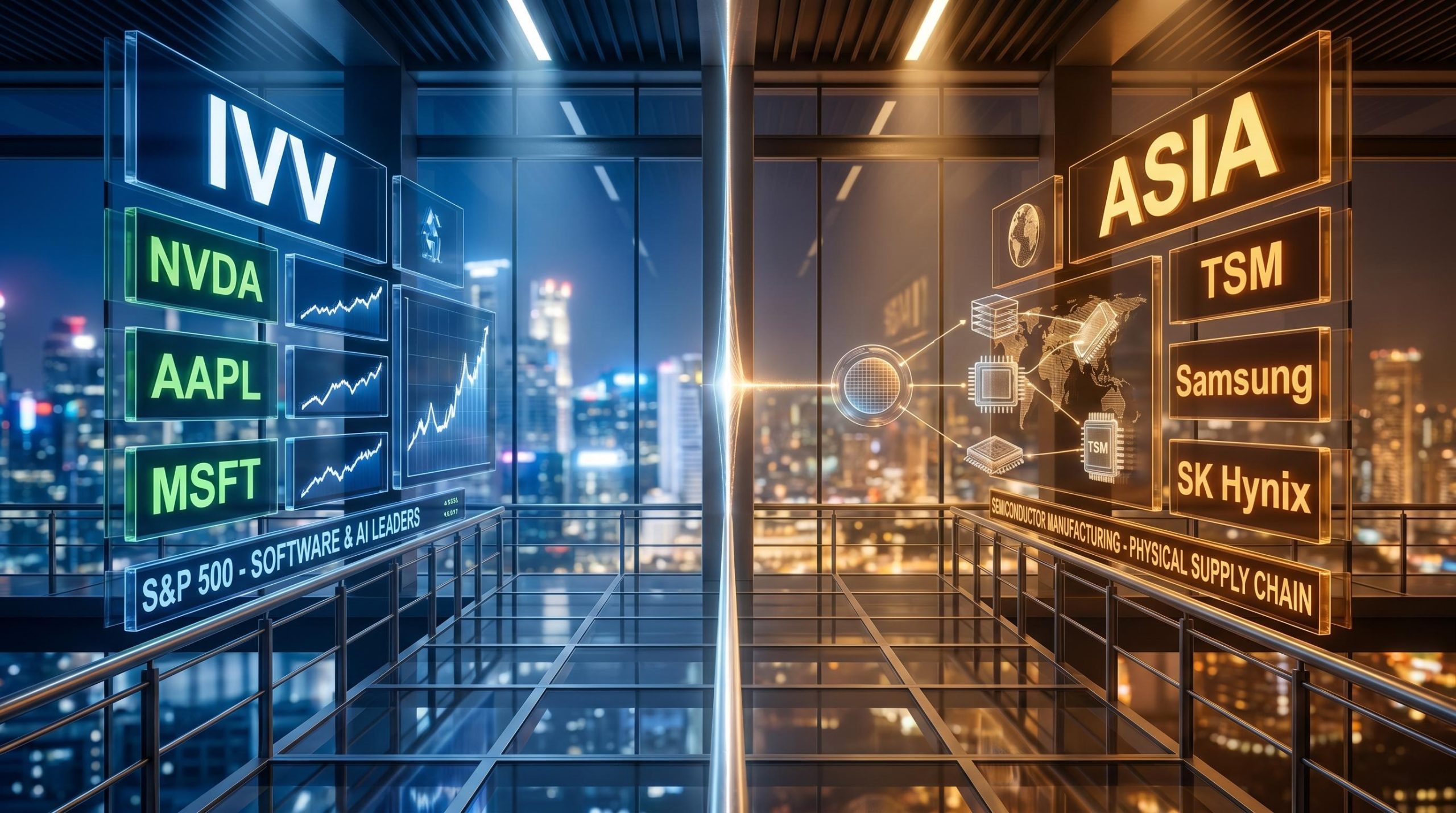
IVV tracks the S&P 500 and delivers US-centric software, artificial intelligence, and digital platform exposure. ASIA targets the semiconductor and hardware manufacturers concentrated in Korea, Taiwan, and China. Both sit on the ASX. Both touch technology. But the underlying businesses, the risk profiles, and the portfolio roles they serve are structurally different, and understanding that difference matters before you decide how to allocate.
ETF name and exposure are not the same thing, and fund names on the ASX are unregulated, meaning two funds with nearly identical labels can hold entirely different securities with very different concentration risks baked in.
Here is a clear analytical framework for thinking about where each ASX technology ETF sits in the global tech supply chain, what distinct risks each carries, and how to decide whether one, the other, or both belong in your portfolio.
Both IVV and ASIA are legitimately described as technology-exposed funds. But the technology each holds is different in kind, not just geography. One gives you the software layer of the global economy. The other gives you the physical manufacturing layer. These are distinct economic activities with distinct revenue drivers, and lumping them together under “tech” obscures more than it reveals.
IVV tracks the S&P 500 Index, which means its tech exposure sits alongside healthcare, financial services, consumer spending, and industrials. Technology is the largest sector weighting, but the multi-sector character dampens volatility relative to a pure-play tech fund. Notable holdings include:
What you are buying with IVV is broad US equity exposure with a strong but cushioned technology tilt, not a concentrated tech bet.
ASIA is a sector-specific fund where performance is tightly tied to semiconductor demand cycles, Asian policy environments, and trade dynamics. Notable holdings include:
This concentration makes ASIA a fundamentally different risk instrument than IVV. Choosing between these two funds is not a geography decision; it is a decision about which part of the technology value chain you want to own.
The software platforms and AI infrastructure that dominate IVV’s technology holdings do not exist without the physical chips and components manufactured by ASIA’s holdings. NVIDIA designs the processors that power AI workloads, but TSMC fabricates them. Apple designs the chips inside every iPhone and Mac, but Samsung and TSMC manufacture them. Microsoft’s Azure cloud runs on servers packed with memory from SK Hynix.
This is not an abstract observation. It is the commercial reality connecting the two funds at the level of actual purchase orders and supply contracts.
Asian semiconductor valuations remained at roughly half the Nasdaq 100 multiple entering 2026 despite earnings growth running nearly three times faster than US peers, a divergence that helps explain why institutional capital began rotating toward the exact companies that dominate ASIA’s holdings.
The interdependence amounts to a “brains and factories” relationship: US companies provide the software, design, and platform intelligence, while Asian companies provide the physical manufacturing that makes it all real. One side cannot function without the other.
What this means for your portfolio is that holding both funds is not doubling up on tech risk. It is capturing two economically distinct positions connected by real commercial relationships. That is a qualitatively different proposition from holding two similar index funds that happen to be listed in different countries.
Understanding what each fund holds is one thing. Understanding how differently they behave under stress is where the decision gets personal.
IVV’s volatility is dampened by design. When technology sells off, the fund’s healthcare, financial, and consumer holdings absorb part of the shock. A bad quarter for cloud spending does not sink the entire fund because other sectors continue generating returns. This makes IVV a natural core holding for investors who want technology exposure without accepting the full force of tech-cycle swings.
ASIA operates on a different frequency. Its performance tracks semiconductor demand cycles, which are inherently boom-and-bust. Layer on sensitivity to US-China trade tensions, Taiwanese geopolitical risk, and shifting policy environments in Beijing and Seoul, and the fund’s return profile becomes materially more volatile than IVV’s.
Semiconductor sector volatility can be amplified well beyond what underlying earnings moves would justify when retail leverage and foreign capital flows interact, a dynamic that played out in June 2026 when over one trillion dollars in Asian semiconductor market value was erased during a period of record US tech inflows.
The key risk dimensions for each fund look like this:
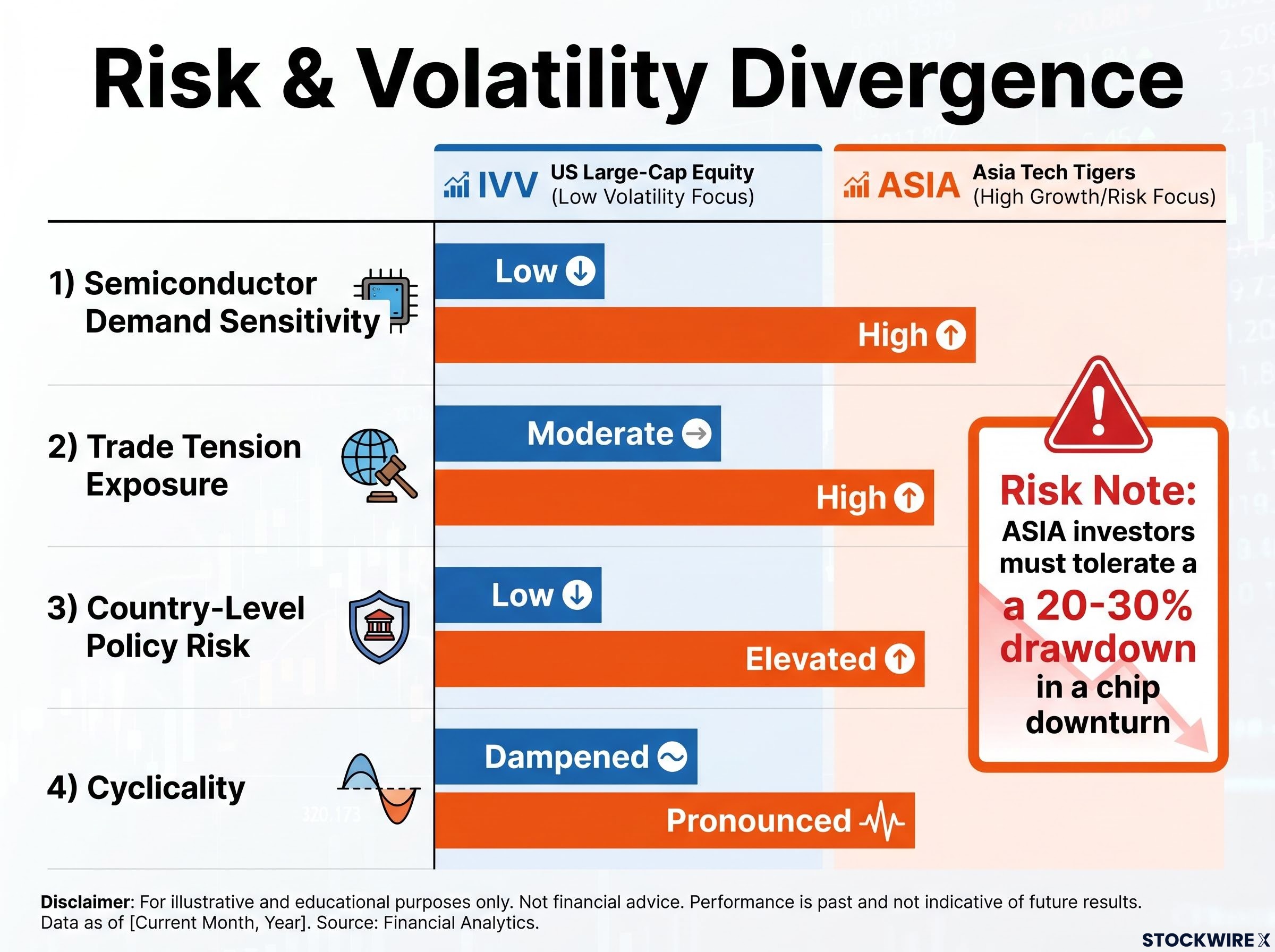
If you underestimate ASIA’s cyclicality, you risk exiting at exactly the wrong point in a semiconductor downturn, turning a structurally sound thesis into a realised loss. Recognising this risk profile in advance is what separates a deliberate position from an accidental one. IVV suits investors seeking a broad, beginner-friendly anchor. ASIA suits investors comfortable with larger swings in pursuit of a targeted thematic position.
The table below consolidates the analytical distinctions already covered. It is designed as a decision aid: each row should tell you immediately what the practical implication is for your own portfolio.
| Dimension | IVV | ASIA | Practical implication |
|---|---|---|---|
| Geography | US only | Korea, Taiwan, China, and other Asian markets | Combining both adds genuine geographic diversification |
| Technology type | Software, cloud, AI, digital platforms | Semiconductors, hardware, Asian e-commerce and internet platforms | You are choosing which part of the tech value chain to own |
| Diversification | Multi-sector (tech, healthcare, financials, consumer, industrials) | Sector-specific (technology and related industries) | IVV cushions downturns; ASIA amplifies them |
| Volatility profile | Dampened by broad sector exposure | Cyclical; sensitive to chip demand, trade tensions, policy shifts | Your volatility tolerance determines which fund is appropriate |
| Portfolio role | Core holding | Satellite holding | IVV is the foundation; ASIA is the targeted addition |
One important note: management expense ratios (MERs) and historical drawdown data for both funds were not confirmed in the research underpinning this analysis. These are decision-relevant metrics, and you should verify them independently before making any allocation decision.
The analysis above gives you the structure. These three questions help you locate yourself within it.
Two illustrative portfolio structures show how the decision plays out in practice:
These allocation structures are illustrative only and should not be interpreted as financial advice or investment recommendations. Investors should consult a qualified financial adviser before making portfolio decisions.
The three-question framework should leave you with a clear sense of which fund, or which combination, reflects your actual situation rather than an abstract understanding of both options.
Investors wanting to put the core and satellite logic into practice with specific allocation rules, rebalancing triggers, and portfolio drift guidelines will find our comprehensive walkthrough of the core-satellite framework, which covers how to size satellite positions and avoid the most common pitfalls including overlapping exposures and performance-chasing.
The most important takeaway from this analysis is not which fund is better. It is that these two ETFs serve different functions and occupy different positions in the global technology supply chain. IVV gives you the software, AI, and platform layer. ASIA gives you the semiconductor and hardware manufacturing layer. One is a broad core holding with meaningful tech weighting. The other is a targeted satellite position with concentrated sector exposure.
For most investors beginning to build technology exposure from the ASX, IVV is the natural starting point. ASIA enters the picture only when you have clarity on your existing US exposure, your tolerance for cyclical volatility, and your conviction in the semiconductor and Asian digital growth thesis.
The global technology economy is increasingly defined by the interaction between US-led software and AI on one side and Asian-led hardware and semiconductor manufacturing on the other. ASX investors now have direct access to both sides of that equation. Understanding what each side actually contains, and how differently each behaves, is the foundation for any allocation decision you make from here.
This article is for informational purposes only and should not be considered financial advice. Investors should conduct their own research and consult with financial professionals before making investment decisions.
IVV tracks the S&P 500 and gives broad US equity exposure with a strong technology tilt across software, cloud, and AI platforms, while ASIA is a sector-specific fund concentrated in semiconductor and hardware manufacturers across Korea, Taiwan, and China. They represent different parts of the global tech supply chain, not just different geographies.
IVV is generally the more appropriate starting point for investors new to technology exposure, because its multi-sector character dampens volatility compared to a concentrated sector fund like ASIA, which can see 20-30% drawdowns during semiconductor downturns.
No. IVV holds the software and AI platform layer while ASIA holds the physical semiconductor and hardware manufacturing layer, and these are economically distinct positions connected by real commercial relationships, not two versions of the same bet.
ASIA carries higher semiconductor demand cycle risk, direct exposure to US-Asia trade tensions, and country-level policy risk across multiple jurisdictions including China and Taiwan, making its return profile materially more volatile than IVV's broadly diversified structure.
The article outlines two illustrative structures: a conservative tilt of 80-90% IVV with 10-20% ASIA, or a more aggressive approach of 60-70% broad global exposure with 30-40% ASIA for higher conviction in chip and hardware cycles. These are examples only and not financial advice.