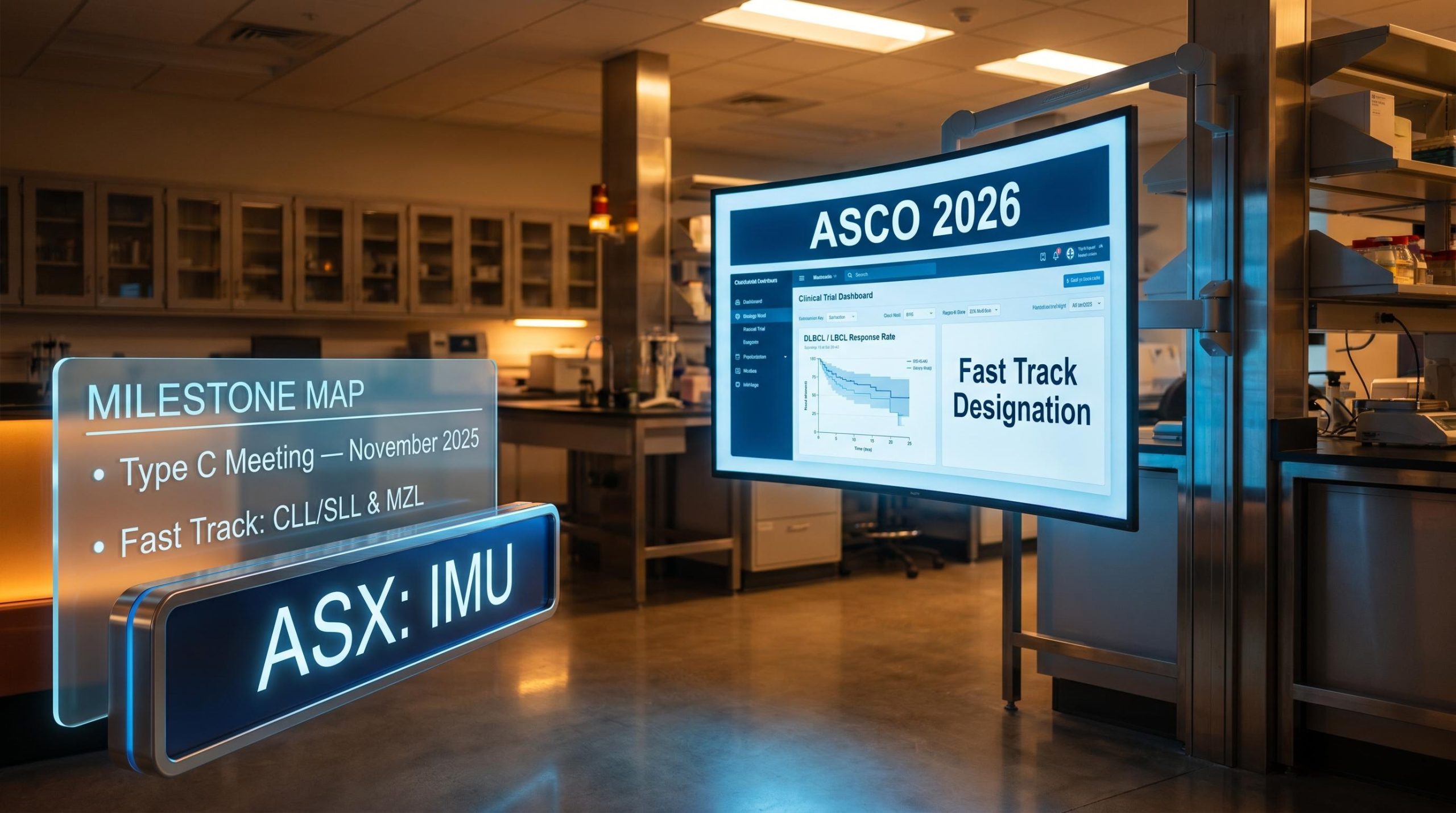
Cell and gene therapy investment flows have long skewed toward US and European equity markets, leaving other regions structurally underrepresented in capital allocation, analyst coverage, and specialist fund infrastructure. Yet one of the clinical programmes generating attention at ASCO 2026 last month, a Phase 1b trial enrolling patients across US academic cancer centres, is listed on the ASX.
That structural gap matters. Australian investors navigating ASX biotech stocks are working with less analytical infrastructure than their US counterparts when interpreting the same clinical signals. The distance is not only geographic; it sits in how milestones are read, how quickly they are interpreted, and how much context surrounds each announcement. With FDA regulatory interactions active and ASCO data freshly delivered, the gap is visible right now.
Here is a framework for reading clinical-stage milestone clusters in ASX biotech, grounded in a live programme as the reference case. The taxonomy comes first. The case study follows. By the end, you will have a reusable lens that applies to every clinical-stage ASX biotech position you encounter.
Why ASX biotech stocks occupy a structurally distinct investment category
Most investors build their biotech mental model from large-cap pharmaceutical stocks: diversified revenue, earnings growth, dividend streams. That model does not transfer to clinical-stage ASX biotech without significant adjustment.
Pre-revenue clinical-stage companies generate no earnings, pay no dividends, and report no revenue growth. The analytical toolkit shifts entirely toward milestone monitoring: regulatory designations, trial readouts, and congress selections become the primary signals of programme advancement.
The core structural differences between large-cap pharma exposure and clinical-stage ASX biotech include:
- Revenue profile: Large-cap pharma generates commercial revenue across multiple products; clinical-stage ASX biotechs are pre-revenue, with value tied to programme progression.
- Value signal type: Pharma investors read earnings and margins; clinical-stage investors read milestones, regulatory interactions, and scientific peer review.
- Risk characteristics: Pharma risk is commercial and competitive; clinical-stage risk is binary, tied to trial outcomes and regulatory decisions.
- Liquidity and coverage context: NASDAQ-listed biotech attracts deep specialist analyst coverage; ASX clinical-stage listings operate in a structurally thinner information environment.
The structural category distinction matters because binary risk in ASX biotech is categorically different from the drawdown profile of large-cap commercial healthcare; Immutep’s 90% single-session collapse in March 2025 following Phase III discontinuation is the sharpest recent illustration of what that category difference looks like when it arrives.
What this means in practice: the same event, say a regulatory designation, carries more interpretive weight for an ASX investor than it would for a specialist US biotech fund that receives daily deal flow on comparable programmes. The structural category shapes how every signal should be read.
When big ASX news breaks, our subscribers know first
Reading the milestone map: a signal taxonomy for pre-revenue oncology programmes
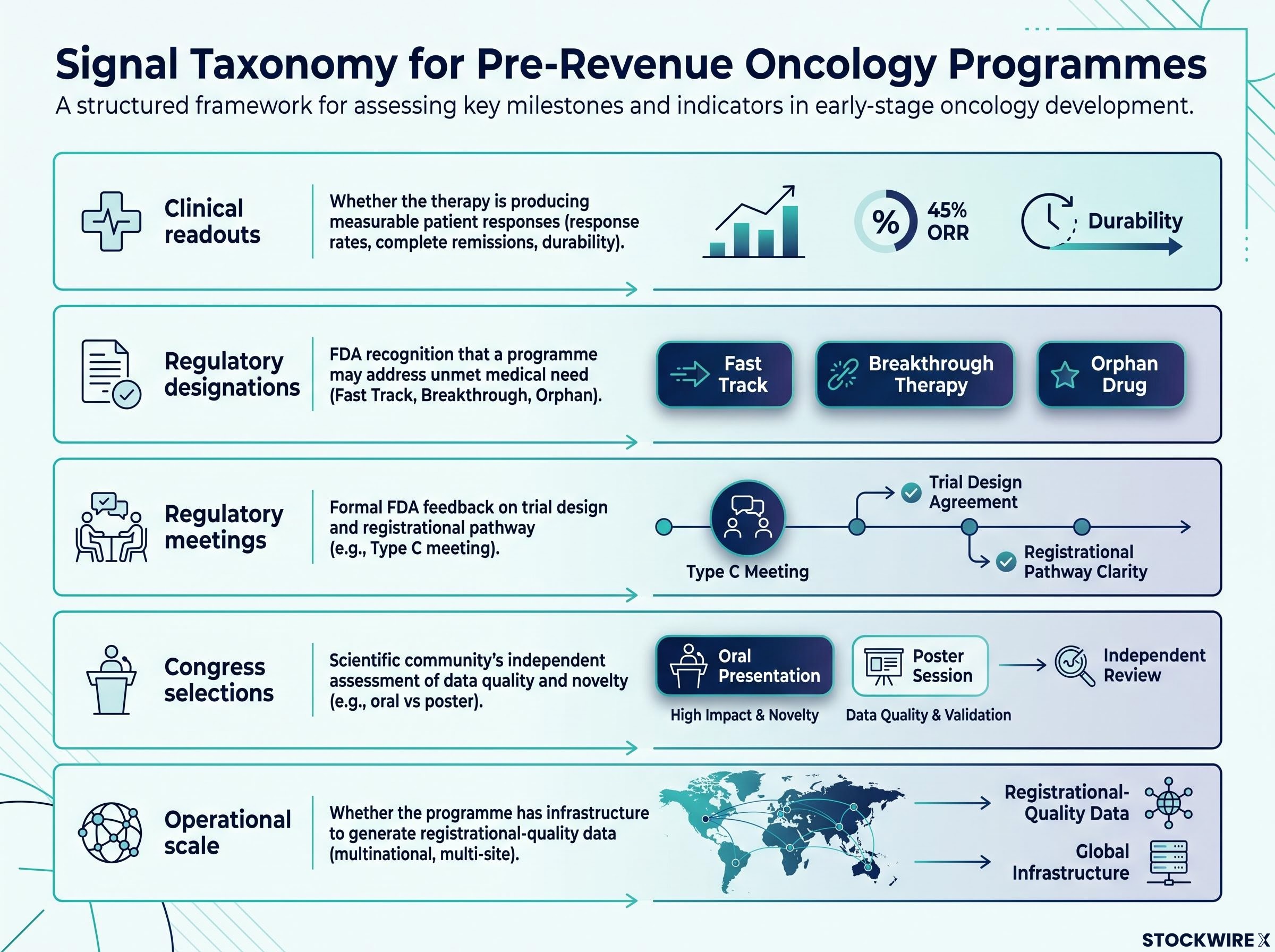
Before any specific programme can be assessed, the investor needs a classification system for the signals clinical-stage companies generate. Five categories matter most.
| Milestone Category | What It Signals | Quality Distinctions to Note |
|---|---|---|
| Clinical readouts | Whether the therapy is producing measurable patient responses | Response rates, complete remissions, and durability data carry different weight; early Phase 1b data is directional, not conclusive |
| Regulatory designations | FDA recognition that a programme may address unmet medical need | Fast Track, Breakthrough, and Orphan designations confer different rights; Fast Track grants more frequent FDA interaction and rolling review eligibility |
| Regulatory meetings | Formal FDA feedback on trial design and registrational pathway | A Type C meeting, a formal mechanism through which sponsors obtain agency guidance on trial design and endpoint acceptability, differs materially from preliminary regulatory contact |
| Congress selections | Scientific community’s independent assessment of data quality and novelty | Oral presentations are awarded through competitive peer review by disease-area experts and carry higher visibility than poster presentations |
| Operational scale | Whether the programme has the infrastructure to generate registrational-quality data | Multinational, multi-site trial footprints signal different development maturity than single-site operations |
Cash burn and runway are programme-management variables, not primary valuation signals. They tell you how long a company has to execute against its milestones. They do not tell you whether those milestones represent genuine scientific or regulatory progress. The programme is the asset; cash management determines how long the company has to advance it.
For an ASX investor, this taxonomy is the translation layer between a company’s ASX announcements and the actual developmental significance of what has been disclosed. Without it, material events and routine updates look the same.
Azer-cel and the B-cell malignancy population: what the programme is targeting and why it matters
The case study starts with the patients, not the company.
Third-line diffuse large B-cell lymphoma (DLBCL) and large B-cell lymphoma (LBCL), a type of aggressive blood cancer, describes a patient population that has already failed two or more prior lines of therapy. Within that group, a subset has already received and relapsed after autologous CAR T therapy, where a patient’s own immune cells are engineered to fight the cancer. For these patients, remaining treatment options are extremely limited.
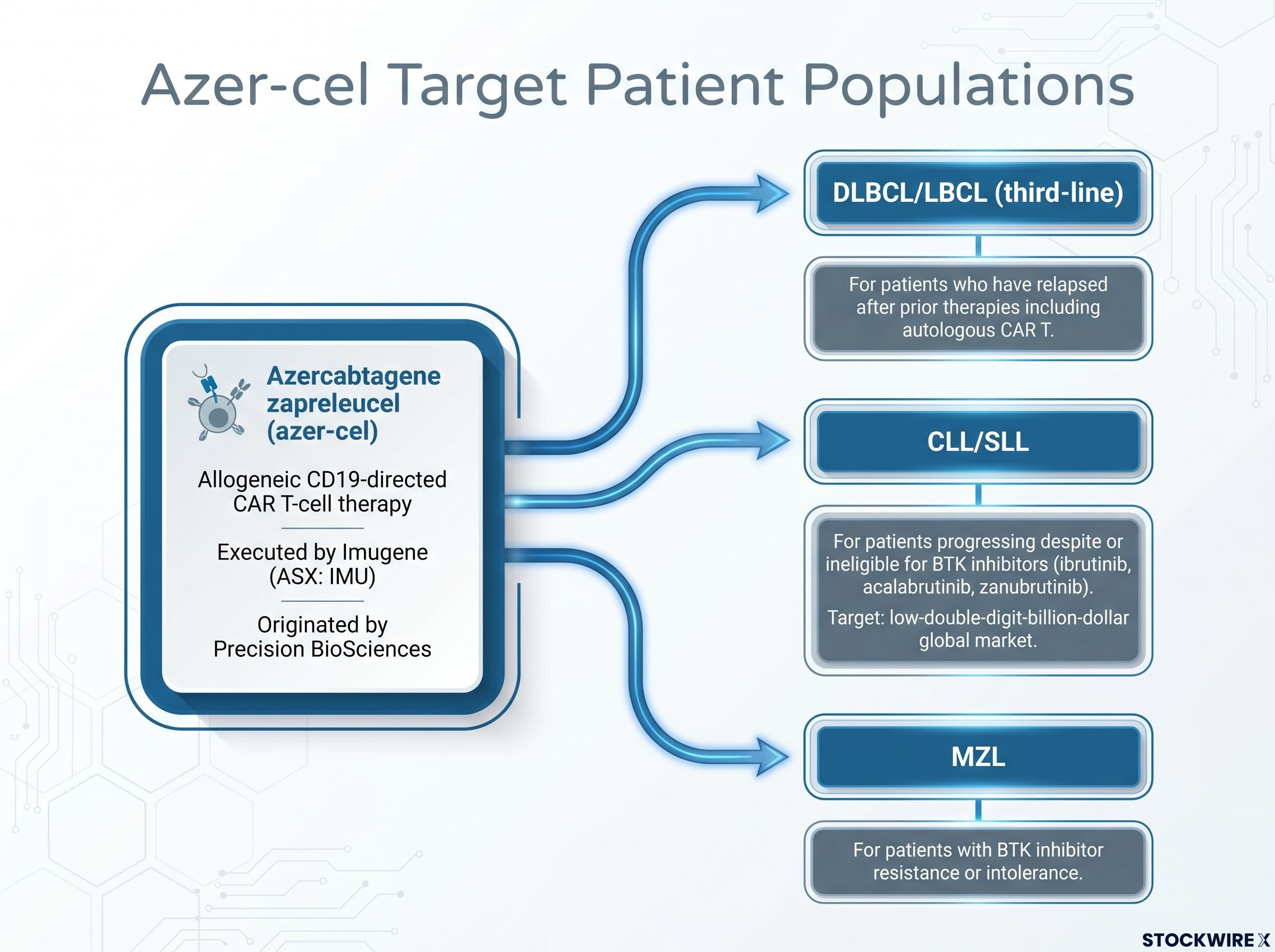
Azercabtagene zapreleucel (azer-cel) is an allogeneic CD19-directed CAR T-cell therapy. Allogeneic means “off-the-shelf”: the therapy is manufactured from donor cells rather than the individual patient’s own cells, which in practical terms could mean faster availability and broader access if the therapy proves effective. The asset originated at Precision BioSciences; Imugene (ASX: IMU) now leads clinical execution.
The programme’s three indication areas address distinct patient populations:
- DLBCL/LBCL (third-line): Patients who have relapsed after prior therapies including autologous CAR T, a population where established treatments have already failed.
- CLL/SLL (chronic lymphocytic leukaemia/small lymphocytic lymphoma): Patients who progress despite or become ineligible for BTK inhibitor therapies (ibrutinib, acalabrutinib, zanubrutinib), the current standard-of-care agents within a low-double-digit-billion-dollar global market.
- MZL (marginal zone lymphoma): A related B-cell malignancy where BTK inhibitor resistance or intolerance creates a comparable gap in available treatments.
For investors, the post-CAR-T relapse focus matters because it defines a patient segment where established therapies have already been exhausted. A novel allogeneic approach that demonstrates efficacy in this population would face limited direct competition, precisely because the alternatives have already been tried and failed.
The breadth of unmet need in this population is documented in peer-reviewed outcomes data for post-autologous CAR T relapse, which shows that patients with DLBCL who progress after autologous transplant or CAR T therapy face severely limited subsequent treatment options and poor prognosis, reinforcing why a novel allogeneic approach targeting this segment attracts both clinical and regulatory attention.
Early readouts from the Phase 1b study, with enrolment ongoing as of June 2026, show high overall response rates and complete remissions in heavily pretreated third-line DLBCL/LBCL patients, including those who relapsed after autologous CAR T. The clinical rationale explains why the FDA and the scientific community are engaging with this programme.
The azer-cel basket trial design evaluates the therapy simultaneously across multiple B-cell malignancy subtypes, with a protocol amendment adding a BTK inhibitor combination arm targeting the growing population of patients who have failed or become ineligible for BTKi therapy, an adaptive structure that allows the programme to prioritise indications as clinical signals mature.
The milestone cluster around azer-cel: applying the signal taxonomy to a live programme
With the vocabulary and the clinical context in place, the azer-cel milestone cluster becomes legible as a specific pattern.
Congress and scientific engagement
Azer-cel data secured an oral presentation slot at ASCO 2026, with the session delivered on 29 May 2026. ASCO is the world’s largest clinical oncology meeting. Oral presentation slots are allocated through competitive peer review by disease-area experts drawn from a submitted abstract pool reported to have numbered more than 8,500 entries (this figure has not been independently confirmed). That selection represents an independent form of scientific endorsement, separate from any regulatory interaction.
FDA regulatory pathway and designations
Following a Type C meeting in November 2025, the FDA provided formal guidance confirming key elements of a potential registrational pathway for third-line and later DLBCL, covering patients who had progressed after autologous CAR T. This is formal agency guidance on trial design and endpoint acceptability for a registration-enabling study.
The FDA granted Fast Track Designation covering both CLL/SLL and MZL at around June 2026. A separate Fast Track designation also covers DLBCL. Fast Track status confers more frequent interaction with the FDA and eligibility for rolling review, which means data packages can be submitted on a rolling basis rather than requiring a complete package, potentially reducing development timeline risk.
The Phase 1b trial is enrolling patients across sites in both the United States and Australia, with the US footprint spanning at least 10 academic cancer centres and an Australian expansion of up to six sites planned.
| Milestone | Taxonomy Category | Evaluating Body | Investor Significance |
|---|---|---|---|
| ASCO 2026 oral presentation (29 May 2026) | Congress selection | ASCO peer-review committee | Independent scientific endorsement of data novelty and clinical relevance |
| Type C meeting outcome (November 2025) | Regulatory meeting | FDA | Agency-confirmed registrational pathway guidance for lead indication |
| Fast Track: CLL/SLL and MZL (approx. June 2026) | Regulatory designation | FDA | Rolling review eligibility and more frequent FDA interaction across two additional indications |
| Fast Track: DLBCL (prior designation) | Regulatory designation | FDA | Lead indication regulatory support preceding registrational pathway discussion |
| Multinational trial operations (US and Australia) | Operational scale | Company (infrastructure build) | Signals capacity to generate registrational-quality data across mainstream academic centres |
These milestones do not individually or collectively constitute regulatory approval, commercial viability, or a recommendation to invest. What they collectively describe is a programme that has passed multiple independent quality filters simultaneously, from different evaluators (peer-review committee, FDA division, company operational execution), which shifts the programme’s characterisation from early-concept to clinically active and regulator-engaged.
That combination, a congress oral selection, agency-confirmed registrational pathway guidance, multi-indication Fast Track status, and multinational operations, is the type of signal cluster that moves a risk-reward assessment. No single event in isolation carries this weight.
What ASX investors need to watch as clinical-stage programmes advance
The taxonomy and the case study describe what has already happened. The more practical question is what to look for next.
For a programme at azer-cel’s stage, the forward-looking indicators that matter most, in order of analytical weight, are:
- Phase 1b data readout completeness: Whether response rates and durability data mature as enrolment continues, and whether the safety profile supports escalation toward a registrational study.
- Transition signals toward a registrational study: Announcements regarding pivotal trial design, informed by the Type C meeting framework, would represent the next category of signal confirming genuine pathway progression.
- Cash runway relative to anticipated milestones: Investors should assess whether the company’s financial runway extends to the next anticipated major milestone event. Cash burn is a programme-management variable, but it determines whether the company can reach the data that matters.
- Additional regulatory designation activity: Further FDA engagement across indications, or progression from Fast Track to other designations, would represent incremental de-risking signals.
There is an information asymmetry risk specific to ASX investors. The global oncology specialist investor community, predominantly US-based, may receive and interpret these signals faster and with more context than retail participants in Australian markets. For Australian investors specifically, that information gap means developing fluency in milestone categories is not optional. It is protective against being the last to understand what an announcement means.
The discipline that separates informed ASX biotech analysis from surface-level announcement tracking is monitoring milestone quality, not just milestone volume. A company can generate a high volume of announcements. What matters is where each one sits in the taxonomy, and what evaluative body stands behind it.
What the convergence of global oncology milestones and ASX listings actually tells you
The structural tension this article opened with, that global cell and gene therapy capital is concentrated offshore while a meaningful clinical programme is listed on the ASX, does not resolve neatly. The gap persists. What changes is how you read signals within it.
ASX biotech stocks in clinical-stage oncology occupy a genuine and distinct position in the global innovation cycle. The analytical frameworks that apply to them are specific to their pre-revenue, milestone-driven character. Applying earnings logic, dividend logic, or even revenue-growth logic to these positions produces noise, not insight.
The azer-cel case illustrates what a substantive milestone cluster looks like in practice: multiple independent evaluators, multinational operations, and regulatory pathway clarity, none of which individually guarantees success but collectively describes a programme that has advanced beyond early-stage concept. Whether azer-cel succeeds clinically is a question only future data can answer.
The durable skill for ASX biotech investors is milestone fluency, not stock picking. The taxonomy transfers across every clinical-stage position you hold. The next comparable situation, when it arrives, will be easier to read because you have a documented reference case for what genuine global oncology engagement looks like at the Phase 1b stage.
That is the asset this framework gives you: not a view on one stock, but a reusable analytical lens for an entire category.
For investors wanting to apply a structured valuation lens to the programme rather than a milestone lens, our deep-dive into allogeneic CAR-T valuation on the ASX examines the market capitalisation gap between Imugene and its US-listed allogeneic peer Allogene Therapeutics, including the milestone payment obligations to Precision BioSciences that represent a material conditional liability.
This article is for informational purposes only and should not be considered financial advice. Investors should conduct their own research and consult with financial professionals before making investment decisions. These statements regarding future programme development are speculative and subject to change based on clinical outcomes, regulatory decisions, and company performance.
—