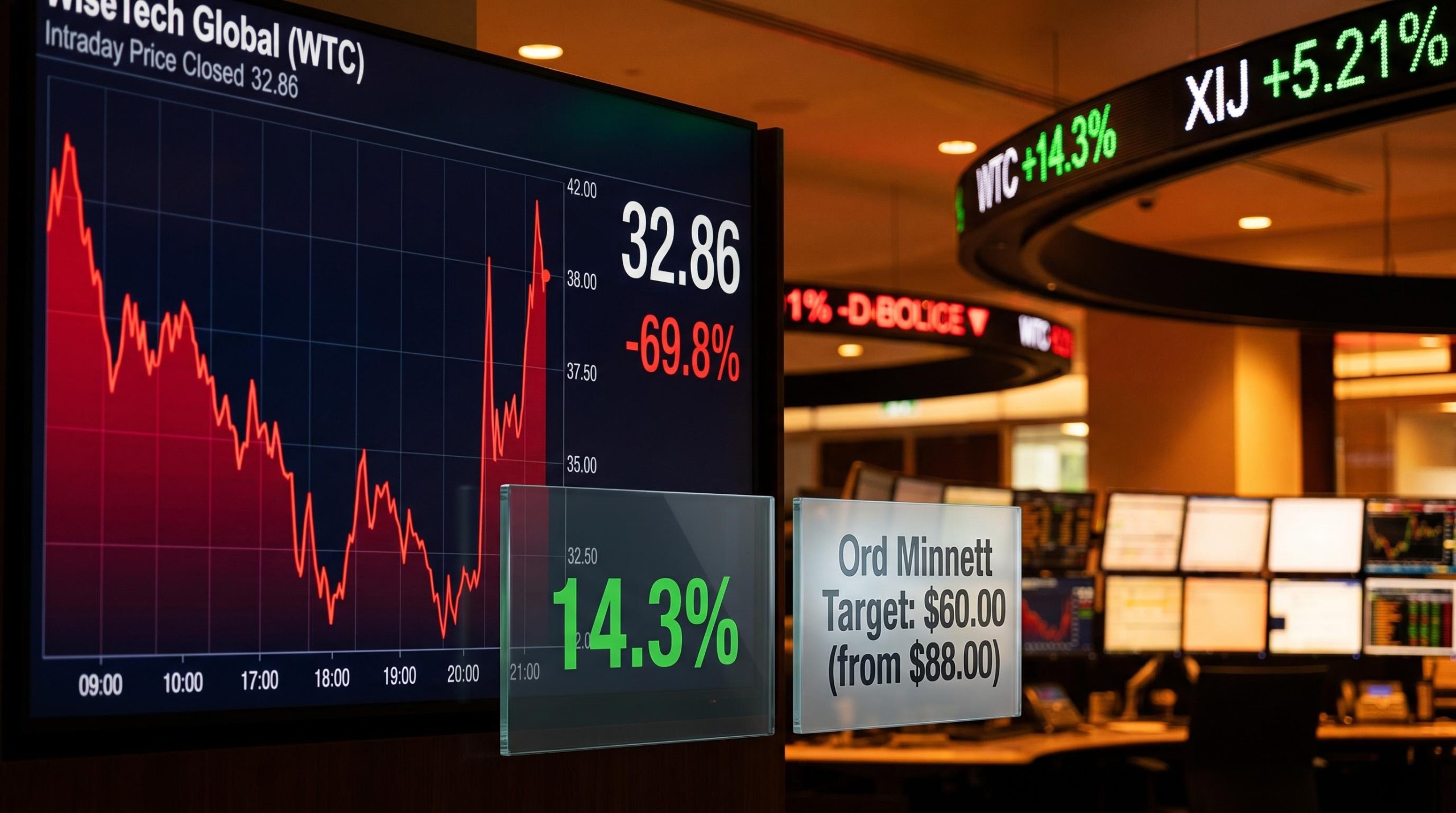
WiseTech Global fell more than 22% across two sessions. Then, on 24 June 2026, it gained 14.3% in a single day. There was no material company announcement to explain the reversal.
A 14% bounce in isolation looks like a recovery signal. Set against unresolved Australian Federal Police (AFP) governance concerns and a stock still down nearly 70% over the prior year, it raises a harder question: what can price action alone actually tell you, and what can it not?
Here is how to separate the mechanics of the bounce from the question of whether anything has genuinely changed for investors holding or watching WiseTech. The goal is a clear basis for interpreting the move, not reacting to the headline number.
A 22% fall, then a 14% bounce: what actually happened
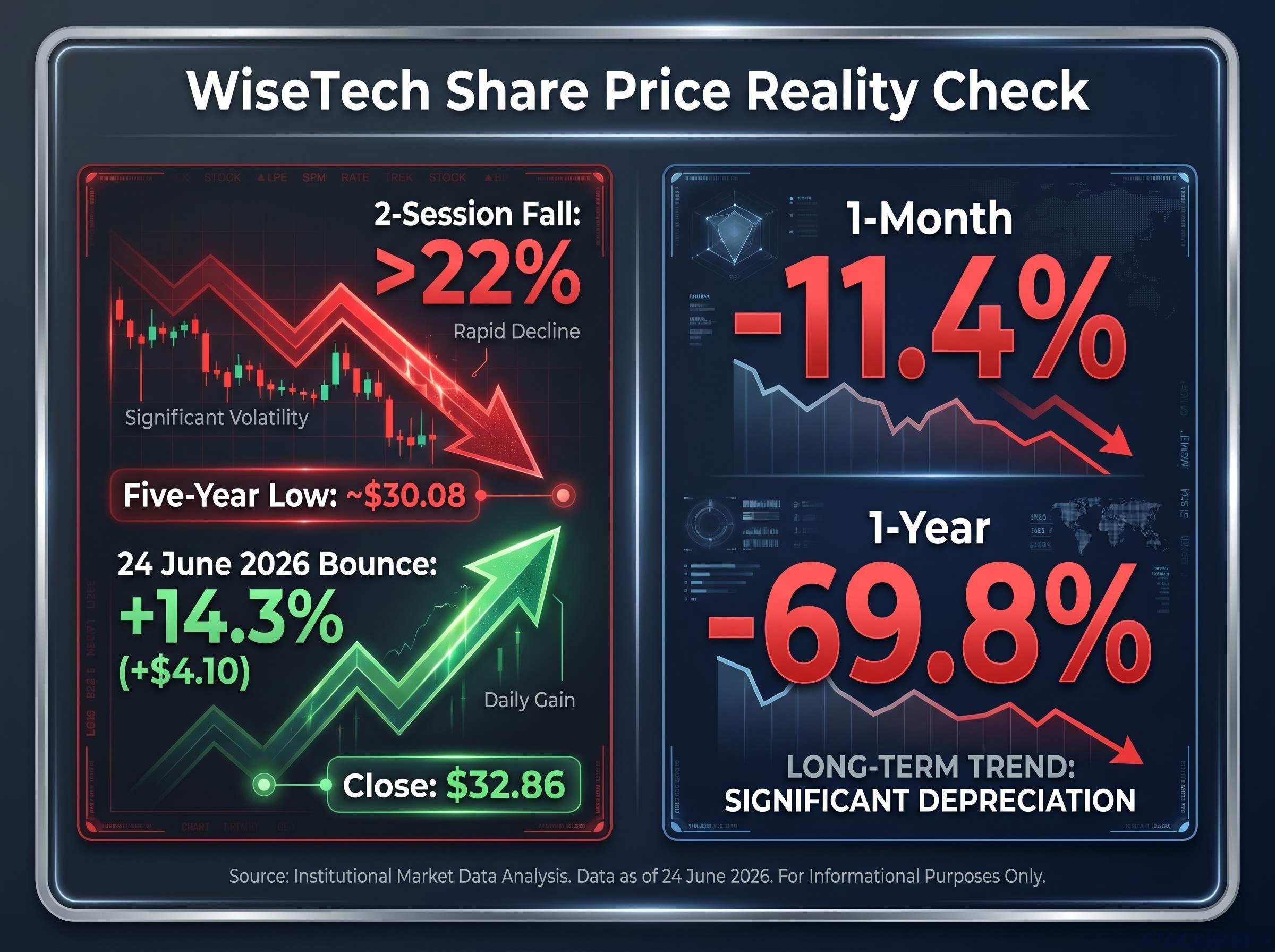
The sequence matters. AFP-related media reports involving founder and executive chairman Richard White triggered a sell-off that wiped more than 22% from WiseTech’s market capitalisation across two sessions, pushing the stock to approximately $30.08, a five-year low.
The two-session drawdown of approximately 22% set the stage for everything that followed.
Then came the reversal. On 24 June 2026, WiseTech gained 14.3% ($4.10) to close at $32.86, with no material company announcement on that day. The key context:
- Rebound day closing price: $32.86 (up $4.10, +14.3%)
- Prior session low: approximately $30.08 (five-year low)
- One-month performance: -11.4%
- One-year performance: -69.8%
A 14% recovery that still leaves the stock down nearly 70% over the year is not a recovery story. It is a single day’s arithmetic inside a much larger drawdown, and investors need to see those numbers side by side to understand how little ground has actually been reclaimed.
When big ASX news breaks, our subscribers know first
Why WiseTech’s shares fell so hard in the first place
The severity of the sell-off reflects more than one headline. The AFP-related media reports alleged that Richard White was being investigated over human trafficking, sexual exploitation, and providing false information on a visa application. Those allegations, whether or not they result in formal charges, placed the founder and executive chairman of a major ASX constituent at the centre of a serious criminal inquiry.
White issued a public statement denying personal knowledge of any AFP investigation targeting him. WiseTech separately confirmed it has no involvement in any legal proceedings and that the matters being reported upon concern White as a private individual, not in his corporate capacity. Those statements address formal legal exposure for the corporate entity, but they do not close the market’s uncertainty. An executive chairman under investigation, regardless of the company’s formal legal standing, is a governance risk that institutional investors cannot ignore.
The earlier share-trading investigation: a second layer of risk
Before the June 2026 AFP allegations, a separate investigation was already underway. The Australian Securities and Investments Commission (ASIC) and the AFP had been investigating alleged share-trading by White and three employees, with a regulatory search warrant executed in late 2025.
This is a distinct matter from the human trafficking allegations. The fact that two separate regulatory inquiries now involve the same executive chairman compounds the governance overhang rather than allowing either issue to be assessed in isolation.
Short covering versus genuine recovery: how to read a governance-driven bounce
Short covering is a mechanical price driver, not a fundamental one. When traders who have sold a stock short (borrowed and sold shares expecting the price to fall) decide to close those positions, they must buy the shares back. If many shorts close at once, particularly after an extreme down-move, the buying pressure can produce sharp upward moves with no change in the company’s underlying situation.
Short squeeze mechanics follow a self-reinforcing logic: forced buying from short sellers covering losing positions creates upward price pressure that triggers further covering, compounding the move well beyond what any improvement in the underlying business would justify.
The 24 June bounce carries three diagnostic features consistent with short covering rather than a genuine recovery:
- No positive news catalyst. There was no company announcement, no regulatory update, and no operational data to justify a sharp upward revision in value.
- Extreme prior drop. The stock had fallen more than 22% across two sessions on news-triggered selling, almost certainly involving forced selling, stop-loss triggers, and opportunistic shorting.
- Velocity without a de-risking event. The bounce was sharp and sudden, but nothing in the governance situation had changed to reduce the risk premium on the stock.
Analysts viewed the rebound as reflecting short-covering dynamics rather than any genuine improvement in the underlying governance position.
The prior year decline of approximately 62% (before the June AFP-related fall) adds further context. Sharp upward moves within a sustained downtrend are a common feature of bear-market rallies, where positioning dynamics temporarily overwhelm fundamentals. A genuine recovery signal would require something different entirely: credible exoneration, a governance reset, or at minimum some form of regulatory resolution.
If nothing has changed in the underlying governance situation, a 14% day tells you where short positions were sized. It does not tell you whether the risk premium on the stock has genuinely fallen.
How analyst valuation adjustments reflect governance uncertainty
Ord Minnett retained a Buy rating on WiseTech but cut its price target from $88.00 to $60.00, a reduction of $28.00 (approximately 32%). That combination is not a contradiction. It is a deliberate widening of the outcome range.
The mechanics work like this. In a discounted cash flow (DCF) model, where an analyst estimates the present value of a company’s future earnings, the same earnings forecasts produce a lower fair value when the discount rate rises. A discount rate is the rate used to adjust future earnings back to today’s value; a higher rate reflects greater uncertainty or risk. Ord Minnett’s target cut quantifies governance uncertainty in dollar terms.
| Broker | Rating | Price Target |
|---|---|---|
| Ord Minnett (WiseTech) | Buy | $60.00 (from $88.00) |
| Citi (Xero) | Buy | $113.60 |
The $60.00 target sits well above the 24 June closing price of $32.86, implying significant upside on the analyst’s base case. But the gap between $60 and $32.86 is not free upside. It is a range that reflects how unresolved the situation remains. The upside case depends on governance risk fading. The tail risks remain material if the situation escalates.
The analyst consensus on WiseTech spans a wide range, with price targets from $78 to $138 reflecting sharply different assumptions about how quickly governance risk fades and whether CargoWise organic growth can return to its historical 27% annual rate.
The sector ripple: why Xero and ASX tech moved with WiseTech
On 24 June 2026, the ASX Information Technology sector index (XIJ) closed at 1,779.8, having risen 5.21% across the session, marking its strongest single-day performance in some months.
The XIJ posted a 5.21% gain on the day, but understanding which stock drove that result matters more than the index-level headline.
That looks like a broad vote of confidence in ASX technology. It was not. WiseTech’s weight in ASX tech indices means a double-digit move in a single constituent can lift the sector reading even if peer fundamentals are unchanged. Key movers on the day:
ASX tech index construction means a single large-cap constituent experiencing a double-digit move can shift the sector reading materially, even when peer companies are trading on entirely different fundamental drivers, making the XIJ’s 5.21% session gain an unreliable signal of broad sector health.
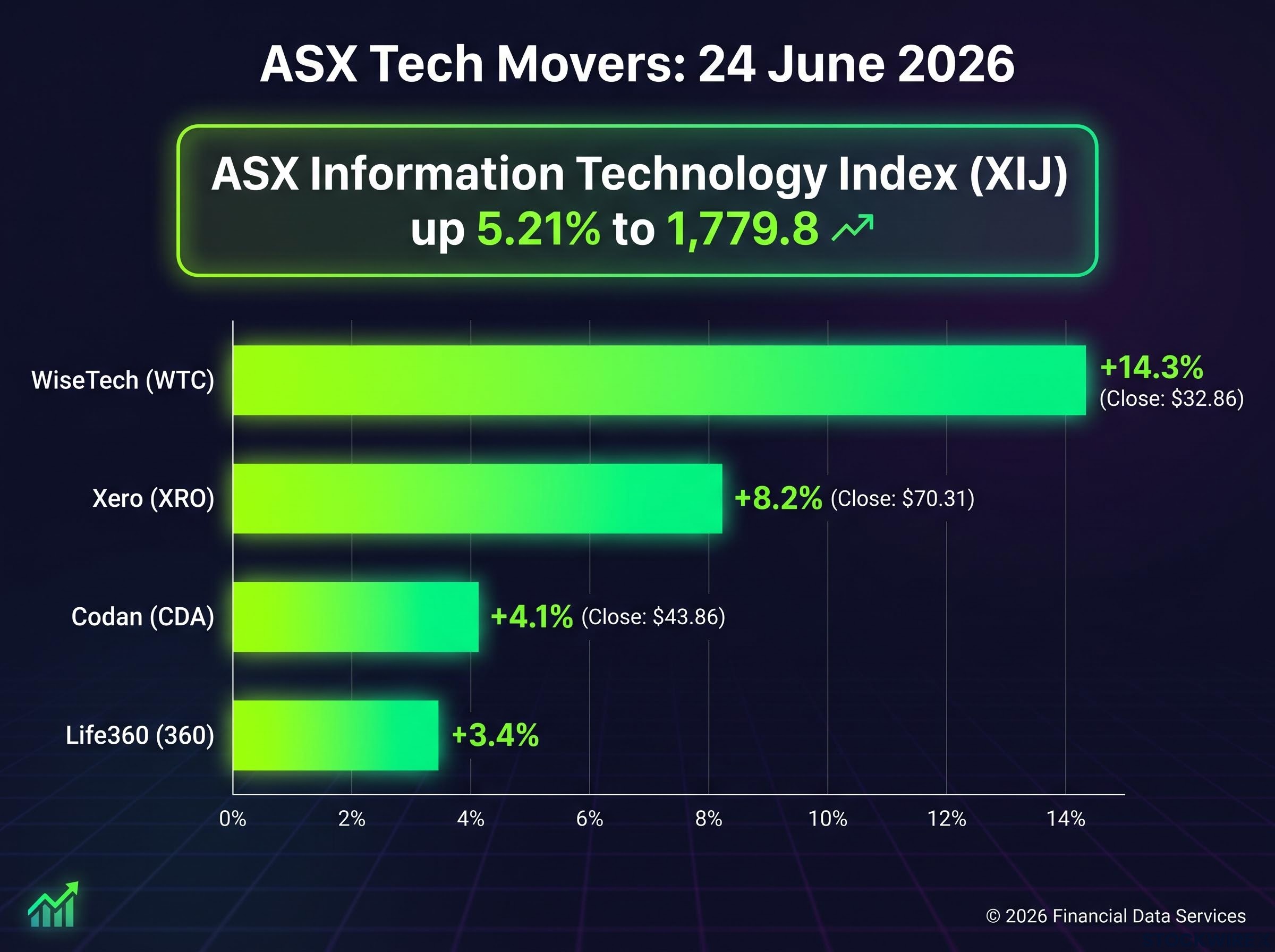
- WiseTech (WTC): +14.3% to $32.86
- Xero (XRO): +8.2% ($5.31) to $70.31 (one-month: -7.3%; one-year: -63.8%)
- Codan (CDA): +4.1% to $43.86
- Life360 (360): +3.4%
Xero’s advance was partly supported by a separate Citi Buy note with a $113.60 price target, giving it an independent catalyst. But the broader sector move was primarily mechanical: ETF and algorithmic flows respond to index-level changes irrespective of what is happening at individual companies.
A 5.21% sector index move driven primarily by short covering in one constituent is not a signal that the fundamental outlook for ASX technology has improved. Reading broad sector strength as independent confirmation of a recovery is an interpretive error worth avoiding.
What investors should watch before reading this as a turning point
Three specific variables will determine whether this bounce marks an inflection or simply an interruption in a longer drawdown.
- Governance and regulatory resolution. Until there is credible closure on either the human trafficking allegations or the share-trading investigation, the risk premium will remain elevated. Both inquiries involve the same executive chairman, and both remain open. No single positive trading day changes that.
- Earnings and operational data. CargoWise, WiseTech’s core logistics platform, retains strong strategic positioning in global freight and supply chain management. But customer, partner, and talent confidence will only be measurable through actual results and management commentary over coming quarters.
- Market structure. Elevated short interest, concentrated ownership, and high prior valuations mean volatility is likely to remain amplified in both directions. One up-day does not establish a floor.
For investors wanting to understand why earnings quality determines which ASX tech stocks recover and which flatline after sector-wide drawdowns, our full explainer on ASX tech recovery divergence examines why Megaport gained 79% in recovery while WiseTech recorded 0%, using cash flow profitability, rate sensitivity, and revenue durability as the differentiating variables.
Ord Minnett’s $60 target represents the analyst’s base case if governance risk fades. That qualifier, “if governance risk fades”, is doing significant work. Without a clear view of how and when that happens, the risk premium embedded in the current price is not going away.
One day’s price action changes the chart, not the risk
The 14.3% bounce is best understood as a positioning-driven technical event. Research characterised it as a “technical snap-back within a still-stressed regime”, and the absence of any de-risking catalyst on the day supports that reading.
Ord Minnett’s framing remains the most honest available read: upside exists if governance risk fades, but that condition has not been met. The gap between $60 and $32.86 measures the market’s uncertainty, not its generosity.
The three variables, governance resolution, operational evidence, and market structure, are where the next durable signal will come from. Until one of them shifts, a single day’s price action changes the chart. It does not change the risk.
This article is for informational purposes only and should not be considered financial advice. Investors should conduct their own research and consult with financial professionals before making investment decisions. Past performance does not guarantee future results. These statements are speculative and subject to change based on market developments and company performance.
—