Five companies spanning defence technology, lithium mining, and gold extraction joined Australia’s benchmark equity index today, the result of a quarterly reconstitution process that quietly reshapes what millions of passive investors own.
The S&P/ASX 200 Index completed its June 2026 quarterly rebalance on 22 June 2026, with all constituent changes effective as of today’s market open. S&P Dow Jones Indices announced the changes in advance, giving index-tracking funds time to reposition their portfolios. For holders of the iShares Core S&P/ASX 200 ETF (IOZ), today’s changes mean new positions in all five additions are now live.
What follows identifies each new ASX 200 member, examines the performance that drove their inclusion, explains how the rebalance mechanism works, and outlines what the changes mean in practice for IOZ investors.
Five companies join the ASX 200 as of today
The five additions cover three distinct corners of the Australian market: defence and space technology, lithium mining, and gold and copper-gold mining. All became effective on 22 June 2026.
| Company | ASX Ticker | Sector | 12-Month Return | YTD 2026 Return |
|---|---|---|---|---|
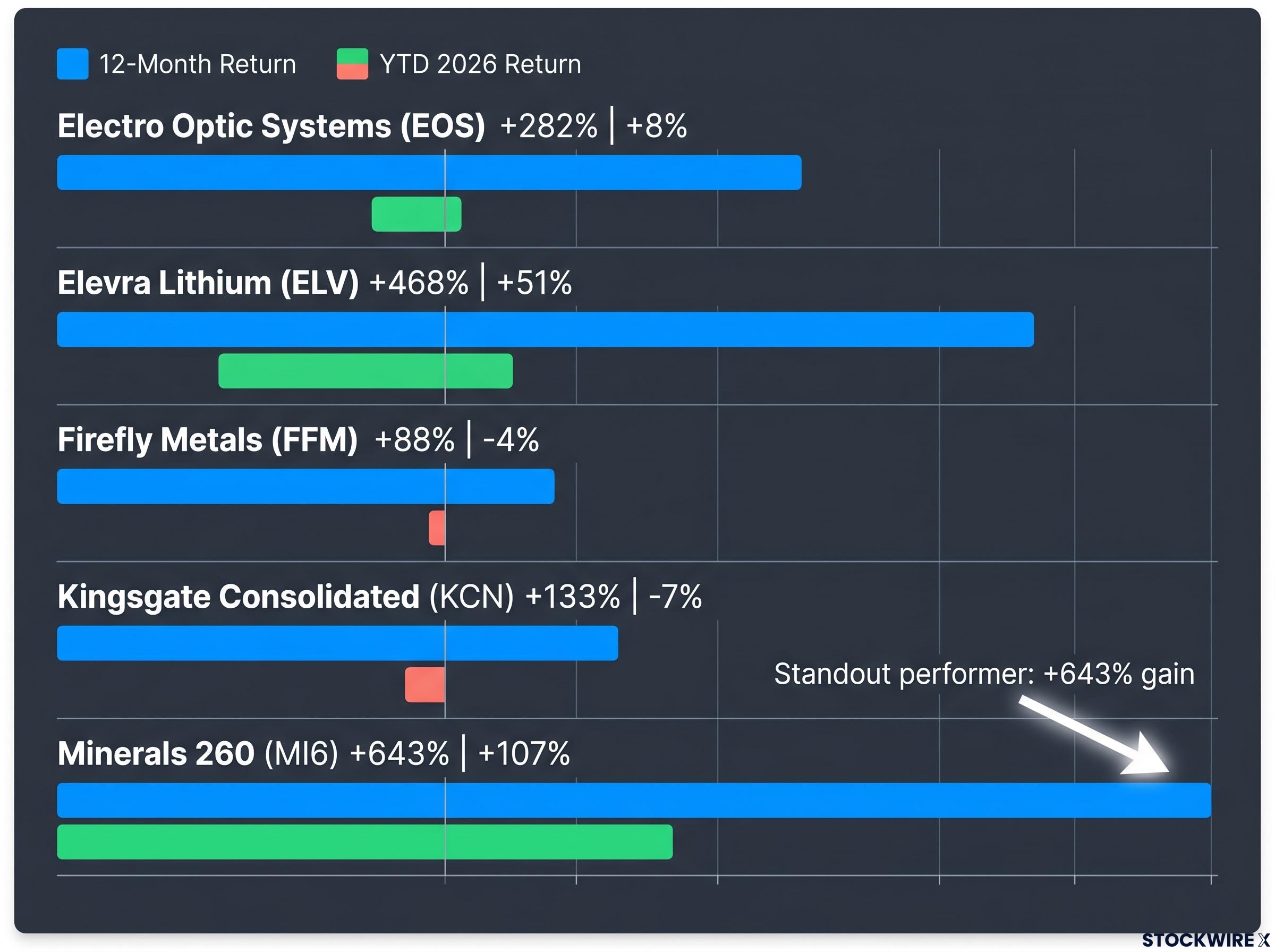
| Electro Optic Systems | EOS | Defence & space technology | +282% | +8% |
| Elevra Lithium | ELV | Lithium mining | +468% | +51% |
| Firefly Metals | FFM | Copper & gold mining | +88% | -4% |
| Kingsgate Consolidated | KCN | Gold mining | +133% | -7% |
| Minerals 260 | MI6 | Gold mining | +643% | +107% |
The 12-month returns tell the story of what carried each company over the market-capitalisation threshold. Every addition recorded a gain of at least +88% over the preceding year. Year-to-date figures, however, show a more mixed picture: Firefly Metals and Kingsgate Consolidated have softened in 2026 even as their longer-term trajectory qualified them for inclusion.
Standout performer: Minerals 260 (MI6) recorded a 12-month return of approximately +643%, the strongest gain among all five additions.
When big ASX news breaks, our subscribers know first
What the quarterly rebalance process actually involves
The S&P/ASX 200 is not curated by the ASX itself. S&P Dow Jones Indices administers the quarterly rebalances, applying a rules-based methodology rather than discretionary selection.
ASX listing and ASX 200 inclusion are governed by entirely separate bodies under different rules: a company can be listed on the ASX for years before its float-adjusted market capitalisation grows large enough to rank in the top 200, and the free float minimum rises from 20% at listing to 30% for index qualification.
The process follows three stages:
- Eligibility assessment: S&P Dow Jones Indices ranks companies by float-adjusted market capitalisation, the portion of a company’s shares available for public trading, and applies liquidity screens to identify candidates for addition or removal.
- Announcement: Changes are published ahead of the effective date, giving index-tracking funds a window to buy incoming constituents and sell outgoing ones.
- Effective date repositioning: On the designated date (in this case, 22 June 2026), all changes take effect simultaneously.
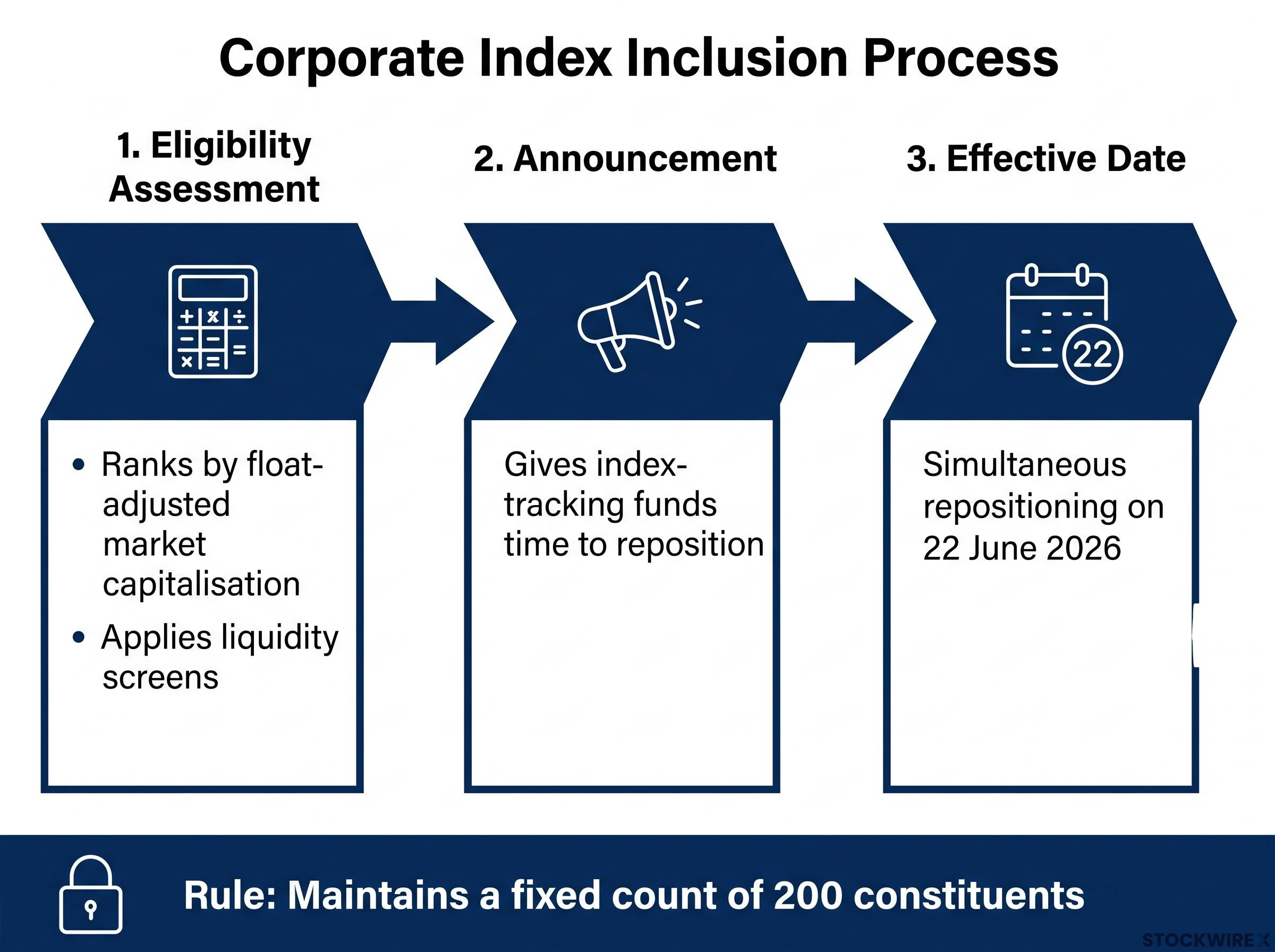
Every addition is paired with a corresponding removal to maintain the fixed count of 200 constituents. The removals for the June 2026 rebalance were not available in the source material for this article; the full list is published by S&P Dow Jones Indices.
The distinction matters: inclusion in the ASX 200 reflects a company crossing a mathematical size threshold, not an endorsement of its quality or prospects.
Gold, lithium, and defence: the sector themes behind the additions
Three of the five additions are gold or copper-gold miners, making resources the dominant theme of this rebalance. One is a lithium miner. One operates in defence technology. Together, they form a snapshot of where Australian investors have been directing capital over the past year.
- Gold and copper-gold mining (KCN, MI6, FFM): Elevated gold prices over the preceding 12 months carried all three companies past the market-capitalisation threshold. Minerals 260 led with a +643% gain, while Kingsgate Consolidated returned +133% and Firefly Metals gained +88%. Both KCN and FFM have pulled back modestly on a year-to-date basis, suggesting the strongest phase of their run may have occurred before 2026 began.
- Lithium (ELV): Elevra Lithium’s +468% 12-month gain points to a significant re-rating of the stock following a period of broader lithium sector weakness. The company continued to gain in 2026, with a year-to-date return of approximately +51%.
- Defence technology (EOS): Electro Optic Systems returned approximately +282% over 12 months, reflecting sustained investor interest in Australian defence capabilities. Year-to-date momentum has been more modest at +8%.
Elevra Lithium’s +468% gain over 12 months sits within a broader lithium sector recovery that pushed spodumene concentrate prices from approximately US$600 per tonne in June 2025 to US$2,500 per tonne by May 2026, lifting multiple ASX-listed producers to new 52-week highs in the process.
For investors already holding sector-specific ETFs alongside broad index exposure, three gold miners entering the ASX 200 simultaneously may shift the resource weighting of their overall portfolio.
Three gold miners entering the index simultaneously concentrates more of the ASX 200 in hard commodities, and the resource weighting of their overall portfolio is something IOZ holders with existing sector-specific ETF allocations will want to revisit, given that financials and materials already account for more than 50% of the index by market-cap weight.
What today’s changes mean if you hold IOZ
IOZ, managed by BlackRock, tracks the S&P/ASX 200 Index and rebalances its holdings to mirror constituent changes. As of today, the ETF holds positions in all five new additions.
The weighting assigned to each new constituent within IOZ is determined by float-adjusted market capitalisation. Because these five companies are recent entrants to the top 200 by size, their individual weightings are likely to be proportionally modest relative to the index’s larger constituents.
The weighting assigned to each new constituent is determined by float-adjusted market capitalisation, the same construction method that places nearly half of the entire ASX 200 into its top 10 companies and means small new entrants like these five receive proportionally modest allocations relative to the index’s dominant banks and miners.
Specific index weightings for EOS, ELV, FFM, KCN, and MI6 within IOZ were not available in the source material for this article. Investors seeking precise figures can refer to BlackRock’s IOZ product disclosures or S&P Dow Jones Indices publications for current holdings data.
IOZ automatically incorporated all five additions as of 22 June 2026 without requiring any action from existing unitholders.
A rebalance that mirrors where Australian investors have been putting their money
Three gold and copper-gold miners, one lithium company, and one defence technology name entering the index in the same quarter is not coincidental. It reflects where sustained capital flows pushed companies past the market-capitalisation threshold over the preceding 12 months: commodities benefiting from elevated prices and a defence sector attracting renewed investor attention.
Looking ahead
Today’s additions are not permanent. The next scheduled quarterly rebalance will assess all 200 constituents against the same rules-based criteria. Companies that fall below the capitalisation or liquidity threshold may be removed just as mechanically as they were added. Investors who want to track future changes can monitor S&P Dow Jones Indices announcements directly, and the removals list for this rebalance should be sourced from S&P Dow Jones Indices for a complete picture of today’s changes.
This article is for informational purposes only and should not be considered financial advice. Investors should conduct their own research and consult with financial professionals before making investment decisions.