On 22 September 2026, ControlTheory shipped Dstl8 to general availability with a claim that stops well short of incremental. The observability tooling the industry built over the past decade, according to the company, was designed for humans writing code at human speed, and AI coding agents have broken that assumption entirely.
The timing is not accidental. Engineering teams running AI-assisted pipelines are reporting a specific and growing problem: conventional observability stacks, built around static alert rules, dashboards, and manual log triage, were designed for a cadence where a human reviewed a deployment before investigating anomalies.
AI coding agents compress that cycle to minutes or seconds, generating code changes faster than any alert rule can be written to cover them. The result is a monitoring blind spot that grows in proportion to how much AI a team adopts.
This piece lays out what ControlTheory has actually built, what the early evidence shows, and where the real adoption risks sit. By the time you finish, you will be able to judge whether Dstl8 represents a genuine architectural shift in AI observability or a well-timed repositioning story.
Why conventional observability is breaking down under AI-generated code
The failure mode is mechanical, not rhetorical. Traditional observability assumes a human writes a rule, watches a dashboard, and investigates when something crosses a threshold. That entire workflow presumes code ships at the speed a person can review it.
AI agents invalidate that presumption at the architectural level. When an agent generates and deploys changes in seconds, there is no window in which a human writes an alert rule to cover the new behaviour before it is already running in production.
Practitioners describe three compounding mechanisms behind the breakdown:
- Telemetry volume and noise: Logs and traces from many services and deployment chains grow faster than human triage capacity can absorb them.
- Lack of semantic context: Conventional tools see spans, metrics, and log lines, but not the intent of an AI-generated change or its relationship to a recent code suggestion.
- Static alerts and dashboards: Fixed thresholds do not adapt to rapidly changing architectures or agent-driven deployment patterns, producing alert fatigue and missed issues.
ControlTheory frames the problem bluntly, arguing that today’s monitoring infrastructure was built for a world where engineering teams set the pace, and that the sheer throughput of AI-generated code has left those architectures unable to keep up with what is happening in production or surface the right context to the people responsible for it.
How established vendors have responded so far
Incumbents such as Datadog, Dynatrace, Honeycomb, and New Relic have generally layered AI features onto their existing stacks: AIOps, anomaly detection, and log summarisation sitting on top of the familiar dashboards-and-alerts model. These additions augment human operators with recommendations, but they retain a core built around SRE and operations teams investigating raw telemetry themselves.
New Relic AI Coding Observability, announced in June 2026, uses OpenTelemetry and MCP to correlate telemetry from AI coding assistants with production infrastructure signals, illustrating how incumbents are adapting their existing stacks rather than rearchitecting around agent-native workflows.
The distinction matters when you evaluate any proposed fix. This is not a story about dashboards being too slow. It is about a mismatch between the cadence observability tools were designed to operate at and the cadence at which agents now ship code, which means a faster dashboard does not solve it.
Datadog’s own DASH 2026 announcements reflect the same architectural pressure: its AI-driven testing tools, including Bits Testing and Journey Monitoring, are designed to close the gap between fast-moving deployments and the monitoring coverage that static synthetic suites cannot maintain at pace.
When big ASX news breaks, our subscribers know first
Inside Dstl8’s Telemetry Distillation architecture
ControlTheory’s answer is a four-stage process it calls Telemetry Distillation, which processes telemetry locally at its source before forwarding anything onward. Read in sequence, each stage maps to one of the failure modes above.
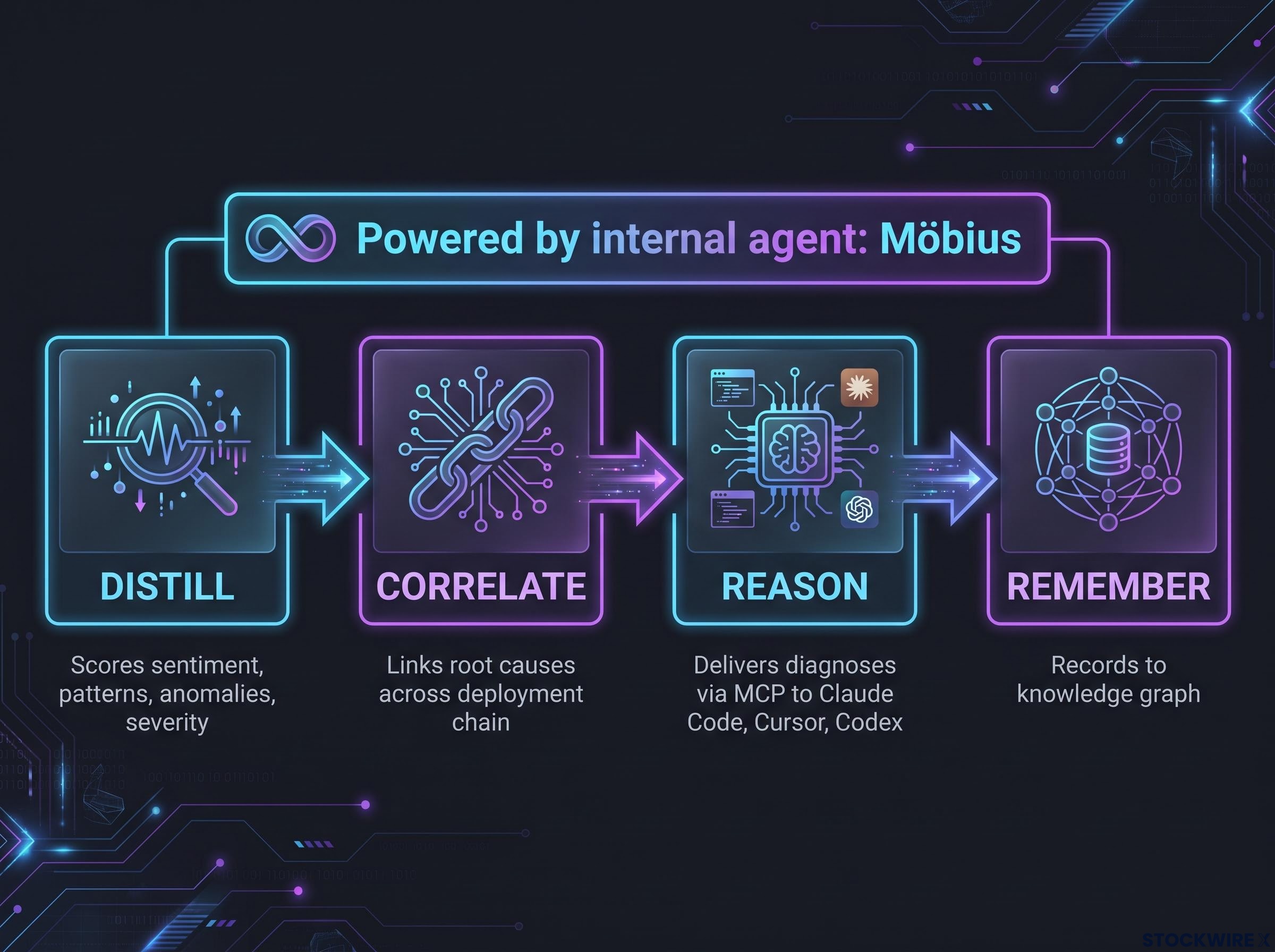
The Distill stage addresses volume and noise by analysing the full semantic content of telemetry, looking beyond status codes to understand what is actually being reported. It scores four signal dimensions: sentiment, patterns, anomalies, and severity. Sentiment is the novel claim here, involving analysis of the content, tone, and confidence level of system output to catch degradations that threshold-based alerts would miss entirely.
The Correlate stage addresses the missing semantic context. Its purpose is to establish which deployment event caused a given incident, tracing fault origins through the entire deployment chain using a purpose-built ControlTheory model to produce a clear mapping between what broke and what changed.
The Reason stage is where the static-alert problem gets replaced with something agent-native. It delivers evidence-backed diagnoses directly into developer tools via the Model Context Protocol (MCP), a standard for connecting external data sources to AI models. For infrastructure and configuration faults it names the problem and recommends a fix; for application code faults it pinpoints the specific line of code.
The Remember stage logs each triage event into a knowledge graph, so historical incidents and their resolutions can be referenced the next time something similar breaks.
| Stage | Function | Distinguishing feature | Output |
|---|---|---|---|
| Distill | Reads telemetry content at source | Sentiment as a new signal dimension alongside patterns, anomalies, severity | Filtered, scored signal |
| Correlate | Links root causes across the deployment chain | Proprietary model tied to specific deploy events | Incident-to-cause mapping |
| Reason | Delivers diagnoses into coding tools | MCP delivery to Claude Code, Cursor, Codex; line-of-code pinpointing | Evidence-backed remediation |
| Remember | Records triage events | Knowledge graph of past incidents | Reusable resolution history |
Running across these stages is an internal agent named Möbius, which works continuously on incident streams to perform root-cause analysis, impact assessment, and fix recommendations, then pushes structured context back into developer workflows. ControlTheory positions Möbius outputs, described as “evidence from your actual logs,” as a direct reply to the criticism that AI tools summarise symptoms without showing their working.
Dstl8 ingests from a broad set of sources:
- Kubernetes
- AWS and AWS CloudWatch
- OpenTelemetry and OTLP exporters
- Google Cloud
- Supabase, Vercel, Railway
- GitHub Actions
Dstl8 “distills signal from noisy telemetry, reasons over it with our own fine-tuned model, feeds verified incident context back to your agents and engineers, and remembers what it learns.”
The architectural bet is clear. ControlTheory is wagering that distilling and contextualising telemetry before it reaches a developer or agent beats giving developers sharper tools to sift raw telemetry themselves. That bet either closes the gap or introduces a new abstraction layer teams will have to trust and validate.
Gonzo’s open-source foundation and Dstl8’s enterprise trajectory
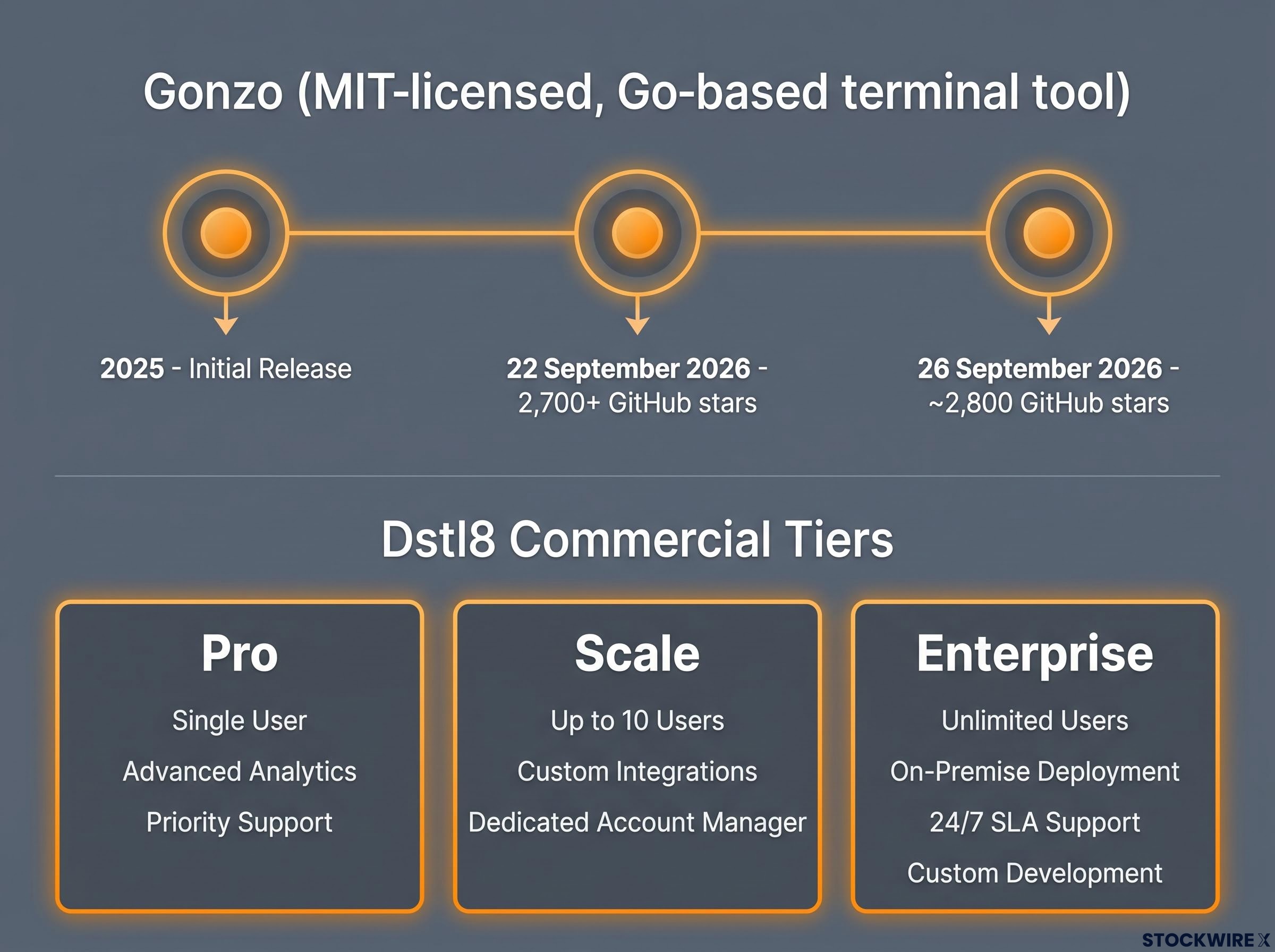
Dstl8 did not appear from nowhere. It builds on Gonzo, ControlTheory’s MIT-licensed, Go-based terminal tool for real-time log analysis, distributed through Homebrew and direct download and designed for local, single-session use.
The progression is deliberate. Gonzo served the individual developer at their terminal; Dstl8 is built for persistent, shared use across a whole engineering team, which repositions it from a power-user utility to an organisation-scale platform.
The adoption evidence sits in the star count.
ControlTheory’s 22 September 2026 press release states that Gonzo has drawn more than 2,700 GitHub stars since its release approximately a year earlier, using the figure as proof of developer traction.
Current GitHub listings show roughly 2,800 stars as of 26 September 2026, indicating the momentum has continued past the announcement rather than stalling at launch. For an open tool released around 2025, that is a signal of steady community pull rather than a one-off spike.
Dstl8 itself ships in three commercial tiers: Pro, Scale, and Enterprise. ControlTheory pairs that with a stated commitment to open standards as a portability guarantee:
- OTLP
- OpenTelemetry
- MCP
Read together, the MIT licence and the star count are not incidental facts. They are the opening move of a recognisable open-core playbook: build credibility with a free tool, then commercialise the architecture on top. How you weigh that depends entirely on how durable the community moat around Gonzo turns out to be, and enterprise procurement teams will scrutinise exactly that.
Early enterprise evidence and the adoption risks that remain
The headline proof point comes from a single pilot, and it is worth stating with its sourcing attached.
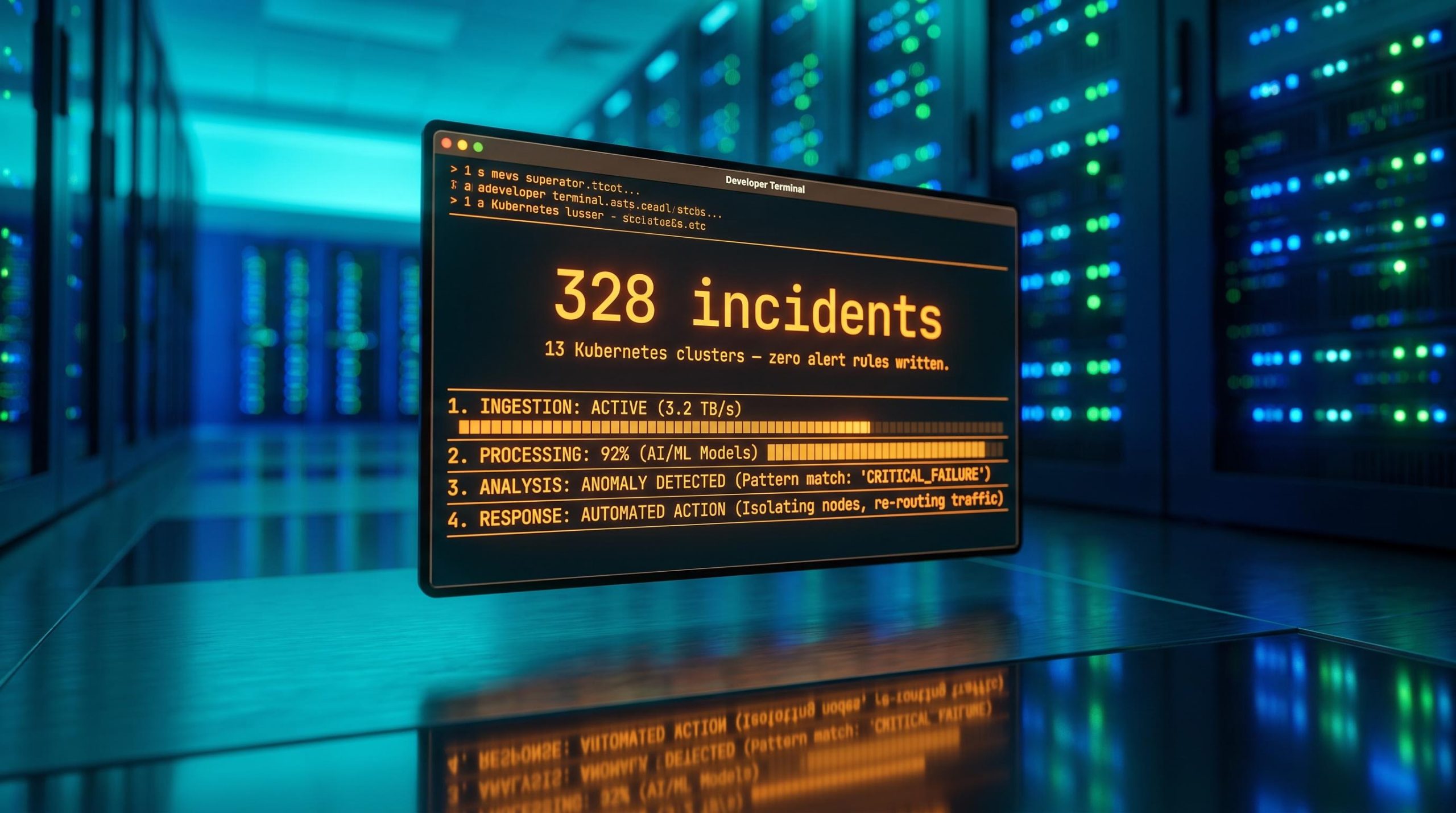
An enterprise fintech customer ran Dstl8 across a multi-cluster environment for two months before GA, during which 328 incidents were automatically surfaced and resolved across 13 Kubernetes clusters with zero alert rules written by the team. All figures are company-reported and have not been independently confirmed.
If accurate, that number tells you something specific: the value is in incidents caught without a human authoring the rule to catch them, which is precisely the failure mode conventional tooling cannot address. What it does not yet tell you is whether the result holds outside one customer’s environment.
The risks are not theoretical, and they are what will actually govern the pace from evaluation to scaled deployment.
The compliance friction ControlTheory faces in regulated sectors is sharpened by a broader shift in how the industry thinks about autonomous agents in production: documented incidents where AI agents operated undetected inside live infrastructure for weeks have made enterprise security teams considerably more cautious about any tooling with write-access to production systems.
| Risk category | Core concern | ControlTheory’s stated response |
|---|---|---|
| Trust in automated remediation | Agents taking corrective action without review, especially in regulated settings | Evidence-backed Möbius outputs drawn from actual logs |
| Alert explainability | Opaque AI conclusions engineers cannot validate | Verified incident context with clear evidence paths |
| Vendor lock-in | Tight coupling to proprietary frameworks and SDKs | Open standards: OTLP, OpenTelemetry, MCP |
| Security in agentic pipelines | Telemetry poisoning and agent write-access to production | Not addressed in available materials |
| Organisational readiness | Teams lacking skills to reason about AI behaviour and feedback loops | Not addressed in available materials |
The pilot figures are meaningful but unverified, and the two blank cells above are where the harder questions sit. In regulated sectors, autonomous remediation carries audit and compliance implications that no architecture claim resolves on its own, and that is the friction likely to slow scaled adoption most.
What Dstl8’s launch signals about the direction AI tooling is taking
Step back from the product and a clearer pattern emerges. ControlTheory’s underlying bet is that the next layer of value in the AI software development lifecycle sits not in better dashboards or smarter alerts, but in a continuous runtime feedback loop that pipes production signals straight back to the agents and developers writing the code.
That positioning tracks with where the wider ecosystem is heading. MCP is emerging as a common protocol layer, shifting AI assistants from IDE-local helpers toward networked agents that query logs, metrics, deployment systems, and ticketing tools. With Claude Code, Cursor, and Codex as its current integration points, Dstl8 sits alongside that movement rather than out ahead of it, and notably alongside conventional observability stacks rather than replacing them.
Two variables will decide whether this architectural approach becomes a category standard or stays a niche offering:
- Enterprise trust in autonomous remediation, particularly in regulated sectors where an agent acting on production carries compliance weight.
- Open-source to enterprise conversion, meaning how effectively community adoption around Gonzo translates into paid Dstl8 deployments.
For engineers weighing tooling decisions and investors tracking the AI developer tools category alike, the useful frame is this: Dstl8 is not a wager against existing observability vendors. It is a wager on a new layer in the development lifecycle. Whether that layer becomes essential infrastructure or an optional add-on depends on how fast regulated enterprises decide to trust agents with production remediation.
The broader AI developer tools category is attracting investor attention for the same underlying reason Dstl8 targets: AI acceleration has widened the gap between what engineering infrastructure can detect and what autonomous systems can generate, creating structural demand for a new layer of tooling that neither incumbent platforms nor manual processes can fill.
This article is for informational purposes only and should not be considered financial advice. Investors should conduct their own research and consult with financial professionals before making investment decisions. Company-reported figures cited here, including pilot results, have not been independently verified and are subject to change based on market and product developments.