
ASIC has imposed the maximum five-year director ban it can hand down without going to court, disqualifying Lambros Hilellis of Kingsgrove, New South Wales from managing corporations until 29 March 2031. The action, announced on 28 April 2026 via media release 26-085MR, followed the collapse of four companies in the security services and building and construction sectors, leaving approximately $12.4 million owed to unsecured creditors. ASIC described the conduct as falling into “the worst category of misconduct” in terms of honesty, integrity, and disregard for director’s duties. The findings draw on supplementary liquidator reports funded through the Assetless Administration Fund, and the case serves as a direct signal about which patterns of director behaviour will attract the regulator’s hardest available administrative response.
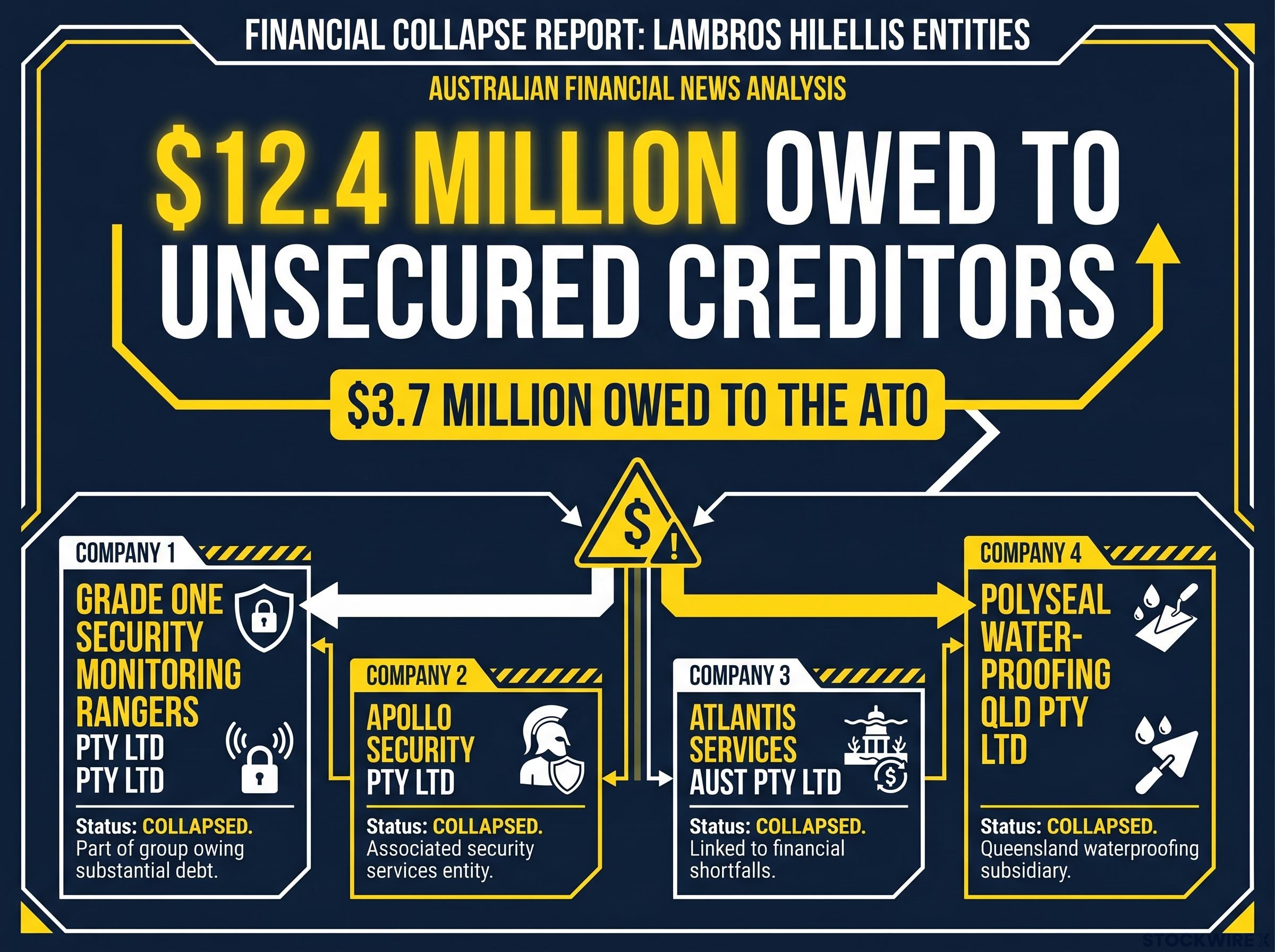
Four collapsed companies, $12.4 million in losses, and one director at the centre
The creditor losses alone set this case apart. Across four companies wound up within the relevant statutory window, approximately $12.4 million was owed to unsecured creditors. Of that, roughly $3.7 million was owed to the Australian Taxation Office (ATO), adding a public-interest dimension that extends beyond commercial losses between private parties.
Hilellis was an officer of all four entities:
| Company | Sector | ACN |
|---|---|---|
| Grade One Security Monitoring Rangers Pty Ltd | Security services | 156 567 967 |
| Apollo Security Pty Ltd | Security services | 154 881 973 |
| Atlantis Services Aust Pty Ltd | Building and construction | 600 383 775 |
| Polyseal Waterproofing Qld Pty Ltd | Building and construction | 149 962 872 |
ASIC’s findings relied on supplementary liquidator reports prepared by Stephen Hundy and Chad Rapsey of Rapsey Griffiths, funded through the Assetless Administration Fund. That funding mechanism matters:
- The Assetless Administration Fund exists specifically to investigate company failures where recoverable assets are minimal or non-existent.
- Without it, the absence of company assets would have prevented independent assessment of Hilellis’ conduct altogether.
- ASIC can pursue accountability even when there is nothing left to distribute.
Four failures, one director. The pattern is the story.
When big ASX news breaks, our subscribers know first
A pattern of dishonesty, not just poor management
Companies fail for many reasons. ASIC’s findings against Hilellis describe conduct that goes well beyond mismanagement into territory the regulator characterised as deliberate.
ASIC found that Hilellis’ conduct fell into “the worst category of misconduct” in terms of honesty, integrity, and disregard for director’s duties.
The specific findings span five categories:
- Unexplained payments: $197,000 was paid from Grade One Security Monitoring Rangers Pty Ltd’s bank account to third parties without reasonable explanation, a quantified finding rather than a general allegation.
- Insolvent trading: Atlantis Services Aust Pty Ltd continued trading while insolvent, exposing creditors to further losses that should not have been incurred.
- False tax returns: Hilellis caused false income tax returns to be lodged with the ATO. ASIC treated this as deliberate dishonesty, not administrative error.
- Record-keeping and reporting failures: Across the four companies, Hilellis failed to maintain proper financial records, failed to submit a Report on Company Activities and Property (ROCAP) to the liquidator, failed to deliver company books and records to the liquidator, and failed to meet statutory lodgement obligations.
- Loans to related entities: Company funds were lent to related entities without any reasonable prospect of repayment.
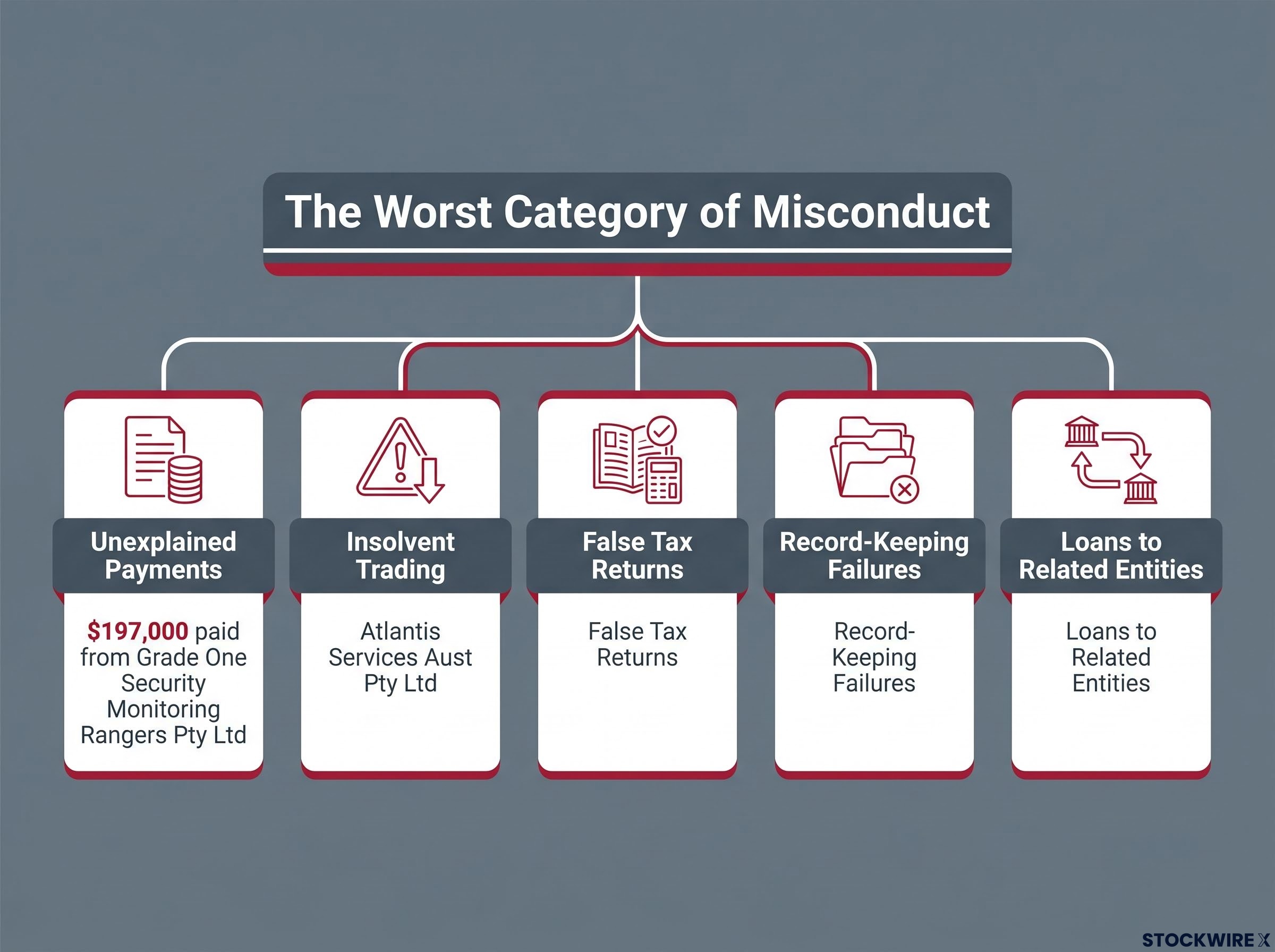
The distinction between negligence and dishonesty is the line that separates a manageable regulatory outcome from a maximum-penalty disqualification. The false tax returns, the unexplained payments, and the loans to related entities without repayment prospects all sit on the dishonesty side of that line. Record-keeping failures and insolvent trading compound the picture, but it was the honesty findings that placed this case, in ASIC’s assessment, at the ceiling.
The Berndale Capital Securities collapse offers a close parallel in terms of director misconduct in finance, where co-director Daniel Kirby received a custodial sentence of nearly three years for conduct that included the unlawful movement of company funds, and where ASIC pursued criminal charges rather than administrative remedies alone.
For directors and company secretaries, these categories form a practical checklist of conduct ASIC treats as disqualification-worthy.
How ASIC’s director disqualification powers actually work
The five-year ban Hilellis received is the maximum ASIC can impose through its administrative pathway. Understanding why “maximum” has a ceiling requires distinguishing between the two disqualification mechanisms available under the Corporations Act 2001.
ASIC’s director disqualification powers under s 206F allow the regulator to act administratively, without court proceedings, capping the available penalty at five years and making it the fastest available route to removing a director from corporate management.
The administrative pathway under s 206F
Under s 206F of the Corporations Act 2001 (the administrative disqualification power), ASIC can ban a person from managing corporations for up to five years without court proceedings:
- Trigger conditions: The person must have been an officer of two or more companies wound up within the previous seven years, and ASIC must be satisfied the person’s management contributed to the failures or to inadequate books and records.
- Maximum penalty: Five years.
- Process: Administrative, meaning ASIC acts on its own authority. No court hearing is required, making the pathway faster and available without litigation resources.
Hilellis met the trigger conditions across all four companies. ASIC imposed the full five years, effective until 29 March 2031.
Court-ordered disqualification and the longer-term risk
Under ss 206C-206D of the Corporations Act 2001, courts can impose longer bans:
- Range: Typically 2-15 years, and in extreme cases permanent disqualification.
- Process: Requires separate court proceedings initiated by ASIC before a court.
- Escalation: ASIC can pursue both pathways in different cases, or escalate from administrative findings to court action where circumstances warrant.
Hilellis retains the right to seek review of ASIC’s decision through the Administrative Review Tribunal. That review right provides due process but does not suspend the disqualification while under review.
The distinction matters for readers who encounter ASIC enforcement coverage regularly. A five-year administrative ban represents the ceiling of one pathway, not the ceiling of regulatory consequences overall.
What this case signals about ASIC’s current enforcement approach
This disqualification was not a default outcome. ASIC imposed the maximum available penalty, and the factors it cited reveal the threshold at which the regulator reaches for the ceiling of its administrative power:
- Multiple corporate failures: Four separate company collapses within the statutory window, not an isolated business failure.
- Scale of creditor losses: Approximately $12.4 million owed to unsecured creditors, including $3.7 million to the ATO.
- Diverse and serious misconduct: Insolvent trading, unexplained payments, false tax returns, loans to related entities, and systemic record-keeping failures, all present in a single director’s conduct.
- Honesty and integrity findings: ASIC assessed the conduct as demonstrating a “complete disregard for director’s duties.”
ASIC found that the conduct demonstrated a “complete disregard for director’s duties.”
The Assetless Administration Fund played a direct role in enabling this outcome. Without funded liquidator reports, the investigation of assetless companies would have stalled. The Fund’s involvement signals that even where company assets are exhausted, ASIC retains the capacity to pursue accountability.
Financial reporting failures sit at the core of ASIC’s 2026 enforcement priorities across multiple company types, with three ASX-listed companies collectively fined $1,170,000 for multi-year non-lodgement of annual reports, a parallel campaign that reinforces the regulator’s appetite to pursue record-keeping and disclosure obligations regardless of company size or sector.
For investors, creditors, and co-directors in multi-entity corporate structures, this case maps the specific combination of factors that triggers ASIC’s hardest available administrative response.
Where this leaves creditors, and what comes next for Hilellis
The ban is set. Hilellis cannot manage corporations until 29 March 2031, and doing so during the disqualification period would constitute a criminal offence.
The forward-looking position involves three facts:
- Ban duration: The five-year disqualification runs to 29 March 2031.
- Review right: Hilellis may apply for review through the Administrative Review Tribunal, though this does not suspend the ban.
- Creditor recovery: The $12.4 million owed to unsecured creditors, including $3.7 million to the ATO, is not restored by the disqualification. A director ban is a regulatory accountability measure, not a recovery mechanism.
That last point warrants emphasis. Creditors and stakeholders in failed company situations often expect regulatory enforcement to translate into financial recovery. It does not. The disqualification prevents Hilellis from repeating the conduct with future companies. It does not return money to the creditors of the four that already failed.
This article is for informational purposes only and should not be considered financial advice. Investors should conduct their own research and consult with financial professionals before making investment decisions.
Maximum penalty, minimum ambiguity on corporate governance expectations
ASIC’s five-year administrative ban of Lambros Hilellis reflects a deliberate escalation to the ceiling of the power available under s 206F of the Corporations Act 2001. The combination of four corporate collapses, $12.4 million in creditor losses, deliberate dishonesty findings (including false tax returns), and systemic record-keeping failures across multiple entities constitutes the clearest trigger for the harshest available administrative response.
The Assetless Administration Fund is an active enforcement tool, not a dormant one. Even where company assets are exhausted and creditor recoveries are nil, ASIC retains the mechanism and the appetite to investigate, find, and disqualify.
ASIC’s shift toward court penalties as the default enforcement posture is visible across multiple regulatory domains: the $10 million Federal Court penalty against Binance in 2026 and the Corporations Amendment (Digital Assets Framework) Act passed in April 2026 both reflect the same institutional preference for maximum available consequences over guidance-based compliance that characterises the Hilellis disqualification.