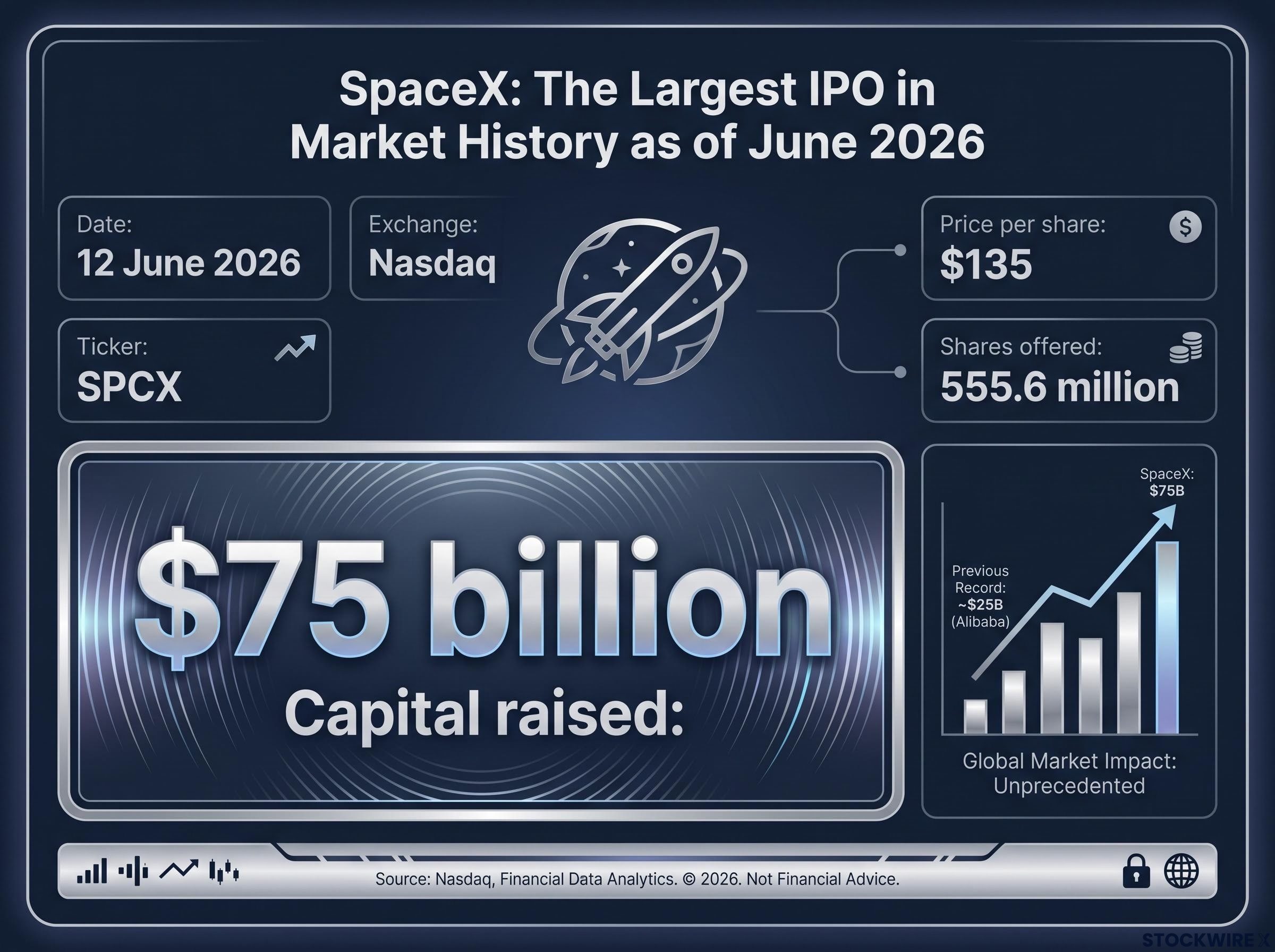
SpaceX closed the largest initial public offering in market history on 12 June 2026, raising $75 billion on the Nasdaq under the ticker SPCX. The listing generated the kind of media spectacle that makes investors feel they need to act immediately. They do not. The more consequential story sits beneath the headlines: what a $75 billion injection of new equity supply, arriving at the front of a broader 2026 IPO pipeline, means for the stocks investors already own. This article breaks down the equity supply mechanics set in motion by the SpaceX listing, how a record buyback surge partially offsets them, what history reveals about buying into newly listed stocks, and five principles for navigating the months ahead with discipline rather than excitement.
A $75 billion listing that rewrote the record books
The core facts of the listing speak for themselves:
- Date: 12 June 2026
- Exchange: Nasdaq
- Ticker: SPCX
- Price per share: $135
- Shares offered: 555.6 million
- Capital raised: $75 billion
SpaceX’s debut is the largest IPO in market history as of June 2026.
That designation will generate weeks of coverage. But the first-day performance of any single stock, no matter how large the offering, tells investors very little about what happens next to their portfolios. What matters more is the supply-side chain reaction this listing has initiated, and the fact that SpaceX is being characterised as the first in a series of major 2026 listings rather than a standalone event.
When big ASX news breaks, our subscribers know first
How a record listing shifts the equity supply equation
Stock markets operate on supply and demand. When a company goes public, it expands the total pool of shares available for investors to buy and sell. If more shares enter the market and investor demand does not grow proportionally, that expanded supply creates downward pressure on prices across the broader market.
SpaceX added 555.6 million shares to the market in a single session. That is a meaningful supply event on its own. The more important point is what comes after it.
Why the 2026 pipeline matters beyond SpaceX
The listing has been framed by market commentary, including analysis from Fisher Investments, as the opening act in a broader wave of anticipated major listings throughout 2026. A single large IPO creates a temporary supply shock. A sustained pipeline of large listings creates cumulative supply expansion that shifts the balance over months, not days. Investors tracking only SpaceX’s share price are watching the wrong variable. The equity supply curve across the full year is what shapes the environment for all US equities.
Standard Chartered global CIO Steve Brice flagged market digestion difficulties as a specific risk for the summer months of 2026, noting that SpaceX, Anthropic, and OpenAI are collectively valued at approximately $3.5 trillion and are all targeting listings within a compressed mid-to-late 2026 window.
Geographic divergence in equity supply trends across developed markets
The supply picture is not the same everywhere. In the United States, equity supply is growing as new listings add shares to the market. In overseas developed markets, the opposite is happening.
European and Japanese markets have seen equity supply contract as companies buy back their own shares and consolidation reduces the number of listed entities. Fewer shares available for purchase, with demand held constant, tends to support prices.
State Street Global Advisors analysis on Japanese buybacks shows that Japanese companies materially increased their average annual share repurchase activity through 2024 and 2025, providing measurable evidence that equity supply contraction in developed markets outside the US is grounded in corporate behaviour rather than projection.
| Market | Equity Supply Trend | Implication for Prices |
|---|---|---|
| United States | Expanding (new IPO listings, 2026 pipeline) | Supply growth may pressure valuations if demand does not keep pace |
| Europe | Contracting (buybacks, consolidation) | Shrinking supply could support prices, all else equal |
| Japan | Contracting (buybacks, consolidation) | Shrinking supply could support prices, all else equal |
This divergence offers a concrete, mechanism-based reason to consider geographic diversification. The case for holding non-US developed market exposure is not a generic risk-management platitude; it is grounded in measurable differences in share supply dynamics that are playing out right now.
US equity home bias has become a structural concentration risk rather than a passive default: the average US investor holds 70-76% of their equity portfolio in domestic stocks, a 9-15 percentage point overweight relative to the MSCI ACWI benchmark, at the precise moment when S&P 500 earnings growth forecasts are disproportionately reliant on a small number of AI-exposed firms.
The $500 billion buyback surge and why it partially cushions the blow
New IPO supply does not operate in isolation. When companies repurchase their own shares, they reduce the total number of shares outstanding, effectively shrinking equity supply and working in the opposite direction to new listings.
More than $500 billion in stock buybacks were announced during April and May 2026 combined, with technology companies leading the activity.
That figure represents a record pace of repurchase activity over just two months. In practical terms, the 555.6 million shares SpaceX added to the market are being partially absorbed by established companies pulling their own shares out of circulation at an unprecedented rate.
The buyback doctrine that drives this activity is rooted in a capital allocation philosophy that has accelerated since the 1980s, with S&P 500 companies repurchasing a record $942.5 billion in shares during 2024 alone, a pace that reflects structural incentives built into executive compensation rather than simply opportunistic responses to rising cash balances.
The qualification matters, though. Buyback programmes can be scaled back quickly if corporate earnings weaken or management sentiment shifts. The current buyback tailwind is real and measurable, but it is a present-tense support for US equity prices rather than a guaranteed backstop. Investors should factor it in without depending on it.
What history actually says about buying into an IPO
The first-day gain on a high-profile listing generates enthusiasm. The subsequent two to three years tend to dampen it. On historical average, newly listed stocks have tended to underperform both the broader market and their sector peers over the two to three years following their debut, according to Fisher Investments analysis.
The post-IPO underperformance pattern is not anecdotal: data spanning 1980 to 2024 shows newly listed companies underperforming comparably sized established peers by an average of 3.3% per year over their first five years, a drag that compounds a $10,000 investment into $12,577 rather than the $14,693 a peer-matched position would have produced.
The pattern is well-documented. What receives less attention is why it persists.
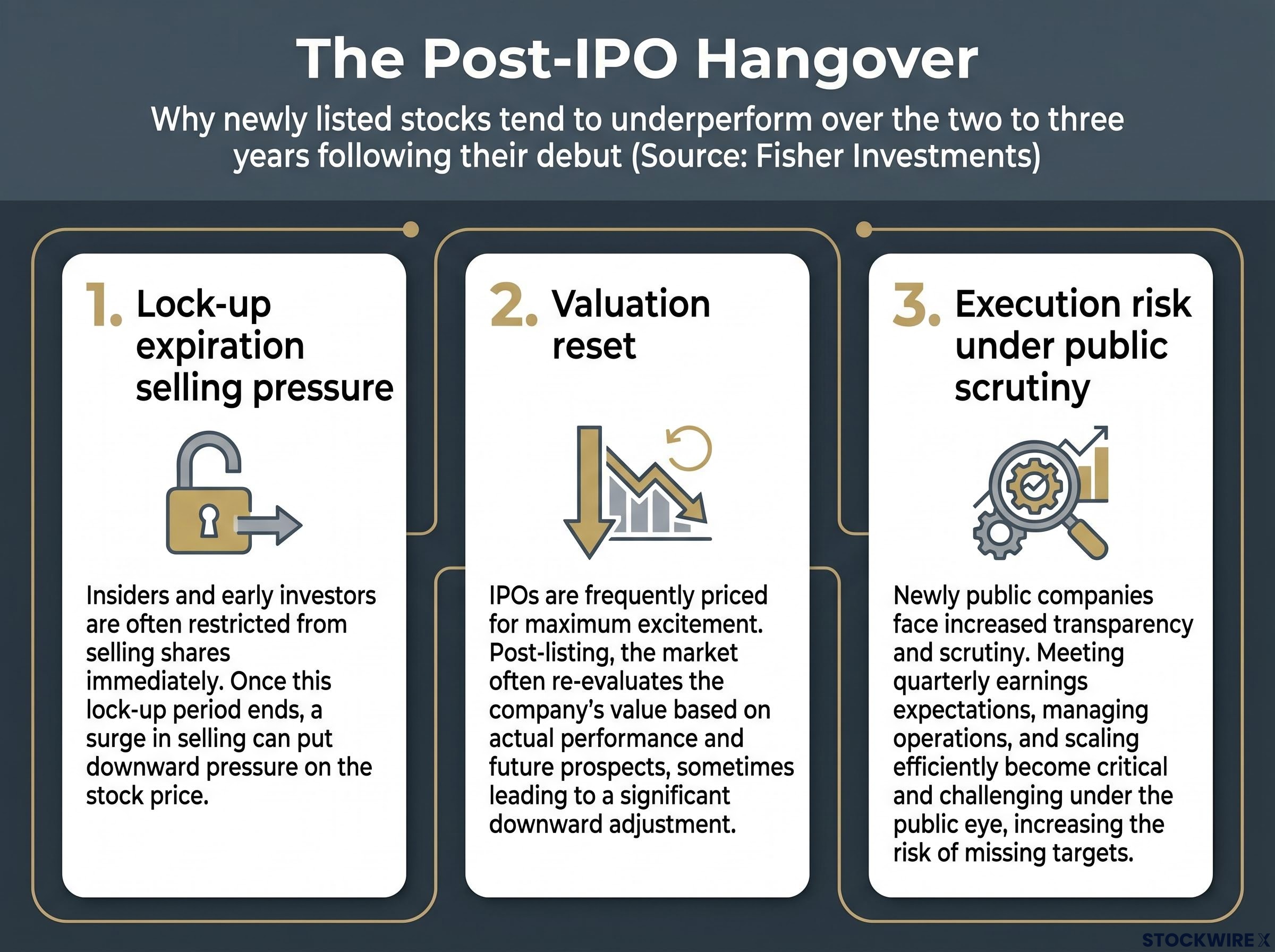
Three reasons the post-IPO hangover tends to repeat
- Lock-up expiration selling pressure. Early investors and employees who cannot sell at the time of listing become eligible to do so months later, creating waves of selling that weigh on the share price after the initial excitement fades.
- Valuation reset. IPOs are often priced to reflect optimistic growth assumptions. When quarterly earnings begin arriving and reality proves more complicated, valuations tend to compress toward levels supported by actual performance rather than projected potential.
- Execution risk under public scrutiny. The transition from private to public company introduces analyst coverage, shareholder expectations, and the relentless cadence of quarterly reporting. Many companies struggle to maintain the growth narrative that supported their listing price once that scrutiny begins.
None of this means SpaceX is destined to disappoint. But the excitement surrounding a debut is a sentiment event, not an investment signal. Waiting through at least one or two earnings cycles, and past the first major lock-up expiration, before committing meaningful capital is the approach more closely aligned with historical outcomes.
Five portfolio principles for navigating the 2026 IPO wave with discipline
The supply dynamics, buyback data, and historical track record covered above translate into five concrete principles:
- Do not abandon strategy for a headline. The $75 billion SpaceX raise generated enormous coverage. Historically, chasing IPO excitement has served long-term investors worse than maintaining a disciplined existing plan.
- Diversify geographically with supply dynamics in mind. US equity supply is expanding while European and Japanese supply is contracting. That divergence provides a data-grounded reason to hold non-US developed market exposure.
- Recognise the buyback tailwind without relying on it. The $500 billion in April-May 2026 buybacks provides real support for US prices, but programmes can be scaled back quickly if conditions change.
- Evaluate new listings on fundamentals, not first-day performance. Waiting through one or two earnings cycles, and past key lock-up expirations, aligns with the two to three year post-IPO underperformance pattern observed historically.
- Treat elevated IPO enthusiasm as a reason to review, not to react. Widespread excitement around new listings can reflect broader risk appetite. It does not require immediate defensive action, but it does warrant confirming that current portfolio exposure still matches long-term objectives.
The headline will fade; the supply math will not
The business story of SpaceX going public will dominate financial media for weeks. The market-mechanics story will shape portfolio outcomes for longer. Three forces are now in motion: rising US equity supply as the 2026 IPO pipeline develops, contracting supply in overseas developed markets creating a geographic divergence, and record buyback activity partially offsetting the new issuance.
As additional major listings arrive in the months ahead, investors who understand the supply-demand equation will be positioned to make decisions grounded in market structure rather than narrative excitement.
This article is for informational purposes only and should not be considered financial advice. Investors should conduct their own research and consult with financial professionals before making investment decisions. Past performance does not guarantee future results.