Barclays Flags Three Risks Threatening Crowded US Equity Bets
2 hrs ago


Brent crude fell 1.6% to $98.03 per barrel and West Texas Intermediate dropped 1.9% to $88.75 in Asian trading on 27 May 2026, reversing the prior session’s military-strike-driven rally even as a fragile ceasefire between the United States and Iran held overnight. The pullback signals a market recalibrating from conflict escalation to diplomatic probability, but the proposed deal framework remains incomplete, the Strait of Hormuz is still a contested negotiating item, and Tehran’s refusal to surrender enriched uranium stockpiles keeps the ceasefire characterised as fragile rather than durable. What follows is a breakdown of the price move, the three-part deal architecture, the specific chokepoint risk still embedded in oil prices, and the signals commodity traders should monitor as talks develop this week.
The numbers arrived early. As of 00:01 ET (04:01 GMT) on 27 May 2026, July-delivery Brent contracts traded at $98.03 per barrel, down 1.6%. WTI sat at $88.75, down 1.9%.
The prior session had moved in the opposite direction. U.S. military strikes on targets in southern Iran pushed crude higher as traders priced in the possibility of sustained escalation. The ceasefire that followed, and held overnight, flipped that calculus.
Tuesday’s move to deal-optimism below $100 had already begun unwinding before the ceasefire, with Brent closing near $98.87 on 25 May as traders repriced Iran’s rejection of the initial framework; Wednesday’s session extended that logic, and the fragile overnight ceasefire effectively reset the market’s probability distribution without resolving either of the two headline unresolved items.
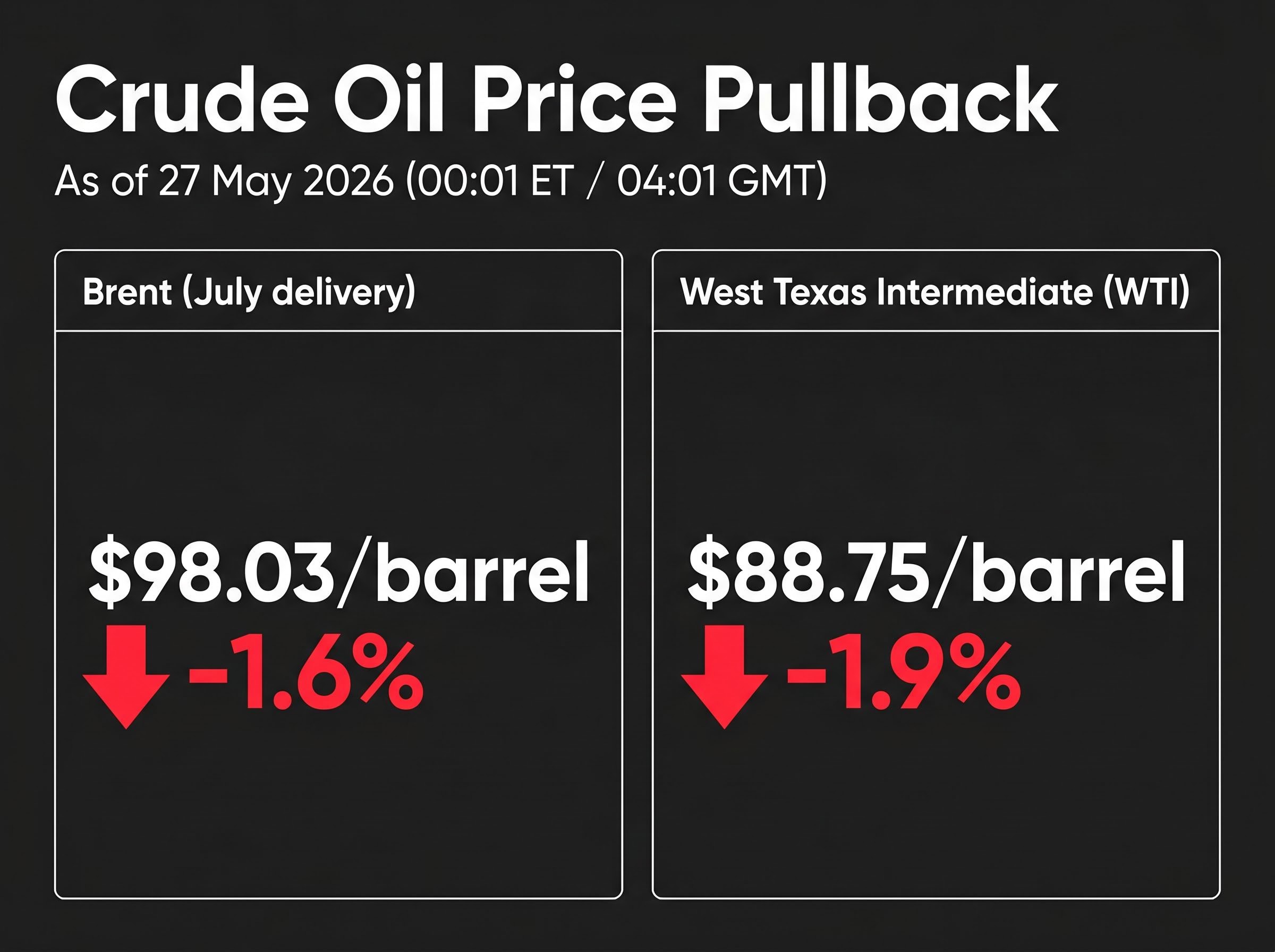
The ceasefire was described as “fragile but holding” at the time of publication, according to Investing.com reporting by Ambar Warrick.
The retreat does not mean risk has disappeared. It means the market’s probability weighting has shifted. Where the prior session priced escalation, early Asian hours on 27 May priced a negotiated outcome as more likely than not. For anyone holding energy positions, that distinction matters: the same barrel of oil is worth different amounts depending on whether traders see diplomacy or conflict as the dominant forward path.
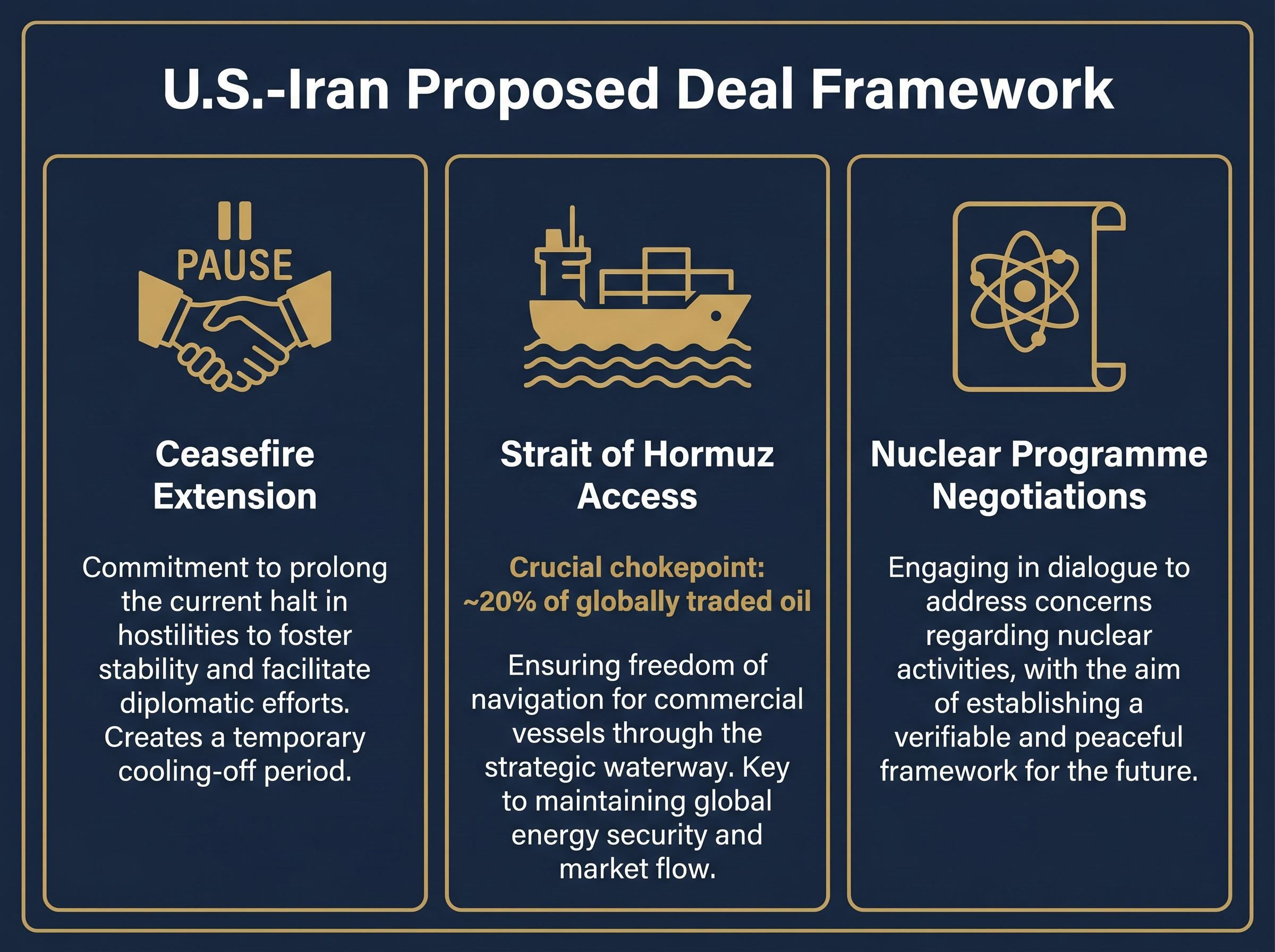
Headlines reduced the U.S.-Iran talks to a binary: deal or no deal. The actual architecture is a three-part package, and each component carries distinct implications for energy markets.
Al Jazeera reported that indirect dialogue continued between the two sides even after the latest military exchange, suggesting the diplomatic channel remained operational despite the escalation. Earlier in the week, the two parties had been described as near agreement on a preliminary framework before strikes disrupted momentum.
As of Tuesday of the week of 26 May 2026, U.S. officials communicated that a deal covering both an end to hostilities and a Hormuz reopening could be days away. Indirect talks continued post-strike, which supports near-term progress but does not guarantee it.
No named senior official has been publicly quoted with a firm commitment to a specific timeline. The “days away” signal came from unnamed U.S. officials, leaving traders to weigh the credibility of the timeline against the absence of a public, on-the-record commitment.
The Strait of Hormuz is a narrow waterway between Iran and Oman connecting the Persian Gulf to the open ocean. It is the single most consequential oil transit chokepoint on earth.
Roughly 20% of globally traded oil, approximately one-fifth of world supply, passes through the Strait of Hormuz.
That concentration of volume means any disruption, restriction, or uncertainty about Hormuz access feeds directly into the risk premium embedded in crude prices. The Strait is not a background detail in these negotiations. U.S. officials explicitly listed Hormuz access restoration as one of two headline items a deal must address, alongside a formal end to hostilities. That framing confirms the Strait’s status is contested and unresolved, not a settled assumption.
What a Hormuz reopening would and would not immediately resolve:
Saudi Aramco CEO Amin Nasser’s warning that supply normalisation into 2027 could be the realistic timeline, even under a best-case resolution, frames the current ceasefire not as a near-term fix for physical supply chains but as the opening of a negotiating process whose full economic effects will be felt well beyond any preliminary framework agreement.
As of 27 May 2026, the current operational status of the Strait remained unconfirmed in available sourcing. That absence of confirmation is itself a market signal: if the Strait were fully open and operating normally, confirmation would be straightforward.
Diplomacy is progressing. The obstacle that has not moved is specific: Tehran has largely declined U.S. demands to surrender its stockpiles of enriched uranium.
This is the reason a comprehensive peace settlement is considered unlikely in the near term, even if a preliminary ceasefire framework advances. The week’s military incidents reinforced the difficulty of bridging positions on a question that sits at the intersection of sovereignty and security.
The uranium question is structurally different from the Hormuz question, and traders should understand why:
That structural difference explains why the ceasefire is described as fragile. A deal covering the first two components (ceasefire and Hormuz) is plausible in the near term. A deal covering the third (nuclear programme, including uranium stockpiles) is not. Any agreement reached this week is likely partial and conditional, meaning the geopolitical risk premium in oil will not fully unwind even if a framework is formalised.
The next several days represent a genuine inflection window. Four observable signals will tell traders whether the diplomatic trajectory is holding, accelerating, or breaking down.
The OPEC+ June 2026 production adjustment, announced on 3 May, committed seven member countries to an incremental increase of 188 thousand barrels per day, a baseline output decision that preceded the Iran crisis and now sits in tension with any supply disruption scenario emerging from the Hormuz standoff.
| Signal | Outcome to Watch | Price Direction Implication |
|---|---|---|
| Deal timeline confirmation | Named officials confirm or deny “days away” framing | Confirmed: bearish; Denied: bullish |
| Hormuz shipping status | Tanker advisories, notices to mariners, operational confirmation | Open: bearish; Restricted: bullish |
| Uranium stockpile flexibility | Any Iranian signal of movement on enriched uranium demands | Flexibility: bearish; Hardened position: bullish |
| OPEC+ production posture | Member commentary on output decisions tied to Iran crisis | Supply increase: bearish; Restraint: bullish |
Real-time data on Hormuz shipping movements and CFTC speculative positioning remained unavailable at the time of publication. Traders should expect partial visibility and plan for headline-driven volatility rather than data-driven clarity.
For traders whose exposure extends beyond crude futures into equities, bonds, or currencies, our deep-dive into how the Hormuz blockade is repricing every asset class examines the ECB rate-hike signal linked explicitly to the oil shock, the 1.6-1.7% single-session declines in Asian equity indices, and the four trackable variables that distinguish a short-duration shock from a structural repricing event.
Two forces are competing in the oil market this week. Diplomatic progress is removing the immediate war premium that pushed crude higher in the prior session. Structural unresolved issues, the uranium impasse and the unconfirmed status of Hormuz, are preventing a full de-escalation.
The 1.6% Brent decline and 1.9% WTI decline on 27 May reflect probability-weighting, not certainty. A breakdown in talks, a resumption of strikes, or a confirmed Hormuz restriction could reverse the move as quickly as it arrived.
The week ahead is an inflection window. The oil market will re-price in near real time as signals emerge, and the difference between a partial ceasefire and a comprehensive resolution remains the difference between a managed risk premium and its full unwind.
The ceasefire is “fragile but holding.” For now, so is the market’s bet on diplomacy.
This article is for informational purposes only and should not be considered financial advice. Investors should conduct their own research and consult with financial professionals before making investment decisions. These statements are speculative and subject to change based on market developments and diplomatic outcomes.
Brent crude fell 1.6% to $98.03 and WTI dropped 1.9% to $88.75 in Asian trading on 27 May 2026 because a fragile overnight ceasefire between the U.S. and Iran shifted market sentiment away from conflict escalation and toward the probability of a negotiated outcome, reversing the prior session's military-strike-driven rally.
The Strait of Hormuz is a narrow waterway connecting the Persian Gulf to the open ocean, through which roughly 20% of globally traded oil passes; any disruption or uncertainty about access to the Strait feeds directly into the risk premium embedded in crude prices, making it a critical variable in U.S.-Iran negotiations.
The proposed deal covers three components: a ceasefire extension to formalise the current pause in hostilities, restoration of Strait of Hormuz access for commercial shipping, and the initiation of formal negotiations on Iran's nuclear programme, each carrying distinct implications for energy markets.
Traders should monitor four key signals: whether named officials confirm or walk back the 'days away' deal timeline, any tanker traffic advisories or operational updates on Hormuz shipping status, Iranian flexibility on enriched uranium stockpile demands, and OPEC+ member commentary on production decisions linked to the Iran crisis.
Tehran has largely declined U.S. demands to surrender its enriched uranium stockpiles, and resolving this issue requires verification protocols, timeline commitments, and political concessions that resist quick resolution; any agreement reached in the short term is likely to be partial and conditional, meaning the geopolitical risk premium in oil prices will not fully unwind.