Ten-year Australian government bond yields have climbed to nearly 4.9%, the highest level of the 2025-26 period, arriving at almost the same moment as a Federal Budget that leaves the fundamental tax rules for share investing largely untouched but quietly reshapes the economics for anyone holding large equity portfolios inside superannuation. Published on 25 May 2026, this analysis connects the dots across three developments that matter simultaneously to Australian retail investors: what the Budget actually changed (and what it did not), what rising long yields mean for equity valuations and income competition, and how the ASX’s structural concentration in banks and miners amplifies every macro shift. The result is a clear, evidence-based picture of how these three forces interact, which investor cohorts face the most material changes, and what portfolio moves strategists are recommending in response.
The ASX concentration problem that makes every macro shift hit harder
The bond yield and budget developments outlined in the sections that follow do not land evenly across a diversified portfolio. They land disproportionately on a market that is unusually narrow.
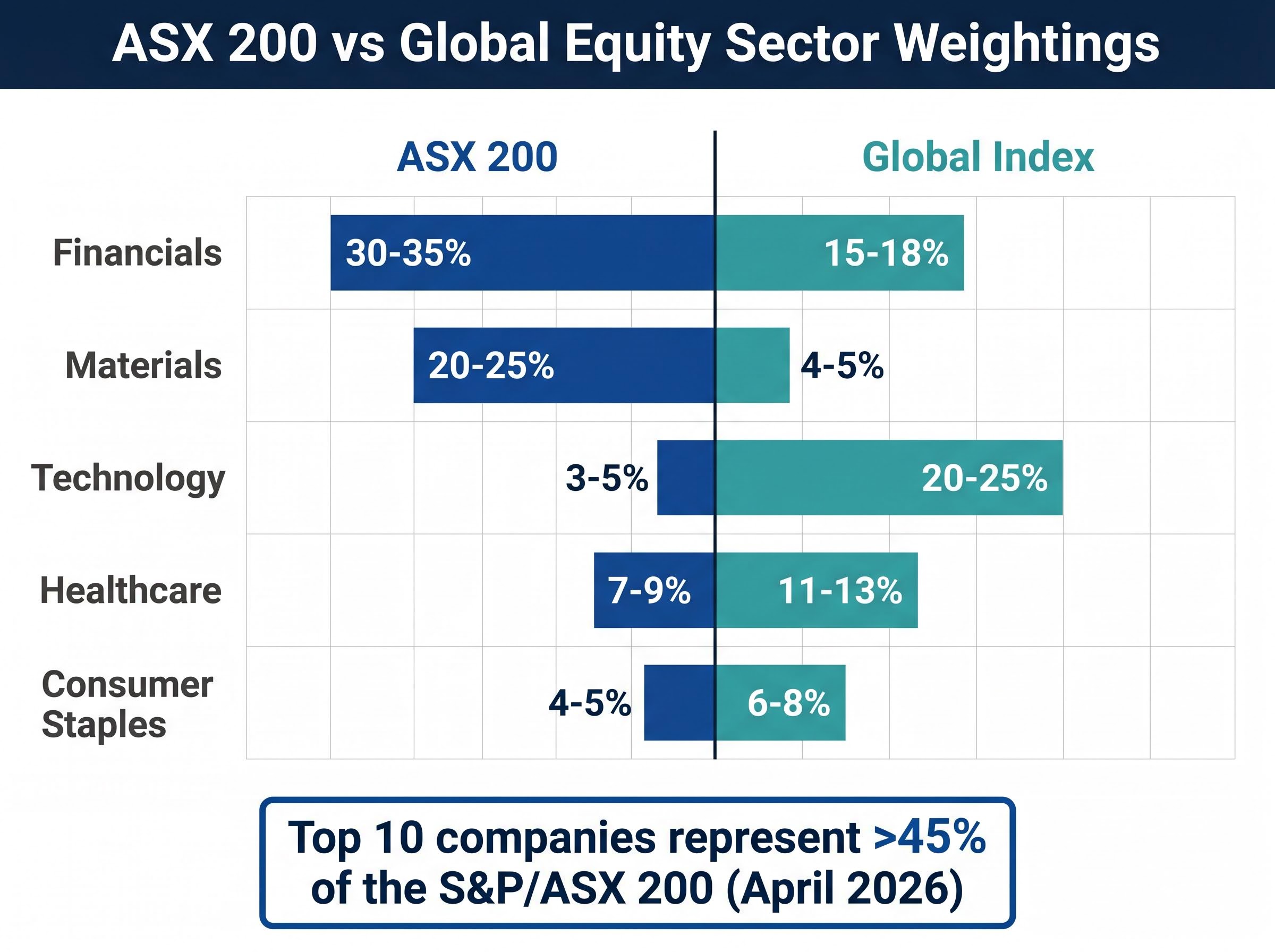
Financials (excluding REITs) and materials together account for an estimated 55-60% of the S&P/ASX 200 by market capitalisation, according to S&P Dow Jones Indices data from March 2026. The big four banks, BHP, Rio Tinto, and Fortescue dominate the upper end of the index.
The top 10 companies by market capitalisation represent more than 45% of the S&P/ASX 200, according to ASX statistical data from April 2026.
That concentration creates a specific vulnerability. When bond yields rise, banks face net interest margin pressure and equity valuation headwinds simultaneously. When commodity prices fall, the materials heavyweights drag the entire index.
ASX 200 concentration risk is more severe than its 200-stock label implies: VanEck research shows two stocks alone have historically represented approximately 22% of a typical cap-weighted Australian equity portfolio, meaning a single large-cap event can produce a 2% or greater drag on the entire index.
| Sector | ASX 200 (approx.) | Global equity index (approx.) |
|---|---|---|
| Financials | 30-35% | 15-18% |
| Materials | 20-25% | 4-5% |
| Healthcare | 7-9% | 11-13% |
| Technology | 3-5% | 20-25% |
| Consumer Staples | 4-5% | 6-8% |
The ASX 200 delivered an estimated 11% total return over the 12 months to March 2026. A concentrated index delivering strong recent returns can give investors a false sense of diversification. Understanding that this performance was substantially driven by a narrow band of banks and miners is the starting point for evaluating whether it is repeatable under a different macro regime.
When big ASX news breaks, our subscribers know first
What the 2026 Federal Budget actually changed for share investors
The headline fear, a capital gains tax overhaul or an assault on franking credits, did not materialise. Budget Papers No.1 and No.2 (Treasury, 12 May 2026) contain no changes to CGT discount rates, and dividend imputation entitlements for individuals and self-managed super funds remain intact.
The change that did happen is targeted but consequential.
- What did NOT change:
- Capital gains tax discount rates for individuals or trusts
- Franking credit entitlements for individuals or SMSFs
- Superannuation guarantee rate path or concessional contribution caps
- What DID change:
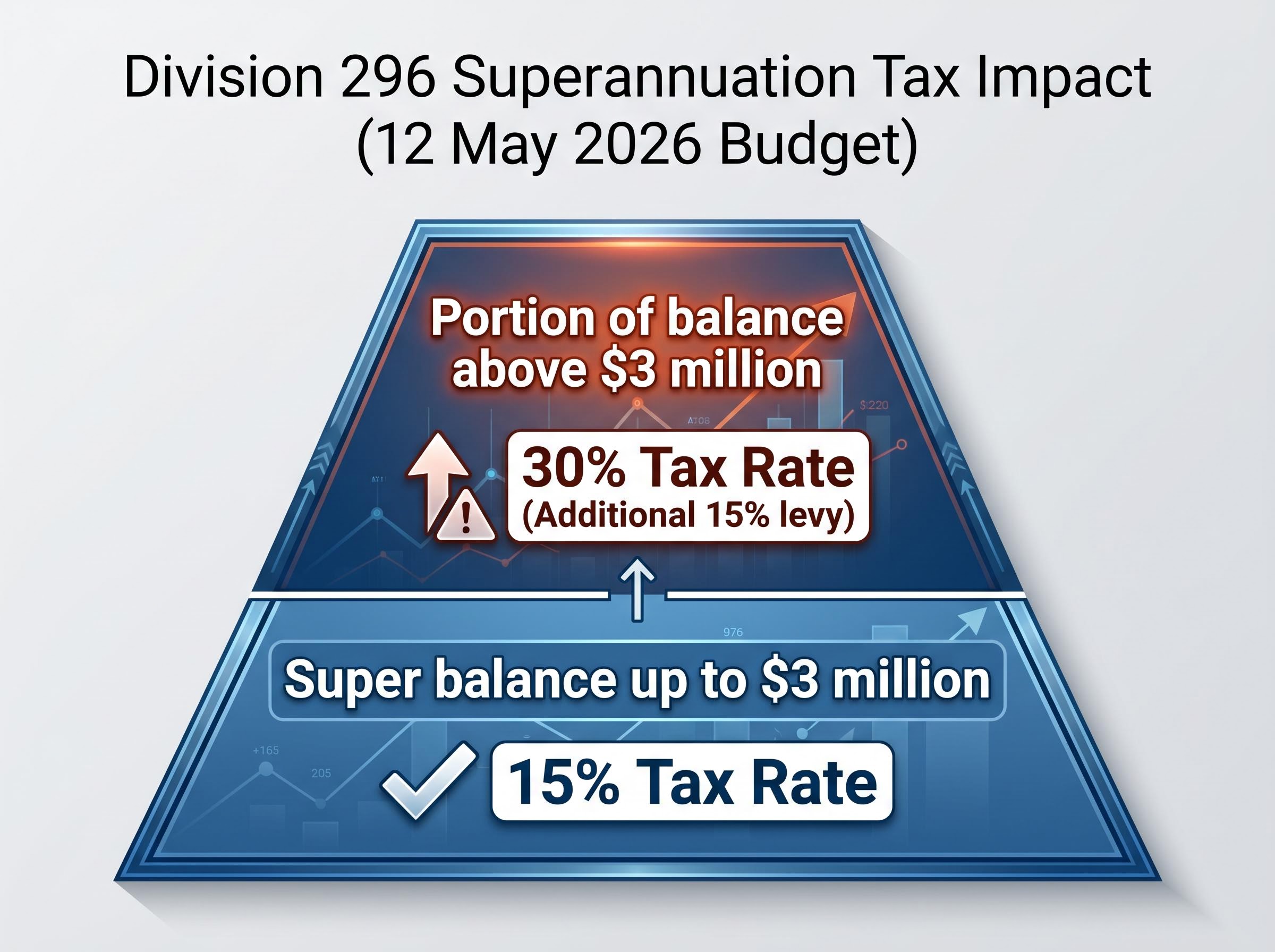
- Division 296 tax confirmed as part of the revenue base: an additional 15% levy on earnings attributable to the portion of a total super balance above $3 million
- Integrity measures targeting managed investment trusts and closely held investment entities, which may prompt structural changes affecting how some investors access ASX equities via listed investment companies (LICs) or unlisted trusts
Division 296 effectively lifts the tax rate on earnings from 15% to 30% for the portion of a super balance above $3 million, including dividends and realised capital gains. Source: Treasury Laws Amendment (Better Targeted Superannuation Concessions) Act 2025, confirmed in Budget Paper No.1, 12 May 2026.
The ATO guidance on Division 296 confirms that individuals whose Total Super Balance exceeds the Large Super Balance Threshold of $3 million will face an additional 15% tax on relevant earnings from 1 July 2026, making the after-tax case for holding large equity portfolios inside super materially different from prior settings.
For the majority of retail investors with super balances below that threshold, the Budget preserves one of Australia’s most investor-friendly tax structures. Fully franked dividends remain intact, and the CGT discount is unchanged. The Division 296 measure is targeted, but for high-balance investors who hold significant ASX equity exposure inside super, the after-tax arithmetic has shifted materially.
Why bond yields near 4.9% change the maths on Australian equities
The 10-year Australian government bond yield has risen from approximately 3.9% in January 2026 to near 4.9% in late May 2026. That 100-basis-point move reprices the competitive dynamics between equities and fixed income across two distinct channels.
The move in Australian 10-year yields does not reflect a domestic story alone; the synchronised global yield repricing of May 2026, which saw the US, UK, Japan, and Australia hit multi-decade highs simultaneously, signals a single coordinated reassessment of the risk-free rate across developed markets rather than four separate local events.
The first is the discount rate mechanism. Higher long-term yields raise the rate used to value future earnings streams, compressing the valuation multiples the market is willing to pay. This pressure falls hardest on long-duration growth stocks, those whose value depends heavily on earnings years into the future.
The second is the competing-asset argument. With the RBA cash rate at 4.35% (decision of 6 May 2026) and 10-year government bonds yielding near 4.9%, risk-free and low-risk income is meaningfully competitive with equity yields for the first time in the post-GFC era. Term deposits and government bonds now offer nominal returns that would have seemed generous just 18 months ago.
The RBA May 2026 cash rate decision lifted the benchmark to 4.35%, a level the Board characterised as restrictive, and the accompanying Statement on Monetary Policy outlined a soft-landing base case in which inflation eases gradually while unemployment remains near 4.2%.
The income competition equation
Income-focused investors, retirees and SMSF members in particular, are now weighing term deposits and bonds against fully franked dividend yields in a way that has not been relevant since before the ultra-low-rate era.
Headline CPI came in at 4.6% year-on-year to March 2026 (ABS, released 29 April 2026). Against a bond yield of approximately 4.9%, the real return on government bonds is narrow, roughly 0.3% before tax.
That narrow real return gap complicates the picture. Nominal bond yields look attractive at first glance, but after adjusting for inflation, the income advantage over equities shrinks considerably. Dividend-paying equities, particularly those with a history of growing distributions above the rate of inflation, retain a structural case as an inflation-linked income source.
The after-tax value of franking credits remains fully intact under Budget 2026-27, which tilts the income comparison toward equities for investors who can utilise those credits. The current environment rewards deliberate allocation between bonds and equities, not a wholesale shift in either direction.
What rising yields mean specifically for bank and resources stocks
The macro picture from preceding sections translates into concrete sector-level consequences for the stocks that dominate the ASX 200. Three sensitivity channels are worth understanding:
- Bank net interest margin dynamics. As rates stay elevated, banks can earn more on their lending books in the short run. However, sustained high long-term yields compress the earnings multiples the market is willing to pay for stable, dividend-paying financials. The RBA characterised monetary policy as restrictive in its February 2026 Statement on Monetary Policy, and with inflation at 4.6% (still above the 2-3% target band), rate relief appears distant. For the big four banks, this means the margin benefit may already be priced in while the valuation headwind builds.
- Commodity price linkage. Materials and resources companies are priced largely on commodity cycle expectations, which are shaped by global growth momentum. That momentum is itself sensitive to the same US yield and Federal Reserve dynamics pushing Australian long yields higher. When global growth expectations soften, commodity prices tend to follow, and the resource heavyweights that account for roughly a quarter of the ASX 200 carry the index down with them.
- Equity duration risk. The concept mirrors fixed income: just as long-dated bonds fall more in price when yields rise, stocks whose value depends heavily on distant future earnings are more sensitive to yield increases than stocks generating strong earnings today. The ASX’s under-representation of high-growth technology names limits this exposure somewhat, but it also means the index lacks the sector that could benefit most when yields eventually fall.
Materials and financials were among the stronger sectors through 2025, according to S&P Dow Jones Indices data published in February 2026. Whether that leadership persists under a different yield regime is the question retail investors holding standard ASX 200 ETFs or heavy bank and miner weightings should be evaluating.
The sector-level damage from the May sell-off illustrates these dynamics in real time: gold miners fell 5-6% in a single session on 20 May 2026 as higher US real yields suppressed gold prices and raised energy input costs simultaneously, while Consumer Staples was the only ASX sector to advance, confirming the defensive rotation pattern that income-focused investors should understand.
Strategies to rebalance without abandoning the franking credit advantage
The diagnosis is clear: concentration, rising yields, and targeted super tax changes create a case for rebalancing. The prescription needs to respect the reason Australian investors own domestic equities in the first place: the franking credit system remains one of the most favourable equity tax structures in the developed world.
- Raise global equity allocation. JBWere’s February 2026 strategy update recommends increasing strategic allocation to global equities to access technology, healthcare, and consumer sectors that are absent or materially underweight on the ASX.
- Diversify within Australian equities beyond the top 20. Morningstar Australia’s Q1 2026 outlook suggests increasing exposure to quality mid-caps in healthcare, infrastructure, and consumer staples rather than concentrating solely in the big four banks and large miners.
- Blend sector and factor ETFs. BetaShares’ November 2025 white paper advocates combining sector ETFs (technology, healthcare) and factor ETFs (quality, low volatility) with a core ASX 200 holding to broaden exposure and reduce dependence on financials and materials.
- Rebalance income sources. JBWere’s July 2025 income strategy paper warns that chasing fully franked bank and resources dividends over-concentrates portfolios in cyclical income sources, and recommends mixing franked income with growth sector exposure to support long-term total return.
A note on superannuation structure for high-balance investors
Investors approaching or above the $3 million Division 296 threshold should review whether concentrating large equity holdings inside super remains optimal, given the effective 30% earnings tax on that tranche. Non-super structures, including family trusts and investment companies, may complement super holdings for some investors. This is an area requiring personal financial advice tailored to individual circumstances.
Investors exploring the practical contribution levers available before and after the threshold changes will find our dedicated guide to superannuation strategy for 2026, which covers the carry-forward rule mechanics, the expiry of unused FY2020-21 cap amounts on 30 June 2026, and the potential $340,000 long-term difference from switching investment options inside an existing fund.
These strategies are drawn from publicly available strategist commentary and should not be considered personal financial advice. Past performance does not guarantee future results.
The case for steady nerves: what history says about high-yield environments and Australian shares
The ASX 200 delivered an estimated 11% total return in the 12 months to March 2026, a period during which yields rose materially. High yields and positive equity returns are not mutually exclusive; the recent evidence reinforces that point directly.
The RBA’s May 2026 Statement on Monetary Policy characterises the broader economic outlook as consistent with a soft-landing scenario: GDP growth modestly below trend but not recessionary, unemployment at approximately 4.2%, and inflation elevated but forecast to ease.
The macro environment is not comfortable, but neither is it crisis-grade. The Budget preserved the fundamental equity tax advantages that make Australian shares distinctive in a global context. Bond yields are high, but real returns on bonds are narrow. ASX concentration is the most structurally persistent risk, and also the most actionable one.
Investors who distinguish between structural risks worth acting on (concentration, super tax settings above $3 million) and cyclical conditions worth monitoring but not over-reacting to (current yield levels, the inflation path) are better positioned to compound returns through this environment rather than be whipsawed by it.
Three themes, one portfolio question: how to act on what strategists are signalling
The Budget’s limited but targeted changes, the yield environment’s dual implications for valuation and income competition, and ASX concentration as the most structurally persistent risk converge on a single portfolio question. It is not whether to own Australian equities; the franking advantage remains compelling for most retail investors. It is whether the current weighting toward banks and miners is still appropriate given the macro environment and budget settings.
The strategist consensus from JBWere, Morningstar, and BetaShares points toward a leaner domestic core with broader global and mid-cap exposure layered around it. Investors should review their sector exposure, consider their super balance relative to the Division 296 threshold, and assess whether their global equity allocation reflects genuine diversification or is an afterthought.
This article is for informational purposes only and should not be considered financial advice. Investors should conduct their own research and consult with financial professionals before making investment decisions.