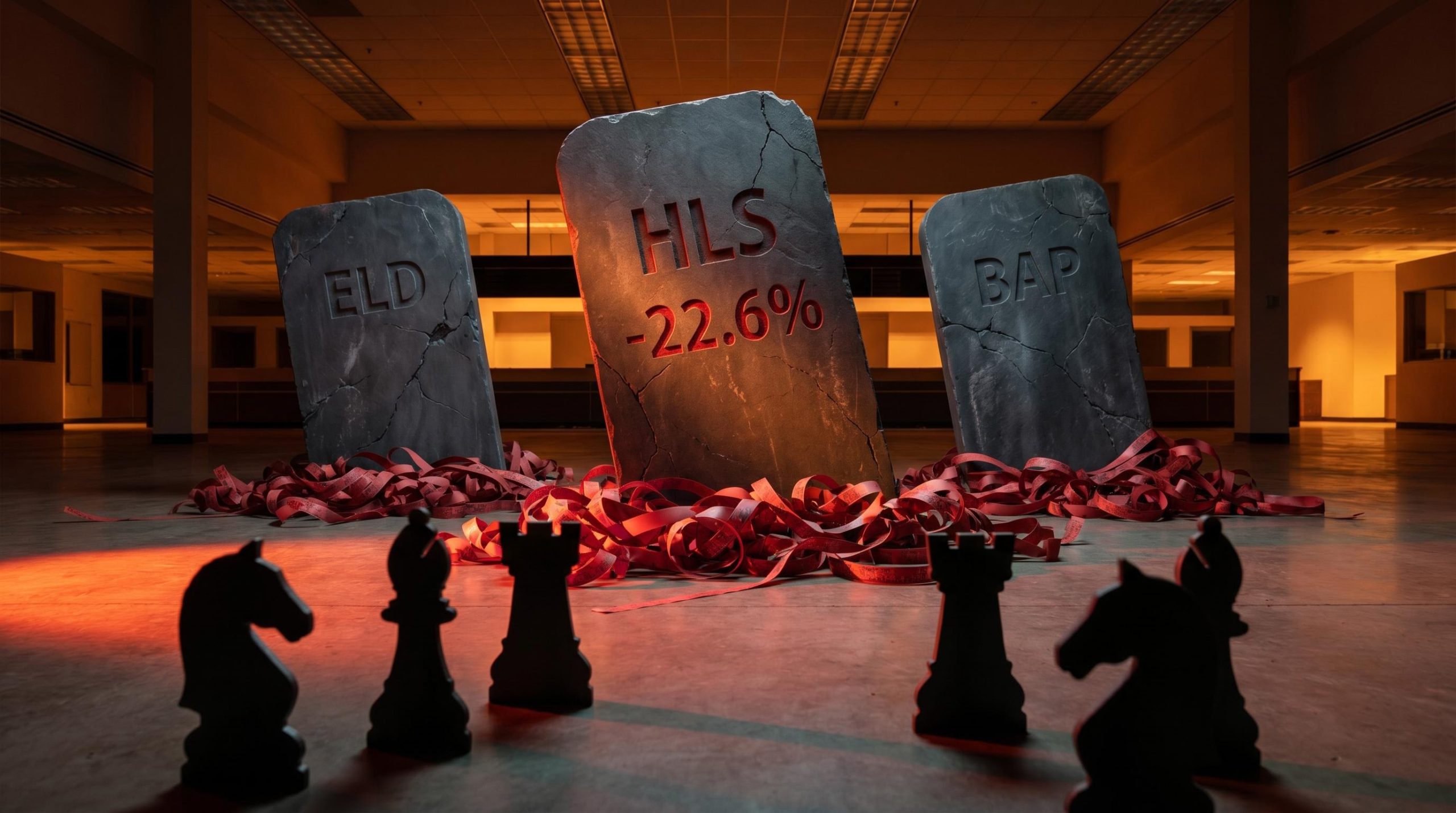
Three ASX companies lost between 18% and 23% of their market value on a single trading day each in the week of 12-18 May 2026, and short sellers responded not by banking profits but by pressing harder. Healius, Elders, and Bapcor each delivered earnings results that fell materially short of consensus expectations, triggering sharp share price falls across healthcare diagnostics, agricultural services, and automotive aftermarket sectors. In every case, ASX short selling data published in the days that followed showed short interest rising, not retreating, after the collapse. The pattern suggests institutional bears view these as deteriorating situations rather than oversold opportunities. What follows is an examination of the specific operational and structural catalysts behind each short interest surge, the sector-wide implications for pathology stocks under Fair Work Commission (FWC) wage pressure, and what the accelerating positions reveal about market expectations for the months ahead.
When earnings day is just the beginning: the mechanics of post-shock short building
Short sellers often accelerate their positions after a large share price fall rather than covering them. The logic is counterintuitive but consistent: a 20%-plus single-day decline on an earnings miss does not mean the bad news is priced in. It means forward earnings estimates are being revised downward, and the repricing cycle is only beginning.
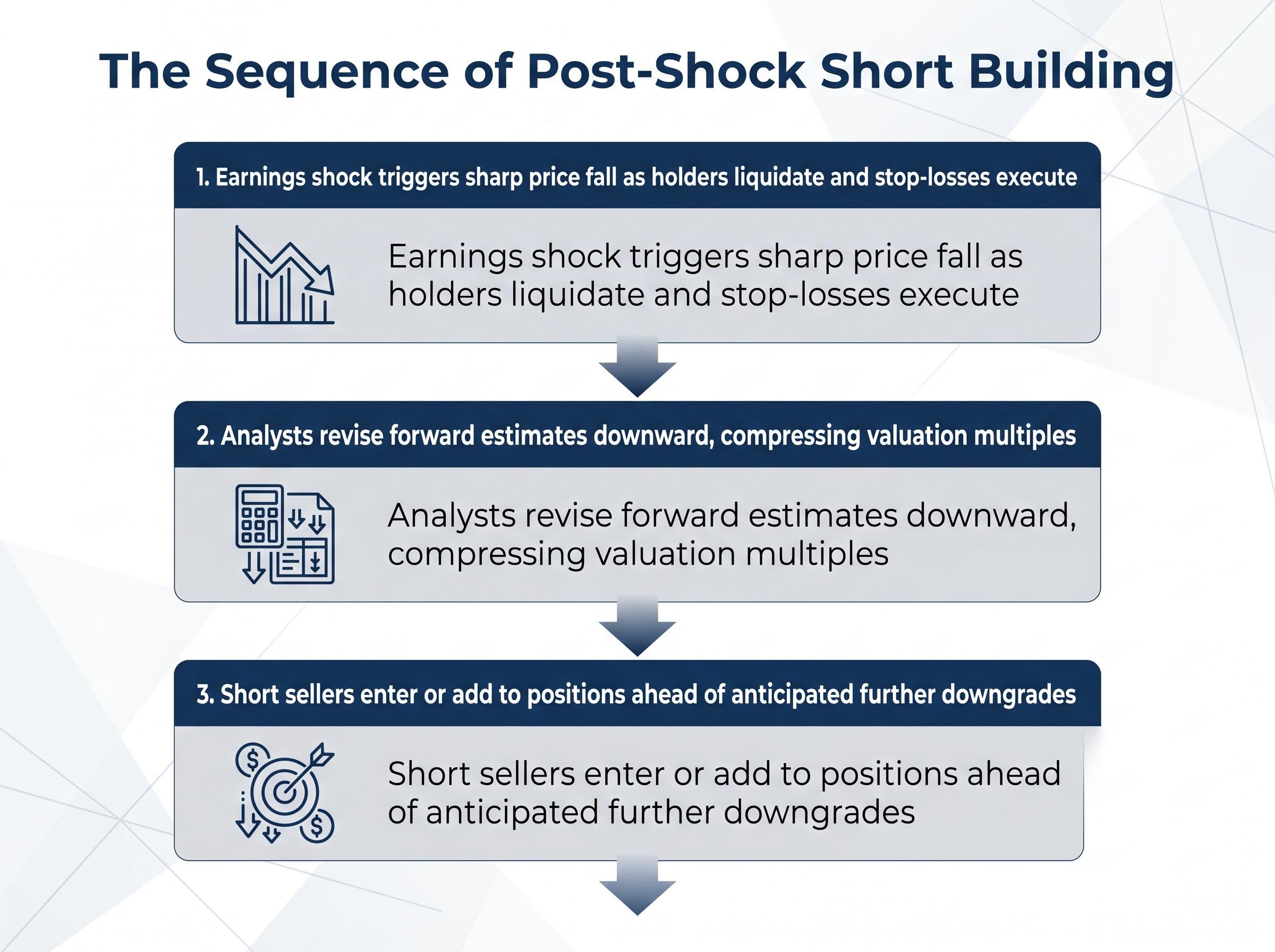
The mechanics follow a recognisable sequence:
- An earnings shock triggers a sharp price fall as holders liquidate and stop-losses execute.
- Analysts revise forward estimates downward, compressing valuation multiples further.
- Short sellers enter or add to positions ahead of anticipated further downgrades, targeting the gap between where the stock trades and where revised estimates suggest it should trade.
ASX short interest data published in the week of 18 May 2026 reflects transactions settled by that date, subject to a four-day lag due to the three-business-day mandatory disclosure window. The figures are trailing signals, not real-time snapshots. Rising short tables capture week-over-week movements of approximately 0.5 percentage points or greater, filtering out minor fluctuations to isolate directional conviction among institutional bears.
When big ASX news breaks, our subscribers know first
Elders and Bapcor: cost structures that proved stickier than the market expected
Outside healthcare, Elders and Bapcor suffered their own single-day collapses in the same week, and short sellers responded with the same post-shock acceleration. The common thread is not sector overlap but cost structures that are proving stickier than investors expected.
| Company | Single-Day Price Fall | Short Interest (%) | Month-over-Month Change (pp) |
|---|---|---|---|
| Elders (ELD) | -22.9% (18 May 2026) | 7.27% | +1.53 |
| Bapcor (BAP) | -18.5% (14 May 2026) | 10.86% | +2.51 |
Elders reported H1 FY26 underlying net profit after tax (NPAT) of $37.9 million, up 13% year-on-year but approximately 20% below consensus. The miss was concentrated in rural products, where lower crop protection and fertiliser volumes weighed on margins, and compounded by a dual-platform technology transition that management described as generating non-trivial costs expected to persist into H2 FY26. The stock fell 22.9% on 18 May 2026, leaving it down 11.5% year-to-date.
Bapcor’s 18.5% fall on 14 May 2026 reflected a guidance downgrade driven by multiple concurrent headwinds:
- Weakening consumer confidence reducing discretionary spending on automotive aftermarket products.
- Middle East conflict disrupting supply chains and elevating input costs.
- Elevated fuel and operating expenses compressing margins.
In both cases, brokers cut earnings forecasts in the days following the results. Neither company has announced a catalyst, whether a cost restructuring, a volume recovery, or a strategic shift, that would stabilise sentiment. Short interest in Bapcor rose 1.01 percentage points week-over-week and 2.51 percentage points month-over-month, among the steepest month-over-month increases in the rising-short table.
Healius: the anatomy of a 22.6% share price fall and the short interest build that followed
Healius released its FY26 trading update on 13 May 2026, guiding to underlying EBITDA of $259-264 million, approximately 4% below analyst consensus of $271.4 million. The miss was not a rounding error. It reflected compounding pressure from pathology margin compression, day hospital headwinds, and a newly quantified labour cost escalation from the Fair Work Commission’s gender undervaluation ruling.
Healius shares fell 22.6% on 13 May 2026 and have declined approximately 60% year-to-date, reaching all-time lows.
The stock’s decline prompted Goldman Sachs to cut its price target and downgrade its rating, as reported by the Australian Financial Review on 14 May 2026. Goldman’s shift reflected a broader reassessment of the structural cost environment facing the company. The three headwinds compressing Healius’ earnings profile are not cyclical:
- Pathology margin compression driven by normalised post-COVID testing volumes and competitive pricing pressure.
- FWC gender undervaluation wage increases, estimated at approximately $1.8 million in additional pathology labour costs for the June 2026 quarter alone, with further escalation flagged from January 2027.
- The Medicare indexation freeze on pathology test fees, which limits the company’s ability to pass rising costs through to payers.
From guidance miss to short acceleration
The sequential logic is straightforward. The guidance miss triggered analyst downgrades. Downgraded estimates attract short sellers who anticipate further estimate cuts ahead. The cycle becomes self-reinforcing until a stabilising catalyst appears, whether new government funding, a policy change on fee indexation, or a material cost-out programme.
No such catalyst has been announced as of 25 May 2026. Healius short interest stood at 9.66%, up 1.58 percentage points week-over-week and 1.76 percentage points month-over-month as of 18 May 2026. Professional investors are not yet pricing in a floor.
Pathology’s sector-wide short wave: why ACL and Sonic are being swept up alongside Healius
The short interest build is not confined to Healius. Australian Clinical Labs (ACL) and Sonic Healthcare (SHL) are experiencing coordinated increases, a pattern that suggests institutional bears are treating the FWC ruling as a systemic earnings risk rather than a single-company event.
| Company | Short Interest (%) | Week-over-Week Change (pp) | Month-over-Month Change (pp) |
|---|---|---|---|
| Healius (HLS) | 9.66% | +1.58 | +1.76 |
| Australian Clinical Labs (ACL) | 8.15% | +1.12 | +1.13 |
| Sonic Healthcare (SHL) | 6.10% | +0.53 | +0.92 |
The FWC’s determination, described as final in respect of finding gender undervaluation and setting a phased wage uplift framework, applies across the pathology workforce, not just at Healius. According to the Australian Financial Review (16 May 2026), analysts expect the full annualised impact to be materially higher than Healius’ $1.8 million June-quarter figure once changes cycle through all affected classifications and hours worked. The impact scales with headcount and award coverage, implying larger absolute costs for Sonic Healthcare as the biggest employer in the group.
The structural headwinds cited by analysts are consistent across all three names:
- FWC-mandated wage cost increases across pathology classifications.
- Post-COVID testing volumes that have structurally normalised at lower, less profitable levels.
- Limited short-term pricing power due to government-set fee schedules.
- The Medicare indexation freeze, which prevents cost pass-through to payers.
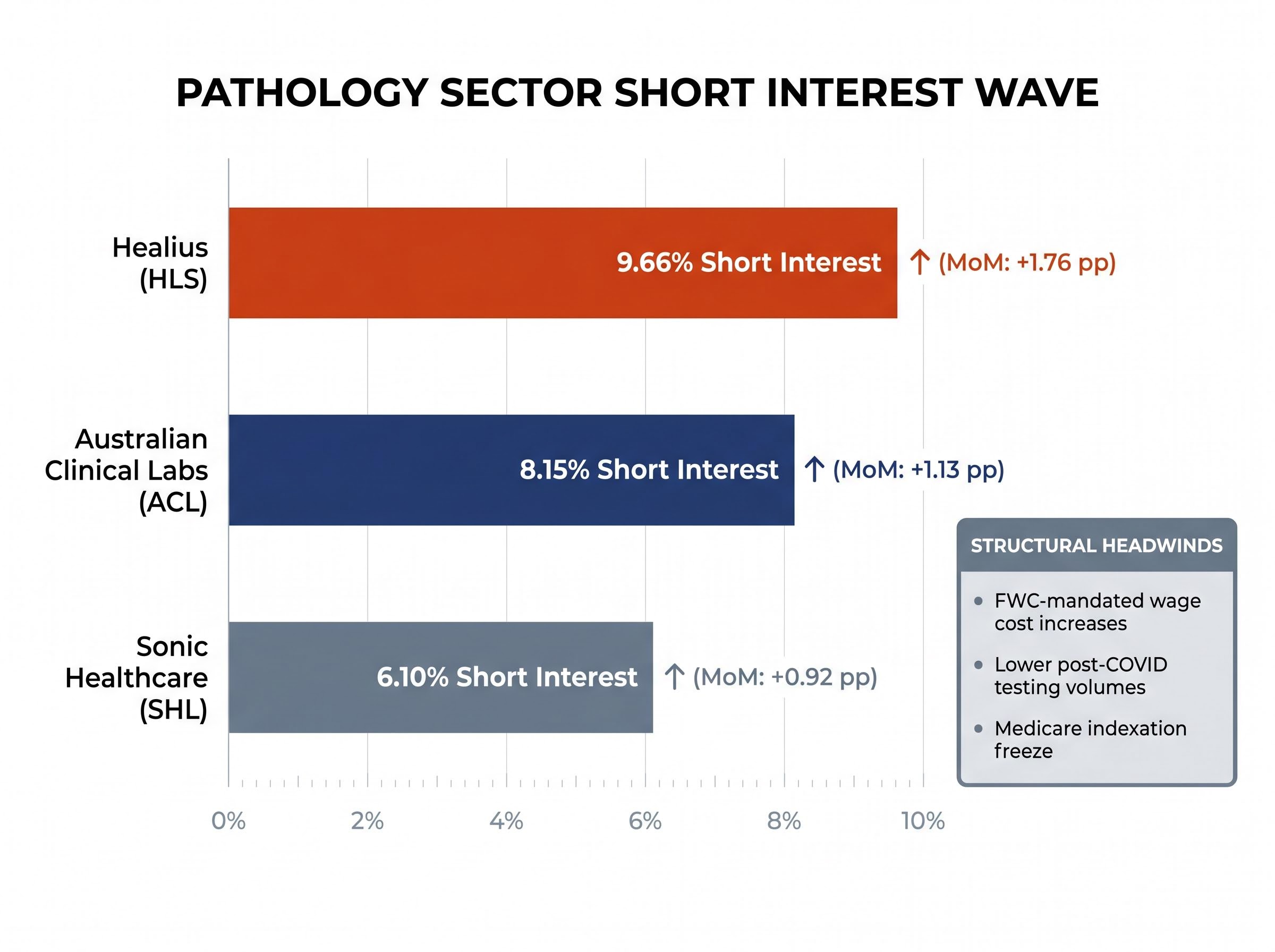
For investors holding any ASX-listed pathology stock, the coordinated short interest pattern carries a clear implication: the margin compression story is being priced across the sector, and the absence of offsetting funding announcements means pressure is likely to persist into FY27.
How short selling works on the ASX, and why rising interest is not a sell signal by itself
Short selling on the ASX follows a straightforward mechanical process, though its implications are frequently misread by retail investors:
- A trader borrows shares from a broker or institutional lender, paying a borrowing fee.
- The borrowed shares are sold at the current market price.
- The trader later buys back the same number of shares at (ideally) a lower price, returns them to the lender, and pockets the difference minus fees.
The Australian Securities and Investments Commission (ASIC) requires mandatory disclosure of short positions, producing the public data set used throughout this article. The data is published with a four-day lag due to the three-business-day disclosure window after the transaction date.
A distinction worth noting: high short interest reflects an existing bearish consensus, while rising short interest reflects new bearish conviction being added. Rising interest in the week immediately following an earnings event is particularly informative because it signals that, even after a substantial price fall, professional investors see enough forward earnings risk to justify entering or adding to positions.
That said, the same conditions that attract short sellers can trigger violent reversals. Two conditions most commonly produce a short squeeze:
- A positive earnings surprise or guidance upgrade that forces short sellers to cover simultaneously.
- A large institutional buyer entering the stock, creating upward price pressure that compounds as shorts rush to close positions.
High and rising short interest is a signal of sentiment, not a guaranteed directional outcome. For retail investors, it is one input to weigh alongside company fundamentals and individual risk tolerance, not a standalone sell signal.
What the short interest data from May 2026 signals about the months ahead
The cluster of post-earnings short position builds in May 2026 shares a common thread across unrelated sectors. Healius, ACL, Sonic Healthcare, Elders, and Bapcor each face cost structures that are harder to reduce than revenue shortfalls are to recover. That asymmetry, sticky costs against uncertain revenue, is precisely the earnings risk profile that short sellers are willing to hold through.
Short sellers building positions after 20%-plus single-day falls are expressing a view that the earnings deterioration has further to run, not that the stock is oversold.
For pathology stocks specifically, the FWC cost impact is expected to escalate from January 2027, per Healius management commentary. Analyst coverage in the Australian Financial Review (16 May 2026) and The Australian (21 May 2026) indicates margin pressure could extend into FY27 and potentially beyond for ASX pathology employers. Short sellers in the sector may be positioning for FY27 earnings risk as much as residual FY26 risk.
Bapcor’s month-over-month short interest increase of 2.51 percentage points suggests sustained conviction rather than event-driven opportunism. Across all five names, no stabilising catalyst, whether new government funding, a policy reversal, or a material cost-out programme, has been announced as of 25 May 2026.
Three conditions would most likely trigger short covering across these names:
- A government funding announcement addressing the pathology fee indexation freeze.
- An operational cost-out result materially ahead of management expectations.
- A broader consumer spending recovery lifting volumes for Bapcor and Elders.
The signal has limits. Rising short interest reflects current sentiment, not guaranteed outcomes, and any sector-specific policy change or unexpected operational improvement could rapidly alter positioning.
Earnings shocks and short conviction: what investors should take away from May 2026
The short interest acceleration following the May 2026 earnings events reflects informed, sustained bearish conviction. In each case, the fundamental drivers extend beyond a single disappointing quarter. Pathology stocks face structural wage cost escalation with no offsetting revenue mechanism. Elders is absorbing technology transition costs that management has flagged will persist. Bapcor is contending with macro headwinds that show no sign of easing.
For ASX investors, the data warrants close monitoring, particularly around upcoming H2 FY26 results and any FWC-related cost announcements that could sharpen or soften the bearish thesis. Short interest is one signal among many, and it should be weighed alongside company fundamentals, sector dynamics, and individual risk tolerance before informing portfolio decisions.
This article is for informational purposes only and should not be considered financial advice. Investors should conduct their own research and consult with financial professionals before making investment decisions. Past performance does not guarantee future results. Financial projections are subject to market conditions and various risk factors.