The Australian share market carries just 3.3% exposure to information technology, a sector that has driven a substantial portion of global equity returns over the past decade. For beginner investors building portfolios entirely inside the ASX, that gap is not a timing issue. It is structural.
The S&P/ASX 200 concentrates more than half its weight in financials and materials alone, making an Australian-only portfolio something closer to a leveraged position on four major banks and a handful of resource companies. The market has noticed. Australian ETF industry funds under management reached approximately A$330.6 billion by the end of 2025, with international equity ETFs representing the largest and fastest-growing category. This piece explains why that shift is happening and shows beginners how three specific ASX-listed international ETFs, IVV, VAE, and MOAT, each fill a distinct gap, along with a practical framework for combining them.
Why your ASX portfolio may only be giving you half the picture
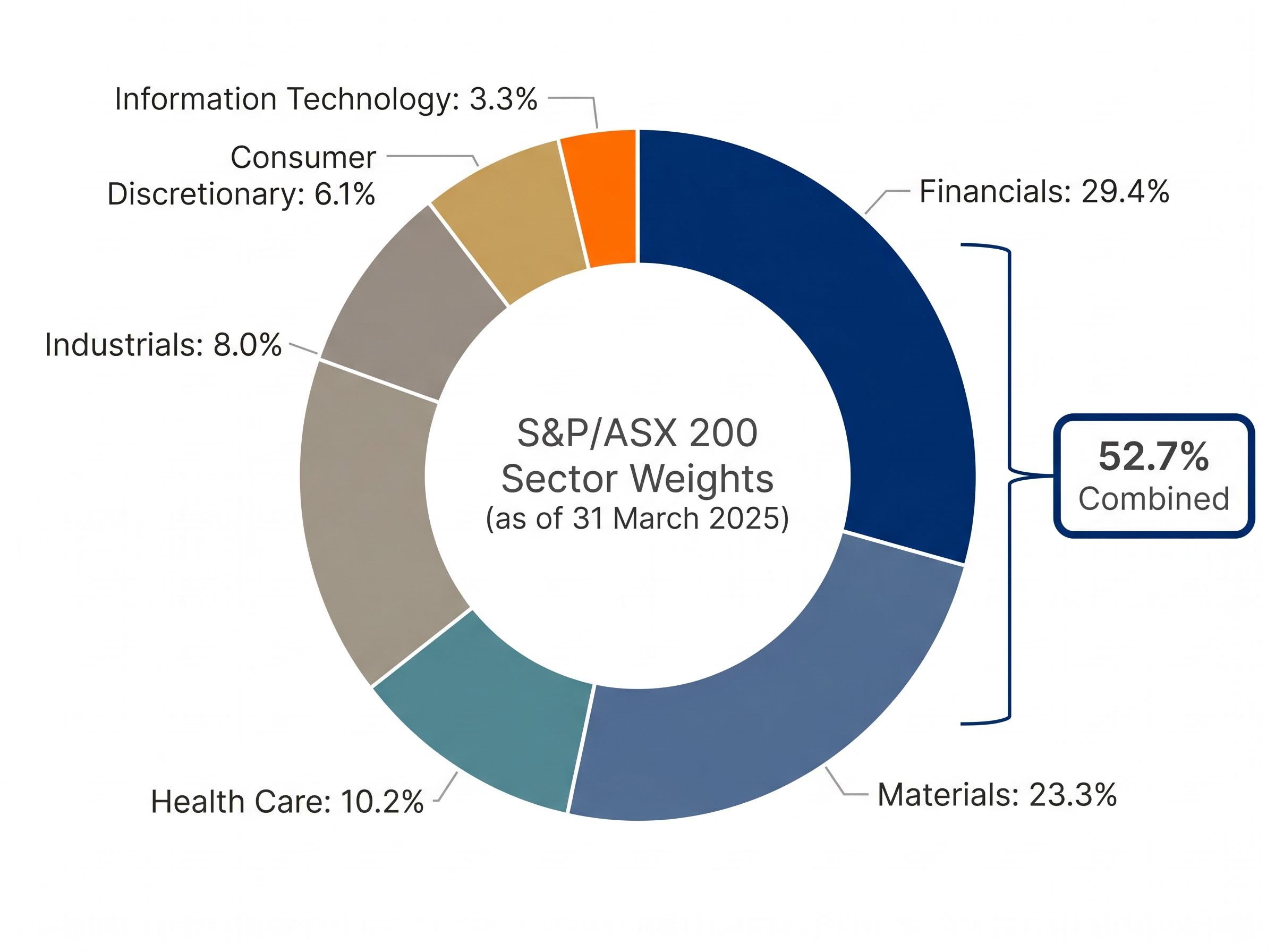
The S&P/ASX 200’s sector composition tells a story that many newer investors do not expect. According to the S&P Dow Jones Indices factsheet dated 31 March 2025, the top five sector weights are:
- Financials: 29.4%
- Materials: 23.3%
- Health Care: 10.2%
- Industrials: 8.0%
- Consumer Discretionary: 6.1%
Financials and materials alone account for approximately 52.7% of the index. That is not a temporary overweight driven by a particular earnings cycle. It is the permanent architecture of the Australian market.
The Australian Financial Review’s Chanticleer column described an ASX-only portfolio as “a leveraged play on four big banks, a handful of miners, and the housing cycle.”
Where the gap becomes most visible is in technology. The ASX 200’s information technology weighting sits at 3.3%, a fraction of what the sector commands in US and global benchmarks. The companies that have generated much of the world’s equity returns over the past decade, from cloud computing platforms to semiconductor manufacturers to digital payments networks, are largely absent from the Australian index.
Vanguard Australia noted in October 2024 that Australia’s market is “one of the most concentrated among developed economies.” Holding 30 ASX-listed companies instead of 10 does not solve the problem. Real diversification means spanning different industries and different economies, not simply adding more names from the same two sectors.
When big ASX news breaks, our subscribers know first
What ETFs actually do for a beginner investor
The most common question a new investor faces is deceptively simple: which stocks should I buy? An exchange-traded fund removes that question entirely. A single ETF purchase provides exposure to hundreds or even thousands of companies in one transaction, with no requirement to analyse individual balance sheets, earnings reports, or competitive positions.
The mechanism is index-tracking. Each ETF follows a pre-defined index, such as the S&P 500 or a regional equity benchmark, and the fund’s returns mirror that index’s performance. The investor is not betting on any single company outperforming. They are participating in the broad performance of a market or strategy.
Not all ETFs work the same way. Three categories matter most for beginners:
- Broad market index ETFs track an entire market (e.g., the ASX 200 or the S&P 500), offering the widest diversification at the lowest cost
- Regional or country-specific ETFs target a particular geography, such as Asia ex-Japan or emerging markets, for targeted international exposure
- Quality-factor or thematic ETFs apply a screening methodology, selecting companies based on specific characteristics like competitive advantages or earnings quality
Why Australian beginners are moving beyond domestic-only funds
The shift is already well underway. According to Vanguard Australia’s “How Australians Invest 2025” report published in March 2025, over 70% of ETF investors under 40 held at least one international equity ETF, with US broad-market funds the most commonly held.
Between 2022 and 2024, the proportion of CommSec ETF investors holding at least one international ETF rose from 48% to 63%, according to the CommSec ETF Investor Study 2025. ASIC’s Moneysmart guidance explicitly recommends “broad-based index funds that invest across different countries” as a diversification tool for new investors.
IVV: low-cost access to 500 of America’s largest companies
A fund holding approximately A$13.5 billion in Australian-listed assets, charging 0.03% per year. That fee structure makes IVV one of the lowest-cost equity exposure options available to Australian investors, regardless of geography.
On a A$5,000 investment, a 0.03% annual management fee amounts to approximately A$1.50 per year.
IVV tracks the S&P 500 Index, providing exposure to approximately 500 of the largest US-listed companies. Its top holdings include Microsoft, NVIDIA, Apple, Amazon, and Meta Platforms, names that represent the technology, healthcare, consumer, and software sectors the ASX structurally underweights.
| Fund Detail | IVV | Notes |
|---|---|---|
| ASX Code | IVV | CHESS Depository Instrument (CDI) |
| Index Tracked | S&P 500 | ~500 largest US-listed companies |
| Management Fee | 0.03% p.a. | Among the lowest for any equity ETF |
| ASX-listed FUM | ~A$13.5 billion | As at May 2026 |
| Key Sectors | Technology, Healthcare, Consumer, Financials | Complements ASX sector gaps |
The structural argument is straightforward. IVV does not duplicate what an Australian portfolio already holds. It provides the technology, healthcare, consumer brand, and payments exposure that the ASX’s 3.3% IT weighting cannot deliver. Morningstar Australia has recommended that beginners start with two to three ETFs maximum, with one being a global or S&P 500 fund. IVV is the most direct route to that allocation.
The CDI structure means Australian investors buy IVV on the ASX like any other listed security, while the underlying exposure sits in the US-domiciled iShares Core S&P 500 ETF managed by BlackRock.
MOAT: quality-focused US exposure for investors who want more than market returns
Where IVV buys the entire S&P 500, MOAT narrows the field. It tracks the Morningstar Wide Moat Focus Index, which selects US companies that Morningstar’s equity research analysts have assessed as having durable competitive advantages, or “wide moats.”
In plain terms, a wide moat means a company has structural defences that protect its earnings from competitors over time. Morningstar identifies five sources of these advantages:
- Brand identity: Consumer recognition and loyalty that supports pricing power
- Cost efficiencies: Structural cost advantages that competitors cannot easily replicate
- Network effects: Products or platforms that become more valuable as more people use them
- Switching costs: High barriers for customers who might consider moving to a competitor
- Intangible assets: Patents, licences, or proprietary technology that exclude competition
MOAT charges a management fee of 0.49% per year, reflecting the active research methodology behind its index construction. The ASX-listed fund held approximately A$1.05 billion in net assets (as at March 2025), operating as a feeder ETF into the US-domiciled VanEck Morningstar Wide Moat ETF, which held approximately US$11.6-11.8 billion as at May 2026.
No ETF can guarantee outperformance. MOAT’s higher fee relative to IVV is the trade-off for its selectivity; whether that selectivity delivers excess returns in any given period is uncertain.
The positioning is as a satellite holding alongside a broad-market core like IVV, not as a replacement for it. Its more concentrated exposure and higher cost make it a complement for investors who want a quality tilt within their US allocation.
VAE: tapping into Asia’s technology supply chains and consumer growth
VAE carries a different profile from IVV. It tracks the FTSE Asia Pacific ex-Japan, ex-Australia Index, and its country composition reads as a portfolio of distinct economic narratives rather than a single regional bet.
The five major country exposures, each with its own investment thesis:
- China: The largest weight, driven by internet and consumer platforms including Tencent and Alibaba Group, though regulatory unpredictability and property sector stress persist
- Taiwan: Anchored by TSMC, the world’s dominant advanced semiconductor manufacturer, whose capital expenditure expansion is being driven by AI chip demand
- India: Market capitalisation crossed US$4.3 trillion in early 2024, overtaking Hong Kong as the world’s fourth-largest stock market, with strong growth in financials and IT services
- South Korea: Home to Samsung Electronics and the global memory chip cycle, where rising chip prices have powered equity gains in early 2025
- Hong Kong: A gateway to Chinese-listed companies, though property sector overhang has weighed on sentiment
VAE charges a management fee of 0.40% per year and held approximately A$814 million in ASX-listed assets as at April 2026.
Understanding the risks that come with Asian market exposure
VAE’s diversification benefits come packaged with higher volatility than either IVV or a domestic Australian ETF. China’s property sector continues to weigh on regional sentiment, with Reuters reporting in February 2025 that developer stress remained a drag on Asian equity markets. Tensions around the Taiwan Strait represent a persistent risk premium for the entire Asia ex-Japan universe.
Currency movements add another layer. VAE’s underlying holdings are denominated in multiple Asian currencies, and exchange rate fluctuations can amplify or reduce returns for Australian investors.
These risks do not disqualify VAE from a beginner portfolio. They do, however, require a longer time horizon and genuine tolerance for periods of elevated drawdowns. This is a multi-decade allocation, not a short-term trade.
Putting it together: a starter framework for geographic diversification
Three ETF profiles do not make a portfolio. What connects them is a framework.
The approach most commonly recommended by Australian industry sources follows a core-satellite structure. BetaShares has described the combination of an Australian broad-market ETF with one or two global equity ETFs as the “default core portfolio” for advisers and robo-advice platforms. Canstar’s guidance aligns: a low-cost broad Australian ETF and international ETFs form the core, with thematic funds as optional satellites.
| Role | Suggested ETF | Rationale | Approx. MER |
|---|---|---|---|
| Core Domestic | A200 or VAS | Broad ASX exposure as the domestic anchor | 0.04-0.07% p.a. |
| Core International | IVV | Low-cost US large-cap exposure filling the tech and consumer gap | 0.03% p.a. |
| Satellite Growth | VAE | Asia ex-Japan diversification for long-horizon investors | 0.40% p.a. |
| Satellite Quality | MOAT | Quality-tilted US equity for investors seeking competitive-advantage screening | 0.49% p.a. |
The AFR noted in March 2025 that even conservative, income-focused investors should consider allocating at least 20-40% of equity exposure offshore, primarily via diversified ETFs. With Australian ETF industry FUM reaching approximately A$330.6 billion by the end of 2025 and international equities as the dominant category, the broader market has already moved in this direction.
Three practical starting principles for beginners:
- Start simple. Two to three ETFs are sufficient for a well-diversified starting portfolio. Complexity can come later.
- Contribute consistently. Regular contributions over time matter more than optimising the perfect allocation split on day one.
- Review annually, not reactively. Rebalance once a year rather than responding to short-term market moves.
The case for going global starts on the ASX itself
The ASX’s concentration in financials and materials is not a flaw to criticise. It is the structural reality of an economy built on banking, mining, and property. Planning around that reality, rather than ignoring it, is what distinguishes a diversified portfolio from a concentrated one.
International ETFs listed on the ASX give beginners the most accessible route to that diversification. IVV fills the technology and consumer gap at near-zero cost. VAE provides exposure to Asia’s distinct economic engines for those with longer time horizons. MOAT offers a quality screen for investors who want selectivity within their US allocation. None is without risk; currency movements, market drawdowns, and geopolitical disruptions apply to all three.
As Vanguard Australia observed, “younger, newer investors are leading the shift toward global diversification via ETFs.” The question for beginners is not whether to diversify internationally, but how to start.
This article is for informational purposes only and should not be considered financial advice. Investors should conduct their own research and consult with financial professionals before making investment decisions. Past performance does not guarantee future results.