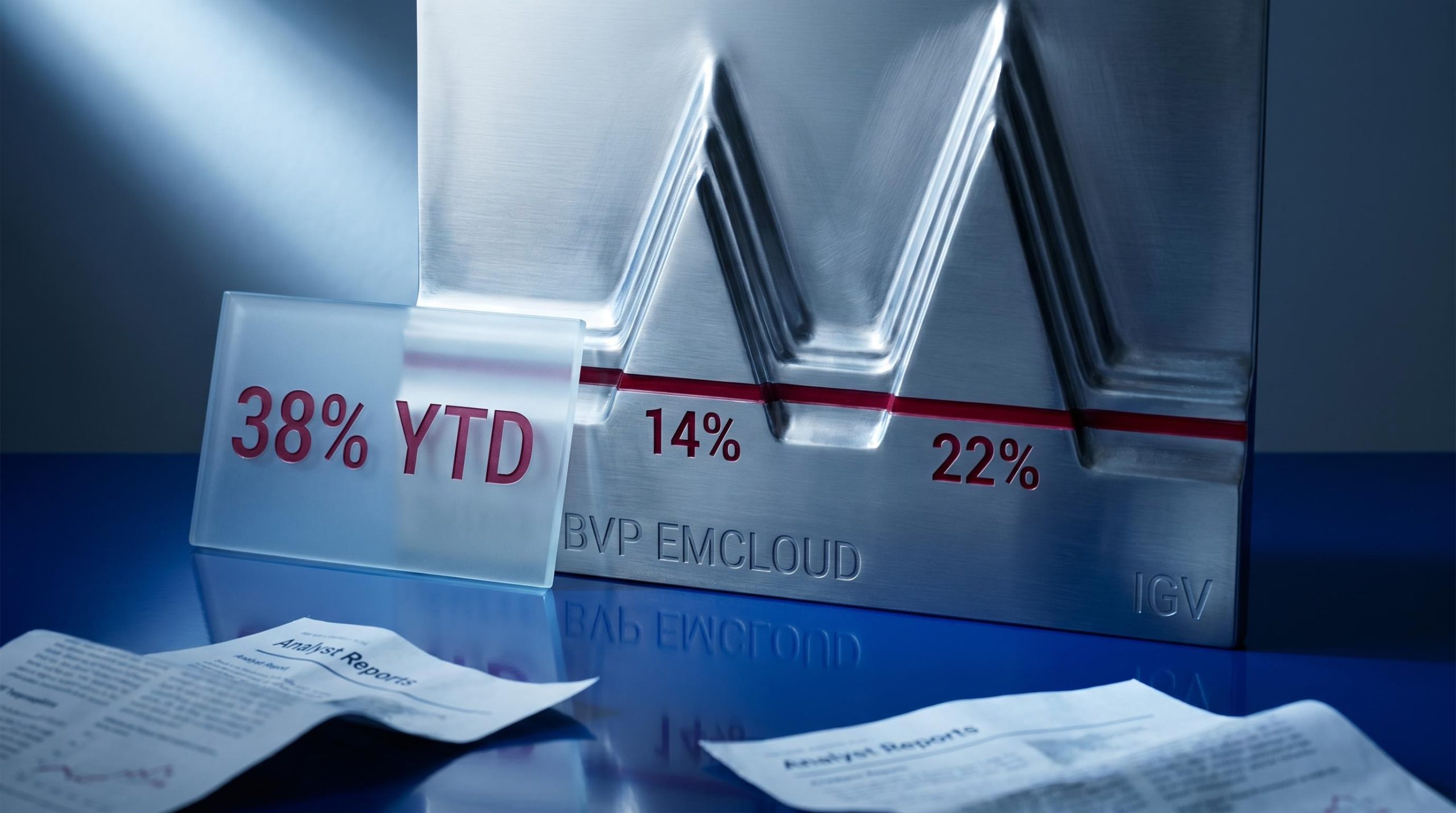
Goldman Sachs analyst Gabriela Borges delivered a stark assessment on 19 May 2026: the median application software stock in Goldman’s coverage universe has fallen roughly 38% year-to-date, bounced twice, and is likely to stay stuck. Two distinct rebounds, a 14% surge between 23 February and 6 March and a 22% rally from 10 April through mid-May, gave investors hope that the software selloff had found its floor. Both faded. With the iShares IGV ETF down approximately 12-14% year-to-date, the WCLD down roughly 18-23%, and the BVP EMCLOUD index still approximately 40% below its 2021 peak, the sector’s inability to sustain a recovery is now the central question for U.S. technology investors. What follows is a breakdown of Goldman’s diagnosis: why the software sector remains range-bound, what needs to change for a durable recovery, and which individual names Goldman views as exceptions worth watching.
Inside the 2026 software selloff: a pattern of decline, relief, and renewed pressure
The decline started early and accelerated through January. By mid-February, the median application software stock in Goldman’s coverage had lost more than a third of its value. Then came the first bounce.
- First rebound (23 February to 6 March 2026): A roughly 14% rally driven by oversold conditions and a brief improvement in risk appetite. It faded within days of peaking.
- Second rebound (10 April through mid-May 2026): A larger recovery of approximately 22%, fuelled by earnings beats from select large-cap names and renewed optimism around AI monetisation timelines. It, too, failed to hold.
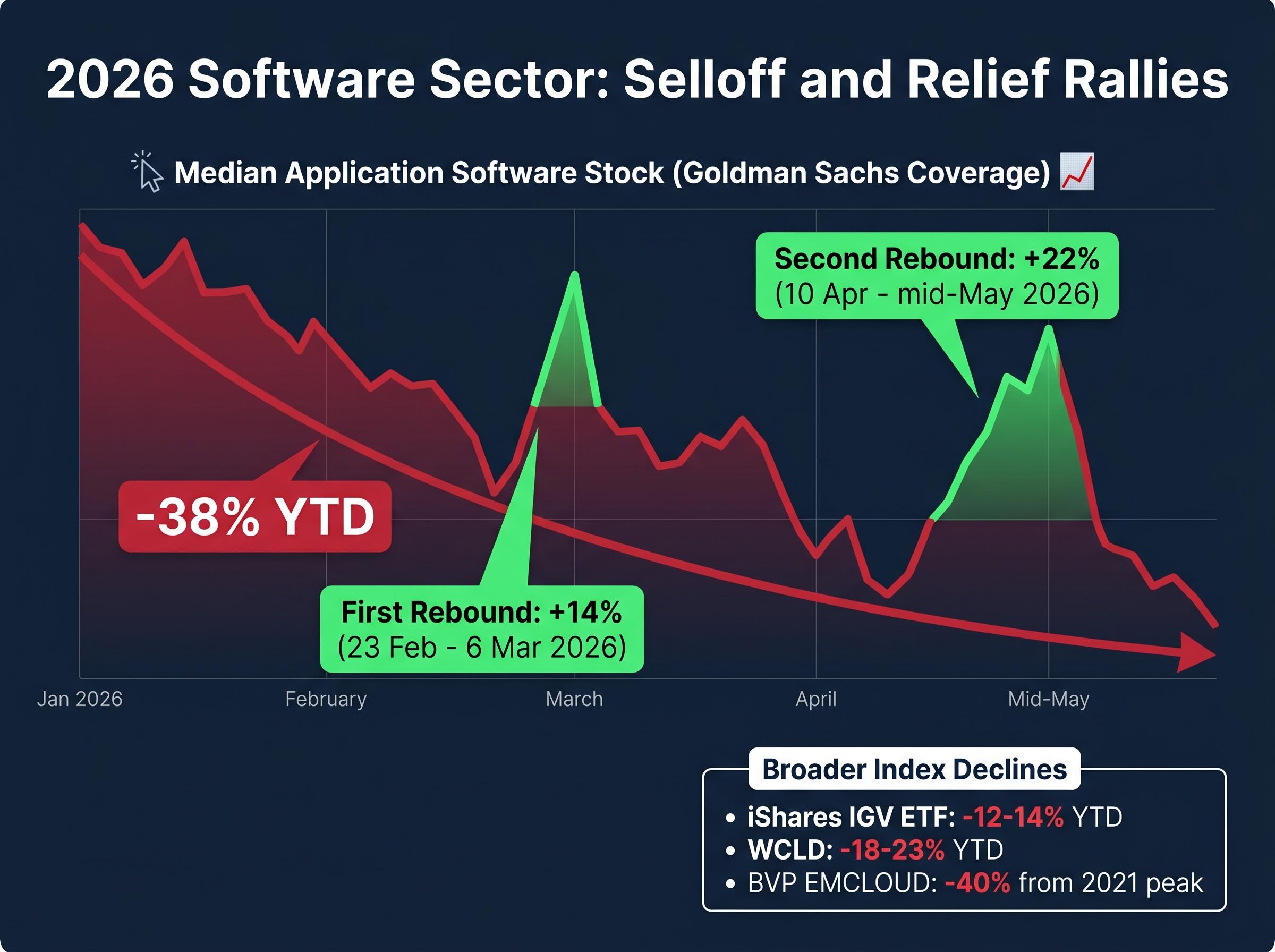
The pattern is now unmistakable. Sell, bounce, sell again. Neither rally generated sufficient follow-through buying to shift the sector’s trajectory.
The February 2026 SaaS value destruction event, in which the US enterprise software sector shed over $1 trillion in market capitalisation as autonomous AI agents began dismantling per-seat licensing economics, set the conditions that Goldman’s range-bound diagnosis is now describing in mid-year terms.
Borges characterised the sector as “challenged,” with AI-driven outperformance framed as “more of a 2027 event” than a 2026 catalyst.
That framing matters. Goldman is not calling a bottom. The bank is diagnosing a sector caught between valuations that have normalised and fundamentals that have not improved enough to justify re-rating. The 38% drawdown is severe, but severity alone does not create a floor.
When big ASX news breaks, our subscribers know first
Why normalised valuations are not enough to restart software sector growth
A sector is range-bound when neither sufficiently strong catalysts nor sufficiently poor fundamentals exist to break valuations decisively higher or lower. Software in 2026 sits precisely in that condition. Multiples have compressed from 2021 bubble extremes, but the stocks are not cheap enough to attract distressed capital. Growth is decelerating, but it is not collapsing.
The result is a holding pattern. Investors who bought the dip twice this year found that normalised valuations without improving fundamentals produce rallies that stall, not recoveries that compound.
What the broader Wall Street consensus says about software valuations
Goldman’s range-bound view is not isolated. Across four major firms, the shared conclusion points in the same direction: wait for a catalyst, not buy the dip.
| Firm | Date | Key Valuation Observation | Sector Stance |
|---|---|---|---|
| Morgan Stanley | 6 March 2026 | Software stocks trading near historical averages on EV/revenue and EV/FCF | Selectively constructive |
| J.P. Morgan | 31 January 2026 | Quality growth names at 10-12x NTM revenue, down from 15-20x at 2021 peak | Range-bound absent IT spending re-acceleration |
| Bank of America | 22 January 2026 | Valuations compressed back toward 2018-2019 levels | Muted multiple expansion expected |
| Evercore ISI | 14 February 2026 | SaaS valuations “fair but not cheap” | Market-weight; overweight AI-levered platforms only |
The table tells the story. Four firms, four variations of the same conclusion: the sector is fairly valued on historical metrics, but fair is not a catalyst.
Microsoft and ServiceNow as standout names: how Goldman identifies company-specific opportunities
Within an otherwise cautious sector call, Borges identified Microsoft and ServiceNow as “idiosyncratic opportunities,” meaning their investment cases rest on company-specific catalysts rather than a broad sector re-rating. Goldman also noted incremental progress among other incumbents, including leadership transitions at Klaviyo, Workday, and Adobe, and early product refinements at ServiceNow and Salesforce, though these were characterised as signals of advancement rather than buy triggers.
Goldman’s implied criteria for an idiosyncratic opportunity in software follow a specific logic:
Record dispersion within the sector, where the spread between the top and bottom deciles of US technology stocks reached 133 percentage points, explains why Goldman’s selectivity framing around Microsoft and ServiceNow is not merely a preference but a structural requirement: buying the sector index captures both the platform consolidators and the names being cannibalised by them.
- AI revenue that is additive to total company growth, not merely substitutive within existing budgets.
- An improving fundamental trajectory visible in quarterly disclosures.
- A catalyst that does not depend on the broader sector re-rating.
ServiceNow reported a roughly $600 million-plus AI ARR pipeline exiting Q1 2026, with CEO Bill McDermott framing AI as “stacked on top of existing platform subscriptions.” Microsoft confirmed on its Q3 FY26 call that AI services had added “several points” to Azure growth. Both companies present cases where AI spending appears to expand their revenue base rather than simply redirect it.
Goldman warned explicitly that attractive valuation alone is not sufficient justification without improving fundamentals, noting that a newer cohort of value-oriented software investors still requires positive fundamental evidence before turning constructive.
The distinction is clear. Goldman is not recommending software broadly; the bank is identifying names where the evidence already supports a differentiated thesis.
The AI monetisation gap: why the sector’s biggest potential catalyst is not arriving on schedule
Investors entered 2026 expecting AI to lift software broadly. Goldman’s Borges framed the reality differently: AI-driven outperformance across the sector is a 2027 event, not a 2026 one. The distinction between additive AI revenue (which expands a company’s total growth) and substitutive AI revenue (which merely redirects existing budget) is what determines investor reception, and in 2026, the evidence favours the latter for most names.
Multiple companies have indicated that 12-18 months beyond current AI product launches is a more realistic timeline for material revenue contribution. AI capabilities remain embedded in existing SKUs at most vendors rather than breaking out as discrete growth drivers.
- Microsoft (Q3 FY26, 29 April 2026): AI services added “several points” to Azure growth, with customers “standardising more AI workloads on Microsoft 365 and Azure,” displacing third-party tools.
- ServiceNow (Q1 2026, 24 April 2026): Roughly $600 million-plus AI ARR opportunity cited; AI described as helping consolidate point tools into the Now Platform.
- Salesforce (FY26 Q1, May 2026): Einstein Copilot and Data Cloud described as “early but promising,” with AI enabling Salesforce to compete more directly with niche analytics vendors.
According to Evercore ISI analysis from 22 April 2026: “For the mid-tier of application software, AI spend looks more redistributive than additive in 2026.”
Platform consolidation versus point-solution risk
The dynamic is structurally asymmetric. Microsoft, ServiceNow, and Salesforce have each confirmed, in varying degrees of directness, that AI capabilities are helping them absorb functionality that smaller vendors previously owned. A Morgan Stanley CIO survey published 1 May 2026 found roughly half of CIOs planned to fund AI software spend by “reallocating from other software categories” rather than expanding budgets. IDC described 2026 as “a transition year where AI spending is more about prioritisation than expansion.”
For large platform vendors, this consolidation trend is positive. For mid-tier and niche application software names, it represents genuine cannibalism of existing wallet share, even as the sector narrative frames AI as uniformly bullish.
The hardware versus software divergence, a spread of more than 70 percentage points between the Morningstar Global Semiconductor Equipment index and the Software Applications index year-to-date, reflects the same budget reallocation dynamic Goldman identifies: enterprise AI capital is flowing into infrastructure spend first, and the software revenue inflection that follows remains deferred.
What would actually break the sector out of its range
Goldman identified two primary conditions for a sustained software recovery, and they are sequenced, not simultaneous. The second cannot arrive without the first.
- Enterprise IT budget stabilisation and acceleration. J.P. Morgan specified that CIO surveys need to show budget growth re-expanding above mid-single-digit levels. Bank of America did not expect a return to double-digit enterprise software budget growth in 2026, suggesting this condition remains unmet.
- Visible AI-driven outperformance at the sector level. This requires AI to shift from an internal reallocation story to a genuine net-new budget expansion story. Bernstein noted in April 2026 that AI features need to become “must-have in enterprise RFPs” and that AI pricing must prove durable, not competed away.
- Demonstrable AI revenue contribution at scale. Morgan Stanley framed quantifiable AI revenue contribution from major platforms as “more a 2027-2028 story,” reinforcing Goldman’s timeline.
Goldman’s framing positions AI-driven outperformance as a 2027 event rather than a 2026 catalyst, a timeline that reflects structural sequencing rather than pessimism.
The logic is straightforward. Budget expansion must precede revenue inflection, and revenue inflection must become visible in earnings before multiples re-rate. In 2026, the first condition remains unfulfilled. The second is still forming. The third is, at best, emerging at a handful of individual names.
Goldman’s sector assessment and the signposts investors should monitor in the second half of 2026
Goldman’s verdict is clear: the software sector is challenged, both 2026 bounces were relief rallies rather than the beginning of sustained recoveries, and the conditions for a durable re-rating remain absent in the near term. The 38% year-to-date decline in Goldman’s median application software coverage has created pockets of value, but value without a catalyst is a range, not a recovery.
For investors with a medium-term horizon, the second half of 2026 offers several specific data points worth monitoring:
- CIO survey data from major research firms showing whether enterprise IT budgets are re-accelerating above mid-single-digit growth.
- Q2 and Q3 2026 earnings from Microsoft, ServiceNow, Salesforce, and Workday, specifically any breakout disclosure of AI revenue as a standalone growth contributor.
- Evidence that AI spend is expanding total software budgets rather than reallocating within them, the single metric that separates a 2027 inflection from continued range-bound conditions.
- Enterprise IT spending indicators from IDC and Gartner quarterly updates, particularly any revision to full-year 2026 growth forecasts.
The software sector’s path out of its current range depends on these signals arriving in sequence. Until they do, Goldman’s diagnosis holds: challenged, range-bound, and selectively opportunistic at best.
Investors wanting a concrete company-level case study of how the additive versus substitutive AI revenue distinction plays out in practice will find our full explainer on Xero’s AI monetisation strategy, which examines the three-pronged pricing model (bundled, standalone add-on, and usage-based), the adoption gap between feature availability and paying subscribers, and the structural moat arguments management is making to justify a late FY27 revenue ramp.
This article is for informational purposes only and should not be considered financial advice. Investors should conduct their own research and consult with financial professionals before making investment decisions. Past performance does not guarantee future results. Forward-looking statements regarding AI monetisation timelines and sector recovery conditions are subject to change based on market developments and company performance.