
TechnologyOne delivered its first-half FY26 result on 19 May 2026, and the headline numbers tell a story that undersells the operating reality. Pre-tax profit rose 9%, free cashflow fell 15%, and revenue growth of 11% hardly screams momentum for a stock trading above 65x earnings. Yet strip out the currency drag from a strengthening Australian dollar and a one-off showcase investment, and the underlying business grew pre-tax profit by 21%, pushed annual recurring revenue (ARR) growth to 19%, and lifted the interim dividend by 21%. The gap between the statutory surface and the underlying engine is the single most important detail in this result. What follows breaks down what the headline numbers conceal, examines the UK growth story, assesses what a competitive win in Townsville signals about the company’s moat, and evaluates whether the upgraded 18-20% full-year profit guidance is credible for Australian investors weighing the TechnologyOne share price at approximately $28.27.
What the headline numbers hide about TechnologyOne’s first-half result
The statutory picture
For the six months to 31 March 2026, TechnologyOne reported total revenue up 11% to $322.7 million, pre-tax profit (PBT) up 9% to $89.1 million, and net profit after tax (NPAT) up 6% to $66.8 million. Free cashflow came in at $20.3 million, down 15% on the prior corresponding period.
On face value, the free cashflow decline and single-digit profit growth look underwhelming for a company priced for high-teens earnings expansion. ARR reached $598 million, up 17%, a stronger signal, but even that number carries a currency distortion.
Strip out the noise
Two factors suppressed the statutory result. The Australian dollar strengthened materially against the British pound during the half, compressing the reported AUD value of UK-sourced revenues. Separately, a one-off showcase investment added costs that will not recur at the same level.
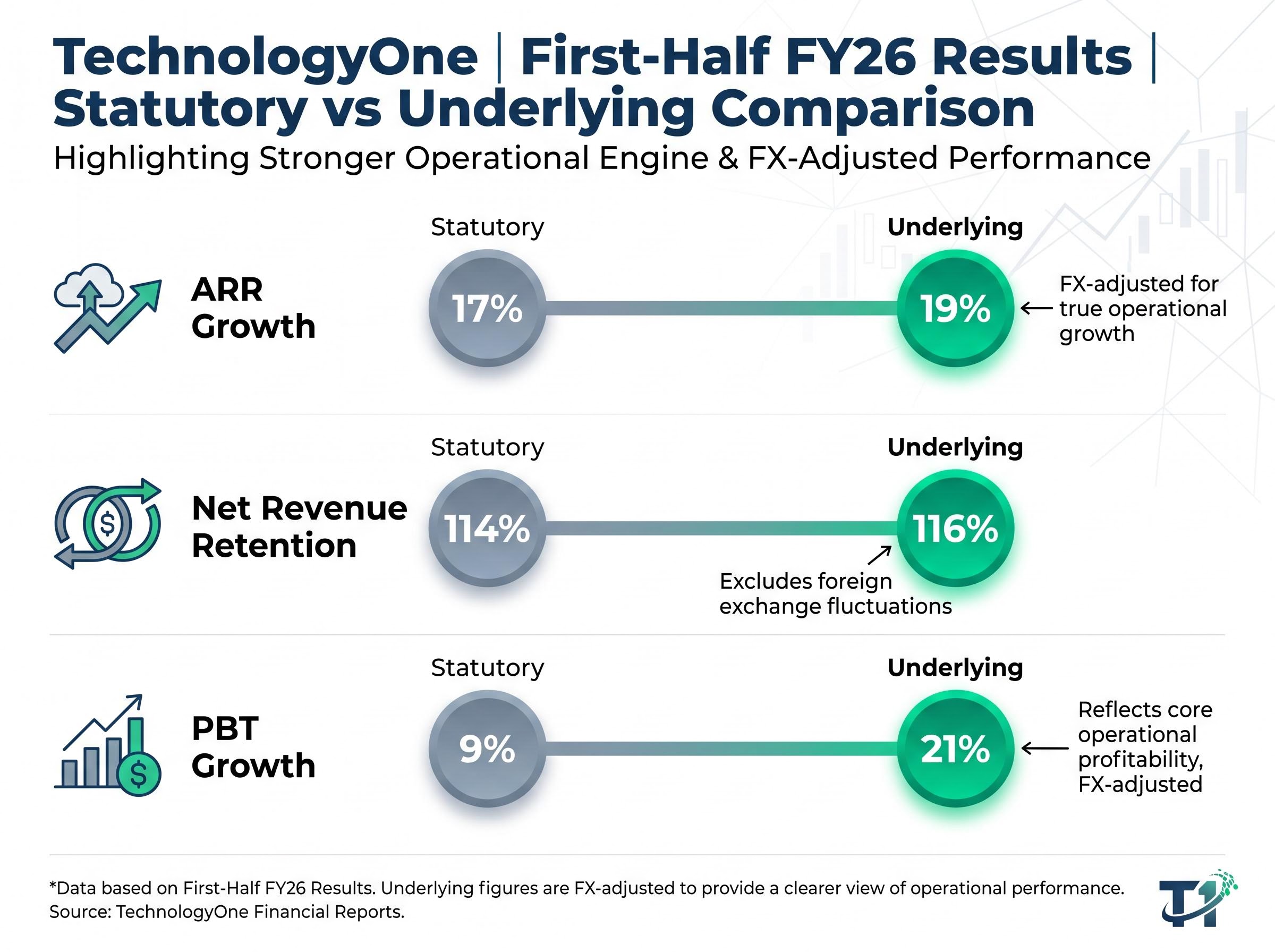
Adjust for both, and the underlying picture sharpens considerably.
| Metric | Statutory | Underlying (FX-adjusted) |
|---|---|---|
| ARR growth | 17% | 19% |
| Net revenue retention (NRR) | 114% | 116% |
| PBT growth | 9% | 21% |
| Interim dividend per share | $0.08 (up 21%) | |
The 21% dividend increase is itself a signal. Management teams do not lift dividends at that rate unless they view the underlying earnings trajectory as durable.
When big ASX news breaks, our subscribers know first
Why understanding annual recurring revenue matters more than profit for this company
For investors more accustomed to reading NPAT as the bottom line, TechnologyOne’s result requires a different lens. The company operates a software-as-a-service (SaaS) model, which means the metrics that matter most are not the ones that matter most for, say, a retailer or a bank.
Three terms frame the entire investment case:
- Annual recurring revenue (ARR): The total annualised value of all active subscription contracts. It measures the size and growth rate of predictable, repeating income.
- Net revenue retention (NRR): The percentage of last year’s subscription revenue retained after accounting for cancellations and upsells. An NRR above 100% means existing customers are spending more each year without any new customer wins needed.
- Churn: The rate at which customers cancel. Low churn combined with high NRR creates a compounding revenue base.
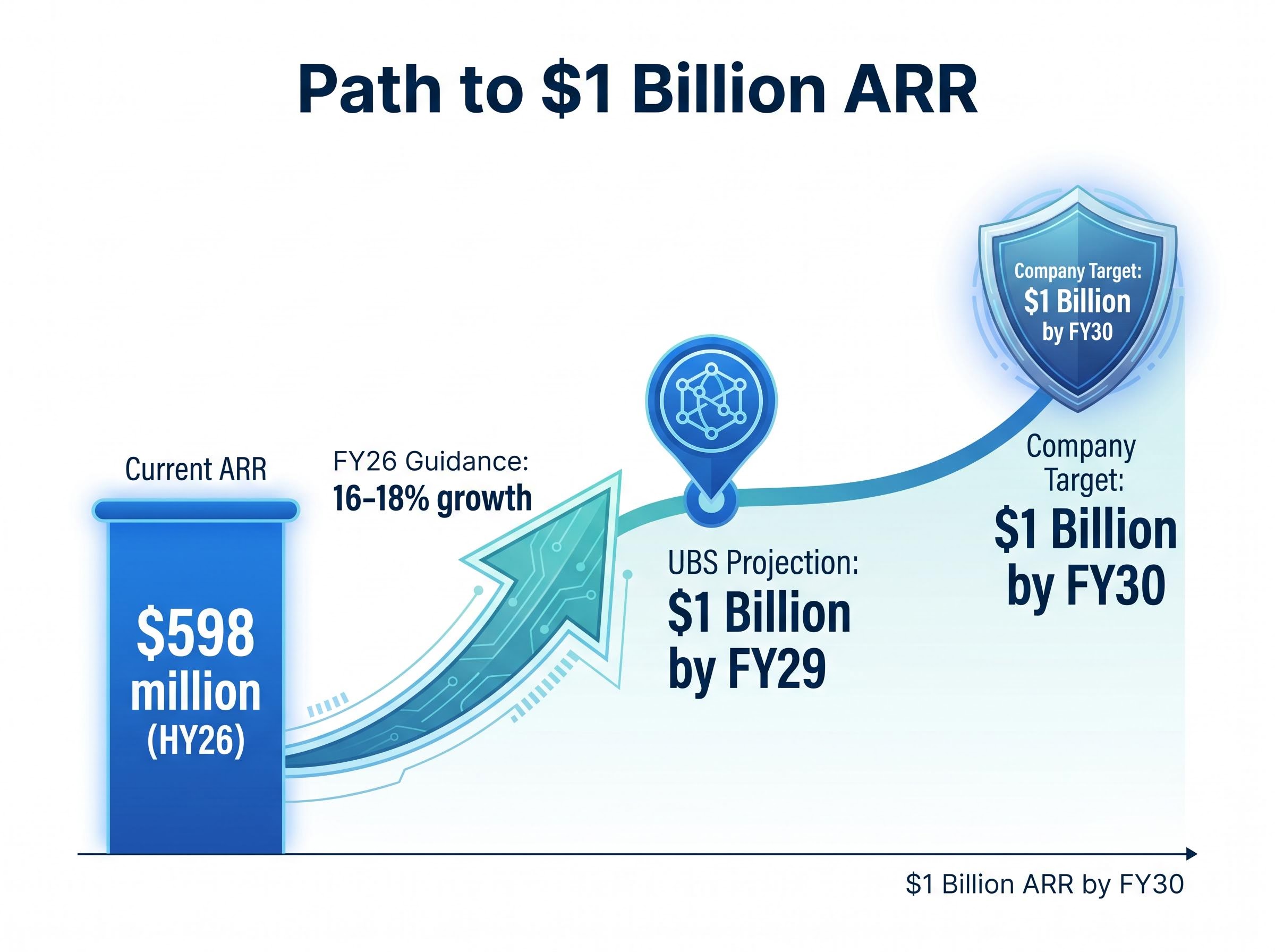
At $598 million in ARR (up 17%, or 19% underlying), with NRR of 114% (underlying 116%), TechnologyOne’s existing customer base is expanding faster than it is contracting. That compounding dynamic is why the company’s target of at least $1 billion in ARR by FY30 is structurally credible rather than aspirational.
UBS projects TechnologyOne will reach $1 billion in ARR by FY29, one year ahead of the company’s own target.
For Australian investors evaluating the stock at any reporting period, ARR growth and NRR carry more interpretive weight than a single half’s NPAT figure.
The UK is outpacing the core business, and why the currency math obscures it
UK ARR reached $53 million in the half, up 23%, a rate that materially outpaces the company-wide 17% statutory growth (and even the 19% underlying figure).
The problem is that Australian investors reading the statutory result in AUD do not see that outperformance clearly. The currency translation mechanism works in three steps:
- Local growth occurs in GBP. UK customers pay in pounds, and that revenue grew 23% in local-currency terms.
- The AUD strengthened against the GBP during the half. Each pound of UK revenue converts into fewer Australian dollars than it did a year ago.
- The reported AUD figure understates the local growth rate. The statutory UK contribution looks smaller than the operational reality.
Structural tailwinds beyond the half
The UK business targets public-sector organisations, particularly local government. Anticipated council consolidation across England, creating larger and more economically viable councils, represents a structural demand catalyst for enterprise resource planning (ERP) systems of the kind TechnologyOne provides.
The UK local government reorganisation policy published by the Ministry of Housing, Communities and Local Government outlines a program to replace two-tier county and district councils with single-tier unitary authorities, a structural shift that materially expands the pool of organisations requiring new or upgraded enterprise resource planning systems.
The UK segment remains small relative to the ANZ core. But its growth rate and its structural tailwinds suggest investors anchoring solely to the current revenue split may be underweighting its long-run contribution.
Townsville’s return and what a defection reversal signals about competitive moat
The City of Townsville left TechnologyOne for a rival ERP provider. The rival could not meet the council’s requirements. Townsville returned.
The council signed a 10-year agreement at a higher contract value than its prior deal, a rare example of a customer defecting and then returning on improved terms.
That sequence matters more than any single contract’s dollar value. In enterprise software, switching costs are the primary mechanism through which providers retain customers. Government and education organisations build years of workflows, data structures, and staff training around a single ERP platform. Leaving is expensive. Returning after leaving is an even stronger signal: it suggests the alternative was not merely different but materially worse.
Switching costs as a moat source operate differently from brand or scale advantages: they are embedded in the customer’s own workflows, data structures, and staff training rather than in the vendor’s product alone, which is why a government council returning to a prior ERP provider after a failed defection is a stronger competitive signal than a new customer win at an equivalent contract value.
A second data point reinforces the competitive picture. TechnologyOne secured a new contract with James Cook University, which includes the company’s Plus agentic AI platform. The Plus platform, which had 22 subscriptions as of approximately February 2026, is designed to drive both new customer acquisition and higher spend from existing clients.
- City of Townsville: 10-year agreement at higher value than the prior contract, returning from a rival vendor
- James Cook University: New contract win including the Plus agentic AI platform
Combined with NRR of 114% (underlying 116%), these wins reduce the probability of the competitive displacement scenario that would most threaten the investment case.
Full-year guidance and whether the $1 billion ARR target is still credible
TechnologyOne upgraded its FY26 PBT growth guidance to 18-20%, up from a prior range of 13-17%. ARR growth guidance sits at 16-18% for the full year, with a long-term pre-tax profit margin target of at least 35%.
With ARR at $598 million at the half and growth typically weighted toward H2, the 16-18% full-year ARR target appears achievable on the current trajectory. The PBT upgrade, from a range that topped out at 17% to one that starts at 18%, reflects management’s confidence that the underlying momentum, not the statutory headline, is the truer signal.
The guidance upgrade from February 2026, which lifted the PBT growth floor from 13% to 18%, established a baseline of management confidence before the HY26 result was even reported; the May 2026 reaffirmation at the top end of that range is therefore not a standalone data point but a continuation of a trajectory management signalled months earlier.
Brokers are split on what the stock is worth from here.
| Broker | Rating | Price target | Key assumption | Implied upside from $28.36 |
|---|---|---|---|---|
| Bell Potter | Buy | $32.25 | ARR growth could outperform expectations | ~14% |
| Morgans | Hold | $31.20 | Valuation above 65x PE limits upside | ~10% |
| UBS | N/A | N/A | 18.4% profit growth; $1B ARR by FY29 | N/A |
The bull case requires three conditions to hold:
- ARR growth sustaining above 17% through FY27 and beyond
- UK segment scaling as a meaningful contributor to group revenue
- Plus driving NRR expansion as enterprise adoption moves beyond the initial 22 subscriptions
Morgans’ Mitch Belichovski has flagged the valuation risk directly, noting the stock was trading on a price-earnings ratio above 65x. The 24 April 2026 downgrade to Hold was not driven by deteriorating fundamentals but by the price itself.
What the HY26 result means for the TechnologyOne investment case right now
What the result confirmed and what remains open
What HY26 confirmed:
- ARR momentum is intact at 19% underlying growth, ahead of the 16-18% full-year guidance range
- The UK business is growing faster than the core ANZ operation, even if currency effects mask it in AUD terms
- Competitive moat signals are strengthening: Townsville’s return and the JCU win both support the NRR reading
- Management confidence is high enough to lift the dividend 21% and upgrade profit guidance
What remains to watch:
- Valuation stretch: the stock trades above 65x earnings, leaving limited margin for execution slips
- Currency headwinds may persist if the AUD remains strong against the GBP, continuing to suppress statutory UK contributions
- Plus adoption is still at early stages with 22 subscriptions; enterprise-wide rollout needs to accelerate for NRR expansion to become a structural driver
- No post-19 May 2026 broker updates are yet available to assess whether analysts have revised their models following the HY26 release
Next catalysts
The H2 FY26 result and any formal broker target revisions following the 19 May 2026 release represent the next meaningful data points. The Morgans downgrade was price-driven, not fundamentals-driven, and the stock is re-rating on growth expectations that demand sustained execution through FY27.
This article is for informational purposes only and should not be considered financial advice. Investors should conduct their own research and consult with financial professionals before making investment decisions.
The bottom line on TechnologyOne after HY26
The statutory numbers understate the operating reality. Underlying pre-tax profit grew 21%, ARR is compounding at 19%, the UK is outpacing the core business at 23% growth, and a customer defection reversal in Townsville reinforces the competitive position in ways that NRR alone cannot capture.
The $1 billion ARR target by FY30 has credible support, with UBS projecting achievement a year early. But the stock’s valuation, above 65x earnings per Morgans’ assessment, prices in a growth trajectory that leaves little room for disappointment.
The variable most likely to determine whether TechnologyOne re-rates higher or consolidates at current levels is Plus. With 22 subscriptions and James Cook University as a named enterprise adopter, the agentic AI platform is the bridge between a strong SaaS compounder and the next phase of the growth story. Whether that bridge holds weight is a question H2 FY26 will begin to answer.
Enterprise AI adoption rates tell a sobering story for vendors counting on rapid platform uptake: with an estimated 70-80% of enterprise AI pilots failing or stalling as of early 2026, and only 17% of enterprises having meaningfully deployed agentic AI, the 22-subscription starting point for TechnologyOne’s Plus platform sits within the realistic early-adopter range rather than signalling slow commercial traction.
Forward-looking statements regarding guidance, ARR targets, and growth projections are subject to change based on market developments and company performance. Past performance does not guarantee future results.