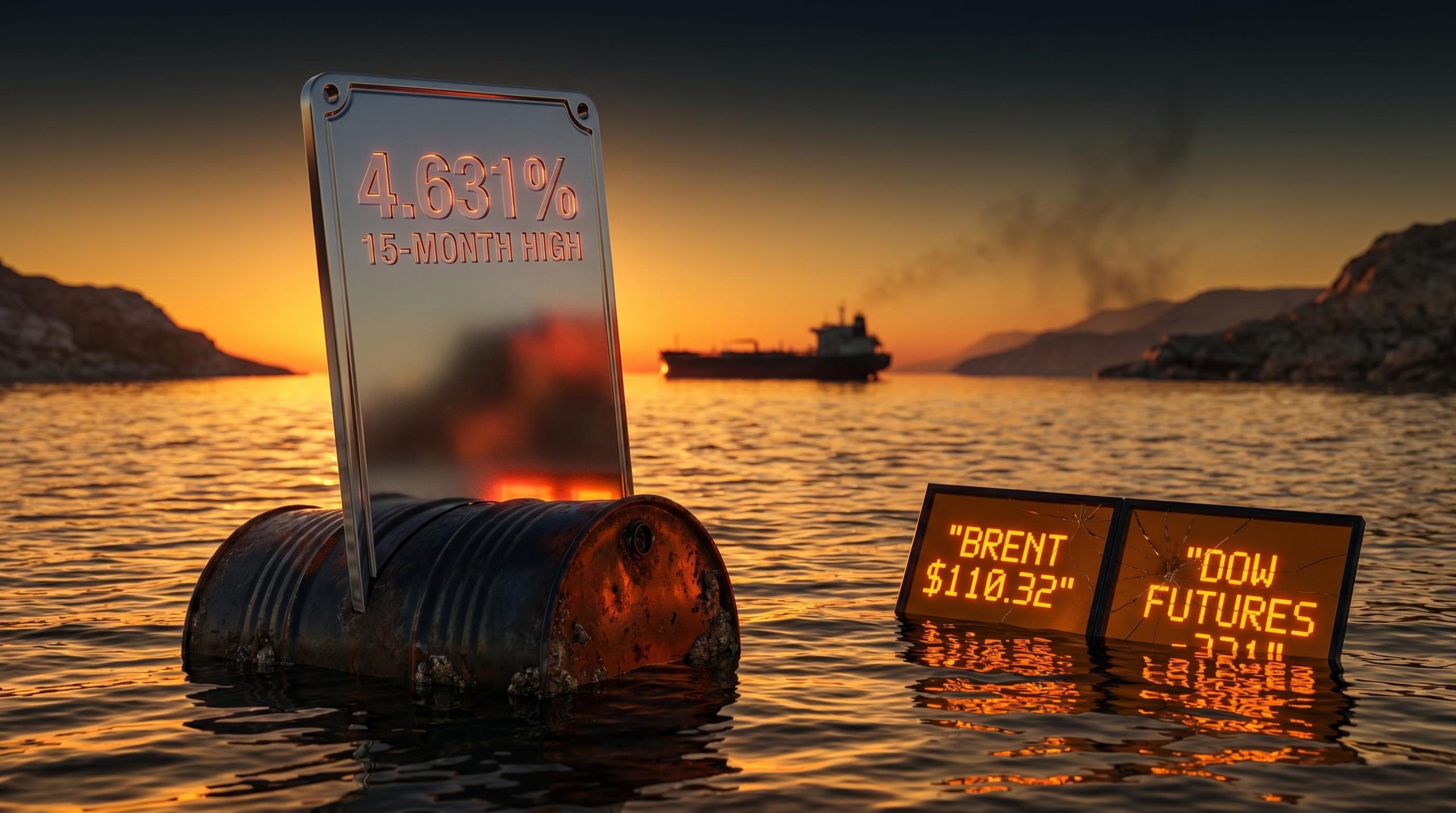
The U.S. 10-year Treasury yield hit a 15-month high on Monday morning as oil crossed $110 a barrel and equity futures pointed to a sharp red open, with Dow futures down 321 points as of 03:28 ET. The proximate cause is not a domestic economic shock or a Federal Reserve meeting surprise. It is a maritime chokepoint roughly 7,000 miles from Wall Street: the Strait of Hormuz, where Iran’s conflict with U.S. and Israeli forces has entered its 80th day with no clear resolution.
A drone strike on a UAE nuclear installation over the weekend, compounded by three intercepted drones in Saudi Arabia, deepened anxiety about a ceasefire already described as fragile. What follows is a step-by-step analysis of how a supply disruption in the Persian Gulf translates into higher borrowing costs for American homeowners, lower valuations for U.S. equities, and an 80% market-implied probability that the Fed will raise rates before 2027. The transmission chain, the portfolio consequences, and the tail risk the market may not yet be pricing are all examined below.
The Strait of Hormuz is the world’s most important oil chokepoint, and it is effectively closed
Approximately one-fifth of global oil supply transits a waterway barely 21 miles wide at its narrowest point. When that waterway is functioning, it is an abstraction, a line on a shipping map that most investors never think about. When it is not functioning, every barrel that cannot pass through it reprices the global energy market in real time.
The disruption is more layered than a simple military blockade: what analysts have characterised as the Hormuz triple lock combines active US naval blockade operations, Iranian toll enforcement on non-US and non-Israeli vessels, and the near-total withdrawal of commercial war-risk insurance coverage, meaning a ceasefire announcement alone would not immediately restore commercial transit.
Brent crude traded at $110.32 per barrel as of 03:59 ET on 18 May 2026, up 1.0% intraday. The weekend’s developments made the price move worse. A drone strike hit a UAE nuclear installation, and Saudi air defences intercepted three additional drones, widening the geographic footprint of a conflict now in its 80th day.
Deutsche Bank analysts observed that the ceasefire has now outlasted the initial combat phase of the conflict, a framing that captures the political and military ambiguity precisely: neither war nor peace, just sustained disruption with no definitive endpoint.
President Donald Trump posted on social media that time is running out for Iran but that Tehran appears willing to deal. The market, however, is pricing the physical reality over the diplomatic signal. Oil remains above $110, and tanker routes remain disrupted.
When big ASX news breaks, our subscribers know first
How energy prices transmit into sovereign bond yields: the three-channel mechanism
The move from $110 oil to a 15-month high on the 10-year Treasury yield is not arbitrary. It follows a transmission chain with three distinct channels, each reinforcing the others:
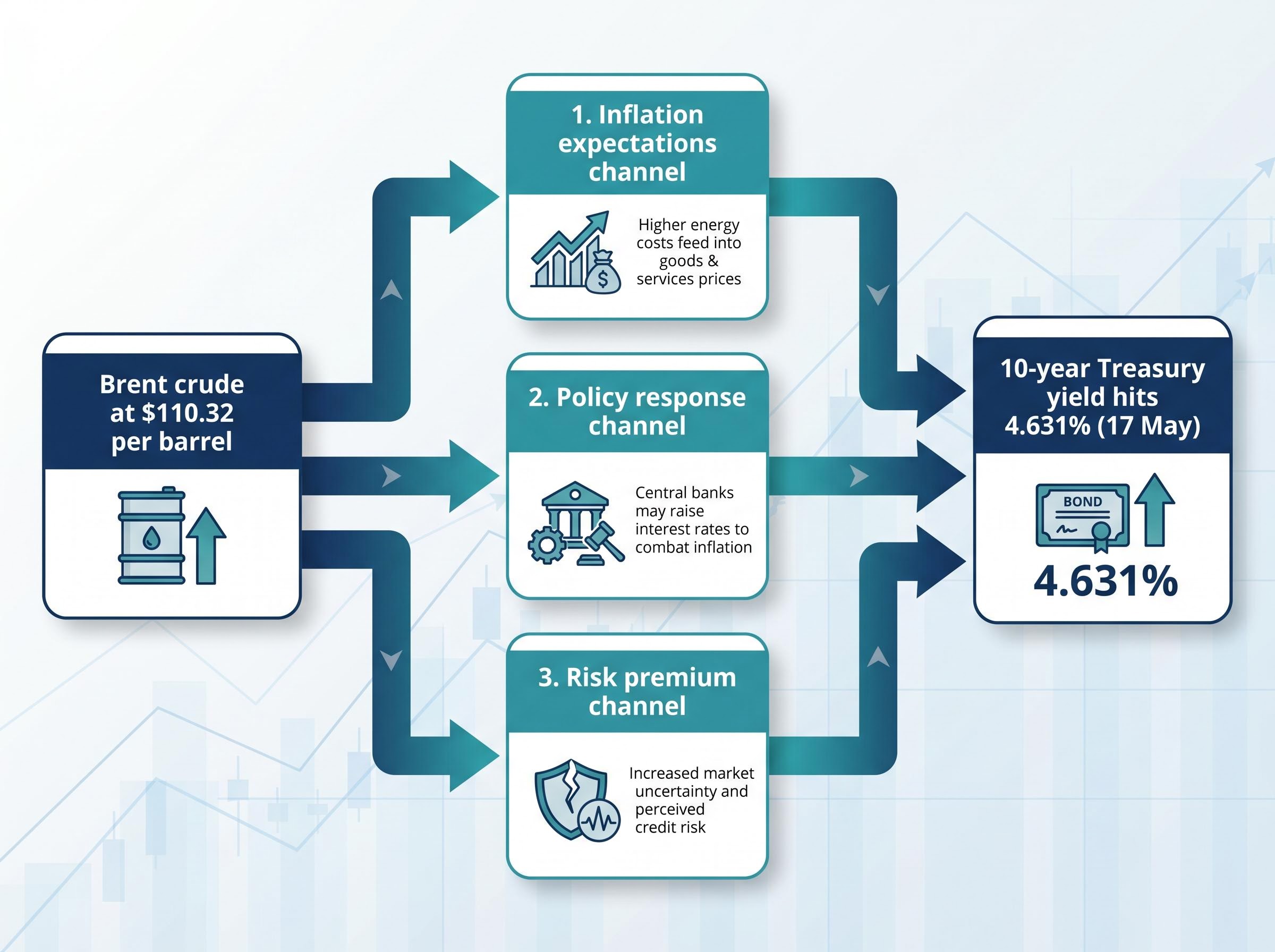
- Inflation expectations channel. Elevated oil costs flow directly into headline Consumer Price Index readings and producer prices. As energy costs rise, the inflation premium embedded in Treasury yields rises with them, because bondholders demand higher compensation for holding fixed-income instruments whose real returns are being eroded.
- Policy response channel. When Federal Reserve officials signal that tightening may follow energy-driven inflation, markets reprice the expected path of the federal funds rate. That repricing lifts yields across the curve before any actual rate decision is made.
- Risk premium channel. Geopolitical uncertainty itself adds a premium to sovereign debt. Investors holding long-duration Treasuries face not only inflation risk but event risk, the possibility that a ceasefire collapse or conflict escalation could trigger a further leg higher in energy costs and, by extension, yields.
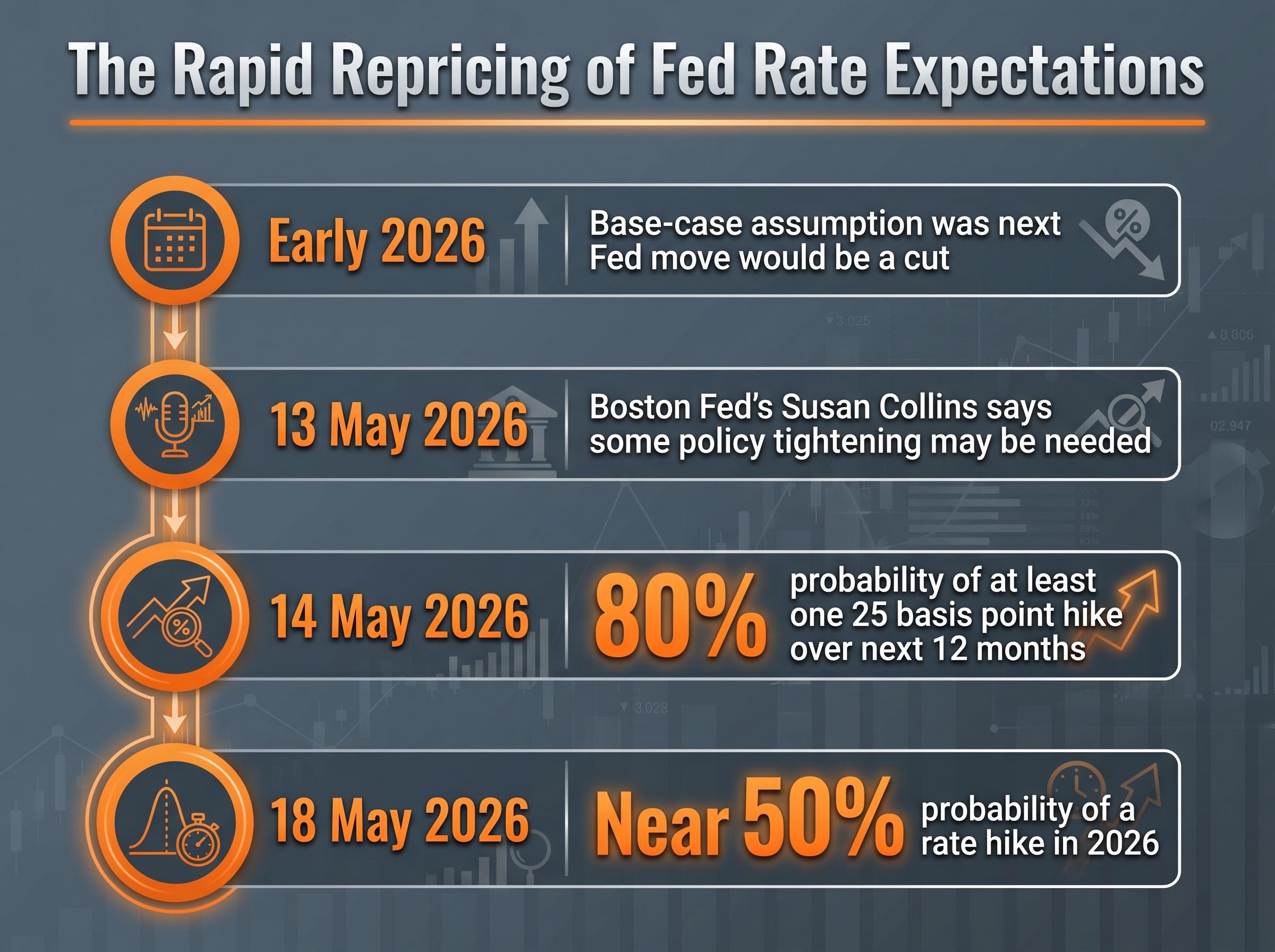
Boston Fed President Susan Collins stated on 13 May 2026 that “some policy tightening may be needed” if energy inflation does not abate, the clearest official confirmation that the policy channel is active.
Analyst estimates on oil price pass-through to core CPI centre on a 40-60% transmission rate over a 3-6 month lag, which means the June and July inflation prints carry considerably more policy weight than the April reading, and the full pressure from $110 crude has not yet appeared in the data the Fed is reacting to.
The speed of the adjustment illustrates all three channels working simultaneously. The 10-year yield moved from 4.47% on 14 May (per FRED data) to an intraday high of 4.631% on 17 May (per CNBC), a meaningful repricing in just three trading days. Reuters reported on 14 May that markets were pricing approximately an 80% probability of at least one 25 basis point Fed hike over the next 12 months.
What rising bond yields actually mean for borrowers, equity investors, and the broader economy
The transmission mechanism matters because its consequences are concrete, reaching well beyond the bond market itself.
- Borrowing costs rise across the economy. Treasury yields serve as the benchmark for mortgage rates, corporate debt issuance, and government financing costs. When the 10-year yield climbs to a 15-month high, the cost of capital rises for households, companies, and the federal government simultaneously.
- Equity valuations compress. Higher yields increase the discount rate applied to future corporate earnings, reducing the present value of stocks. The effect is most pronounced in long-duration growth equities, where a larger share of expected cash flows sits further in the future.
- The U.S. dollar strengthens, creating a bifurcated picture. ING analysts characterised elevated oil prices and rising yields as a significant drag on risk assets while being supportive of the dollar. For investors, that means not every asset class moves in the same direction.
Futures markets on 18 May reflected the pressure clearly:
| Index | Futures Move (Points) | Futures Move (%) | Direction |
|---|---|---|---|
| Dow Jones | -321 | -0.7% | Lower |
| S&P 500 | -32 | -0.4% | Lower |
| Nasdaq 100 | -96 | -0.3% | Lower |
All three major indices had already finished more than 1% lower the preceding Friday. The mechanism is self-reinforcing: higher yields beget lower equity prices, which can trigger further risk-off selling, feeding back into demand for safe-haven assets and complicating the yield picture further.
Why the Fed’s next move is no longer obvious, and why that uncertainty is itself a market risk
How market pricing of Fed hikes has shifted in weeks
The repricing has been swift. As recently as early 2026, the base-case assumption was that the next Fed move would be a cut. By 14 May, Reuters reported an 80% probability of at least one 25 basis point hike over the next 12 months. ING-cited market pricing as of 18 May placed the probability of a rate hike in 2026 at near 50%.
That shift is not merely a consequence of the yield move; it is a driver. When markets reprice the Fed’s rate path, the term premium on longer-dated Treasuries rises in anticipation, pushing yields higher before any policy action occurs.
The supply-shock dilemma: why rate hikes may not fix this inflation
The Fed’s bind is genuine. Energy-driven inflation is cost-push rather than demand-pull. Rate hikes suppress demand, but they do nothing to reopen the Strait of Hormuz or restore disrupted tanker routes. Raising rates into a supply shock risks slowing the economy without addressing the source of inflation.
Allowing inflation expectations to become unanchored, however, carries its own danger.
Reuters reported on 14 May that the Fed may need to hike to defend its inflation-fighting credibility, framing the choice as one where inaction itself becomes a risk to the institution’s mandate.
The FOMC’s April 2026 statement acknowledged that inflation was elevated in part due to rising global energy prices and cited Middle East developments as a source of significant uncertainty, establishing the official policy record against which Collins’s subsequent tightening signal should be read.
Collins’s 13 May statement reinforced that framing. The political dimension adds further pressure: sharply higher petrol prices ahead of November midterm elections increase scrutiny on both the Fed and the White House, narrowing the window for patience.
The uncertainty itself is the destabilising variable. Duration risk in a standard 60/40 portfolio is no longer well-hedged by the historical inverse correlation between equities and Treasuries when both asset classes face simultaneous selling pressure.
Warsh’s approach to the rate path adds a further layer of uncertainty: his expected acceleration of balance sheet runoff to $100 billion per month represents a form of tightening that operates independently of rate decisions, putting additional upward pressure on yields even if the FOMC holds the federal funds rate steady.
Portfolio implications: what this macro configuration means for duration, sectors, and inflation protection
The move from 4.47% to 4.631% on the 10-year yield over three trading days illustrates the mark-to-market losses accumulating in long-duration bond portfolios. For investors holding bonds with maturities beyond 10 years, even modest yield increases translate into meaningful principal declines.
| Asset Class | Direction of Pressure | Instrument / Proxy | Key Risk |
|---|---|---|---|
| Duration / Long bonds | Negative (mark-to-market losses) | Long-duration Treasuries | Further yield increases if oil rises or Fed hikes |
| Rate-sensitive equities | Negative (valuation compression) | Utilities, REITs, long-duration growth | Discount-rate sensitivity amplified at current yield levels |
| Energy sector equities | Positive (revenue tailwind) | Energy ETFs, integrated oil majors | Ceasefire or demand destruction reverses the trade |
The sector rotation logic is straightforward: energy outperformance versus rate-sensitive sectors is the standard positioning in a rising-yield, elevated-crude environment. Nvidia, down 4.42% to $225.32 on 18 May, illustrates the pressure on AI-heavy, long-duration growth names, even as broader AI investment optimism has partially cushioned the S&P 500, which remains above pre-conflict levels.
Three instrument categories warrant consideration in this environment:
- Short-duration bonds reduce mark-to-market exposure to further yield increases while preserving income
- Treasury Inflation-Protected Securities (TIPS), which adjust their principal based on inflation, become more relevant when energy-driven price increases persist and the Fed is perceived as potentially behind the curve
- Energy equities offer direct exposure to the supply-disruption tailwind, though they carry reversal risk if diplomacy succeeds
This article is for informational purposes only and should not be considered financial advice. Investors should conduct their own research and consult with financial professionals before making investment decisions. Past performance does not guarantee future results.
The risk the market is not fully pricing: what a ceasefire failure would mean
Current market pricing reflects a base case of sustained but stable disruption. Oil at $110-$111 per barrel, yields near 4.60%, and equities down but not in freefall all suggest investors have absorbed the initial shock and positioned around it. The base case is priced. The tail risk is not.
A ceasefire breakdown or geographic widening of the conflict would represent an unpriced shock. Brent at $110.85-$111.32 is already elevated; further escalation from this base would compound the inflation channel, accelerate the Fed repricing, and put yields on a trajectory toward 5%, a level that would meaningfully alter the calculus for mortgage markets, corporate issuance, and equity valuations.
The weekend’s events signal that the conflict’s geographic footprint is expanding, not contracting. Drone strikes reached a UAE nuclear installation. Saudi air defences intercepted three separate attacks. These are not signs of a conflict winding down.
ING characterised the bond selloff as “the single most consequential story across global financial markets,” a framing that underscores the breadth of the pressure.
The global yield selloff is not a U.S.-only phenomenon. European and Asian sovereign yields have also risen, meaning a U.S. investor’s foreign bond allocation does not function as a safe haven in this environment.
The synchronised global bond selloff extends well beyond US Treasuries, with the UK 30-year gilt hitting a 28-year high and Japan’s 30-year JGB touching a record, meaning the traditional portfolio logic of offsetting domestic bond losses with foreign fixed income exposure is not functioning in this environment.
Iran, oil, and yields are now a single macro variable, and the next data point that matters
The chain is integrated, not sequential. Hormuz disruption sustains elevated oil. Elevated oil feeds inflation expectations. Inflation expectations force a Fed repricing. The Fed repricing lifts yields. Higher yields compress equity valuations. And the equity selloff reinforces the risk-off sentiment that feeds back into geopolitical anxiety. These are not separate stories. They are one feedback loop.
The near-term catalysts that will either accelerate or interrupt the current dynamic are specific and identifiable:
- Ceasefire developments. Trump’s signal that Iran is eager to deal remains the single geopolitical data point that could reverse the chain. Any confirmed diplomatic progress would compress oil prices rapidly, easing the inflation channel.
- Upcoming CPI data. The next inflation print will determine whether energy costs are flowing through to core measures at the pace the bond market is pricing.
- Nvidia earnings. Due during the week of 18 May, the report serves as a real-time test of whether AI investment optimism, the partial cushion that has kept the S&P 500 above pre-conflict levels, can hold under yield pressure.
The analytical posture is clear. The Strait of Hormuz is now a leading indicator for bond markets. Until the physical supply disruption resolves, rising Treasury yields remain the financial expression of a geopolitical crisis that has no confirmed end date.
These statements are speculative and subject to change based on market developments and geopolitical conditions.