The BYD Seagull sells for under $12,000 in China. It has earned favourable reviews from major US technology creators. It launched in Australia in November 2025 under a different name, at a price point that undercuts most Western competitors by thousands of dollars. American car buyers cannot purchase one, and the reason has nothing to do with the vehicle itself. US trade policy has constructed a three-layer barrier around the domestic auto market, combining a 100% tariff, a connected vehicle software ban, and federal tax credit exclusion rules that together prohibit Chinese-manufactured electric vehicles from reaching American consumers. With tariffs simultaneously raising prices on domestically assembled vehicles, the policy architecture shaping what Americans pay for cars in 2025 and 2026 carries direct financial consequences for every buyer in the market. What follows unpacks each layer of that barrier, explains why even a competitively priced, well-reviewed product cannot legally enter the US market, and connects those restrictions to what car buyers are paying today.
The car that reveals the barrier: BYD’s $10,000 EV and why it never arrived
BYD has surpassed Tesla as the world’s leading EV seller globally, and the Seagull is its most aggressive play for mass-market adoption. In China, where nearly 70% of global EV manufacturing output now originates, the Seagull retails for approximately $9,800-$12,000 USD. In Australia, it launched in November 2025 under the rebadged name Atto 1 at approximately A$25,000 before on-road costs.
The vehicle’s key market prices tell the story at a glance:
- China: approximately $9,800-$12,000 USD
- Australia (Atto 1): approximately A$25,000 before on-road costs
- United States: commercially unavailable at any price
The competitive quality of Chinese EVs at these price points is not theoretical. In late 2025, technology reviewer MKBHD assessed a comparable Chinese EV and reached a striking conclusion:
A Chinese EV priced at approximately $42,000 in its home market was assessed as delivering value equivalent to a $75,000 US-manufactured vehicle.
The product exists. It has been reviewed favourably by credible, independent sources. It travels freely to dozens of markets around the world. It is commercially unavailable to Americans by deliberate policy design. Understanding why requires understanding three distinct policy mechanisms, each of which would independently block or disadvantage the vehicle even without the others.
When big ASX news breaks, our subscribers know first
How the 100% tariff price barrier shapes Chinese EV access
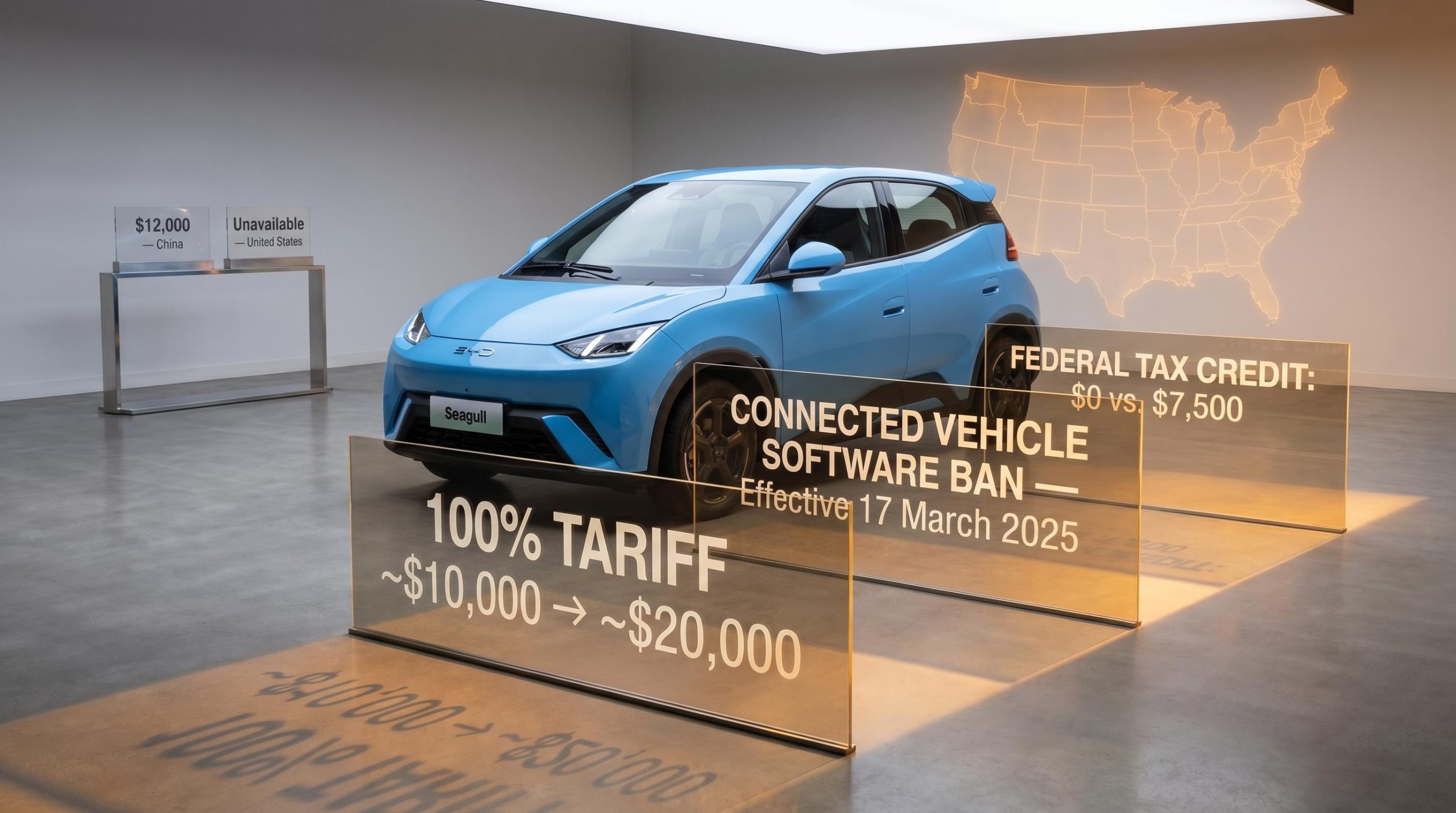
The most visible barrier is the tariff. In September 2024, the United States imposed a 100% additional tariff on Chinese-manufactured electric vehicles, a rate that effectively doubles the cost structure any Chinese automaker faces to enter the US market.
The arithmetic is straightforward. A BYD Seagull priced at roughly $10,000 in China faces an import cost structure that, after the 100% tariff, pushes the vehicle’s landed cost to approximately $20,000 before shipping, compliance, dealer margins, and additional import duties are factored in. The vehicle’s core competitive advantage, its price, is eliminated before it reaches a showroom floor.
| Cost component | Before tariff | After 100% tariff |
|---|---|---|
| Base import price (Seagull) | ~$10,000 | ~$20,000 |
| Shipping, compliance, margins | Variable | Variable |
| Estimated US retail floor | ~$15,000-$18,000 | ~$28,000-$35,000+ |
| Current US entry-level EV alternatives | ~$27,000-$30,000 | |
At the post-tariff price, the Seagull would compete directly with established US and allied-market EVs that carry brand recognition, existing service networks, and federal tax credit eligibility. The cost advantage that makes the vehicle compelling in China and Australia disappears entirely.
What the tariff rate history tells us about policy direction
The 100% rate did not appear from nowhere. Prior to 2024, the US tariff on Chinese EVs stood at 25%, already a meaningful barrier. The quadrupling to 100% represented a deliberate acceleration, not a baseline protective measure.
Broader Chinese import tariffs have continued to escalate, reaching 125% on some categories as of mid-2026. No confirmed waivers, exemptions, or successful legal challenges to the EV-specific tariff have been publicly documented. The rate survived both the Biden and Trump administrations, signalling bipartisan consensus that this particular barrier should remain intact. The direction of travel has been toward greater restriction, not toward opening.
Bilateral trade negotiations have produced preliminary signals of de-escalation, including a May 2026 summit consensus on tariffs and agricultural purchases, but no formal tariff schedule or implementation timeline has been published by either government, leaving the 100% EV rate structurally intact until any written agreement is reached.
Why Chinese EVs cannot qualify for the federal tax credit either
The federal EV tax credit, worth up to $7,500 under current law, is available only to vehicles that meet specific manufacturing and sourcing requirements. A vehicle must be assembled in North America. Its battery materials must be sourced from the United States or approved trade partners.
Chinese-manufactured vehicles fail both conditions:
Treasury guidance on Clean Vehicle Credit sourcing rules explicitly bars vehicles containing battery components manufactured by a foreign entity of concern from credit eligibility, a designation that encompasses the Chinese battery supply chains used across BYD’s vehicle lineup.
- Assembly requirement: Must be assembled in North America. Chinese EVs are not.
- Battery sourcing requirement: Must source battery materials from the US or approved trade partners. Chinese battery supply chains do not qualify.
- Combined effect: Chinese EVs receive $0 in federal tax credit support, while qualifying US and allied-market EVs receive up to $7,500, widening the effective price gap further.
For consumers evaluating EV purchases, this has direct financial consequences. A qualifying US-assembled EV priced at $30,000 carries an effective cost of $22,500 after the credit. A hypothetical Chinese EV at the same sticker price would cost $30,000 out of pocket, even before tariff and software considerations apply.
What the stacking effect means for any future negotiation
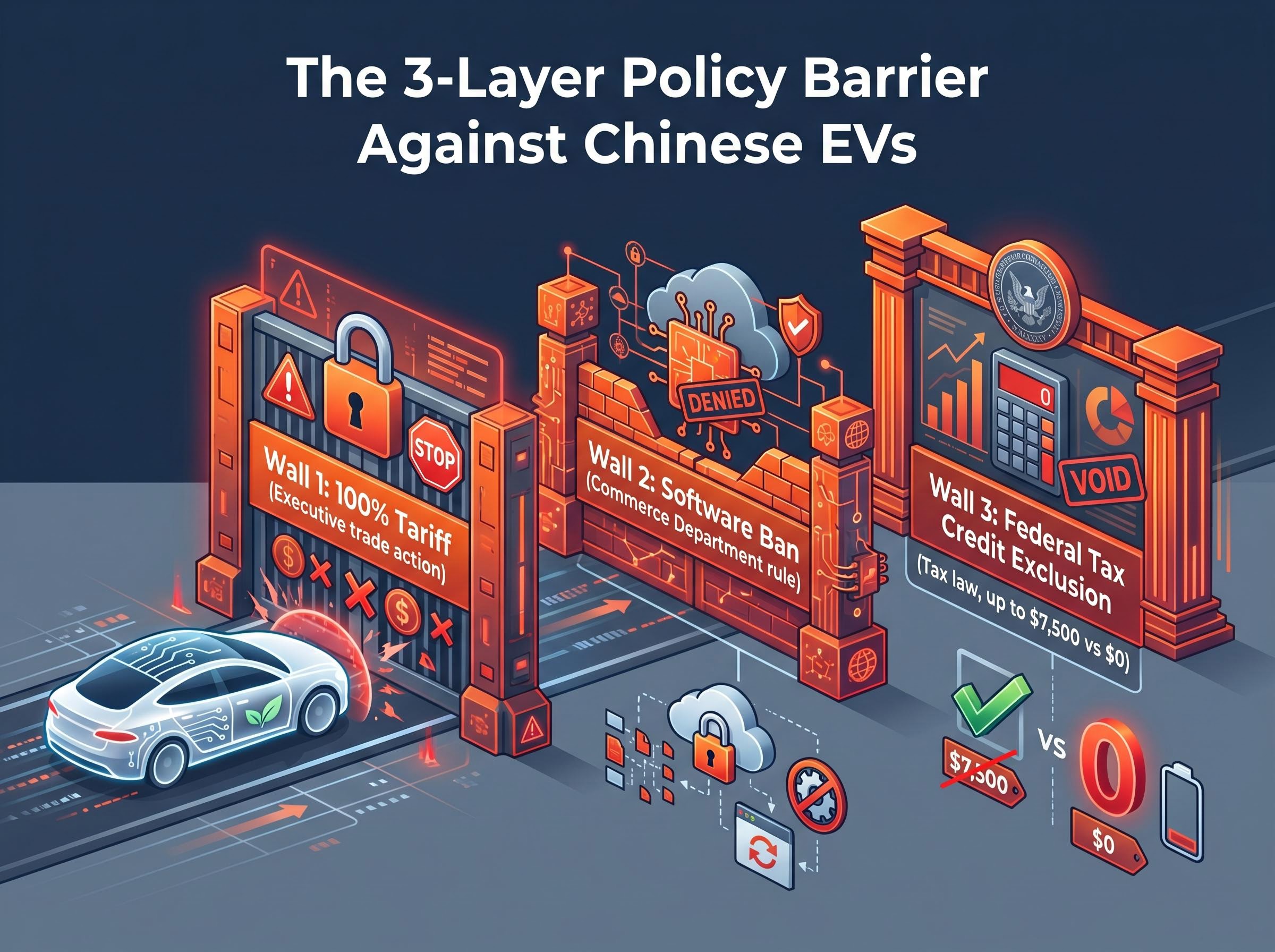
Each of the three barriers operates under independent legal authority. The tariff is an executive trade action. The software ban is a Commerce Department regulation. The tax credit exclusion is embedded in federal tax statute. Removing or reforming one does not affect the others.
This legal independence is why the market closure is structurally durable. A bilateral trade deal could theoretically reduce the tariff. It would not affect the software ban. Congressional legislation could revise the tax credit rules. It would not remove the tariff or the regulatory prohibition. No single policy change removes all three simultaneously, which means any path to Chinese EV market access in the US would require coordinated action across multiple branches of government and multiple legal frameworks.
Legal challenges to executive tariff authority have advanced further than many investors realise, with two federal courts striking down the broadest statutory pillars of executive tariff power within a three-month window in early 2026, though the administration retains Section 232 national security authority as its most defensible remaining tool.
The software ban: a regulatory prohibition that operates independently of price
Even if the 100% tariff were removed entirely tomorrow, Chinese EVs would still be prohibited from entering the American market. A second barrier, less visible but arguably more durable, ensures that.
The connected vehicle software ban, finalised in the Federal Register on 16 January 2025 and effective 17 March 2025, prohibits vehicles using software or hardware tied to entities in countries of concern (primarily China and Russia) from being sold in the United States. The rule is administered by the Commerce Department’s Bureau of Industry and Security (BIS), and its stated rationale centres on national security, drawing an analogy to the concerns raised around TikTok and other Chinese-linked technology platforms.
The BIS final rule on connected vehicle software establishes that any vehicle incorporating software or hardware with sufficient nexus to China or Russia is prohibited from US sale, with software prohibitions taking effect for Model Year 2027 and hardware prohibitions extending to Model Year 2030.
The national security framing draws a direct parallel to the TikTok debate: connected vehicles collect location data, cabin audio, driving patterns, and network information, creating surveillance risks that the US government has determined cannot be mitigated through commercial agreements alone.
The compliance timeline unfolds in stages:
- 17 March 2025: Rule takes effect; Declaration of Conformity process begins
- 17 March 2026: Deadline for Declarations of Conformity from affected entities
- Model Year 2027: Software prohibitions take effect for new vehicles
- Model Year 2030: Hardware prohibitions take effect for new vehicles
This is the layer most readers will not have encountered before, and it changes the character of the market closure. The tariff is an economic barrier; it could theoretically be reduced through trade negotiations. The software ban is a regulatory prohibition grounded in national security law, a qualitatively different kind of restriction that operates independently of any price consideration. Removing it would require a separate regulatory process with its own legal and political constraints.
What the closed door is costing American car buyers
The barriers against Chinese EVs are one side of the cost equation. The other side affects vehicles already in the market. Tariffs on steel, aluminium, and imported auto parts raise costs on domestically assembled vehicles too, since no US-assembled vehicle uses 100% domestic components.
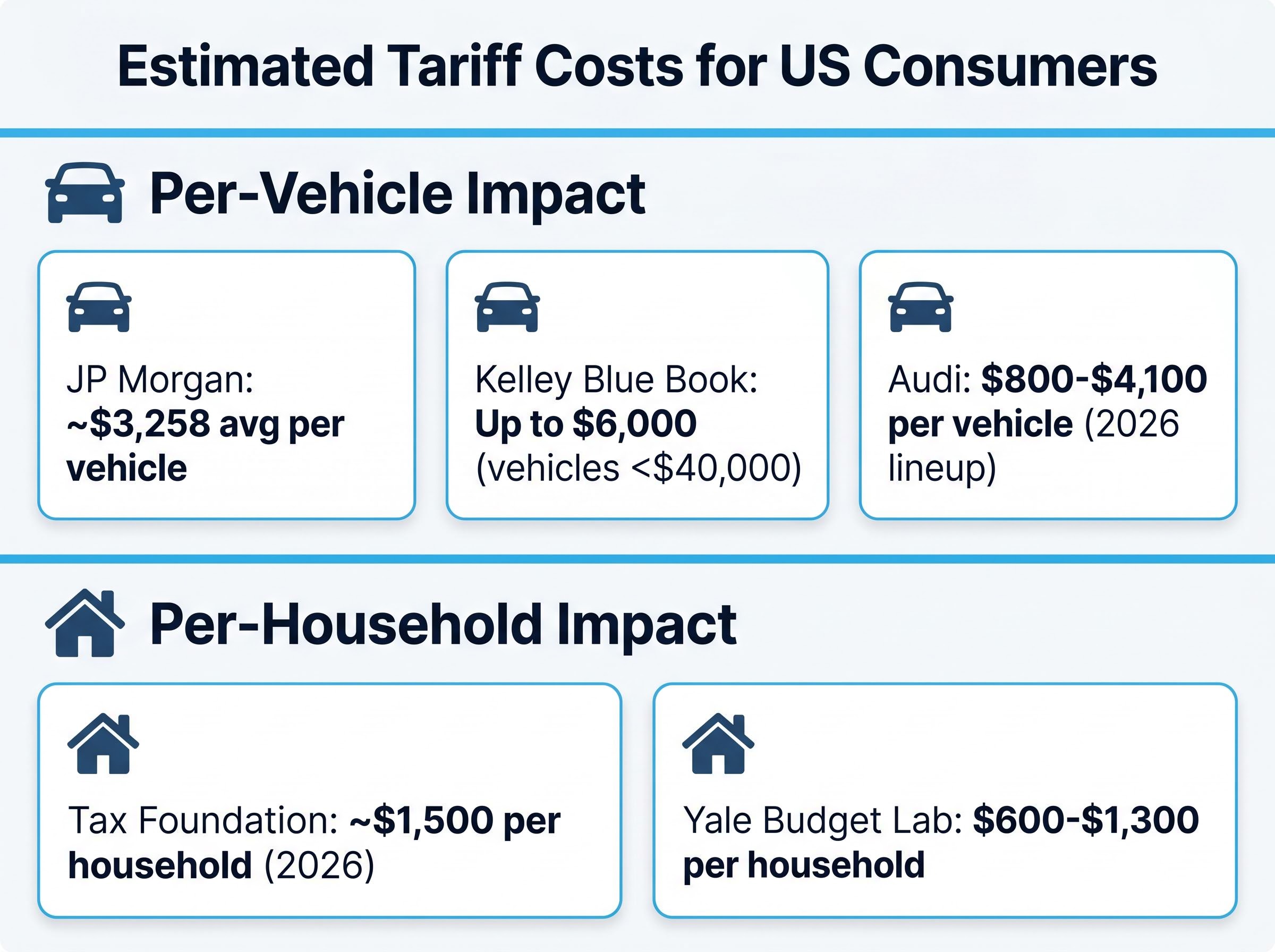
The consumer price impact is quantifiable. JP Morgan estimates that combined tariffs on vehicles and parts could cost the auto industry approximately $41 billion in year one, rising to approximately $52 billion by year three, translating to an average increase of approximately $3,258 per vehicle. Kelley Blue Book estimates that tariffs could add as much as $6,000 to vehicles priced below $40,000, the segment where affordability pressures are most acute.
| Source | Cost impact estimate | Scope |
|---|---|---|
| JP Morgan | ~$3,258 per vehicle (average) | All new vehicles |
| Kelley Blue Book | Up to $6,000 | Vehicles priced below $40,000 |
| Audi (announced) | $800-$4,100 per vehicle | 2026 model lineup |
Consumers have responded predictably. Used vehicle prices have risen approximately 4% or more year-over-year as buyers shift away from new-vehicle sticker prices. Auto loan terms have extended to record lengths as borrowers attempt to manage higher monthly payments. A segment of potential buyers has deferred purchases entirely.
For American households trying to quantify the full cost picture beyond vehicle purchases, our comprehensive guide to the 2026 tariff impact on consumers breaks down the exact dollar figures across vehicles, electronics, and pharmaceuticals, with five actionable steps to reduce individual exposure.
Ford CEO Jim Farley, speaking on 14 April 2026, warned that allowing Chinese EV sales in the US “would be devastating” to the domestic auto industry, framing the tariff as a necessary protective measure despite its consumer cost implications.
The domestic industry’s position is clear: the cost to consumers is acknowledged but viewed as preferable to the competitive disruption that Chinese EV market access would bring.
This article is for informational purposes only and should not be considered financial advice. Investors should conduct their own research and consult with financial professionals before making investment decisions.
What this means for the road ahead: trade walls, global realignment, and what buyers should do now
While the US market remains closed, the competitive products are reaching consumers elsewhere. BYD launched the Atto 1 in Australia in November 2025 at approximately A$25,000. Chinese automakers have accelerated into Southeast Asia and South America, targeting price-sensitive markets where their cost advantages face no tariff offset.
The global trade picture is also shifting. Canada reached a bilateral deal with China reducing tariffs on Chinese EVs in exchange for Chinese tariff reductions on Canadian canola oil, signalling that other countries are actively engaging with Chinese automakers while the US holds its barriers firm.
The global trade realignment accelerating outside US borders has produced three major trade agreements ratified since late 2025, including the Canada-China EV deal and an EU-India FTA, each explicitly excluding the United States and redirecting capital flows toward markets where Chinese automakers face no comparable tariff offset.
For American households, the cost picture extends beyond the car lot. The Tax Foundation estimates that current active tariffs add approximately $1,500 in costs per American household in 2026. The Yale Budget Lab places the figure at $600-$1,300 per household.
According to the Tax Foundation, current active tariffs add approximately $1,500 in costs per American household in 2026, a figure that encompasses vehicles, consumer goods, and industrial inputs.
For buyers navigating this environment, the practical considerations are straightforward:
- Timing: Vehicle prices are projected to stay elevated or rise further through 2026. Circulating market analysis suggests buying sooner rather than later if a purchase is planned.
- New versus used: The used vehicle market offers lower sticker prices but is also tightening, with prices rising and selection narrowing in popular segments.
- Tax credit eligibility: Buyers considering an EV should verify credit eligibility before purchase, as assembly location and battery sourcing requirements disqualify a growing number of models.
Financial projections referenced in this article are subject to market conditions and various risk factors. Past performance does not guarantee future results.
Three barriers, one closed market: what unavailable vehicles reveal about US trade policy
The BYD Seagull remains under $12,000 in China. It sells in Australia for roughly A$25,000. BYD operates freely as the world’s leading EV seller in dozens of markets. American consumers cannot buy one.
Three independent barriers ensure this remains the case:
- 100% tariff (economic barrier, executive trade action): eliminates the vehicle’s price competitiveness
- Connected vehicle software ban (regulatory barrier, Commerce Department rule): prohibits sale on national security grounds regardless of price
- Federal tax credit exclusion (statutory barrier, tax law): denies any subsidy incentive that could offset remaining cost disadvantages
No single policy change removes all three. Each operates under independent legal authority, which is why the market closure is structurally durable rather than a temporary negotiating posture.
The barriers exist for stated reasons, national security concerns about connected vehicle data and protection of domestic manufacturing, that carry genuine policy arguments behind them. They also carry measurable costs: higher vehicle prices, reduced consumer choice, and a competitive environment where domestic incumbents face less pressure to match the pricing that Chinese manufacturers have achieved globally.
Understanding this architecture is itself a form of financial literacy. Buyers who grasp the three-layer structure can set realistic price expectations, evaluate EV purchase timing with better information, and follow future policy developments with a framework already in place. The car they cannot buy is, in this sense, the most informative vehicle on the market.
—