
Woolworths Group has grown annual revenue at 6.8% per year for three consecutive years. Over the same period, net profit has contracted at negative 6.2% per annum. That divergence, not the share price chart, is the signal that defines the current investment case for WOW. With the stock trading at A$32.54 as of mid-May 2026 and broker consensus placing fair value at approximately A$33.50, Woolworths is priced near the upper boundary of what analysts consider reasonable. A 19% full-year profit slump in FY25 has reset the earnings base materially lower. This analysis unpacks the specific cost pressures compressing margins, explains how to read the headline financials in context, and assesses what the current valuation implies for investor risk and return. The goal is a framework for evaluating Woolworths’ fundamentals, not just its share price movement.
Revenue is growing, but profit is moving in the opposite direction
The numbers tell the story before any interpretation is needed.
- Revenue CAGR: 6.8% per annum over three years, reaching A$67,922 million in the most recent financial year
- Net profit CAGR: Negative 6.2% per annum over the same period, falling from A$2,074 million to A$1,711 million
- Gross margin: 56.0%, indicating product-level profitability before overhead costs remains intact
“Net profit has compounded at negative 6.2% per annum over three years while revenue grew at 6.8%.”
The FY25 profit decline of 19% represents the most acute deterioration in this three-year window. Revenue growth without corresponding profit growth can signal structural cost problems rather than a temporary blip. For investors relying on top-line momentum as a positive indicator, the profit trajectory tells a materially different story.
That gap between revenue and profit is the central analytical question. The rest of this analysis explains what is driving it, why it may persist, and what it means for the stock at current prices.
When big ASX news breaks, our subscribers know first
What is actually eating into Woolworths’ margins
The margin compression is not one problem. It is several, reinforcing each other simultaneously, and the order of magnitude matters.
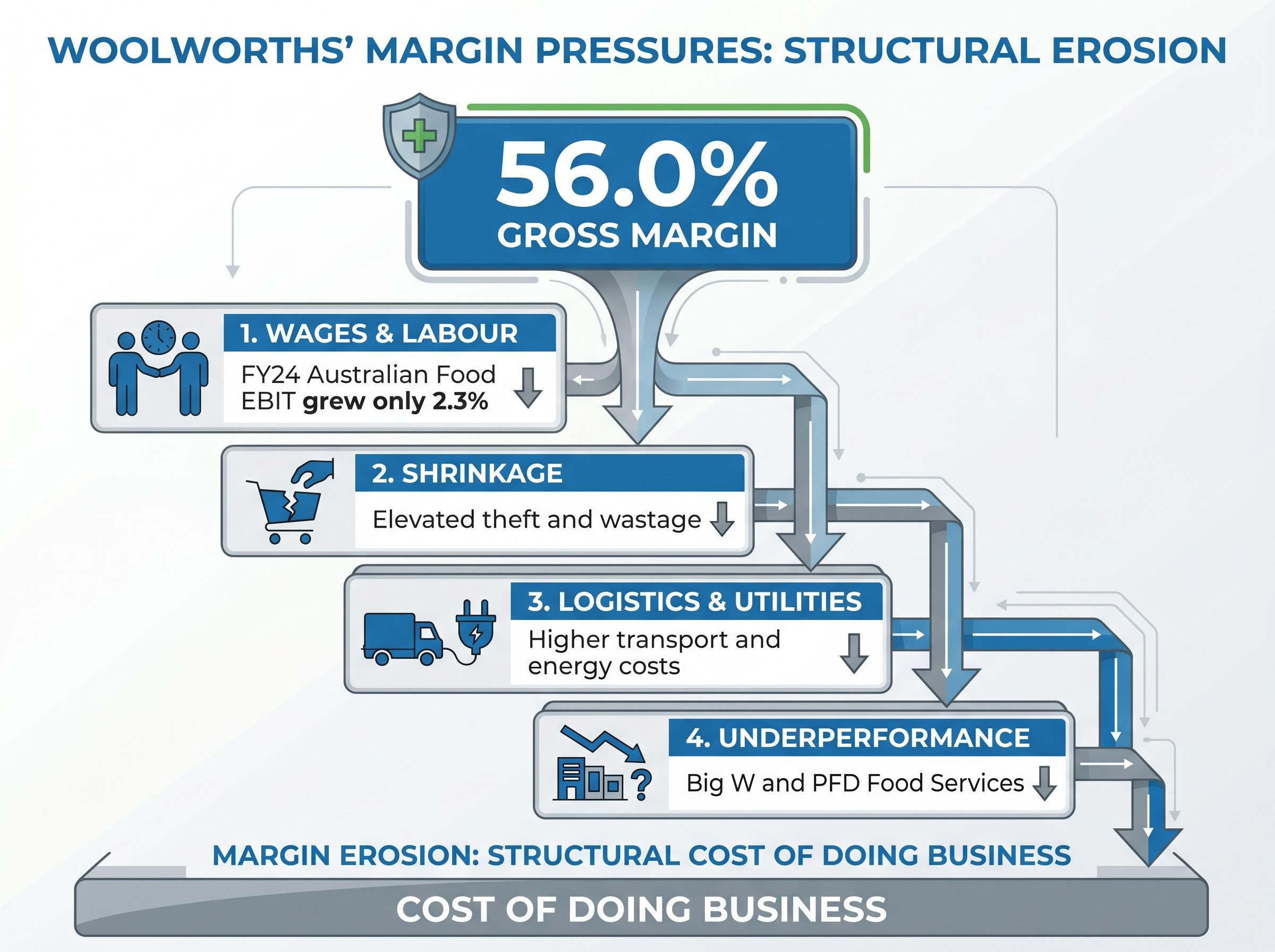
- Wages and labour costs: In FY24, Australian Food earnings before interest and tax (EBIT) grew only 2.3% despite solid sales, with higher wages, increased team hours, and cost-of-doing-business (CODB) inflation cited as the primary cause. Enterprise agreements, higher penalty rates, and additional staffing in fresh food and online fulfilment have pushed the wage bill structurally higher. This is not a cyclical pressure that eases with time.
- Shrinkage (theft and wastage): “Increased stock loss (shrink)” was listed explicitly as a main driver of CODB increases in Australian Food in FY24. Both Woolworths and Coles have flagged elevated theft levels as an ongoing headwind that continues to pressure supermarket profit margins.
- Logistics and utilities: Higher transport, distribution centre, and refrigeration energy costs remained elevated through FY24 even as global freight rates eased from pandemic peaks. Internal logistics costs did not follow the same downward trajectory.
- Big W and PFD underperformance: Big W delivered lower EBIT in FY24 due to subdued discretionary spending, higher CODB, and clearance activity. PFD Food Services reported sales growth but lower EBIT margin, citing higher operating costs and ongoing integration expenses.
Separating one-off impairments from structural cost pressures
The New Zealand Food segment impairment of approximately NZ$1.6 billion (roughly A$1.5 billion) was the dominant statutory profit headwind in 1H FY24. This was a non-cash, non-recurring item that distorted statutory net profit after tax (NPAT) but does not represent an ongoing cost drag.
The distinction matters. The recurring margin headwinds, wages, shrinkage, and utilities, persist regardless of the impairment. Stripping out the one-off does not resolve the underlying picture.
Reading beyond the headline: what gross margin does and does not tell you
Woolworths’ gross margin of 56.0% looks healthy at first glance. Gross margin measures the difference between revenue and the direct cost of goods sold, essentially capturing product-level profitability before rent, wages, energy, logistics, and other overhead costs are deducted.
Net profit margin, by contrast, reflects what remains after all those costs. When CODB growth outpaces sales growth, the gap between a healthy gross margin and a shrinking net profit widens. That is precisely the dynamic playing out at Woolworths.
“A 56% gross margin looks healthy until you see that cost-of-doing-business growth is eroding all the headroom between the product and the bottom line.”
| Metric | WOW Figure |
|---|---|
| Revenue growth (3-year CAGR) | 6.8% |
| Gross margin (current) | 56.0% |
| Net profit growth (3-year CAGR) | Negative 6.2% |
Australian Food EBIT growing at only 2.3% in FY24 despite solid sales growth illustrates this mechanism in practice. Revenue figures can be a misleading primary indicator for companies operating in high-volume, low-margin categories like grocery, where the overhead cost base is large relative to the product margin.
Investors who can identify CODB growth as the separating factor between gross margin and net margin are better equipped to avoid over-relying on top-line revenue signals, not just for Woolworths but across any ASX company operating with a similar cost structure.
Capital structure, dividends, and what they signal about financial health
The income statement tells one story. The balance sheet adds a dimension of risk the revenue-versus-profit framing alone does not surface.
The distinction between dividend yield and total return matters acutely here: a yield that has risen from 2.92% to 4.37% because the share price has declined is a fundamentally different income proposition from one driven by genuine dividend growth, and conflating the two leads investors to misread the income opportunity.
| Metric | WOW Figure |
|---|---|
| Net debt | A$15,424 million |
| Debt-to-equity ratio | 300.2% |
| Return on equity (FY24) | 1.9% |
| Dividend yield (current vs. 5-year avg) | 4.37% vs. 2.92% |
A return on equity of 1.9% signals poor capital efficiency. When a stock is priced near broker consensus fair value, that figure warrants scrutiny.
Total FY24 ordinary dividends came to 103 cents per share (46 cents interim, 57 cents final), fully franked, with the payout ratio toward the upper end of the group’s target range. The interim FY25 dividend has already been trimmed to 45 cents per share, consistent with a more cautious capital allocation stance following the 19% profit slump.
Woolworths’ EBIT trajectory tells the leverage story most directly: interest coverage has declined from 4.5x to 3.4x in a single year, and with net gearing now at 324.7%, the earnings headroom available to sustain the current dividend is narrower than the headline yield figure suggests.
“WOW’s current yield of 4.37% sits well above its five-year average of 2.92%, but with profits falling 19% in FY25, the sustainability of that payout is a legitimate question.”
The Endeavour Group divestment raised approximately A$851 million across two tranches in 2024, simplifying the group and raising capital for balance sheet management. That capital event, however, does not resolve the structural earnings pressure that will determine whether the current dividend level can be maintained.
Competitive and regulatory forces that limit the path to recovery
Even if Woolworths’ internal efficiency programmes deliver, the external environment constrains how much margin recovery is realistically achievable.
- Aldi and Coles pricing competition: Woolworths holds over 35% of the Australian grocery market, but that dominance has not translated to pricing power sufficient to offset cost inflation. Aldi continues to gain share in key categories, and Coles has invested aggressively in price and loyalty programmes.
- ACCC regulatory scrutiny: The ACCC Supermarkets Inquiry released its interim report on 31 August 2024 and its final report on 28 February 2025. The final report recommended pricing transparency improvements and supplier codes of conduct but stopped short of major penalties. The inquiry nonetheless elevated political scrutiny and created a ceiling on pricing strategy.
- Consumer sensitivity: Prolonged cost-of-living pressure has made Australian consumers acutely sensitive to price increases, further constraining Woolworths’ ability to pass through cost inflation without risking volume loss.
ACCC pricing conduct proceedings against Coles, which resulted in a Federal Court finding of misleading promotional timing even as the price increases themselves were ruled commercially justifiable, illustrate the precise regulatory ceiling that constrains both supermarket operators from using promotional pricing as a margin recovery lever.
The ACCC Supermarkets Inquiry final report, published in February 2025, recommended pricing transparency improvements and supplier codes of conduct as its central remedies, stopping short of structural penalties but signalling that regulatory oversight of supermarket pricing practices will remain active in the years ahead.
These dynamics mean that margin recovery depends primarily on cost reduction rather than revenue yield improvement. Cost reduction at the scale required is harder to execute, particularly when wage costs are structurally higher and shrinkage remains elevated. Investors weighing a recovery thesis need to account for these constraints as structural features of the operating environment, not temporary headwinds.
What the current valuation implies for investors weighing WOW today
At A$32.54 (as of 14 May 2026), Woolworths trades close to the broker consensus target of approximately A$33.50, implying roughly 3% price upside from current levels. The stock has declined approximately 10.6% year-to-date. Hold ratings dominate the broker consensus as of May 2026, with several brokers having trimmed ratings citing the disconnect between resilient sales and softer profit trends.
“At A$32.54 with a broker consensus target of A$33.50, WOW offers approximately 3% price upside. The question is whether that margin compensates for ongoing earnings uncertainty.”
HY26 NPAT rose approximately 16.4% on the prior corresponding period, providing a tentative positive signal. That recovery, however, is measured against a depressed FY25 base following the 19% profit slump, and a single half-year result does not confirm a sustained earnings turnaround.
Before making a position decision, investors may consider evaluating three factors:
Institutional investors including Morningstar Investment Management and Franklin Templeton have been building the contrarian case for consumer staples at current valuations, with the thesis resting on distinguishing cyclical headwinds from structural impairment, a distinction the analytical framework in this article is designed to help individual investors apply.
- Is there evidence that CODB growth is decelerating relative to sales growth?
- Can the FY25 earnings base support a sustainable dividend at current payout levels?
- Does the regulatory and competitive environment allow for meaningful pricing yield improvement?
If the answer to all three remains uncertain, the limited valuation buffer at current prices becomes a material risk rather than a buying opportunity.
The gap between top line and bottom line is the signal investors should act on
Revenue growth of 6.8% per annum alongside profit contraction of negative 6.2% per annum is the defining tension in any Woolworths investment thesis. Structural cost pressures from wages, shrinkage, and utilities remain unresolved. The dividend sustainability question is open, with the FY25 payout already trimmed. Current pricing offers limited buffer against further earnings disappointment.
Investors considering a position in WOW should consult primary sources, including Woolworths’ FY25 annual report, current ASX filings, and broker research, for up-to-date balance sheet metrics and price-to-earnings comparisons before making decisions.
The analytical framework applied here, comparing revenue trend against profit trend, identifying CODB growth as the separating mechanism, stress-testing capital structure and dividend sustainability, and weighing external constraints, is not specific to Woolworths. It applies to any ASX company where a strong top line may be masking a deteriorating bottom line.
This article is for informational purposes only and should not be considered financial advice. Investors should conduct their own research and consult with financial professionals before making investment decisions. Past performance does not guarantee future results. Financial projections are subject to market conditions and various risk factors.