
Three tax changes announced on 12 May 2026 have effectively rewritten the after-tax return profile of almost every major asset class Australians invest in, and the direction of those changes is not the same for everyone. Treasurer Jim Chalmers delivered the 2026 Federal Budget with reforms to capital gains tax, negative gearing, and discretionary trust distributions that together represent the most significant reshaping of the investment tax landscape in decades. As of Budget night, none of these measures has passed Parliament, but the direction is clear enough for investors to begin thinking about what it means for their portfolios.
What follows is a map of which investments are set to lose their tax-efficiency edge, which are positioned to benefit, and how to think about repositioning without making reactive decisions before the legislative details are confirmed.
Three reforms that rewired how Australian investments are taxed
The Budget introduced three distinct changes. Each targets a different part of the investment tax architecture, and each operates on a different timeline.
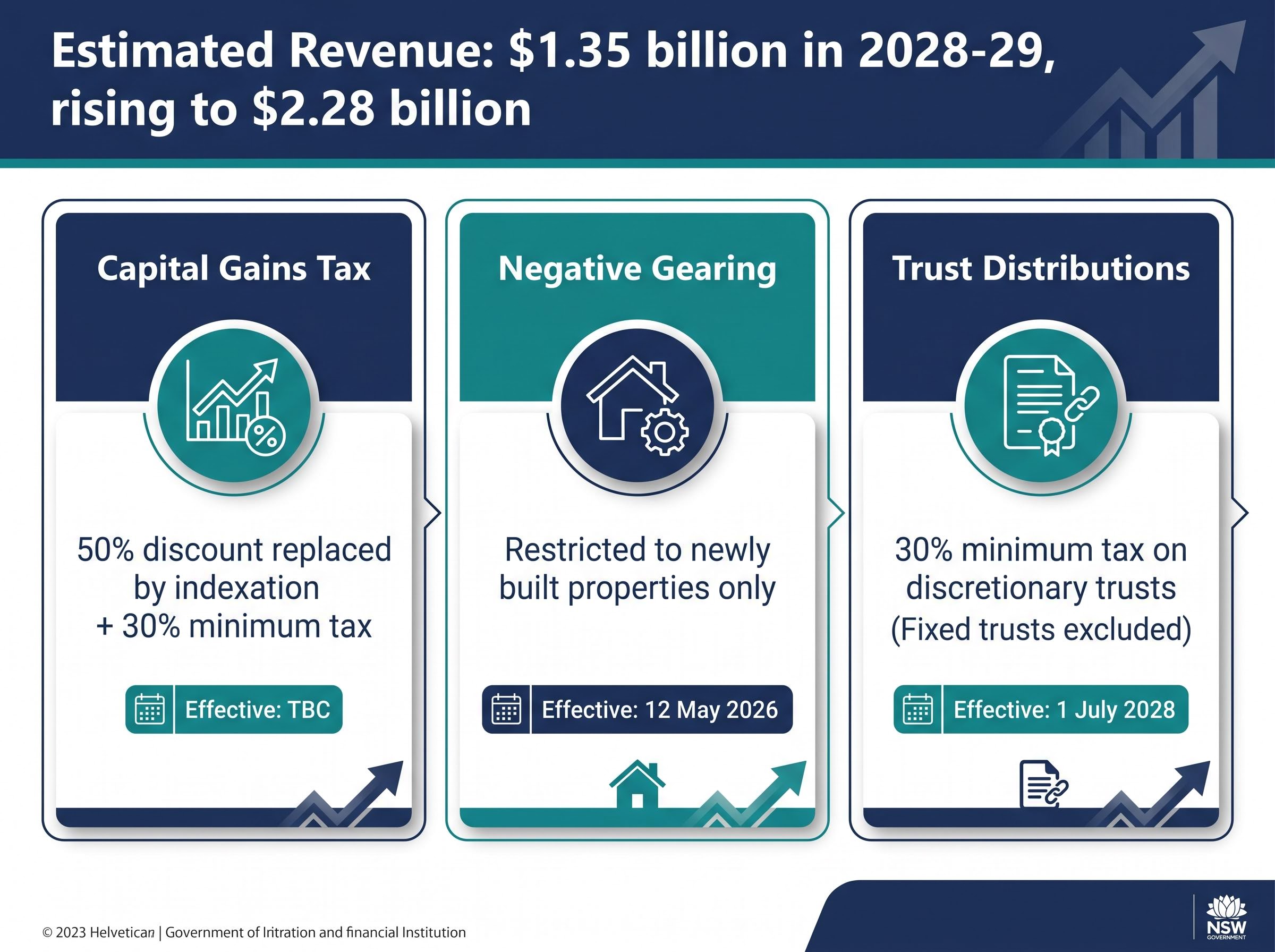
Capital gains tax: The longstanding 50% CGT discount for assets held longer than 12 months is replaced by an inflation-indexation-based discount plus a 30% minimum tax floor on capital gains. The effective date for the new regime has not yet been confirmed in the Budget papers.
Negative gearing: From Budget night itself (12 May 2026), negative gearing deductions on interest expenses are restricted to newly built properties only. Any purchase of existing residential property after that date is not eligible for deductions against other income.
Trust distributions: A 30% minimum tax applies to discretionary trust distributions from 1 July 2028. Fixed trusts are excluded.
The combined revenue estimate from the Budget papers is approximately $1.35 billion in 2028-29, rising to approximately $2.28 billion in subsequent years.
Budget Paper No. 1 Statement 4, published by the Australian Treasury on Budget night, sets out the full legislative rationale for the three reforms, framing them as measures to make the tax system fairer and more sustainable while redirecting capital toward more productive economic uses.
| Change | Effective date | Who is affected | Key uncertainty |
|---|---|---|---|
| CGT discount replaced with indexation + 30% minimum tax | TBC (no date confirmed in Budget papers) | All investors holding CGT assets | Transitional and grandfathering rules for existing assets not yet released |
| Negative gearing restricted to new builds | 12 May 2026 (Budget night) | Investors acquiring existing residential property | Precise definition of “new build” and treatment of existing loans pending |
| 30% minimum tax on discretionary trust distributions | 1 July 2028 | Discretionary trust beneficiaries | Trust structure scope and interaction with Division 7A unconfirmed |
What is still unconfirmed
Several details will determine precisely how these changes land in practice, and none has been released as of Budget night:
- Transitional and grandfathering rules for CGT on assets acquired before the new regime
- The precise definition of “new build” for negative gearing purposes
- Treatment of existing loans on pre-Budget residential properties
- The full scope of which trust structures are captured under the 30% minimum tax
- Interaction between the trust distribution rules and existing Division 7A obligations
Treasury exposure drafts and ATO guidance are the primary sources to monitor. Investors making significant decisions should wait for those releases rather than acting on the announcements alone.
When big ASX news breaks, our subscribers know first
Why the tax change hits harder than it looks: the compounding effect
A few percentage points of additional tax drag may appear modest in any single year. Compounded over a typical investment horizon, those percentage points translate into wealth differences measured in tens of thousands of dollars.
The impact is not uniform. Three illustrative 10-year scenarios show how differently the new rules bite depending on asset type and investor profile:
- ETF investor: A $100,000 portfolio held over 10 years faces an estimated after-tax wealth reduction of approximately $26,000 under the new settings
- Property investor: The same scenario applied to leveraged residential property produces an after-tax wealth decline of more than $50,000, reflecting the dual loss of negative gearing deductions and the higher effective CGT rate
- Business founder: Selling a $1 million company at the end of the period could result in a loss of more than $225,000 in after-tax proceeds compared with the prior regime
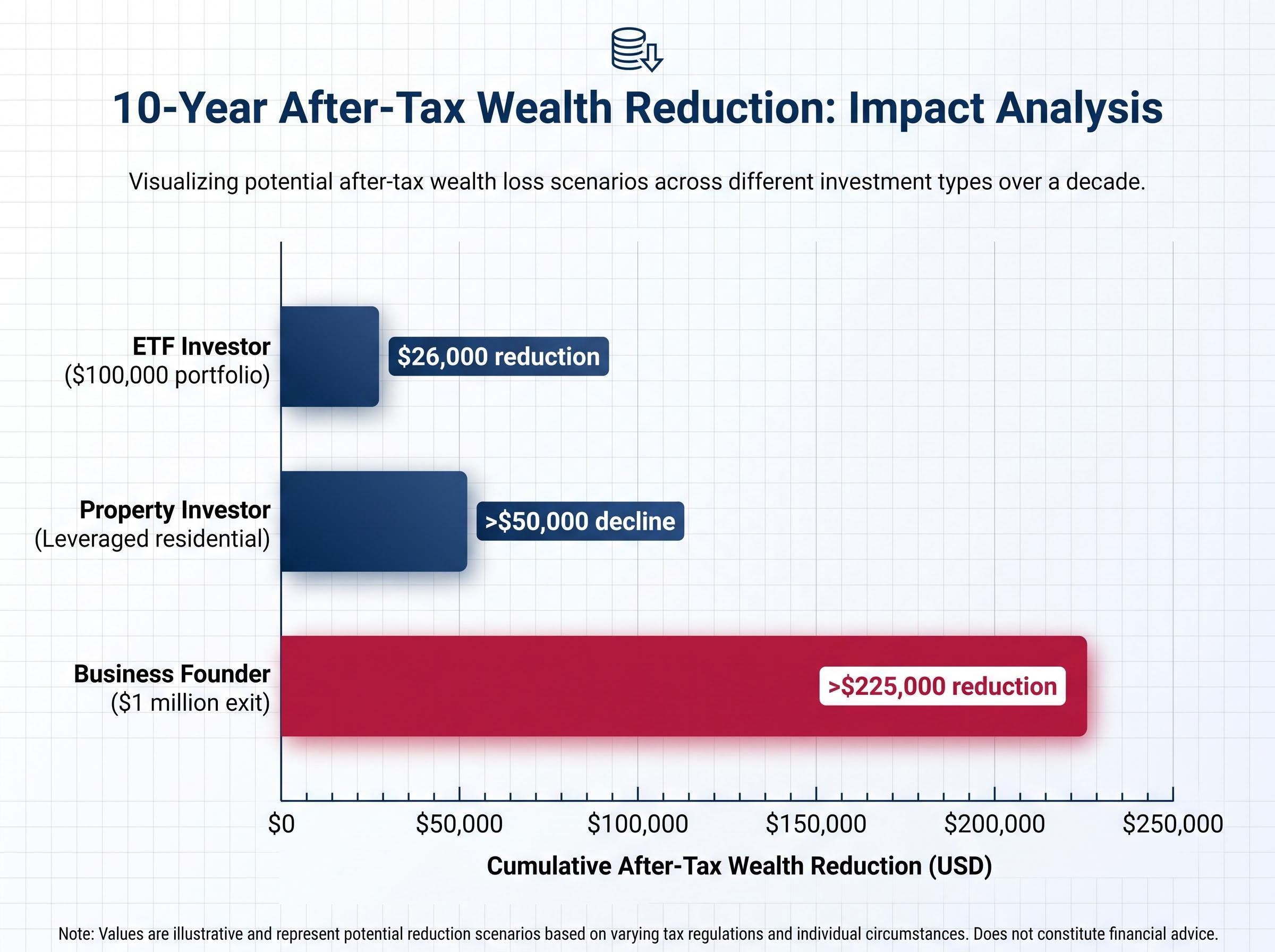
The business founder scenario is the starkest illustration of the new regime’s impact. A $225,000+ reduction in after-tax proceeds on a $1 million exit fundamentally alters the risk-reward calculation for entrepreneurial investment in Australia.
These projections show that the tax changes are not marginal. The revised framework effectively raises how much Australians must save to reach identical financial outcomes, and younger investors accumulating wealth outside superannuation are disproportionately exposed compared with older investors drawing on established super balances.
Investments that lose their tax-efficiency edge
Not every asset class is equally affected. The losses concentrate where the investment case relied on specific tax advantages that the Budget has now diminished or removed.
- Investment property (existing stock acquired post-Budget night): This category loses both pillars simultaneously. Negative gearing deductions are gone for new acquisitions, and the higher effective CGT rate on eventual sale reduces the back-end return. The dual removal strips the two mechanisms that made leveraged residential property one of the most tax-efficient asset classes in Australia.
- High-turnover active funds and unit trusts: Managed funds that trade frequently generate realised capital gains distributed to unit holders each year, regardless of whether the investor personally sold anything. Those distributions now hit the 30% minimum tax floor, amplifying tax drag even for passive holders of actively managed funds.
- Startups and venture investments: Extended hold periods combined with uncertain exits make venture returns almost entirely capital-appreciation-based. The CGT overhaul taxes that upside more heavily at the point of realisation, compressing the risk-adjusted return for early-stage investment.
- Gold and Bitcoin: The majority of return from these assets comes from price appreciation rather than income. With no income-side offset to absorb the tax increase, gold and crypto holdings are fully exposed to the CGT overhaul.
The lock-in effect: why higher CGT can freeze portfolios
A less visible consequence sits underneath the asset-specific analysis. Investors facing a larger CGT bill on disposal may hold underperforming or misallocated assets longer than is financially optimal, simply to defer the tax event.
This creates a tension between tax minimisation and sound investment decision-making. A portfolio frozen by tax-deferral logic can underperform a portfolio that accepts the tax cost and redeploys capital more effectively. The lock-in effect reduces capital mobility across the economy and, at the individual level, may quietly erode returns in ways that are harder to measure than the tax bill itself.
Investments positioned to benefit from the new settings
The same changes that diminish certain tax advantages create relative tailwinds elsewhere. The winning side of the ledger is specific and structural.
| Asset class | Why it benefits | Key consideration or limitation |
|---|---|---|
| Passive ETFs (e.g., VAS) | Low portfolio turnover generates fewer realised capital gains distributed to investors, reducing exposure to the 30% minimum tax floor | Underlying index rebalancing still creates some taxable events |
| Dividend-paying blue-chip equities | A higher proportion of total return arrives as franked income rather than capital gain, with franking credits offsetting personal tax | Dividend income still taxed at marginal rates; benefit depends on individual tax position |
| Inflation-linked bond ETFs (e.g., ILB on ASX) | Returns are income-dominated, and CPI-linked CGT indexation creates a natural portfolio hedge | Lower total return potential compared with equities |
| ASX-listed REITs | Provide property-sector exposure without the negative gearing restriction that applies to direct residential holdings | REIT distributions can include capital gains components; structure varies by trust |
| Superannuation | Concessional tax environment retained; accelerating contributions is widely recommended | Contribution caps apply; capital locked until preservation age |
| Owner-occupied housing | CGT exemption unchanged; relative advantage increases as other asset classes lose tax efficiency | Illiquid, concentrated, and not an investment strategy for all profiles |
The tax changes do not eliminate sound investment options for Australians. They shift relative advantages, and knowing which assets now carry a structural tax tailwind is the starting point for a coherent portfolio review.
Superannuation’s resilience under the 2026 Budget is not incidental: super’s tax wrapper advantage over identically invested portfolios held outside the system is projected to create a $230,000 wealth gap over 25 years for mid-career investors, a structural edge the Budget has left entirely intact.
How to think about your portfolio now without making reactive decisions
The instinct after a Budget of this magnitude is to act quickly. That instinct should be resisted selectively, not entirely. Some actions are already sensible given confirmed changes. Others should wait for legislative detail that does not yet exist.
A sequenced approach:
- Review superannuation contribution capacity. This does not require a CGT event, and the concessional tax advantage is already in place. Maximising contributions before any further rate changes is widely recommended as a near-term priority.
- Assess new residential property acquisitions against the new negative gearing rules. The restriction is already in effect from Budget night. Any acquisition of existing residential stock after 12 May 2026 should be evaluated on the assumption that deductions will not be available. New-build residential property remains the one category eligible for negative gearing.
- Flag discretionary trust structures for adviser review ahead of 2028. The 1 July 2028 effective date provides a meaningful planning window. Fixed trust or corporate structure alternatives may be appropriate for some investors, but urgency-driven restructuring is not warranted with two years of lead time.
- Await transitional CGT rules before major disposal decisions. Treasury exposure drafts have not been released. Selling assets to crystallise gains under the old regime before understanding the grandfathering rules risks being premature.
Salary sacrifice mechanics illustrate the immediate tax saving available before the broader legislative changes take effect: at the $120,000 income level, directing $15,000 into concessional contributions generates an estimated $4,800 tax saving in the current financial year, with the benefit scaling further at higher marginal rates.
Holding an asset purely to defer a CGT bill can be a more expensive mistake than paying the tax and redeploying capital more effectively. Optimising for tax alone, without regard to the underlying investment case, is its own financial risk.
This article is for informational purposes only and should not be considered financial advice. Investors should conduct their own research and consult with financial professionals before making investment decisions. Past performance does not guarantee future results. Financial projections are subject to market conditions and various risk factors.
Reform logic and its discontents: the economic trade-offs investors should understand
The government’s rationale for the package rests on a specific economic argument. Whether that argument holds is genuinely contested.
The government’s case:
- Reducing the tax bias toward leveraged investment in existing housing should redirect capital toward more productive economic uses
- Restricting negative gearing on existing stock is expected to apply modest downward pressure on speculative property demand
- The combined reforms are projected to raise approximately $1.35 billion in 2028-29, contributing to fiscal repair
The critics’ case:
- The CGT changes reduce after-tax returns not only on property but also on equity investing, venture capital, and business formation
- Australia already faces weak productivity growth and concentration in incumbent businesses; further reducing the after-tax reward for growth-oriented risk-taking may reinforce rather than reverse those trends
- Tax settings influence where founders establish businesses and where investors allocate long-term capital; Australia competes globally for both
- If investors adapt by holding assets longer or restructuring, the projected $1.35 billion in 2028-29 revenue may not be fully achieved
The tension at the centre of this reform is genuine: simultaneously promoting innovation and entrepreneurship while materially increasing the tax burden on the upside that incentivises such risk-taking is a contradiction the legislative process will need to resolve.
The investors best positioned under these reforms are those who understand the full policy logic, not just the immediate changes, because the reform trajectory and the political uncertainty around it are themselves portfolio risks to monitor.
Where Australian investors stand as the dust settles on Budget night
The 2026 Budget has created three distinct categories for investors to track: changes already in effect (the negative gearing restriction from Budget night), changes pending legislative confirmation (the CGT overhaul and the trust distribution minimum tax from 1 July 2028), and asset classes that now sit on different sides of the tax-efficiency ledger.
The winners-and-losers framework in this article is a starting point for a structured conversation with a financial adviser, not a basis for immediate portfolio decisions. Much depends on transitional rules, grandfathering provisions, and legislative detail that has not yet been released.
The legislative process from June 2026 onward, Treasury exposure drafts, and independent modelling from bodies such as the Parliamentary Budget Office and the Grattan Institute will provide the clarity investors need. Those are the sources worth monitoring, rather than reacting to coverage alone.
—