

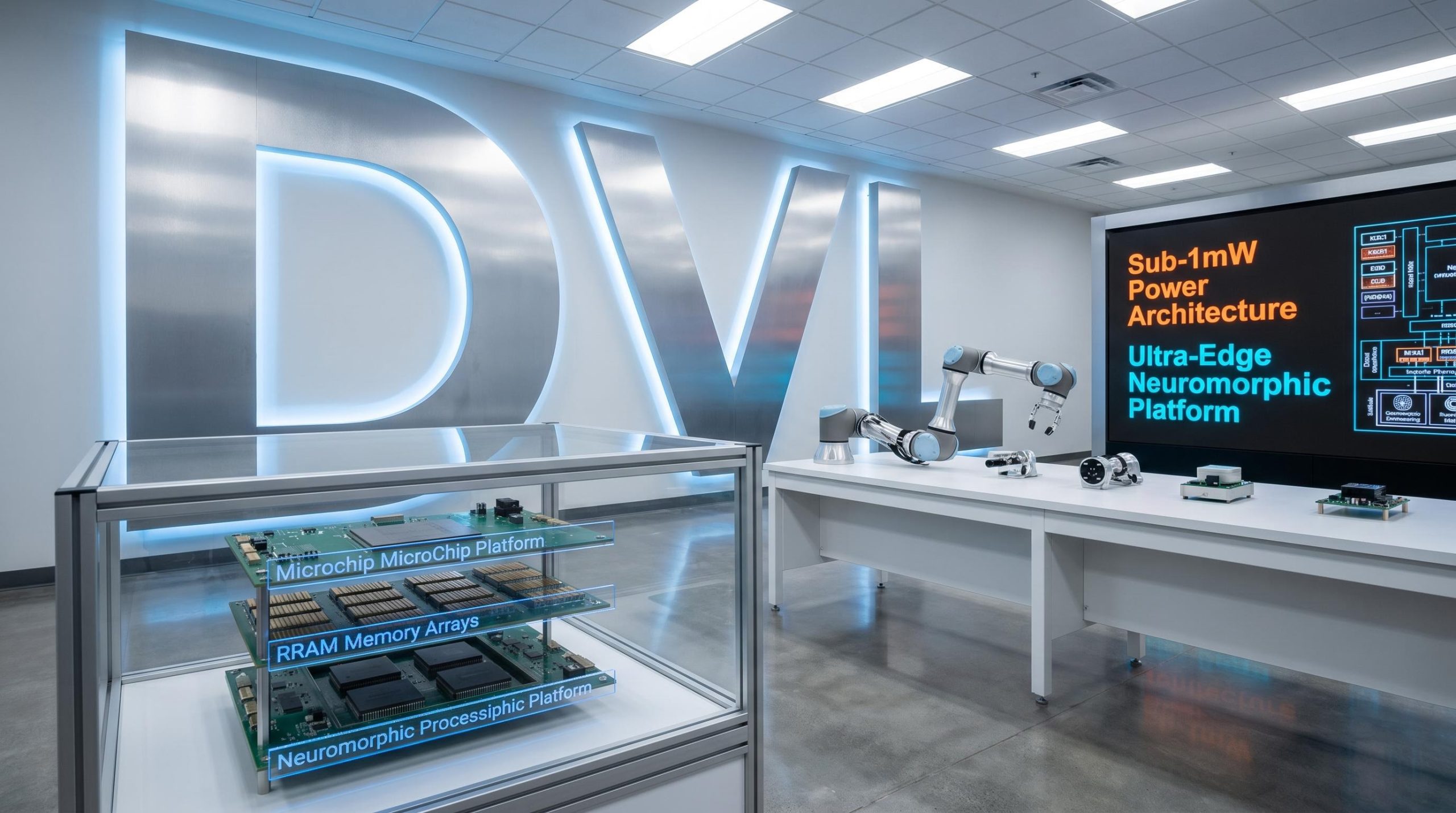
dorsaVi launches modular hardware platform programme to commercialise ultra-edge chip technology
dorsaVi Limited (ASX: DVL) has commenced its Ultra-Edge Modular Design and Build programme, the third workstream in its five-stage Execution Plan. The programme marks a strategic transition from technology development to the design of a manufacturable hardware platform, converting validated RRAM semiconductor and neuromorphic computing IP into a partner-ready product designed for licensing, embedding, or deployment across robotics, exoskeletons, autonomous systems, and industrial AI applications.
The modular architecture separates sensing, compute, and memory into distinct but interoperable layers, enabling flexible configuration across target applications including robotics, autonomous systems, exoskeletons, clinical wearables, and industrial IoT. The platform targets sub-1mW power consumption, the threshold required for coin-cell battery-operated autonomous devices.
Technical guidance from the company’s Technical Advisory Board, including Roger Peniche (former VP Engineering & Manufacturing at Omron Robotics), has directly shaped the hardware design priorities. This programme represents dorsaVi’s pivot from R&D phase to hardware commercialisation, a de-risking milestone for investors tracking the company’s technology-to-product journey.
When big ASX news breaks, our subscribers know first
What is ultra-edge computing and why does it matter for investors?
Ultra-edge computing refers to AI inference performed locally at the point of sensing, without cloud connectivity. Conventional edge AI devices consume excessive power and introduce latency that makes them unsuitable for safety-critical applications such as collaborative robotics, autonomous drones, and wearable devices.
The core innovation dorsaVi is developing centres on in-memory compute using RRAM technology, which eliminates the data bottleneck between memory and processor. Rather than shuttling data back and forth between separate memory and compute units (the traditional Von Neumann architecture), RRAM enables AI inference to occur directly within the memory array itself.
dorsaVi’s modular platform targets sub-1mW power budgets, a threshold that allows autonomous devices to operate on coin-cell batteries. This capability addresses a gap in high-growth markets including robotics, autonomous vehicles, and industrial IoT, where existing architectures cannot deliver local AI at sufficiently low power levels.
The investment thesis centres on dorsaVi’s position to deliver proprietary hardware that enables applications current architectures cannot support. Successful execution positions the company as a platform provider in markets where local AI inference at ultra-low power represents a capability gap.
Three-layer modular architecture separates sensing, compute, and memory
The Ultra-Edge Modular Design programme implements a three-layer architecture rather than a monolithic chip design. Each layer corresponds to a distinct function within dorsaVi’s “Sense → Decide → Act” framework and can be configured, upgraded, or licensed independently.
| Layer | Function | dorsaVi Implementation |
|---|---|---|
| Sensing | Data capture from the physical world | FDA-cleared and TGA-certified movement sensor hardware with 10+ years of field deployment across clinical, elite sports, defence, and occupational health environments |
| Compute | Real-time inference and decision-making | Neuromorphic processing architecture (the “reflex engine”) delivering brain-inspired parallel processing that adapts at the edge without cloud dependency |
| Memory | Persistent storage of model weights and states | RRAM technology developed with Nanyang Technological University Singapore (NTU) and ITRI enabling non-volatile storage of AI model parameters directly within the memory array |
The modular design philosophy delivers commercial flexibility. The same core architecture can be configured for different products (clinical wearables, industrial safety sensors, collaborative robotics platforms) without full redesign. Individual layers can be upgraded independently as the technology matures, preserving existing commercial relationships and integrations.
Modularity unlocks multiple commercial pathways. dorsaVi can license at the layer level, partner on specific applications, or sell integrated systems. This flexibility expands the addressable market and reduces single-product risk.
Sub-1mW power architecture targets coin-cell battery operation
The power architecture workstream addresses a fundamental constraint: conventional edge AI devices are designed around the assumption that computation and memory are separate, with data moving continuously between them. This assumption is embedded in voltage regulators, clock distribution networks, and memory refresh cycles.
dorsaVi is designing power management specifically optimised for in-memory compute, targeting operation within sub-1mW power budgets. The workstream encompasses:
- Voltage supply and regulation compatible with RRAM switching requirements
- Power gating for near-zero power states between inference events
- Energy harvesting compatibility for embedded industrial sensors and remote autonomous systems
Sub-1mW operation represents a hard technical threshold that conventional Von Neumann architectures cannot achieve whilst delivering meaningful AI inference capability. Reaching this target would differentiate dorsaVi’s hardware from competing edge solutions, enabling applications that require day-long battery life in compact form factors.
API integration layer designed to attract robotics and industrial partners
Alongside the hardware architecture, dorsaVi is assessing the design of an API layer that would provide a clean integration interface for external partners. The API would abstract the underlying RRAM and neuromorphic complexity, enabling robotics manufacturers, industrial automation integrators, autonomous systems developers, and medical device companies to embed dorsaVi’s ultra-edge capability into their own platforms without developing semiconductor expertise.
Mathew Regan, Group Chief Executive Officer
“The robotics and autonomous systems industry is seeking embeddable hardware capabilities that can be integrated into platforms already under development. Our approach is designed to support sub-millisecond local inference within highly constrained power environments, and to enable partners to incorporate this capability without needing to develop underlying semiconductor architecture themselves.”
The API layer positions dorsaVi as a platform provider rather than a component supplier. This is a higher-margin, higher-leverage business model that allows the company to participate in end-market value without building every application itself. Partner developers would access dorsaVi’s sensing, compute, and memory layers through a documented interface, integrating ultra-low-power local inference into their products without requiring deep expertise in RRAM physics or neuromorphic chip architecture.
Target markets represent combined opportunity exceeding US$500 billion by 2031
dorsaVi’s three primary target verticals represent substantial commercial opportunity. The company is not competing across entire markets, but targeting the ultra-low-power edge AI hardware layer where existing solutions fall short.
| Market | Projected Size | Key dorsaVi Capability |
|---|---|---|
| Autonomous vehicle systems | US$214 billion by 2030 | Sub-1mW inference, no cloud dependency, real-time edge decisions |
| Robotics | US$218 billion by 2031 | Sub-millisecond neuromorphic compute, safety-critical edge AI |
| Industrial IoT & Edge AI Hardware | US$68.7 billion by 2031 | Modular architecture, API-first integration, OEM licensing model |
Exoskeletons and rehabilitation robotics remain a priority vertical across the entire integrated platform. Even modest penetration of the edge AI hardware layer across these verticals represents substantial commercial opportunity for dorsaVi.
Validation pathway uses existing FDA-cleared sensor hardware
dorsaVi’s validation strategy centres on initially validating the modular architecture within its own FDA-cleared and TGA-certified sensor hardware. This approach de-risks the commercialisation pathway by generating real-world performance data in a regulated environment before approaching external partners.
The company’s sensor hardware has over a decade of deployment across clinical, elite sports, defence, and occupational health environments. Initial validation is planned within these existing regulatory-approved products.
Using existing certified hardware as the validation platform accelerates the path to commercial deployment. dorsaVi does not need to wait for external regulatory approvals before demonstrating real-world performance, a significant advantage in reducing time-to-market risk.
Technical Advisory Board shapes hardware design priorities
Roger Peniche, former VP Engineering & Manufacturing at Omron Robotics, has provided guidance on the hardware requirements of next-generation robotics and autonomous systems. The modular architecture’s design priorities have been directly shaped by industry requirements for:
- Collaborative robots: Sub-millisecond safety-critical decisions without cloud dependency in human environments where latency creates unacceptable risk
- Autonomous drones: Real-time navigation on milliwatt power budgets without GPS or connectivity
- Industrial automation: Continuous anomaly detection without cloud latency or bandwidth overhead
- Exoskeletons and prosthetics: Instantaneous response to human movement intent on day-long battery life in compact, wearable form factors
Industry-guided design reduces the risk of building technically impressive hardware that does not meet commercial requirements. dorsaVi is building to market specifications established by industry leaders, not laboratory ideals.
Ultra-Edge programme positions dorsaVi for transition to hardware platform provider
Successful completion of the Ultra-Edge Modular Design programme would represent a defining milestone in dorsaVi’s evolution: the transition from technology developer to hardware platform provider. The modular architecture means dorsaVi controls each layer independently and can license, partner, or commercialise each layer separately or in combination.
Mathew Regan, Group Chief Executive Officer
“The decision to build modularly was deliberate. A monolithic design may have accelerated early development, but it would have constrained us to a single configuration and commercial pathway. The modular architecture provides flexibility — to configure the platform for different applications, to upgrade individual layers as the technology evolves, and to partner at the layer level rather than only at the full-system level.”
The modular approach addresses a common failure mode in advanced technology development: the gap between impressive lab results and manufacturable products. By building around interoperable layers rather than a monolithic design, each layer can be tested and refined independently before full system integration. By validating the architecture in its own FDA-cleared sensor hardware first, dorsaVi generates real-world performance data in a regulated environment before approaching external partners. By developing the API layer in parallel with the hardware, the commercial interface is ready at the same time as the hardware.
The modular design also strengthens dorsaVi’s IP position. The company controls each layer of the stack (sensing, compute, and memory) independently, enabling flexible licensing and partnership structures depending on the specific requirements and commercial structure of each partner relationship.
Want the Next Biotech Hardware Platform in Your Inbox?
Join 20,000+ investors receiving FREE breaking ASX biotech news and analysis within minutes of release. StockWire X delivers real-time alerts on emerging technology plays like dorsaVi, complete with in-depth coverage the moment announcements hit the market. Click the “Free Alerts” button to stay ahead.