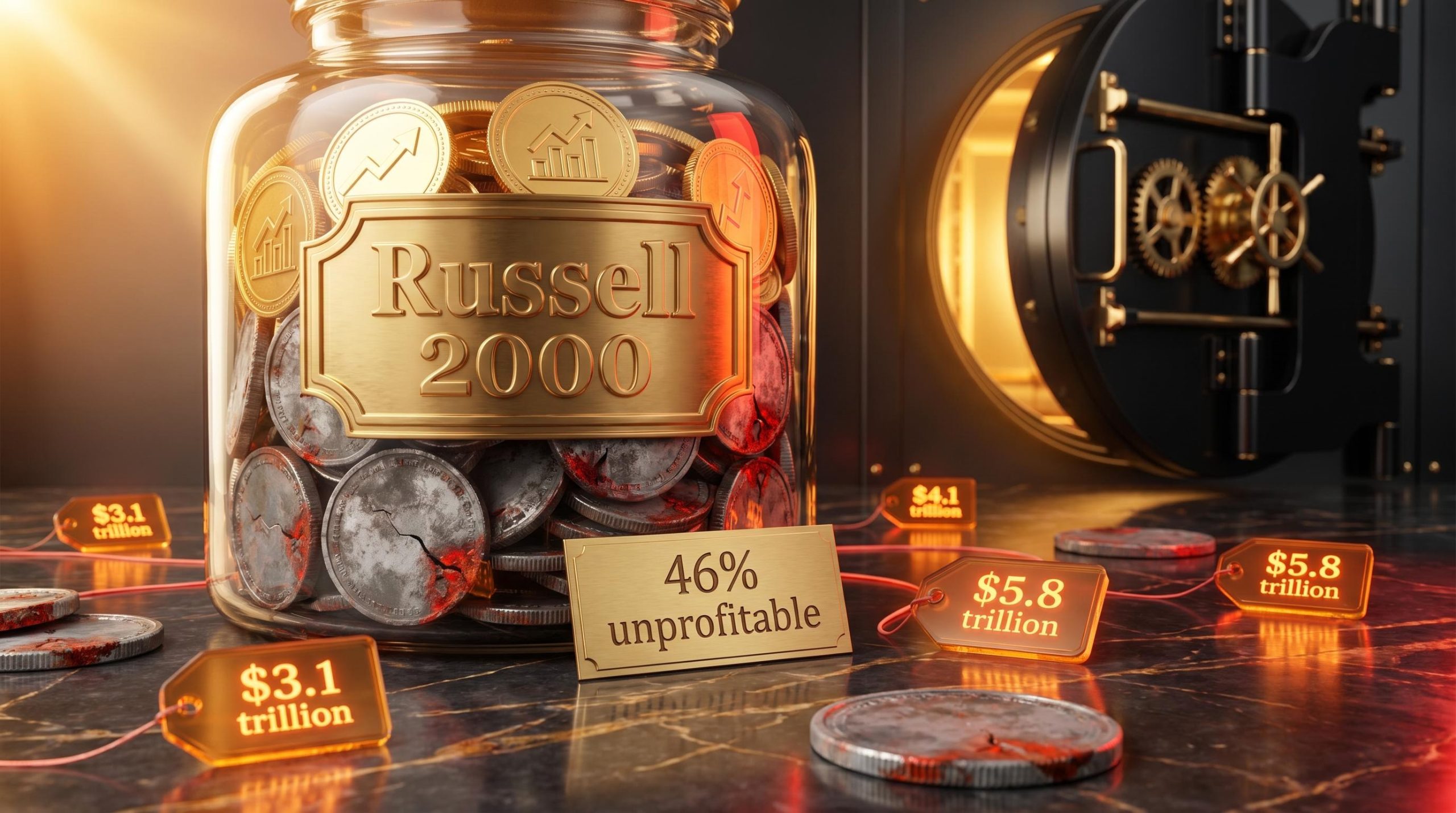
Nearly half of the companies in the Russell 2000 are currently unprofitable. Before the Global Financial Crisis, that figure sat closer to one in four. The deterioration is not subtle, and the explanation for it sits largely outside the public markets themselves.
Small cap stocks have underperformed large-cap equivalents across most major global markets for the better part of a decade, a duration that strains cyclical reasoning. The persistence of this gap, and the measurable decline in the quality profile of publicly listed small-cap companies, points toward a structural rather than temporary cause. Private capital markets, specifically venture capital and private equity, have grown large enough to reshape what remains in public small-cap indexes. This analysis explains the mechanism by which private markets drain quality from public small-cap universes, quantifies its scale using current data, and examines what the shift means for investors who rely on public small-cap exposure for growth.
The prolonged underperformance that demands a structural explanation
The underperformance is not confined to the United States, nor to a single economic cycle. The Morningstar Global ex-US Small Cap Target Market Exposure Index underperformed its large- and mid-cap equivalent by more than 1 annualised percentage point across the 10-year period ending 30 January 2026. The Russell 2000 has lagged the Russell 1000 by approximately 30% over the most recent three-year period, extending a trend of prolonged underperformance dating to 2014.
Across geographies, the pattern holds with few exceptions:
- UK small caps showed an even wider underperformance gap versus larger-cap UK equities than was observed in the US.
- Japanese small caps lagged in 2021, the year of Japan’s strongest economic growth in multiple decades.
- The ECB and Bank of England rate cuts in 2025 did not produce a corresponding boost for European small caps.
- Indian small caps significantly outpaced the broader Indian market over the past decade, and Australian small caps posted a marginal outperformance advantage.
The Indian and Australian exceptions are real, but they are exceptions. The dominant pattern across developed markets is persistent small-cap underperformance through conditions that historically should have reversed it.
Passive index concentration at the large-cap end of the market has accelerated over the same decade that small-cap quality has deteriorated, with five mega-cap stocks controlling approximately 23% of the broad US market index by mid-April 2026 and the cap-weighted S&P 500 outperforming its equal-weighted equivalent by more than 40 percentage points over three years, a gap driven entirely by valuation expansion rather than superior earnings growth.
Why the usual explanations do not hold
Rate sensitivity, economic cycle positioning, and sector composition explain portions of the gap but not its persistence. US small caps carry a meaningful technology underweight relative to the large-cap S&P 500, and that sector allocation has been a drag. Yet European small caps carry above-average technology exposure and still underperformed. The usual explanations account for quarters of relative weakness, not a decade of it.
When big ASX news breaks, our subscribers know first
Quality is measurably leaving the small-cap universe
The performance gap is not just a matter of price returns. The composition of what sits inside public small-cap indexes has changed materially.
Approximately 40%-46% of Russell 2000 companies are currently unprofitable, compared with approximately 27% before the Global Financial Crisis. The proportion of money-losing companies in the index has nearly doubled.

The quality deterioration carries a precise quantitative form. As of December 2025, US small-cap quality factor exposure measured approximately -0.64 per the Morningstar Risk Model, reflecting a significant negative quality tilt. Global ex-US small caps registered a more moderate reading of approximately -0.06, still negative but far less severe. Large-cap equities moved in the opposite direction on quality measures across most regions over the same decade.
| Segment | Quality Factor Exposure (Dec 2025) | Decade Direction |
|---|---|---|
| US Small Cap | -0.64 | Deteriorating |
| Global ex-US Small Cap | -0.06 | Modestly deteriorating |
| US Large Cap (reference) | Positive | Improving |
Research from AQR Capital, led by Cliff Asness and co-authors in their paper “Size Matters, If You Control Your Junk”, found that higher-quality small caps do outperform large caps. The broader small-cap premium, however, becomes questionable once quality is left uncontrolled. The composition of the index matters as much as its valuation.
How private markets work as a selective filter on public small-cap quality
The quality drain operates through two sides of the same mechanism. Understanding this filtering process is necessary before the scale of its effects can be measured.
- The entry filter (venture capital). High-growth companies that would historically have listed publicly at small-cap scale now remain private through successive funding rounds. Global PE/VC assets under management reached approximately $3.1 trillion by Q1 2024, according to Preqin, with projections to approximately $5.8 trillion by 2028. That capital base is large enough to finance companies from inception to mid-cap scale without requiring a public listing. The best growth companies simply never arrive in public small-cap indexes.
- The exit filter (private equity buyouts). PE firms acquire the highest-quality existing public small caps, taking them private. Quent Capital reported in August 2025 that PE buyouts of existing small caps are a documented driver of quality reduction in public indexes. Marquette Associates noted in May 2025 that PE deal value surged particularly in IT and healthcare growth sectors, where deal sizes now routinely overlap with small-cap market capitalisations.
Private capital deployment at this scale is not an abstraction: Blackstone alone reported $69 billion in Q1 2026 inflows, with technology and infrastructure identified as primary targets, illustrating how a single major PE platform can absorb capital at multiples of many small-cap companies’ entire market capitalisation.

The net result, as NEPC research documented, is that companies staying private longer via PE financing deprive public small-cap investors of the early-stage growth phase that historically drove small-cap outperformance. Regulatory compliance costs add an asymmetric burden on smaller public issuers, making the private route relatively more attractive for precisely the companies investors most want to own.
What “quality” means in the context of small-cap analysis
In this context, quality refers to profitability, balance sheet strength, and return on invested capital, the metrics used by factor models and institutional researchers. Quality is not the same as size or sector. A small company can be high quality; the issue is that fewer such companies are reaching or remaining in public small-cap indexes. The AQR finding reinforces why this matters: the small-cap premium holds when quality is controlled for, which means the composition of the index directly affects the return investors can expect from it.
AQR’s size and quality research, published on SSRN by Asness, Frazzini, Israel, Moskowitz, and Pedersen, established that the small-cap premium is statistically robust when controlling for quality, but effectively disappears when low-quality companies are included in the sample, making index composition a direct determinant of realised returns.
The unicorn market as a measure of what public investors cannot reach
The private market’s absorption of growth-stage companies is not abstract. It has a measurable form.
The aggregate valuation of global unicorns reached approximately $5.2 trillion as of the end of 2025, a pool of private enterprise value largely inaccessible through public small-cap indexes.
As of January 2026, PitchBook data showed approximately 1,591 global unicorns, with 853 based in the United States. The Morningstar PitchBook Global Unicorn Index tracks 1,461 private companies each valued above $1 billion, with 824 US-based.
Different tracking sources produce different counts, reflecting methodological variation rather than disagreement on direction:
- PitchBook: approximately 1,591 global unicorns as of January 2026
- CB Insights: over 1,300 as of March 2026
- Eqvista: over 1,735 as of April 2026
The consistent picture across all three is one of scale and growth. The population expanded from approximately 1,200 unicorns in 2022 to roughly 1,591 in early 2026. Many of these companies operate at valuations that would classify them as small or mid cap if publicly listed. They represent precisely the growth exposure that public small-cap indexes can no longer deliver.
What this structural shift means for the small-cap premium and investor strategy
The small-cap premium, the historical return advantage that justified the volatility and illiquidity of smaller companies, may have been partly a quality-of-pipeline premium. If the pipeline has changed structurally, the premium case needs to be reconstructed rather than assumed.
| Dimension | Small-Cap Bull Case | Structural Concern |
|---|---|---|
| Valuation | Historically cheap relative to large caps; Morningstar assesses upside potential as of early 2026 | Cheapness may partly reflect lower quality, not just neglect |
| Growth Capture | Small caps remain an entry point to emerging sectors | PE/VC absorbs the highest-growth companies before or after listing |
| Forward Returns | European small caps show an even wider valuation gap than US | PE/VC projected to deliver approximately 13.5% annualised returns over 2025-2035; public equity projections are more modest |
Morningstar Investment Management assessed US small caps as historically undervalued relative to large caps as of early 2026, with upside potential even after outperforming in January 2026. European small caps were assessed as having an even wider valuation gap versus European large caps. The valuation argument is real.
The small-cap rotation case in early 2026 is being driven by valuation, with the Russell 2000 trading at roughly 18x earnings versus 22x for the S&P 500, and institutional fund flows shifting from approximately 8% of equity inflows in 2025 to approximately 25% in 2026; the valuation argument is real, but it is a separate question from whether the structural quality composition of the index has improved.
But private markets captured approximately 50% of global value creation in alternatives by 2025. As Marquette Associates framed it, this may fundamentally alter “where value creation occurs,” not merely the cyclical balance between asset classes.
Active management and private market access as adaptive responses
The quality drain strengthens the case for active management within public small caps. Stock selection can filter for the profitability and balance sheet strength that passive indexes no longer guarantee. Access to private markets through PE fund vehicles, interval funds, or secondaries has become a strategic question for investors seeking the growth exposure that small caps historically provided, though accessibility remains constrained for most retail investors.
For investors wanting to implement the active quality tilt that the structural shift in small caps now demands, our dedicated guide to quality factor investing covers the specific return on equity, leverage, and earnings stability screens that define the quality factor, with analysis of how quality-tilted ETF vehicles have performed relative to broad cap-weighted indexes across recent market cycles.
A structural recalibration, not a cyclical wait
The mechanism is now large enough to sustain itself. Private capital can finance quality companies from inception to mid-cap scale without requiring public listings. PE buyouts complete the drain by removing the best existing public small caps. The result is a public small-cap universe that is compositionally different from what it was a decade ago, carrying nearly twice the rate of unprofitable companies and a measurably negative quality tilt.
The valuation opportunity in public small caps is real and may produce periods of outperformance. Morningstar data supports the view that small caps are historically cheap. But the structural quality shift will persist regardless of macro conditions, rate cycles, or economic recoveries. Waiting for the right moment to buy broad small-cap index exposure is a response to a cyclical problem. The problem is not purely cyclical.
Marquette Associates: This dynamic may fundamentally alter “where value creation occurs,” representing a structural shift rather than a cyclical one.
Investors who treat public small-cap indexes as equivalent to the small-cap opportunity of a decade ago are working from an outdated map. The territory has changed. The response is not to abandon the asset class but to recognise that passive small-cap exposure now carries a quality discount that did not exist to the same degree before, and to adapt accordingly.
This article is for informational purposes only and should not be considered financial advice. Investors should conduct their own research and consult with financial professionals before making investment decisions. Past performance does not guarantee future results. Financial projections are subject to market conditions and various risk factors.