A Morgan Stanley survey of 60 Chinese chief information officers, published 4 May 2026, shows Alibaba’s share of enterprise AI deployment preference jumping 9 percentage points in a single survey cycle. The AlphaWise 1H26 China CIO Survey, conducted across March and April 2026, captures enterprise decision-making at a moment when Chinese technology spending is being squeezed by geopolitical headwinds, deflationary pressure, and a rapidly shifting vendor race. Overall IT budget growth has collapsed to 4.8%, a six-year low, yet AI’s share of those budgets has nearly doubled. The survey offers the most granular read available on where enterprise AI spending is actually flowing inside China, and the findings carry direct implications for investors tracking Alibaba, ByteDance, and the sharp reversal in DeepSeek’s enterprise momentum.
Alibaba jumps to 41% CIO preference as enterprise AI deployments consolidate
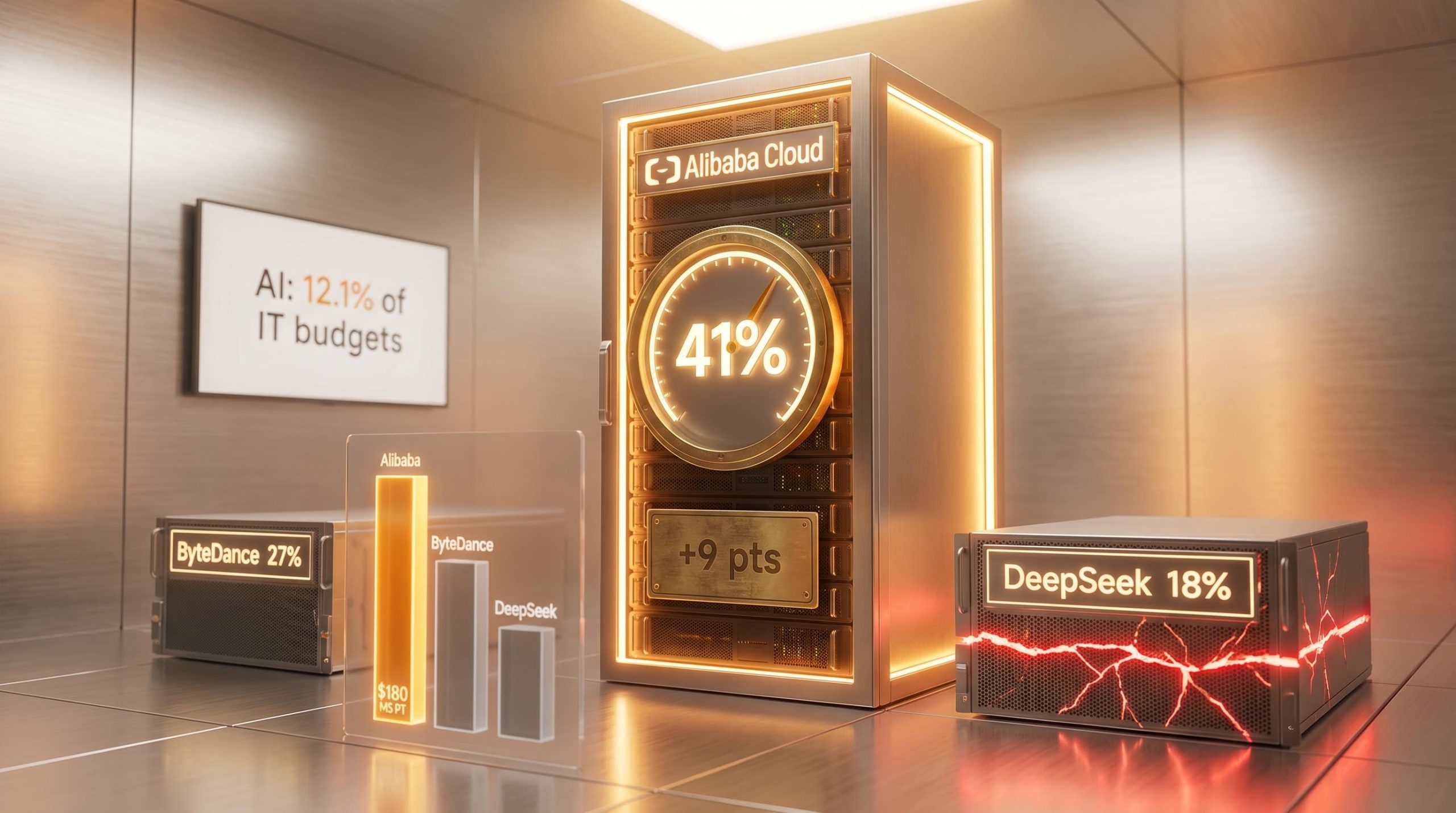
The headline finding is stark. Alibaba now commands a 41% CIO selection rate for enterprise AI deployment, up from 32% in the prior survey period, according to the Morgan Stanley AlphaWise 1H26 China CIO Survey led by analyst Yang Liu.
41% of surveyed CIOs selected Alibaba as their preferred enterprise AI deployment partner, a 9-percentage-point rise in a single survey cycle, per the Morgan Stanley AlphaWise 1H26 China CIO Survey.
What makes that number more significant is the competitive context around it. 30% of respondents expect Alibaba to capture the largest share of incremental AI spending in FY2026, placing it first in the forward-looking category. The top three vendors collectively account for 86% of CIO survey preferences, meaning enterprise AI spending in China is not fragmenting across a broad market. It is consolidating around a short list:
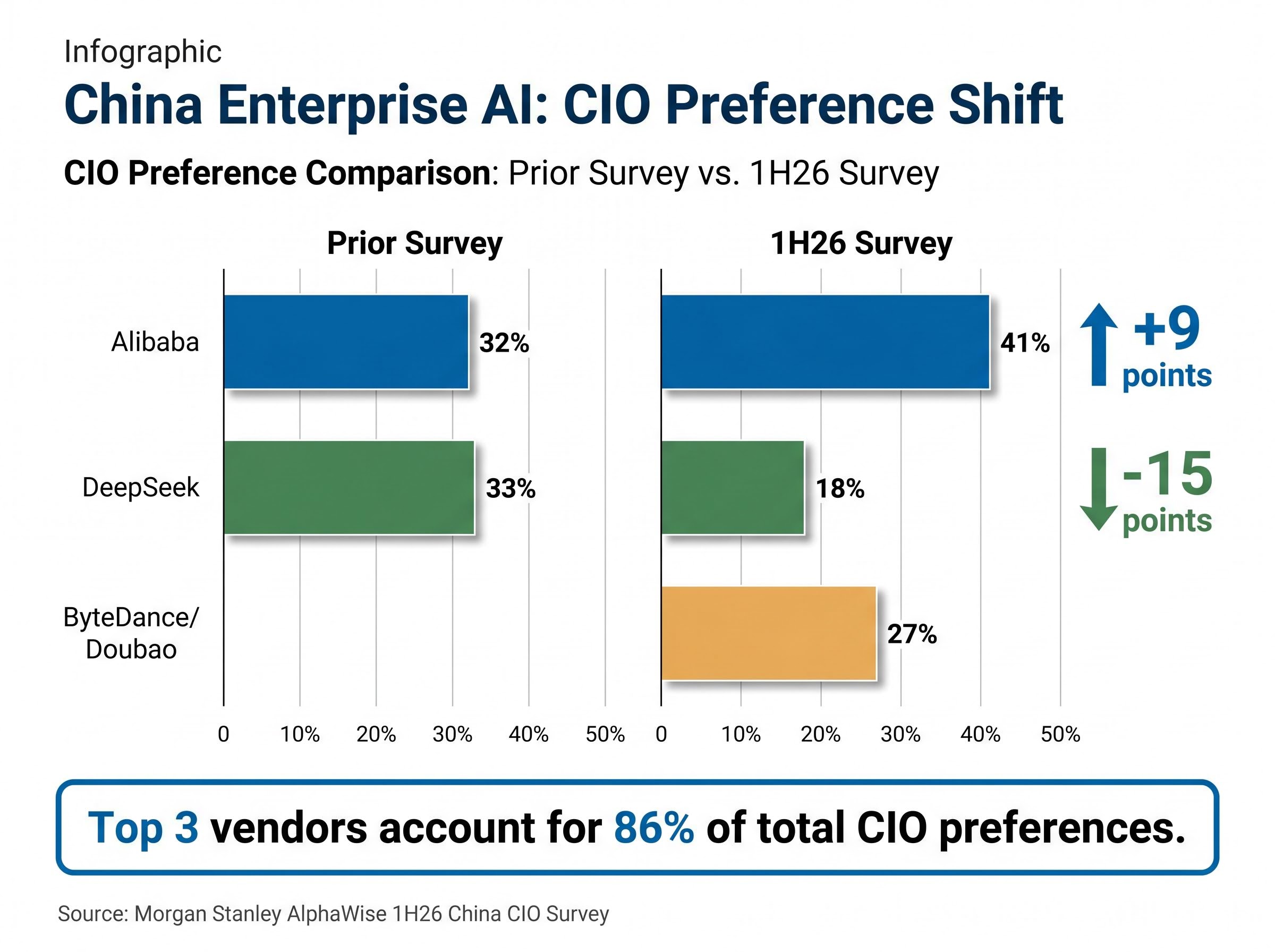
- Alibaba: 41% CIO preference
- ByteDance/Doubao: 27%
- DeepSeek: 18%
For investors tracking BABA or 9988.HK, the directional shift in CIO preference is a leading indicator for cloud revenue trajectory. Concentration at the top is accelerating, and Alibaba is widening its lead within that narrowing field.
When big ASX news breaks, our subscribers know first
What is driving Alibaba’s enterprise AI advantage
A 9-point preference swing in a single survey cycle raises an obvious question: is this a durable structural lead or a snapshot that could reverse just as quickly?
The answer sits in Alibaba’s full-stack positioning. The company operates cloud infrastructure through its Cloud Intelligence Group, develops foundational models through the Qwen series, and deploys end-user applications across its commercial ecosystem. That vertical integration gives enterprise buyers a single vendor for compute, model access, and deployment, reducing the friction that slows adoption when CIOs must stitch together components from multiple providers.
Qwen model momentum and open-source reach
Alibaba has maintained an aggressive release cadence across the Qwen model family:
- Qwen3.5 (February 2026): expanded enterprise applicability for complex task performance
- Qwen3.6-Plus (April 2026): targeted specifically at agentic AI enterprise deployment
Cumulative downloads exceeded 700 million by January 2026, spanning 29 or more languages. The open-source and multilingual strategy has been a driver of both domestic and international enterprise adoption, giving Qwen a distribution footprint that proprietary-only competitors cannot easily replicate.
Cloud revenue as corroborating evidence
The CIO survey data does not exist in isolation. Alibaba’s Cloud Intelligence Group reported revenue growth of approximately 35% year-over-year in Q3 FY2026 and approximately 36% in Q4 FY2026. That acceleration aligns directly with the rising enterprise preference captured in the survey.
Morgan Stanley has maintained its $180 price target on BABA through April 2026, with Alibaba designated a top pick. The alignment between survey data and actual cloud revenue growth gives the preference findings independent validation.
ByteDance builds infrastructure scale while trailing on enterprise preference
ByteDance holds a strong second-place position at 27% CIO spending preference for its Doubao platform. The number commands respect in a market where three vendors hold 86% of preferences.
Yet preference share and spending scale are telling two different stories. ByteDance plans to spend $23 billion (approximately 160 billion yuan) on AI in 2026, up approximately 7% year-over-year, with roughly half allocated to chip procurement. The company has secured 500MW of Vnet data centre capacity dedicated to the Doubao buildout.
Doubao 2.0 launched in February 2026 with agentic AI capabilities at competitive low-cost positioning. The platform has surpassed 100 million daily active users and processes more than 50 trillion tokens daily.
| Provider | CIO Preference (1H26) | Prior Period Preference | Key 2026 Development |
|---|---|---|---|
| Alibaba | 41% | 32% | Qwen3.6-Plus, 35-36% cloud growth, $180 MS price target maintained |
| ByteDance/Doubao | 27% | Not specified | $23B AI spend, Doubao 2.0 launch, 100M+ DAU |
| DeepSeek | 18% | 33% | V4 underperformance, chip constraints, geopolitical restrictions |
ByteDance’s infrastructure commitments signal it is playing a long game, even from second place. Investors tracking the Chinese AI sector should treat it as a structural competitor to Alibaba rather than a near-term challenger to the top position.
ByteDance’s $23 billion infrastructure commitment sits within a broader global AI capex trajectory where Amazon, Microsoft, Alphabet, and Meta collectively spent $130 billion in Q1 2026 alone, with full-year combined guidance reaching approximately $725 billion — context that helps investors calibrate whether ByteDance’s commitment is aggressive or modest relative to global peers.
DeepSeek’s enterprise collapse and what undid a breakout story
DeepSeek’s CIO preference fell from 33% to 18% between survey periods, a 15-percentage-point single-cycle decline that ranks among the sharpest reversals the AlphaWise series has recorded.
The Morgan Stanley team characterised DeepSeek as a low-profile research organisation with longer intervals between model releases, a profile that left it exposed when competitors accelerated.
Morgan Stanley described DeepSeek as maintaining a “low-visibility, research-oriented approach” with slower model release cadence, contrasting sharply with the aggressive deployment timelines of Alibaba and ByteDance.
Four compounding factors explain the decline:
- Model release cadence: Longer gaps between releases allowed competitors to capture enterprise attention
- V4 model underperformance: The V4 model failed to meet enterprise buyer expectations or move benchmark comparisons
- Chip constraints: Reliance on Huawei chips following U.S. export controls on Nvidia and other suppliers introduced performance and supply limitations
- Geopolitical restrictions: Founders face constraints on leaving China, limiting international partnership and expansion activity
For investors, the reversal clarifies that DeepSeek’s early 2025 breakout reflected a moment of market novelty rather than a durable platform position. Enterprise AI momentum can erode rapidly when model velocity slows and hardware access is constrained.
AI spending rises to 12% of IT budgets as overall growth hits a survey-era low
The budget environment framing these competitive shifts contains a paradox that matters more than any single vendor’s preference share.
Overall Chinese IT budget growth is projected at 4.8% for 2026, down from 12.6% in the prior survey period. This is the weakest figure in the AlphaWise survey’s history, which dates to 2020.
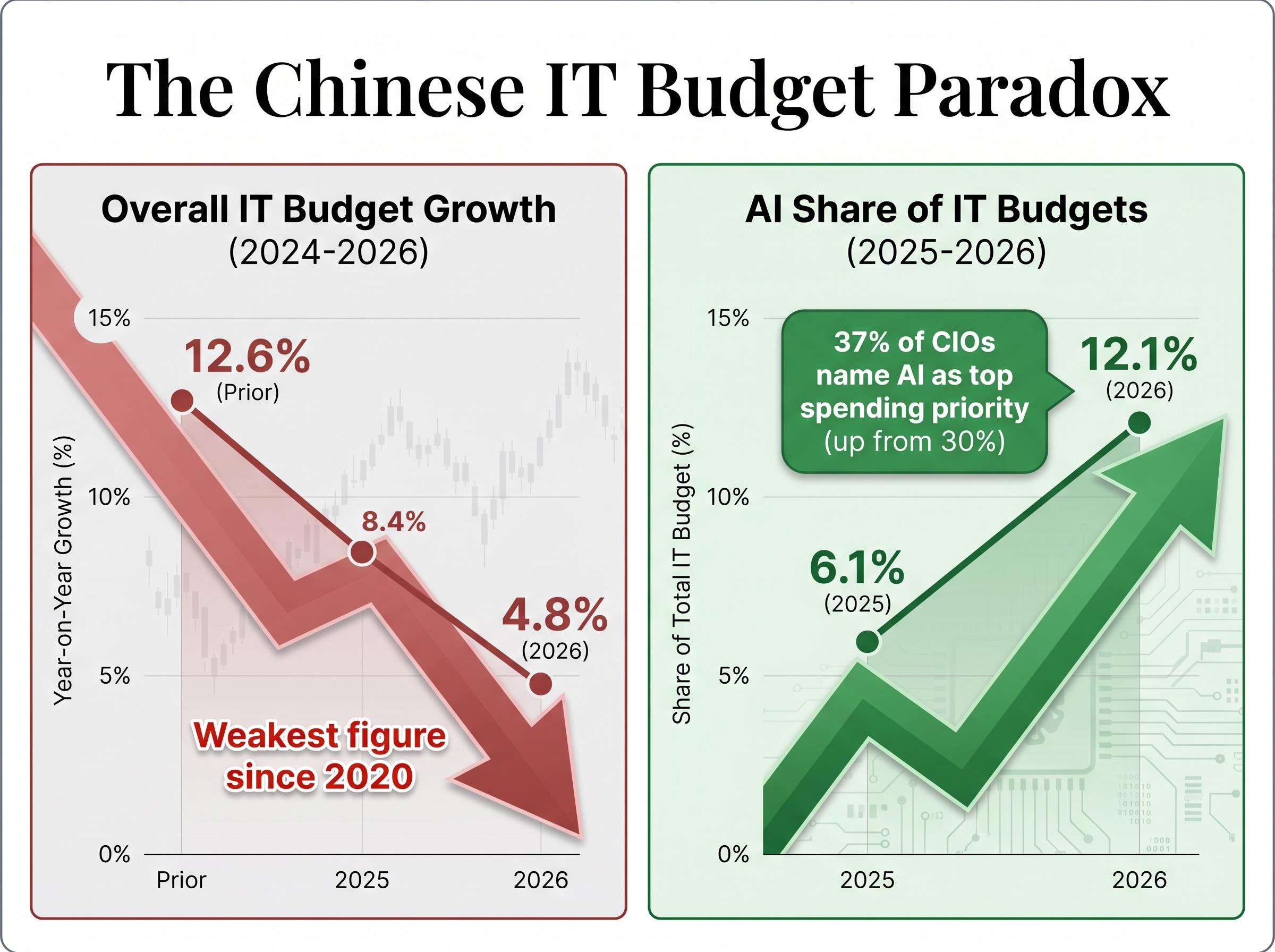
CIOs are cutting total spending growth to record lows while simultaneously doubling AI’s share of what remains. AI’s allocation has risen from 6.1% of IT budgets in 2025 to a projected 12.1% in 2026. Some 37% of CIOs now name AI as their top spending priority, up from 30%.
Three categories of headwinds are compressing overall budgets:
- Geopolitical tensions, including the U.S.-Iran escalation from late February 2026 and ongoing U.S.-China technology restrictions
- Deflationary conditions in parts of the Chinese domestic economy
- Rapid technology change that makes long-term IT planning difficult
The structural implications extend beyond a single budget cycle. 47% of CIOs are targeting 2027 for initial AI project rollouts, suggesting the current preference data is a leading indicator for spending that has not yet fully materialised. The share of AI funding drawn from software budgets has risen to 22% from 10%, creating direct pressure on traditional enterprise software vendors.
AI budget reallocation away from traditional software is not a China-specific phenomenon: autonomous AI agents are dismantling per-seat SaaS models globally, and the US enterprise software sector lost more than $1 trillion in market capitalisation in early 2026 as institutional capital rotated toward AI-native infrastructure — the same structural shift that Chinese CIOs are now executing at the budget level.
- More than 50 trillion tokens are processed daily across leading Chinese AI platforms
- More than half of surveyed CIOs expect cloud pricing to increase in the next 12 months
This tells investors more about urgency than abundance. AI is not growing because budgets are expanding. It is growing because CIOs are redirecting constrained resources toward the category they view as most pressing.
Alibaba’s AI lead is real, but the runway still has geopolitical turbulence ahead
The survey validates three structural advantages that position Alibaba heading into the second half of 2026:
- Cloud infrastructure scale through the Cloud Intelligence Group, with consecutive quarters of 35-36% revenue growth
- Qwen model momentum, with 700 million cumulative downloads and an aggressive open-source release cadence
- CIO preference lead at 41%, widening rather than narrowing against competitors
The unresolved variable is hardware supply. U.S. chip export controls constrain compute scaling for all Chinese cloud providers, not just DeepSeek. Alibaba’s infrastructure advantages do not exempt it from this systemic risk.
Hardware supply chain vulnerabilities affecting cloud profitability extend beyond Chinese providers: hyperscalers globally are committing hundreds of billions in FY2026 infrastructure capex while escalating inference costs compress the profitability of the AI applications that capex is meant to support — a tension that shapes how quickly any cloud provider can convert infrastructure investment into sustained earnings growth.
- Risk factor: chip export restrictions remain a binding constraint on how fast any Chinese AI provider can scale compute capacity
The BIS revised licensing policy for semiconductor exports to China, effective January 2026, shifted advanced AI chips including the Nvidia H200 to a case-by-case review framework — codifying the supply constraint that now limits compute scaling for every Chinese cloud provider competing in enterprise AI.
A majority of surveyed CIOs expect public cloud adoption to accelerate over the next three years, and more than half anticipate upward cloud pricing pressure, creating a revenue tailwind for Alibaba’s platform even within constrained budgets. AI’s rising share of IT spending, projected at 12.1%, reinforces structural demand.
Morgan Stanley’s $180 price target and top-pick designation reflect this reading: a constructive case grounded in platform scale, with hardware supply as the variable that could govern how quickly that scale translates into sustained earnings growth.
Investors wanting to situate Alibaba within the broader Asian technology equity landscape will find our full explainer on AI boom dynamics across Asian tech, which examines how hyperscaler capex is flowing to Korean and Taiwanese chipmakers trading at roughly half the valuation multiple of their US peers, alongside the earnings validation from Samsung, SK Hynix, and TSMC that underpins the regional investment thesis.
This article is for informational purposes only and should not be considered financial advice. Investors should conduct their own research and consult with financial professionals before making investment decisions. Forward-looking statements, including analyst price targets and spending projections, are subject to change based on market developments and company performance.