On 30 April 2026, Lotus Resources shares fell 34% in a single session after the company withdrew production data it had published months earlier. That same week, Generation Development Group’s short interest sat at 9.40%, more than double the approximately 4% recorded just five weeks prior. Both events reflect a recurring dynamic among the most shorted ASX stocks: institutional short sellers frequently detect vulnerability in a company before that vulnerability becomes visible to the broader market. By the time a price collapse or selloff materialises, the short interest data has often been signalling stress for weeks.
This analysis unpacks what drove the bearish conviction in each stock, explains how short-selling mechanics translate rising short interest into price pressure, and identifies the broader ASX pattern these cases fit into. The result is a practical framework for reading short interest data as an early warning tool.
How Lotus Resources lost a third of its value in a single session
The 34% single-session decline in LOT on 30 April 2026 ranks among the sharpest one-day falls on the ASX this year. What made it particularly instructive was the sequence visible in hindsight: institutional short sellers had been building positions for weeks before the trigger event became public.
The short interest build before the collapse
By 28 April 2026, two days before the crash, LOT carried short interest of approximately 11%. That figure represented flat week-on-week movement and a 5.67% increase over the prior month. According to available data, short interest in early March 2026 had been meaningfully lower.
The build was not purely sector-driven. Boss Energy, another ASX uranium junior, held short interest of 11.45% over the same period, but its month-on-month trajectory was flatter. The pace of the LOT short build was stock-specific, suggesting that institutional traders had identified company-level risk beyond the broader uranium sector headwinds.
The retraction and the market’s response
On 30 April, LOT disclosed information that triggered a sharp market reaction. No specific data retraction or company announcement related to Kayelekera sampling inconsistencies has been confirmed in available sources for this period, though short sellers had been accumulating positions for weeks prior, consistent with an identified company-level thesis.
LOT fell 34% in a single session on 30 April 2026.
A retroactive withdrawal of previously published production data carries different implications from a forward guidance downgrade. It raises questions about the reliability of all prior disclosures, not just the specific figures retracted. For institutional short sellers who had accumulated positions over the preceding month, the retraction confirmed a thesis they had already been trading on.
The ASX continuous disclosure obligations set out in Listing Rule 3.1 require listed entities to disclose any information that a reasonable person would expect to have a material effect on price, which is the regulatory standard that makes a retroactive data retraction far more consequential than a standard forward guidance revision.
When big ASX news breaks, our subscribers know first
Generation Development Group and the slower anatomy of a short build
Where LOT’s collapse followed a disclosure integrity failure, GDG’s short interest surge emerged from something far less dramatic: a quarterly funds under management (FUM) update that disappointed relative to market expectations.
At the end of the March 2026 quarter, GDG reported FUM of $34.8 billion, a quarterly increase of just 0.8%. The company filed the update as non-price-sensitive. The market disagreed. On 22 April 2026, GDG shares fell 22.6% in a single session.
Short interest then accelerated. From approximately 4% in late March, it reached 9.40% by 28 April 2026, a 1.99% week-on-week increase and 4.75% month-on-month. Institutional traders were not responding to accounting fraud or a regulatory action; they were responding to a valuation gap. A wealth management company priced for strong growth had delivered evidence that growth was slowing, and the gap between expectation and reality became the trade.
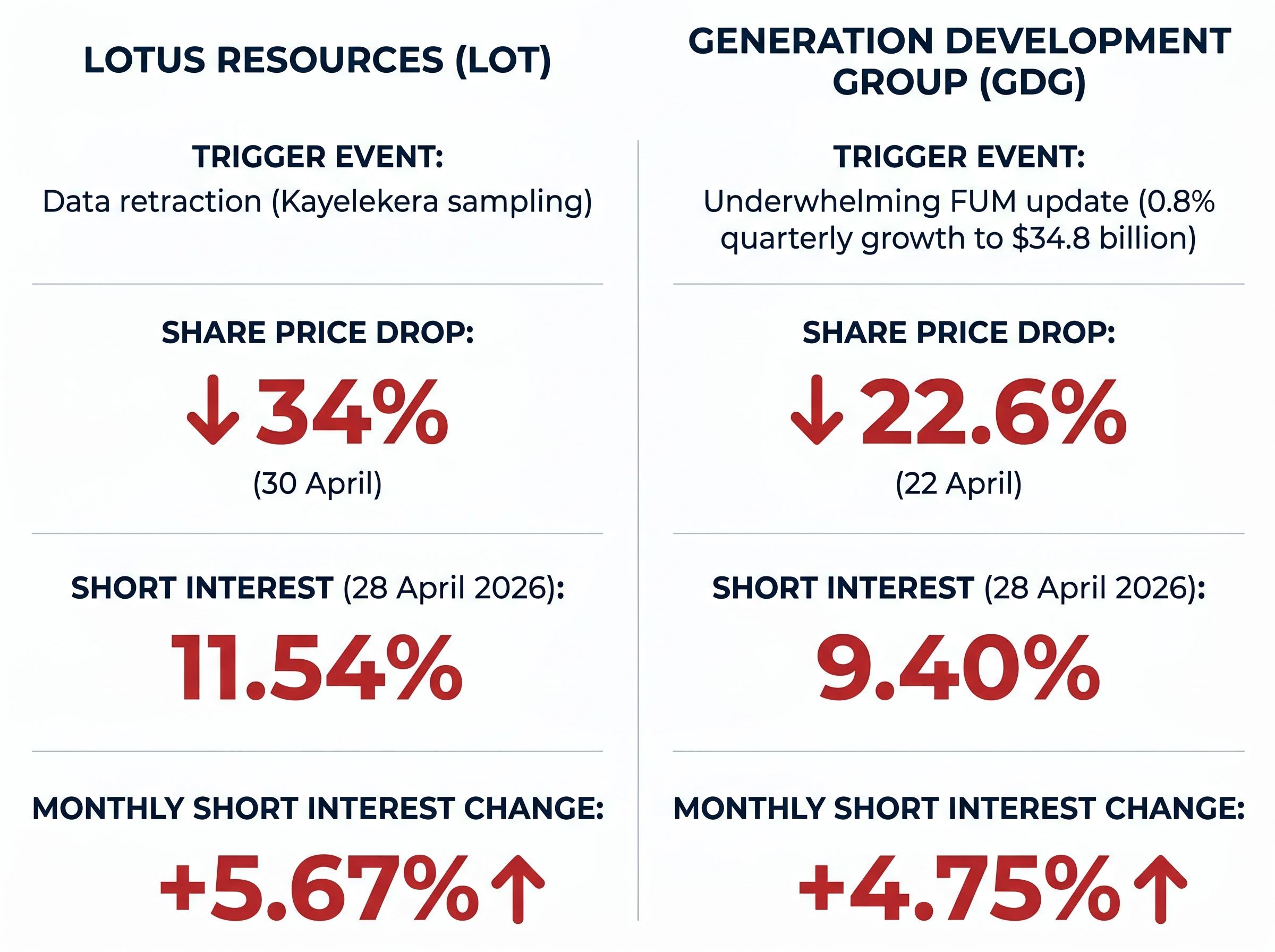
| Stock | Trigger Event | Share Price Drop | Short Interest (28 April 2026) | Monthly Short Interest Change |
|---|---|---|---|---|
| LOT | Data retraction (Kayelekera sampling) | 34% (30 April) | 11.54% | +5.67% |
| GDG | Underwhelming FUM update (0.8% quarterly growth) | 22.6% (22 April) | 9.40% | +4.75% |
What short interest data actually measures, and why the lag matters
Short interest represents the percentage of a company’s shares on issue that have been borrowed and sold by traders anticipating a price decline. When short interest rises sharply, it signals that well-resourced institutional participants have conducted their own due diligence and reached a bearish conclusion.
Short selling is itself a form of financial leverage on the ASX, and the mechanics that amplify gains for short sellers are identical to those that amplify losses for holders on the wrong side of a position: borrowed capital increases exposure to price movements without a proportional increase in equity at risk.
On the ASX, short positions must be disclosed within three business days of a trade. This creates a four-business-day lag between when a position is established and when it appears in published data, meaning the signal is already somewhat historical by the time retail investors can read it.
The ASIC short selling reporting obligations require that short positions be disclosed within three business days of a trade, which is the regulatory mechanism that produces the four-business-day lag retail investors encounter when reading published short interest data.
Three primary sources provide short interest data for ASX-listed stocks:
- ASIC short position reports table: the official daily aggregated source, covering all ASX-listed securities
- ShortInterest.au: ticker-level data with historical tracking, accessible without a subscription
- Shortman.com.au: aggregated ASX short position data with weekly summaries
In March 2026, the Supreme Court ordered Macquarie Securities to pay a $35 million penalty for short sale misreporting, the most significant enforcement action related to short selling disclosure on Australian markets in recent years.
That penalty signals that ASIC actively monitors and enforces reporting accuracy, which provides a degree of confidence that published short interest figures reflect actual market positioning.
The broader ASX short selling picture in late April 2026
LOT and GDG do not sit in isolation. As of 28 April 2026, heavy short interest spans multiple sectors across the exchange.
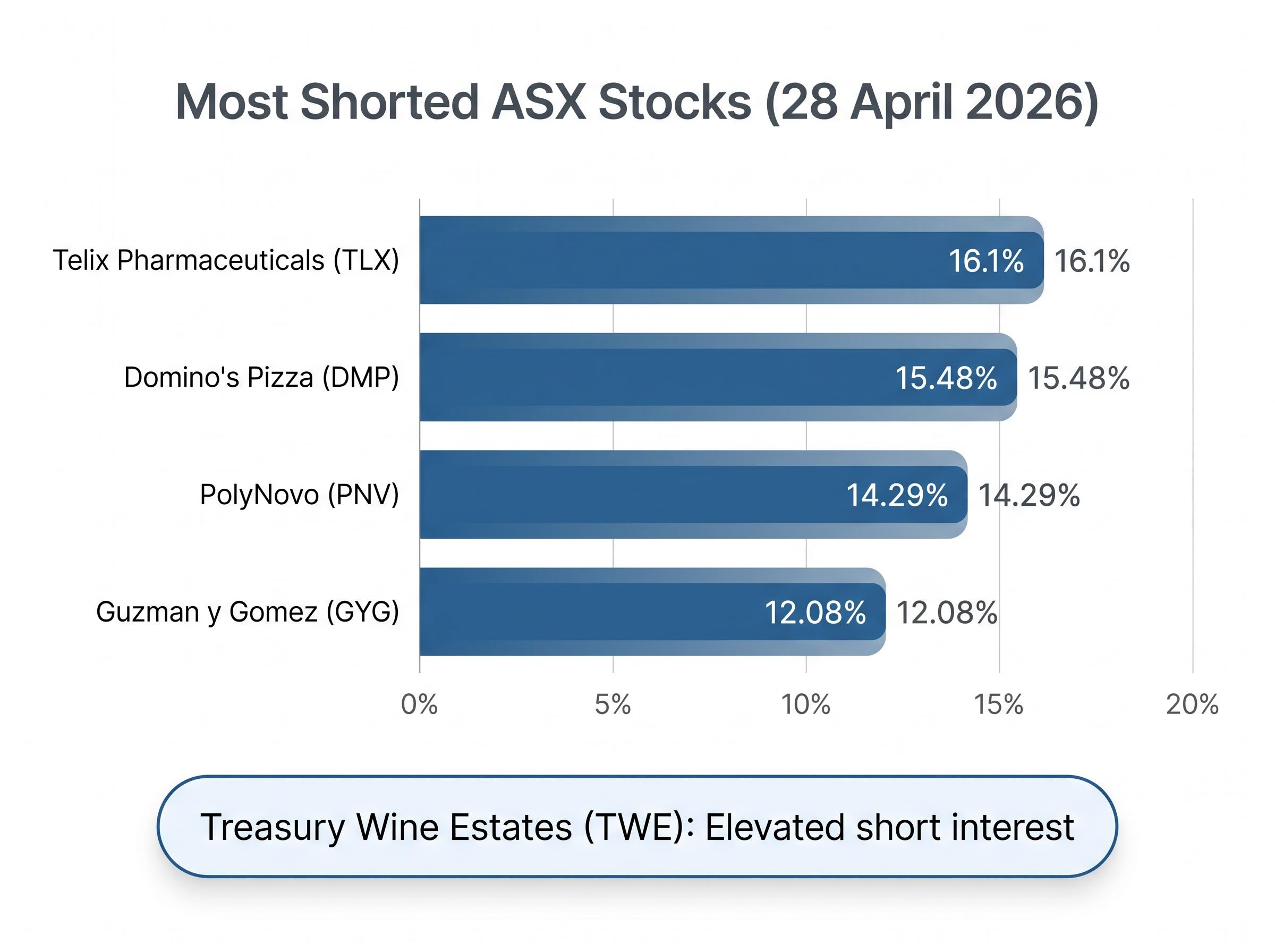
The five most shorted ASX stocks by short interest:
- Telix Pharmaceuticals (TLX): 16.1%, the highest on the exchange, reflecting institutional uncertainty around commercial execution despite strong revenues
- Domino’s Pizza (DMP): 15.48%, driven by franchise model pressures and international market concerns
- PolyNovo (PNV): 14.29%, amid medtech sector positioning
- Treasury Wine Estates (TWE): elevated short interest tied to trade exposure
- Guzman y Gomez (GYG): 12.08%, driven by growth pessimism, sluggish same-store sales, and concerns about whether premium valuations are sustainable
The week’s largest short covers, where traders closed bearish positions, signalled changing sentiment in other corners of the market:
- Beach Energy (BPT): largest short cover, down 3.62% week-on-week to 4.89%
- Genesis Minerals (GMD): short covering in the gold sector
- Pilbara Minerals (PLS): lithium short interest declining as sentiment shifted
On the other side, Predictive Discovery (PDI) saw the largest new short build among smaller names, up 1.25% week-on-week to 2.15%, reflecting bearish positioning in African gold mining. The breadth of these moves confirms that institutional short conviction is distributed across biotech, fast food, uranium, and consumer discretionary rather than concentrated in a single macro theme.
The concentrated short interest in names like TLX, DMP, and GYG sits within a broader context of deteriorating ASX market breadth, where 22 ASX 200 constituents hit fresh 52-week lows in the same week, signalling that the stress visible in heavily shorted individual stocks is one expression of wider sectoral pressure beneath a relatively flat headline index.
What retail investors can take from the LOT and GDG events
Rising short interest does not guarantee a crash. It does, however, indicate that institutional traders with significant research resources have identified reasons to bet against a stock. The distinction matters: short interest is a signal worth investigating, not a signal to act on reflexively.
Both the LOT and GDG cases shared a common preceding pattern. In LOT’s case, short interest climbed 5.67% month-on-month in a small-cap uranium producer with production execution risk. In GDG’s case, short interest doubled from a low base following a quarterly disclosure that the company itself considered non-price-sensitive.
Three practical steps when rising short interest appears in a stock held in a portfolio:
- Check the monthly trend, not just the weekly figure. A sharp month-on-month rise (as seen in both LOT and GDG) carries more weight than a flat or marginal weekly change.
- Review recent company disclosures. In both cases, the catalyst for the selloff was information already filed with the ASX. Revisiting quarterly reports and announcements can reveal what short sellers may have identified.
- Assess whether the short interest is sector-wide or stock-specific. LOT’s short build outpaced peer Boss Energy, suggesting company-specific rather than sector-level risk, a distinction that changes the interpretation.
The four-business-day data lag remains the practical constraint. By the time short interest data is published, institutional positioning is already established. The value for retail investors lies not in racing to replicate the trade, but in using the data as a prompt to revisit their own due diligence before a price move materialises.
Two stocks, two triggers, one lesson for ASX investors
LOT and GDG arrived at the same destination through different pathways. One involved a disclosure integrity failure; the other involved a quarterly earnings update that fell short of expectations. In both cases, institutional short interest had been building for weeks before the price collapse, and the published data was available to any investor willing to monitor it.
Short interest data is publicly accessible through ASIC’s reports and several retail-friendly aggregator tools. It is updated frequently and, following ASIC’s $35 million enforcement action against Macquarie Securities in March 2026, carries regulatory weight that supports its reliability. The information gap between institutional and retail investors on this specific metric is narrower than many assume.
For readers wanting to understand the full scope of ASIC’s regulatory enforcement posture toward ASX market infrastructure, our dedicated guide to the ASIC inquiry final report and ASX’s $150 million capital response covers the governance reforms, program reset deadlines, and risk management changes that form the broader compliance environment within which short sale reporting obligations sit.
Neither rising short interest nor a single week’s data point constitutes a reason to sell. What both cases demonstrate is that month-on-month short interest momentum, particularly sharp rises in smaller-cap names, warrants a closer look at the underlying company disclosures before institutional positioning moves price.
This article is for informational purposes only and should not be considered financial advice. Investors should conduct their own research and consult with financial professionals before making investment decisions.