
On 22 April 2026, Lululemon shares dropped 12% following a controversial chief executive appointment that escalated an already explosive boardroom battle. The market reaction captured the immediate crisis facing the athletic wear company as it attempts to navigate a contested transition of power.
Founder Chip Wilson and major institutional player Elliott Management are mounting aggressive campaigns to overhaul the board amidst a collapse in corporate valuation over the last two years. This Lululemon activist investor intervention targets specific governance failures and capital allocation decisions.
What follows is a comprehensive roadmap of the proxy mechanics, proposed executive alternatives, and market implications. Shareholders must now weigh these conflicting visions as the enterprise approaches its most consequential annual meeting in history.
The Secret Escrow Dispute That Ignited the Public Proxy War
The public proxy fight began after private negotiations collapsed over a specific financial demand. Current leadership required a minimum financial security deposit, known as an escrow provision, before considering any governance adjustments. Management’s refusal to consider further director changes without this deposit acted as the final catalyst, forcing the campaign into the public sphere.
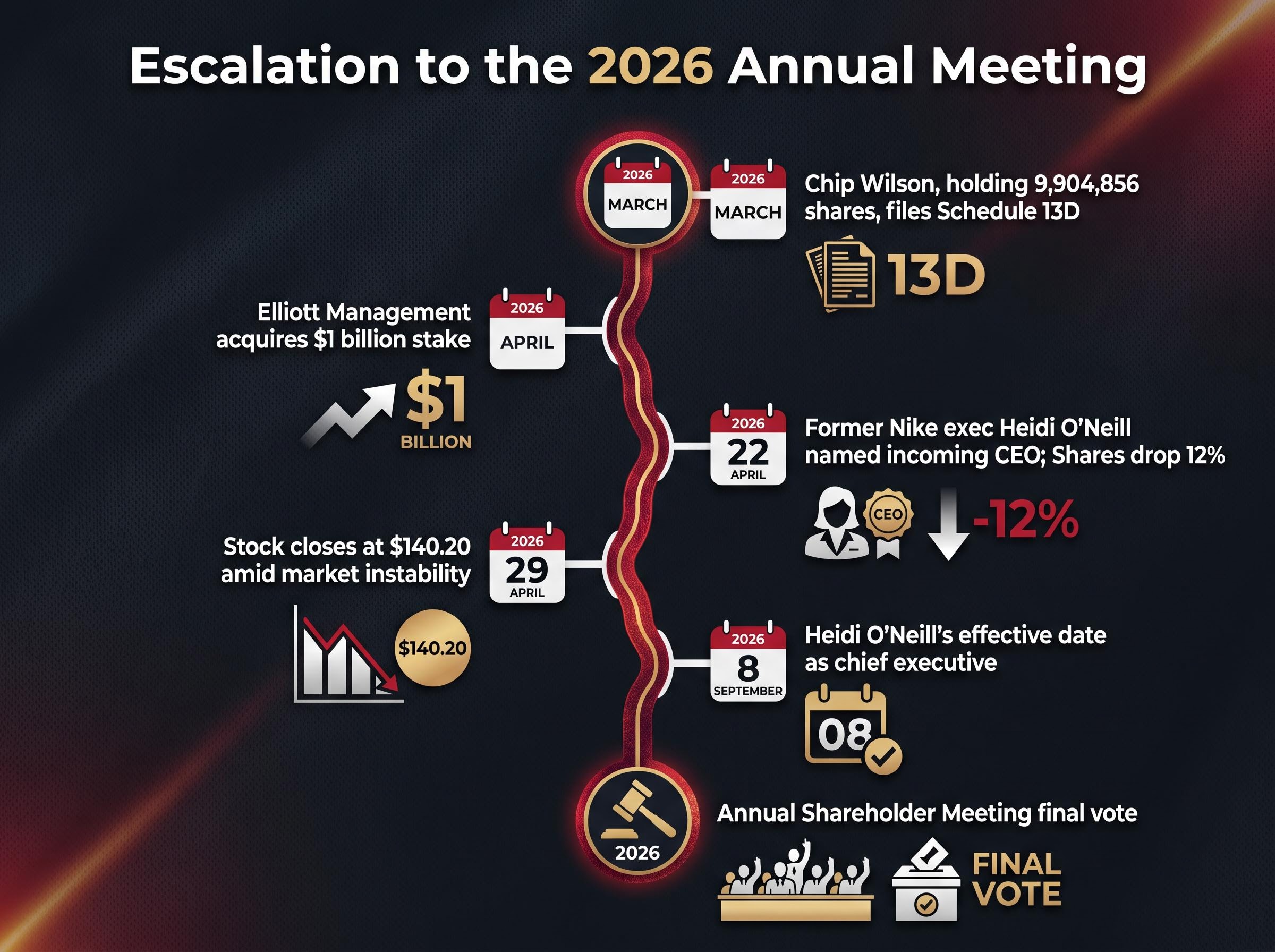
Wilson, holding an aggregate beneficial ownership of 9,904,856 shares, formalised his escalation through Schedule 13D filings and subsequent amendments in March 2026. The founder then took his case directly to the market.
The official SEC Schedule 13D regulatory filings provide complete transparency into the exact stock volume backing the founder’s governance challenge. This documentation ensures that institutional investors can verify the precise scale of the initial stake used to launch the campaign.
Activist Mandate “The company requires a quantum of change to restore shareholder value and realign strategic priorities,” Wilson stated in a public press release on 5 March 2026.
The disclosure of these failed negotiations proved that a public confrontation was inevitable, rather than a sudden development. Understanding why private settlements failed gives retail and institutional shareholders important context on the depth of distrust between the founder and current management. This breakdown sets the financial stakes for the upcoming shareholder vote.
When big ASX news breaks, our subscribers know first
Decoding the Universal Proxy Card and Board Governance Constraints
The activist group is utilising a GOLD universal proxy card to target specific board seats. A universal proxy card allows shareholders to mix and match director candidates from both the management and dissident slates on a single ballot. This mechanism contrasts with traditional voting methods, which historically forced investors to choose entirely between the company’s slate or the challenger’s slate.
This voting tool empowers dissidents to systematically target entrenched boards, but structural hurdles remain. The company utilises outdated continuity mechanisms and maintains concentrated private equity influence, complicating the activist path to victory. A staggered board means only a fraction of directors face election each year, preventing an immediate complete overhaul.
A recent Harvard Law School proxy card analysis demonstrates that allowing shareholders to mix candidates fundamentally increases the success rate of activist campaigns against entrenched incumbents. This regulatory shift forces companies to defend individual director track records rather than relying on a collective board slate.
Specific governance critiques include:
Lululemon operates as one of the minority of Standard & Poor’s 500 companies still utilising staggered board terms. According to reports, four current oversight committee individuals possess substantial career overlaps with Advent International L.P. * According to reports, principal director David Mussafer departed the board ahead of the annual gathering.
This procedural breakdown demystifies corporate governance mechanics. Investors can now evaluate the mathematical probability of the campaign succeeding against a deeply entrenched board structure.
The Heavyweight Challenger Slate and Institutional Escalation
The activist momentum accelerated in April 2026 when Elliott Management entered the fray. The institutional heavyweight acquired a $1 billion stake in the company, providing massive financial validation to the founder’s initial push for governance reform. This coordinated, high-pedigree alternative reality for the company directly challenges the current board’s defensive posture.
Wilson officially nominated three alternative directors with distinct track records in driving operational expansion and brand loyalty. These nominees present a sharp contrast to incumbent leadership.
Incumbent directors have formally urged shareholders to reject these alternative candidates, arguing that the proposed changes would further destabilise the brand’s premium athletic identity and complicate existing capital allocation frameworks.
| Candidate Name | Former Executive Role | Key Growth Metric |
|---|---|---|
| Marc Maurer | Co-CEO, On Holding AG | Multiplied corporate revenues by a factor of nearly four |
| Eric Hirshberg | CEO, Activision Publishing Inc. | According to reports, generated an approximate 500% surge in corporate shares |
| Laura Gentile | Promotional Director, ESPN Inc. | Directed brand expansion and audience growth initiatives |
This proposed slate allows shareholders to conduct a direct comparison between recent enterprise performance and the specific growth metrics promised by the alternative candidates. The sudden entry of institutional capital suggests large shareholders are actively weighing this operational alternative.
Chronic Value Destruction and Brand Strategy Misalignment
The intense activist intervention stems directly from severe capital erosion and operational stagnation across the Americas over recent reporting periods. Financial observers have repeatedly questioned a controversial alliance with The Walt Disney Company, noting a perceived misalignment with the athletic wear firm’s typical affluent demographic. Furthermore, governance experts raised conflict of interest concerns because the current apparel chief executive occupies a governance seat at Disney.
This strategic drift has directly impacted regional performance, with sales in the core Americas market remaining stagnant while competitors steadily capture market share among affluent consumers.
The numerical data systematically justifies the current shareholder rebellion. The company has recorded significant structural deterioration across multiple timeframes.
- According to reports, roughly $17 billion of investor equity vanished over the preceding half-decade.
- According to reports, the enterprise shed 65.9% of its corporate valuation in under 24 months.
- According to reports, regional comparable retail transactions failed to grow, or actively shrank, throughout eight uninterrupted financial quarters.
- According to reports, comprehensive investor yields trailed rival medians by 19.5% over a 12-month span and 63.6% across a 36-month interval.

Connecting this abstract boardroom drama directly to portfolio performance proves the governance dispute is rooted in fundamental business deterioration. These performance failures have left long-term holders exposed to persistent capital depreciation.
The CEO Succession Shockwave and Immediate Market Reality
The ongoing governance crisis collided with immediate market reality on 22 April 2026. Management announced former Nike executive Heidi O’Neill as the incoming chief executive, effective 8 September 2026. This appointment directly conflicted with activist demands for comprehensive leadership restructuring and a renewed focus on premium merchandise.
The market delivered a violent rejection of the succession plan. The stock plunged 12% immediately following the announcement, demonstrating high-stakes instability and a lack of investor confidence in the board’s unilateral decision. Current stock pricing rests at $140.20 as of the market close on 29 April 2026.
Analyst Consensus and Institutional Outlook
Wall Street analysts maintain a cautious outlook on the transition. Jefferies analyst Randal Konik commented that while the broader brand strategy might hold logic, there are underlying concerns regarding the company’s trajectory during an active proxy fight.
Major proxy advisory firms, including ISS and Glass Lewis, have yet to release their final voting recommendations. This market pricing context delivers actionable information on how the governance crisis is currently affecting trading volumes, helping both short-term traders and long-term holders navigate the volatility.
For investors evaluating how this leadership vacuum impacts historical valuations, our detailed coverage of the equity collapse tracks the transition from the enterprise’s peak near a $50 billion market capitalization to its current pricing levels.
The Final Tally Awaiting the 2026 Shareholder Meeting
The enterprise remains on a collision course between current management’s defensive manoeuvres, the high-profile activist slate, and Elliott Management’s massive financial leverage. The ultimate resolution hinges entirely on the forthcoming 2026 Annual Meeting, where shareholders will determine the operational future of the brand.
This specific proxy battle could redefine corporate governance standards for legacy athletic brands facing market saturation and activist pressure. The outcome will likely establish new precedents for how entrenched boards handle coordinated institutional challenges.
This article is for informational purposes only and should not be considered financial advice. Investors should conduct their own research and consult with financial professionals before making investment decisions. Past performance does not guarantee future results. Financial projections are subject to market conditions and various risk factors.