
The Federal Reserve interest rates remain anchored in a restrictive holding pattern as of April 2026, trapping policymakers between slowing domestic consumer demand and fresh geopolitical energy shocks. The central bank faces an increasingly complex macroeconomic picture where traditional monetary levers are losing their immediate effectiveness. Global volatility has fractured the recovery narrative, sending unpredictable crosscurrents through the American economy.
This macroeconomic friction does not exist solely in policy documents or academic forecasting models. The tension cascades directly from institutional boardrooms down to retail checkouts, travel bookings, and digital payment volumes.
What follows is a layered analysis of how these high-level policy decisions and external shocks physically reshape corporate profit margins and consumer behaviour across the United States.
The Monetary Policy Tightrope and Institutional Shifts
Central banks operate on a mechanical mandate to maintain price stability while maximising employment. They use the baseline cost of capital as their primary tool to cool overheated demand or stimulate growth. However, a central bank cannot print oil or untangle physical supply chains, making external commodity shocks notoriously difficult to manage with interest rate adjustments alone.
Policymakers must now weigh domestic disinflation against external price spikes. The federal funds rate target range remains locked at 3.50%-3.75% as of late April 2026. This represents a notable moderation from the 4.50%-4.75% peak seen in 2024, yet it leaves the baseline cost of capital elevated enough to restrict aggressive corporate borrowing and expansion.
The March 2026 FOMC statement explicitly links this prolonged restrictive stance to ongoing inflation risks, indicating that committee members require sustained evidence of price stability before authorising additional monetary easing.
The Impending Leadership Transition
This delicate balancing act coincides with a proposed transformation at the very top of the institution. President Trump has nominated Kevin Warsh to serve as the Federal Reserve Chair. Warsh brings a specific agenda focused on enacting structural reforms that enhance independence and ensure strictly data-driven decision-making.
His prospective tenure points toward a systematic reduction of the central bank’s balance sheet over the coming years. This approach prioritises institutional humility over aggressive forward guidance.
Institutional Policy Shift “The prospective transition toward a data-driven framework signals a departure from forward-guidance reliance, prioritising balance sheet reduction and institutional humility in an era of unpredictable supply shocks.”
Understanding this baseline cost of capital is a critical requirement for market participants. The central bank’s overarching framework dictates the broader economic environment for borrowing, spending, and corporate expansion over the next 18 months.
When big ASX news breaks, our subscribers know first
Geopolitical Shocks and the Energy Market Cascade
The abstract discussions of monetary policy collide violently with the physical reality of global supply chains. The ongoing United States-involved Iran conflict has fundamentally destabilised global energy markets. This geopolitical friction has pushed oil prices surging above $100 per barrel, introducing a massive headwind that complicates domestic economic stability.
The prolonged embargo strategy specifically targets financial resources to restrict adversarial capabilities in the region. However, this strategy carries severe inflationary side effects that bleed directly into the domestic American economy. Energy prices function as a hidden tax on every tier of commerce.
The transmission mechanism from geopolitical conflict to domestic inflation follows a highly predictable sequence:
- Embargo Implementation: Supply restrictions remove significant daily crude volumes from the global market.
- Spot Price Spikes: Benchmark crude oil surges above the $100 threshold as refiners bid up remaining available barrels.
- Logistics Cost Expansion: Freight, rail, and maritime shipping operators face immediate fuel surcharge increases.
- Retail Margin Compression: Retailers pass these elevated logistics costs down to the consumer at the physical checkout counter.
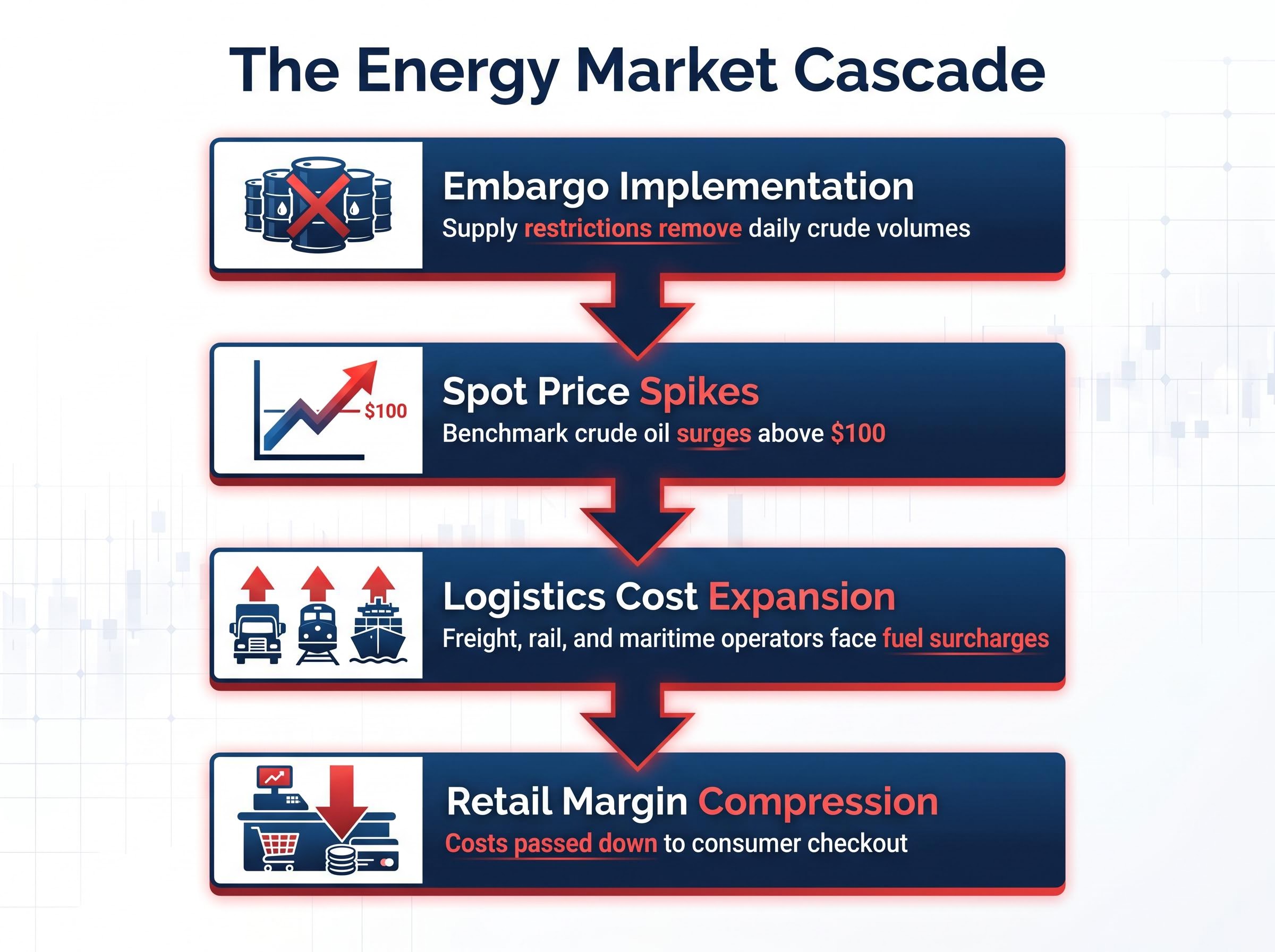
Recognising this dynamic helps analysts anticipate profit margin compression across logistics-heavy sectors. The energy market cascade is the primary force keeping inflationary pressures alive in 2026.
For investors exploring the macroeconomic consequences of sustained crude prices above the century mark, our detailed coverage of oil price shock transmission breaks down the simultaneous channels that impact consumer income, corporate hiring, and federal rate pressure.
The American Consumer Pivot Toward Value
The collision of restrictive borrowing costs and energy shocks has created a uniquely squeezed American consumer. Psychological indicators reflect this financial strain heavily across all demographic groups. Consumer sentiment indicators are currently hovering at multi-year lows, driven by the persistent friction of daily living costs and rising fuel expenses.
Yet a significant divergence exists between what consumers report feeling and how they actually deploy their capital. The volume of consumer activity remains structurally intact, even as the location of that spending undergoes a radical shift.
Sentiment Versus Actual Register Receipts
Despite the overwhelmingly negative psychological outlook, physical register receipts tell a story of remarkable resilience. Retail sales rose by 0.6% in February 2026, defying expectations of a broader economic contraction. This data reveals a defensive rotation rather than a total consumer retreat.
However, this aggregate spending resilience is highly dependent on the rapid exhaustion of household financial buffers, creating an unsustainable consumption pattern as personal savings rates drop toward critical lows.
Discretionary spending is being aggressively rerouted to value-oriented retail enterprises. Shoppers are abandoning premium discretionary categories and redirecting those funds toward discount grocers, bulk retailers, and off-price apparel merchants. Value retailers are uniquely positioned to capture this shifting market share because they offer the exact pricing flexibility that budget-constrained households require.
Retail resilience serves as the final firewall preventing a broader economic contraction. Identifying where household capital is flowing allows market observers to spot defensive retail segments that can weather a prolonged period of elevated inflation.
Aviation and Tourism Profitability Under Pressure
While value retail demonstrates structural resilience, the travel sector provides a stark case study in vulnerability. Airlines stand directly in the crosshairs of dual macroeconomic headwinds. They must absorb both astronomical fuel costs and a subtle cooling in consumer travel sentiment.
Aviation fuel prices have spiked to between $150 and $200 per barrel, instantly rewriting the financial outlooks of these capital-intensive enterprises. Carriers are forced to pass these ballooning operational expenses onto passengers via aggressive fare increases. This pricing action tests the absolute limits of traveler elasticity.
Specific distress signals are rapidly emerging across the aviation and tourism ecosystem:
Carrier Downgrades: Major operators including American Airlines and JetBlue have revised their financial outlooks downward, warning of potential 2026 net losses. Fare Hikes: Airlines are implementing broad base-fare increases to offset the energy market cascade. * Accommodation Contraction: First-quarter accommodation occupancy expansion has contracted globally.
This margin destruction illustrates how external shocks penetrate corporate financials. The ripple effect extends well beyond the tarmac, suppressing global accommodation and reservation platforms as tourists recalculate their vacation budgets.
Digital Transaction Networks Prove Their Durability
Amidst the margin compression in physical logistics and travel, a powerful counter-narrative of systemic strength is emerging in the digital economy. Payment processing networks continue to demonstrate remarkable growth despite broader macroeconomic stagnation. This resilience highlights a paradox where the rails facilitating commerce remain highly profitable even as the merchants themselves face margin pressure.
The persistent global shift from physical currency to digital methods is simply overriding short-term economic turbulence. Network operators extract a fraction of every transaction, shielding them partially from the margin destruction impacting physical retailers. However, the major network operators are experiencing varying degrees of success during the first quarter of 2026.
| Payment Network | Q1 FY2026 Adjusted EPS | Cross-Border Volume Growth |
|---|---|---|
| Mastercard | $4.76 | 13% increase |
| Visa | Not reported explicitly | 12% estimated growth |
| American Express | Material reduction | Double-digit decline |
Identifying sectors that can maintain pricing power and volume growth during macroeconomic stress offers a clear roadmap for defensive financial positioning. The divergence between durable digital toll collectors and struggling physical operators defines the current market cycle.
Charting the Fragmented Economic Reality
The American economic environment of 2026 is defined by severe fragmentation. Restrictive monetary policy and violent commodity shocks are colliding with a surprisingly resilient underlying consumer base. The central bank’s interest rate holding pattern is a direct consequence of this complex crosscurrent of data. Policymakers simply cannot ease borrowing costs while energy markets continuously inject fresh inflation into the system.
Global equity markets have struggled to process this paradigm; algorithmic trading models often treat physical supply shocks as routine dips rather than structural constraints, creating dangerous mispricing across major indices.
Consumers and market participants must adapt to a highly divergent environment throughout the remainder of the year. Defensive capital positioning requires distinguishing between sectors that possess structural pricing power and those trapped by rising input costs. Digital transaction networks and value retail currently hold the high ground, while capital-intensive transport operators face severe margin erosion.
This article is for informational purposes only and should not be considered financial advice. Investors should conduct their own research and consult with financial professionals before making investment decisions. Past performance does not guarantee future results, and financial projections are subject to market conditions and various risk factors.