
Global equity markets absorbed a nearly $1 trillion selloff in traditional software stocks in February 2026. Capital continues to rotate aggressively toward artificial intelligence enablement instead.
The recent capital injection and resulting valuation jump for marketing technology firm Hightouch illustrates this stark market divergence. This analysis examines the mechanics behind the specific Hightouch funding strategy and what it reveals about enterprise software appraisals moving forward.
By deconstructing how synthetic media generation and strategic capital deployment are redefining corporate valuations, investors can understand the structural realignment occurring within the United States market.
The gap between legacy software infrastructure and generative artificial intelligence agents is widening at an unprecedented pace. This divergence is establishing a new baseline for technology investment, rewarding platforms that actively generate digital content over those that merely store passive data.
Financial professionals are increasingly recalibrating their portfolios to account for this rapid technological shift. The contrast between falling traditional cloud valuations and explosive multi-billion-dollar artificial intelligence appraisals highlights a fundamental change in how the market prices software utility.
The Financial Mechanics Behind a Multibillion-Dollar Appraisal
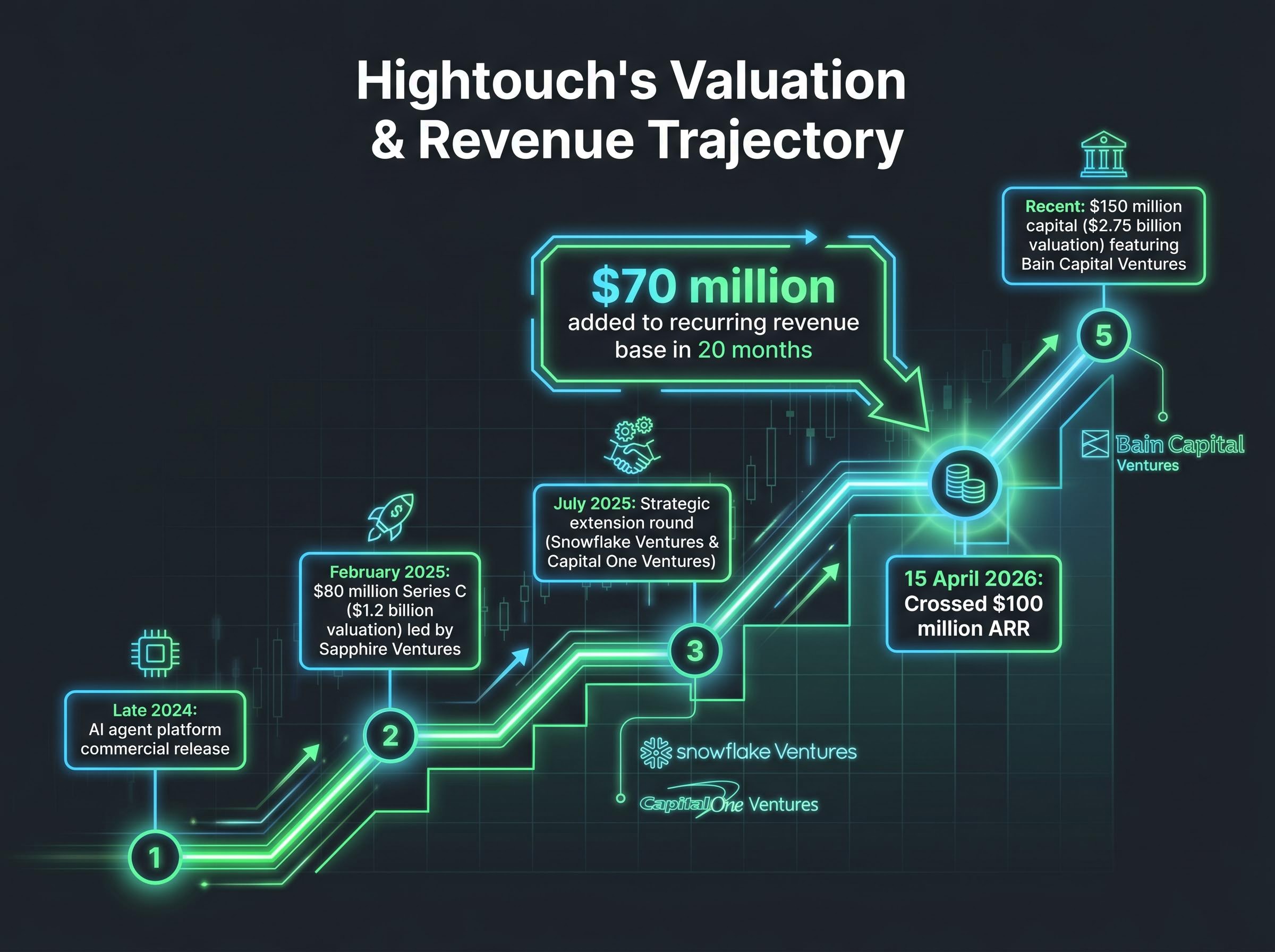
The trajectory of enterprise valuations now heavily rewards platforms demonstrating generative artificial intelligence capabilities. According to unverified reports, Hightouch recently secured an additional $150 million in capital, propelling the company to a $2.75 billion corporate valuation.
This marks a substantial acceleration from its early 2025 financial cycle, highlighting the velocity of capital moving into specialised software sectors. In February 2025, the firm completed an $80 million Series C round led by Sapphire Ventures, reaching a $1.2 billion appraisal.
Prior to the latest capital event, the company had accumulated $172 million across six primary funding rounds. Following the Series C, the firm also secured a strategic extension round in July 2025 featuring investments from Snowflake Ventures and Capital One Ventures.
The most recent syndicate composition signals strong institutional confidence in the platform’s revenue trajectory. The latest investment round features heavy participation from Bain Capital Ventures.
The official Bain Capital Ventures funding announcement details the Series D capital structure, formally moving the enterprise into an elite tier of private market appraisals.
This backing triangulates with broader market patterns where tier-one investment firms are consolidating massive capital reserves into distinct category leaders. Analysts evaluating the current United States software market note that liquidity remains highly concentrated among firms offering tangible artificial intelligence integration.
Understanding the specific trajectory of these funding rounds provides finance professionals with a benchmark for evaluating growth velocity in emerging technology sectors. According to unverified reports, the rapid doubling of the corporate valuation within slightly more than a year demonstrates how investors are pricing the transition from conventional data management to active content generation.
| Company | Event Type | Valuation | Key Backers / Acquirers |
|---|---|---|---|
| Hightouch | Funding Round | According to unverified reports, $2.75 Billion | Bain Capital Ventures |
| Profound | Series C | $1.0 Billion | Institutional Syndicate |
| Semrush | Acquisition | $1.9 Billion | Adobe |
When big ASX news breaks, our subscribers know first
From Cloud Categorisation to Synthetic Content Generation
To understand the premium valuation, investors must look at the underlying architectural shift from passive data storage to active asset creation. Hightouch originally operated as a cloud-based consumer categorisation tool, formally classified within the industry as a Customer Data Platform.
These legacy systems primarily functioned to sort and synchronise user information across different corporate databases. Between 2023 and 2024, the company fundamentally transitioned its core infrastructure to support synthesised asset features and advanced reinforcement learning capabilities.
Modern artificial intelligence agents differ fundamentally from legacy data platforms because they execute complex, multi-step workflows rather than merely sorting static information. This pivot from categorisation to generation created massive enterprise value by directly reducing the time required to launch marketing campaigns.
The platform avoids producing generic visual outputs by blending a brand’s historical multimedia library with freshly generated digital assets. This specific technical capability allows commercial teams to consistently deploy consumer-grade promotional materials without requiring dedicated graphic design personnel.
Parallel developments in AI-native video environments are also introducing new cryptographically governed control layers, ensuring that automated multimedia assembly strictly adheres to established brand safety parameters and licensing agreements.
The mechanism driving this transformation relies on a sequential process that bridges historical data with generative outputs. The workflow illustrates how an artificial intelligence agent moves from analysing customer behaviour to deploying a targeted visual asset.
- The system connects directly to existing corporate data warehouses to analyse historical consumer purchasing patterns and engagement metrics.
- The artificial intelligence agent interprets these complex data signals to determine the optimal visual and textual parameters for a specific target demographic.
- The platform synthesises custom digital assets by combining established corporate brand guidelines with newly generated, highly specific multimedia elements.
- The automated infrastructure deploys the targeted visual asset directly to relevant marketing channels while continuously monitoring initial consumer engagement for future optimisation.
Translating Artificial Intelligence into Rapid Revenue Velocity
Technological capability only supports premium market appraisals when it translates directly into demonstrable commercial utility. On 15 April 2026, the company reached a significant financial milestone by officially crossing $100 million in Annual Recurring Revenue.
This growth trajectory accelerated dramatically following the late 2024 commercial release of its artificial intelligence agent platform. According to co-chief executive Kashish Gupta, the company added a staggering $70 million to its recurring revenue base in the 20 months following the initial product launch.
This rapid revenue velocity reflects how major United States enterprise clients are actively utilising synthetic media generation to optimise customer loyalty and purchase frequency. Powering these highly personalised campaigns requires immense data synchronisation capabilities engineered specifically for an enterprise scale.
Beyond content generation, advertising technology firms are increasingly deploying automated AI recruitment agents to streamline complex influencer and affiliate marketing networks at a global scale.
Connecting abstract technological capabilities to concrete enterprise adoption validates the aggressive financial backing provided by institutional investors. Several major consumer brands now rely on these automated systems to drive their digital engagement strategies.
PetSmart: Synchronises over 4 billion individual data points through the composable data infrastructure to execute highly personalised marketing campaigns. Domino’s: Utilises the predictive data infrastructure to process complex customer ordering behaviour and immediately automate targeted promotional outreach. Spotify: Leverages the generative system to translate vast, unstructured listener data sets into segmented promotional materials across multiple regions. Chime: Deploys the automated software infrastructure to streamline financial service marketing and improve critical user retention metrics. * DraftKings and HelloFresh: Integrate the artificial intelligence decisioning capabilities to optimise return on advertising spend and customer acquisition costs.
Forfeiting Immediate Profitability for Product Dominance
In winner-takes-all technology markets, corporate capital allocation strategies often prioritise sustained product innovation over short-term margin padding. While there is no verified public company statement outlining a specific two-year profitability deferment timeline, market analysts observe that the recent capital influx is clearly being directed toward aggressive engineering expansion.
The United States advertising technology sector is currently experiencing a fierce structural arms race, where technological stagnation leads rapidly to platform obsolescence. Growth-stage companies are heavily diverting resources to maintain product dominance rather than optimising for immediate financial returns.
This strategic operational focus on expanding platform capabilities directly supports the high valuation multiples assigned by institutional investors. Expanding the reach of generative marketing tools requires continuous, massive investments in computing infrastructure and talent acquisition.
Executive Perspective on Innovation Priorities “Our focus remains completely centered on expanding the analytical capabilities of our platform to meet the massive data synchronisation demands of our enterprise clients,” stated Kashish Gupta, co-chief executive.
This approach reflects a broader survival mandate across the entire software technology sector. Financial professionals evaluating these elevated valuations must weigh the high potential for long-term category leadership against the delayed realisation of net corporate profitability.
Investors supporting these funding rounds understand that capturing market share during this critical transition period outweighs immediate free cash flow generation. The premium appraisal specifically relies on the company establishing a dominant operational footprint before legacy competitors can re-engineer their own platforms.
For analysts evaluating how the broader technology sector is balancing long-term innovation with immediate financial metrics, our detailed coverage of hyperscaler cash flow pressures examines the massive capital expenditures driving these platform builds and the resulting options market volatility.
The Macro Realignment and the Trillion Dollar Software Selloff
The explosive growth of generative platforms is occurring against the backdrop of a brutal market correction for traditional digital infrastructure providers. On 4 February 2026, a major market selloff wiped out nearly $1 trillion in value from global software and services stocks.
Financial reporting covering the global software equity selloff indicates that this historic capital flight was primarily triggered by mounting institutional anxiety regarding legacy platform obsolescence.
This destruction of equity value served as a stark indicator of how artificial intelligence is actively disrupting legacy business models. Capital is rotating heavily out of static workflow tools and into enablement technologies, driven by massive, permanent shifts in consumer internet behaviour.
Industry data recorded a massive 269% year-over-year surge in automated artificial intelligence traffic to United States retail sites in March 2026. This macroeconomic backdrop proves that the success of generative marketing platforms is part of a structural industry realignment rather than an isolated corporate event.
Q1 and Q2 Corporate Acquisitions and Capital Shifts
This structural realignment is highly visible in the intense merger and acquisition activity defining the first half of 2026. Adobe completed an all-cash acquisition of Semrush for $1.9 billion on 28 April 2026.
This strategic transaction was specifically designed to strengthen Adobe’s enterprise customer experience offerings with enhanced search and brand visibility capabilities. Concurrently, marketing technology firm Profound secured a $96 million Series C raise on 24 February 2026.
This recent funding achieved a $1.0 billion valuation, providing the capital necessary to scale its new discovery platforms. These distinct financial transactions demonstrate a clear, sector-wide industry pivot toward automated brand visibility and intelligent media generation.
The shift away from traditional software providers reflects a new reality where investors demand active productivity gains from enterprise tools. Companies that fail to integrate these advanced discovery and generative capabilities are seeing their forward revenue multiples aggressively compressed.
The New Baseline for Advertising Technology Valuations
The recent funding events within the advertising technology sector indicate that specialised, generative integrations are now a mandatory prerequisite for premium market appraisals. The massive corporate valuation awarded to platforms executing these tasks is a direct reflection of demonstrated enterprise utility and rapid revenue velocity.
These appraisals are anchored in measurable financial momentum rather than isolated speculative hype. Connecting complex artificial intelligence capabilities to concrete commercial outcomes provides the analytical justification for these multibillion-dollar assessments.
As institutional capital continues to rotate throughout the remainder of 2026, the divide between legacy software providers and next-generation platforms in the United States market will likely widen. Investors must closely monitor how quickly established technology firms can adopt generative capabilities to defend their market share.
The ongoing reallocation of enterprise technology budgets suggests that automated content generation will remain the primary driver of software valuation expansion.
For investors wanting to understand the supply chain vulnerabilities that could disrupt this transition, our deep-dive into AI hardware market risks outlines the escalating infrastructure costs and macroeconomic threats currently facing the underlying semiconductor sector.
This article is for informational purposes only and should not be considered financial advice. Investors should conduct their own research and consult with financial professionals before making investment decisions. Past performance does not guarantee future results. Financial projections are subject to market conditions and various risk factors.