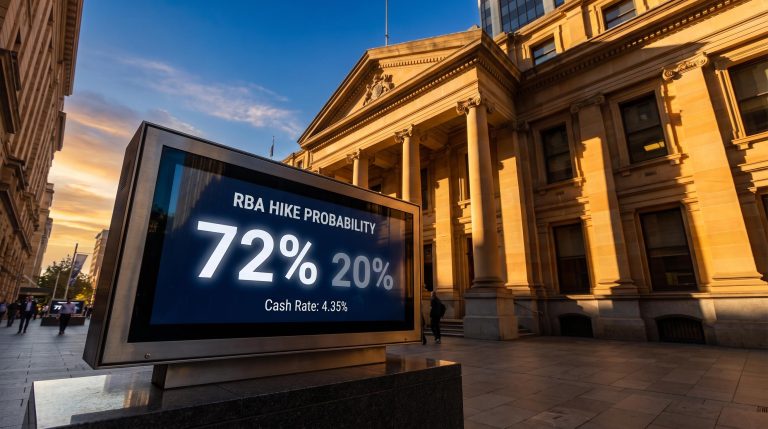
According to market estimates, a single Wednesday afternoon will soon see $10 trillion in market capitalisation open its books to intense Wall Street scrutiny. Today, 29 April 2026, marks the most sensitive juncture of the current bull market as Meta, Microsoft, Alphabet, and Amazon report their financial results simultaneously.
Coming off an early spring market contraction, these concurrent AI stocks earnings reports will dictate the immediate direction of US equities. Investors are showing heightened sensitivity to advanced computing infrastructure spending levels following a period of massive capital deployment.
The upcoming announcements require a close examination of the specific capital expenditure numbers driving market anxiety, the options market volatility expectations, and the downstream risks for the broader technology ecosystem. This simultaneous reporting block leaves portfolio managers with limited room to hedge against aggressive spending projections.
The Weight of the Wednesday Reporting Block
The closing bell will trigger a coordinated release from four companies that hold disproportionate influence over the broader US equity markets. This small cohort has acted as the primary engine for market expansion since late 2022, single-handedly pulling major indices higher through concentrated momentum. According to market data, their combined market valuation now exceeds $10 trillion, commanding a massive 17% total weighting within the S&P 500 index.
Because this handful of firms dictates overall benchmark direction, passive index investing effectively functions as a highly concentrated thematic bet on the technology sector rather than a diversified market allocation.
The synchronised timing of these releases multiplies the potential for widespread market instability. Retail and institutional investors understand that today’s announcements will dictate broader portfolio performance regardless of direct exposure to these four specific equities. A negative reaction across this group could easily reverse the recovery seen since the recent market low on 30 March 2026.
Concentrated Market Risk “According to market estimates, when 17 percent of your primary benchmark reports within a single hour, index funds effectively become concentrated bets on four management teams,” noted financial analysts reviewing the structural vulnerabilities of cap-weighted indices.
When big ASX news breaks, our subscribers know first
Dissecting the $750 Billion Artificial Intelligence Spending Spree
Advanced computing infrastructure outlays are aggressively ramping up, targeting data centres and processing units at an unprecedented scale. CreditSights estimates that total 2026 capital expenditures across the top five hyperscalers, including Oracle, will reach $750 billion. Approximately 75% of this budget, or $562.5 billion, is dedicated entirely to artificial intelligence infrastructure.
The magnitude of these budgets has fueled a historic semiconductor supercycle, with physical hardware and data centre construction consuming the majority of newly allocated capital.
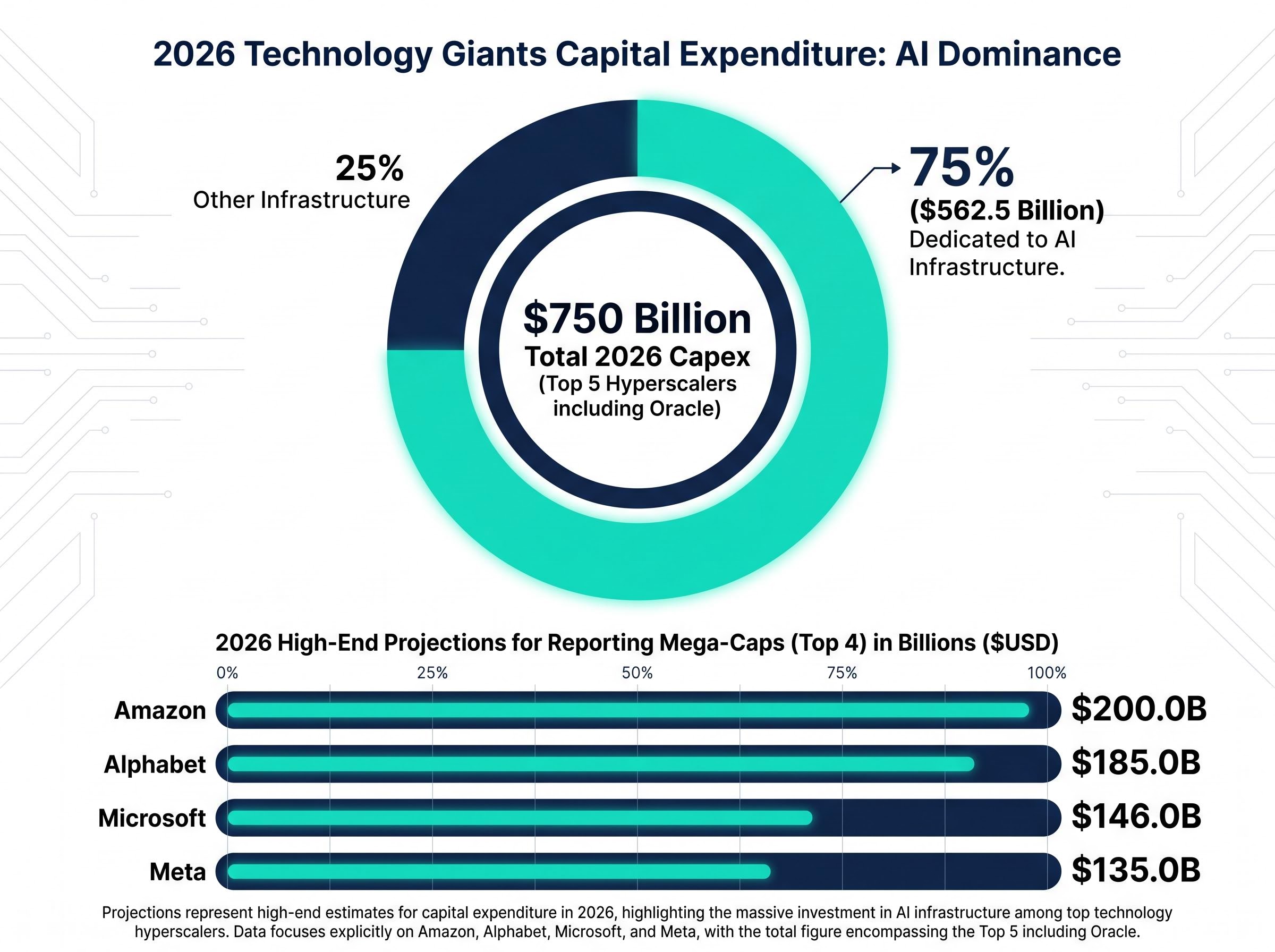
A stark divide is growing between Wall Street consensus estimates and the actual spending reality reported by these technology giants. Analysts note that historical spending outpaced consensus by over 50% in 2024 and 2025. Amazon recently announced $200 billion planned for 2026, while Alphabet guided for $175 billion to $185 billion, exceeding broad US industry benchmarks.
This escalating spending contrasts sharply with historic limits and fuels investor skepticism regarding the lack of near-term commercial monetisation. According to market estimates, companies are projected to shift from spending 50% of operating cash flow in 2024 to approximately 90% approaching 2027. Investors need to see these exact figures to understand why strong revenue numbers alone might not prevent stock sell-offs if forward spending guidance remains too aggressive.
| Company | 2025 Capex Baseline | 2026 High-End Projection | Implied Growth Rate |
|---|---|---|---|
| Meta | $72.0B | $135.0B | 87.5% |
| Microsoft | $88.2B | $146.0B | 65.5% |
| Alphabet | Not Disclosed | $185.0B | N/A |
| Amazon | Not Disclosed | $200.0B | N/A |
The Hyperscaler Balance Sheet and Delayed Return on Investment
Building advanced computing facilities involves severe physical and operational realities that separate capital deployment from immediate financial returns. Massive capital outlays today cannot translate into immediate software or service revenue tomorrow.
Tangible proof of commercial growth for remote server hosting and digital marketing divisions requires completing a multi-stage operational pipeline. Hardware deployment and subsequent enterprise contract acquisition operate on a standard timeframe that naturally delays revenue generation.
Facility construction and power procurement Processor deployment and server rack installation * Enterprise software integration and client onboarding
Navigating the Threat of Eroding Shareholder Patience
Financial sector professionals are actively demanding proof of concept to justify these massive budgets. Wall Street commentary indicates that shareholder patience for delayed returns is currently estimated at a maximum of one year.
There is a severe risk of abrupt valuation corrections if revenue expansion fails to materialise rapidly. For example, Amazon recently suffered a 9% stock drop despite reporting solid Q4 2025 revenue of $213.4 billion, illustrating the harsh market penalty for unbalanced spending profiles. By understanding this timeline, readers gain the analytical tools to judge whether a company’s earnings call promises are realistic.
Derivative Markets Signal Heightened Downside Risk
Institutional derivative markets are preparing for aggressive percentage swings before the closing bell rings today. Options market pricing as of 29 April 2026 shows significant expected post-announcement volatility for all four mega-caps.
The synchronised reporting limits the ability of traders to hedge effectively across the broader technology index. Comparing current implied moves against historical trailing averages highlights a potential underpricing of risk in certain equities.
For retail investors attempting to navigate these severe post-announcement price swings, our dedicated guide to options market implied volatility outlines a framework for assessing event risk and understanding how premiums typically collapse after an earnings call.
| Equity Name | Ticker Symbol | Implied Volatility Move | Historical Average Move |
|---|---|---|---|
| Amazon | AMZN | 7.0% | Not Specified |
| Meta | META | 6.9% | Not Specified |
| Alphabet | GOOGL | 5.25% | Not Specified |
| Microsoft | MSFT | 5.0-7.0% | Not Specified |
Semiconductor Equities Face Immediate Downstream Vulnerability
Vulnerability has transferred directly to the semiconductor sector despite its recent historic rally. Hyperscaler spending budgets connect directly to the valuation of component and processor manufacturers.
Hardware indices absorbed early spending tailwinds, resulting in exponential growth throughout the early spring. However, institutional investors executed sudden de-risking manoeuvres in the days leading up to today’s earnings announcements. Readers holding hardware equities will understand that their portfolios are completely at the mercy of the forward guidance provided by the software buyers reporting today.
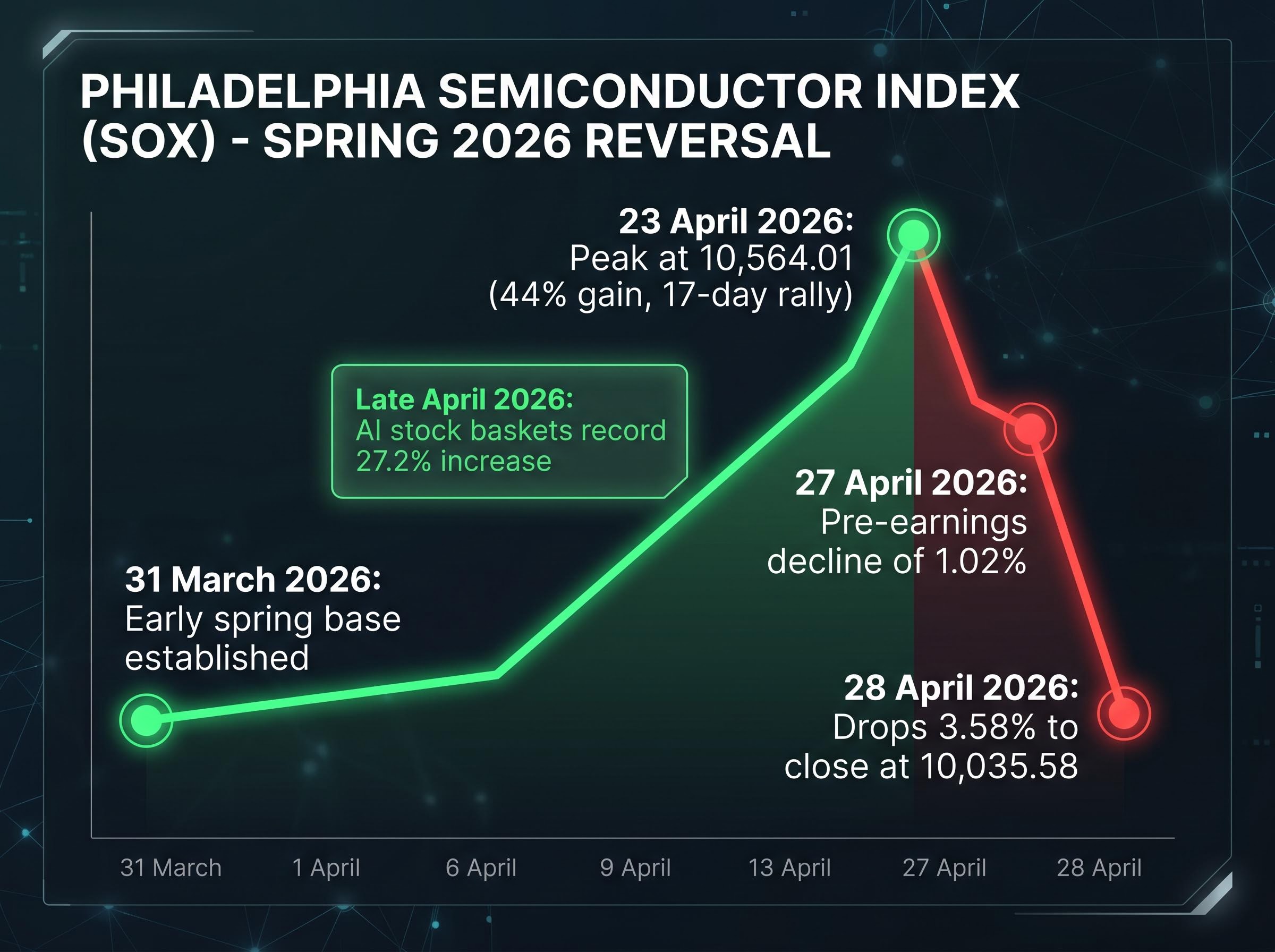
- 31 March 2026: The Philadelphia Semiconductor Index (SOX) establishes its early spring base.
- Late April 2026: According to market data, specialised artificial intelligence stock baskets record a 27.2% increase.
- 23 April 2026: The historic 17-day rally peaks at 10,564.01, marking a 44% gain.
- 27 April 2026: Pre-earnings de-risking begins with the SOX index declining 1.02%.
- 28 April 2026: Vulnerability accelerates with a 3.58% drop to close at 10,035.58.
Assessing the Horizon for Market Momentum
The era of unconditional support for advanced computing infrastructure is ending. Market participants are no longer willing to reward capital deployment without clear timelines for commercial monetisation.
The true test for these mega-cap technology companies lies in their forward guidance and projected commercial revenue, not just clearing their Q1 profit benchmarks. A failure to satisfy Wall Street expectations tonight could trigger a broader valuation correction across major indices moving into the summer of 2026.
Key indicators for the sustainability of this investment cycle include expanding free cash flow margins and early evidence that new artificial intelligence products are generating genuine corporate demand.
This article is for informational purposes only and should not be considered financial advice. Investors should conduct their own research and consult with financial professionals before making investment decisions. Past performance does not guarantee future results, and financial projections are subject to market conditions and various risk factors.