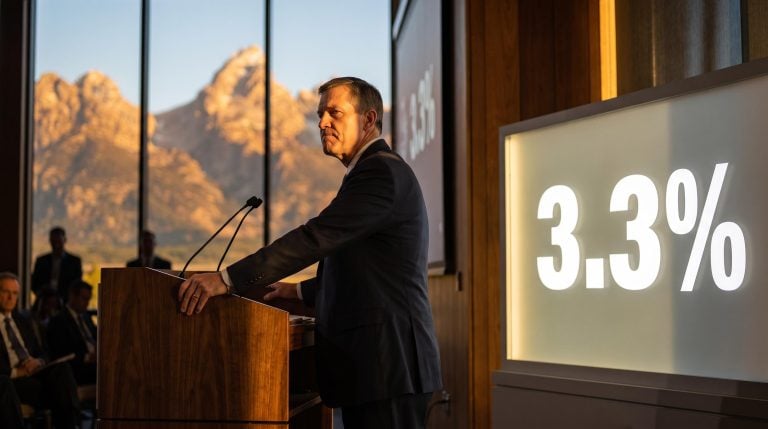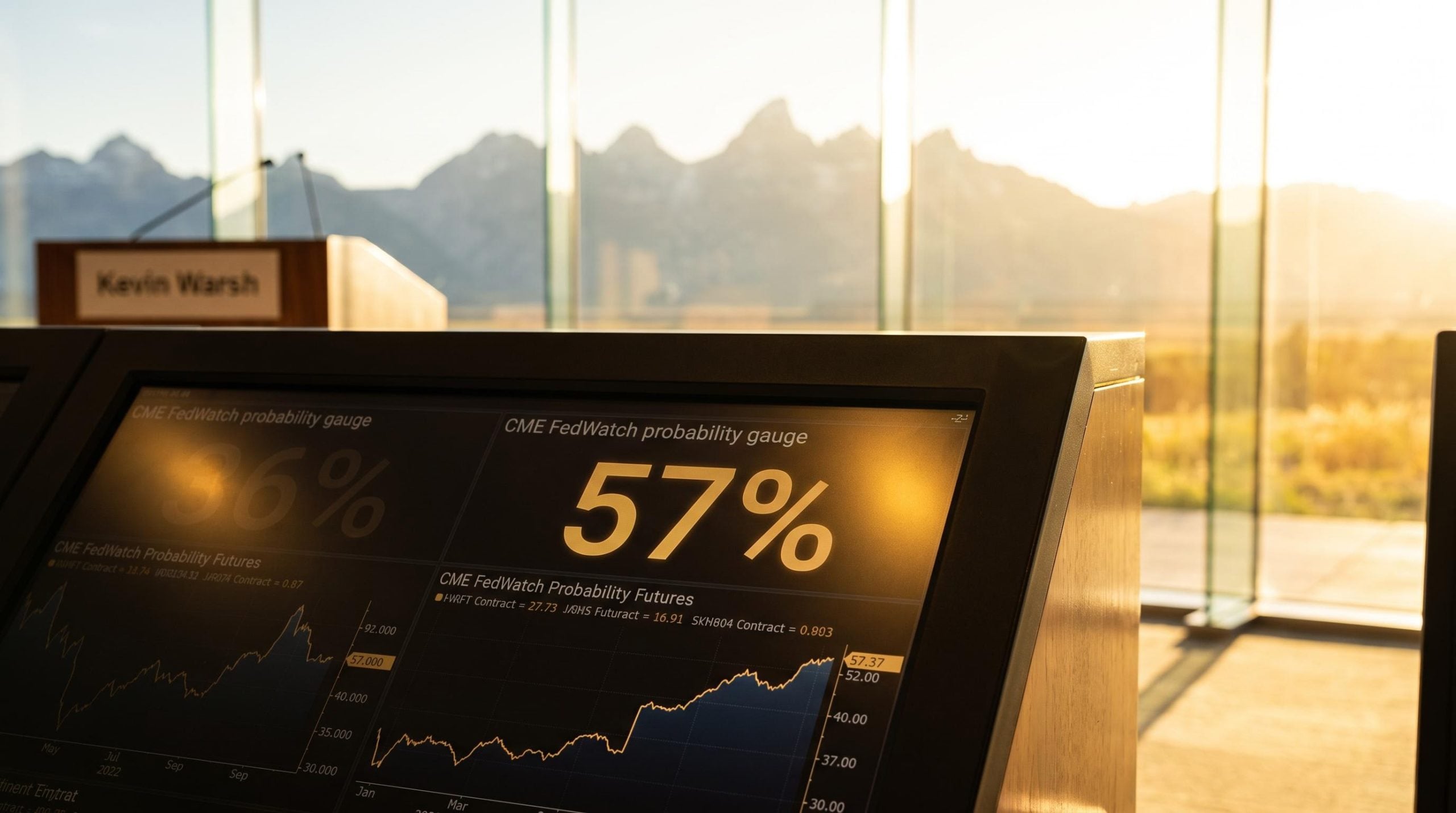
Fed Chair Kevin Warsh shifted the September rate hike debate from “unlikely” to “favoured” in a single Jackson Hole address on 27 August 2026, sending futures-implied odds of a September increase from roughly 36% to 57% in one session. Every rate-sensitive position in a US portfolio is now reading differently as a result.
The speech was Warsh’s debut as chair at the Kansas City Fed’s annual symposium, the Fed’s most closely watched policy signal event, and his tone carried outsized interpretive weight. He delivered it against a backdrop of stubborn inflation, resilient employment, and a stated view that monetary policy had not yet become genuinely tight. He said he would struggle to call current financial conditions restrictive, and pointed to credit and loan markets as showing little sign that policy was constraining activity.
Here is what the speech contained, how markets repriced in response, which economic data reinforce the hawkish case, and what you need to watch between now and the September FOMC meeting to stay ahead of the next move.
What Warsh actually said, and why the hawkish read stuck
Warsh opened with what sounded like a concession. He acknowledged that the run of inflation data through the summer had come in more favourably than anticipated. But he then spent the remainder of his address systematically closing the door on any interpretation that the improvement was enough.
In assessing the broader economy, Warsh struck an upbeat note: he highlighted healthy consumer spending, a stable labour market, and rapidly expanding business investment. None of that was the hawkish signal. The signal was what he said next: that despite all of that economic strength, he could not characterise current financial conditions as genuinely restrictive, and that credit and loan markets showed “limited evidence of monetary policy restraint.”
The core hawkish markers from the speech:
Warsh’s Jackson Hole remarks, published in full on the Federal Reserve Board’s official website, confirm that the chair characterised credit and loan markets as showing limited evidence that monetary policy restraint was yet constraining economic activity.
- Financial conditions are not yet genuinely restrictive, in Warsh’s own assessment
- Recent inflation figures have not persuaded him that the underlying trend in price growth has durably changed
- The Fed’s task is not complete, and there is still progress to be made on bringing inflation to target
- The 2% PCE inflation target remains non-negotiable
Warsh’s statement that policymakers still have “additional work ahead” is the clearest signal from the speech. A Fed chair who sees the economy as resilient but financial conditions as insufficiently tight is not describing a pause. He is describing a policy rate that has more room to rise before it genuinely bites.
That framing matters directly for how long rate-sensitive positions face headwinds. This is not a chair looking for reasons to hold. This is a chair who believes his own tightening cycle has not done enough work yet.
When big ASX news breaks, our subscribers know first
How markets repriced September in a single session
The centrepiece number is the shift in CME FedWatch Tool probabilities. Before the speech, markets priced a September hike at approximately 36%. Afterward, that figure stood at approximately 57%.
That is not a rounding error. It is a threshold crossing.
The July FOMC dissent, in which three officials voted for an immediate 25 basis point hike, had already established that the hawkish faction needed only two more votes to command a majority, framing Warsh’s Jackson Hole posture as confirmation rather than a new development.
| Metric | Pre-speech | Post-speech |
|---|---|---|
| September hike probability (CME FedWatch) | ~36% | ~57% |
| US Dollar direction | Neutral | Positive |
| One-year inflation expectations (UMich) | 4.2% | 4.0% (limited offset) |
The policy question itself changed shape. Before the speech, the debate was “is a hike possible?” After it, the debate became “is a hike slightly more likely than not?” The US Dollar’s positive reaction corroborated the move across asset classes. The University of Michigan’s near-term inflation expectations ticked down from 4.2% to 4.0%, a modest softening that did little to counteract the broader repricing.
When futures-implied odds cross above 50%, rate-sensitive assets face a fundamentally different risk calculus. The burden of proof has shifted. The data now needs to prevent a hike, rather than justify one. For anyone holding real estate, utilities, or long-duration bonds, that distinction is the one that matters most heading into September.
The economic data that complicates the dovish case
Two releases landed alongside the Jackson Hole speech, and neither gave the Fed a reason to back off.
Labour market:
- According to the Bureau of Labor Statistics (BLS) preliminary nonfarm payrolls benchmark revision, total employment for the twelve months through March was lowered by approximately 79,000 jobs, or -0.1%
- That compares with a downward adjustment of -911,000 jobs in the equivalent exercise a year earlier, meaning this cycle’s revision is far smaller and signals that the labour market was not as weak as some had feared
- The limited scale of the revision points to a jobs market that remains fundamentally intact rather than quietly unravelling
Consumer sentiment:
- The University of Michigan Consumer Sentiment Index reached a final August reading of 51.7, lifted from the flash estimate of 51.0, though still trailing July’s 55.2
- The Expectations sub-index was also revised upward, from an initial 50.6 to 51.5, yet this too sits below the 55.4 recorded in July
- University of Michigan one-year consumer inflation expectations settled at 4.0%, easing from the prior reading of 4.2%
- The five-year inflation expectations measure held steady at 3.3%
One-year inflation expectations at 4.0% are roughly double the Fed’s 2% PCE target. Households are not yet living in a 2% world, and that limits how much comfort the Fed can take from a modest sentiment improvement.
The core PCE trend entering Jackson Hole showed two consecutive months at 3.3% year over year, a pattern the Dallas Fed trimmed mean and Cleveland Fed median gauges were tracking toward the 2% target faster than headline measures, complicating any clean read on whether underlying inflation was durably cooling.
The combined picture is an economy that is steady rather than deteriorating, with consumers who feel pressure but are not collapsing. That is precisely the backdrop that supports more tightening. The modest jobs revision and the still-weak sentiment reading together reduce the probability that the Fed will be handed an obvious reason to pause. Absent a sharp deterioration in either, the data backdrop supports Warsh’s “higher for longer” posture.
Four variables that will determine whether September becomes a live meeting
The Jackson Hole speech set the direction. These four variables will determine the destination.
- Core PCE inflation for August. This is the single highest-stakes release before the FOMC. Any re-acceleration in underlying price pressures would cement the case for a hike, and any further progress would be the strongest counterweight to Warsh’s hawkish posture.
- August nonfarm payrolls report. Warsh characterised employment as “steady.” A surprise to the downside is the primary data point that could complicate the case for tightening. A number in line with recent trends confirms the Fed has room to act.
- FOMC member communications. Warsh’s tone needs to be weighed against whether other committee members echo or balance it. A chorus of hawkish remarks would reinforce the repricing. A visible split would pull odds back toward the middle.
- Financial conditions. Credit spreads, lending standards, and equity performance are variables the chair has already flagged as insufficiently restrictive. Any further easing in these measures could itself increase hike pressure, because it would validate Warsh’s core concern that policy is not yet biting.
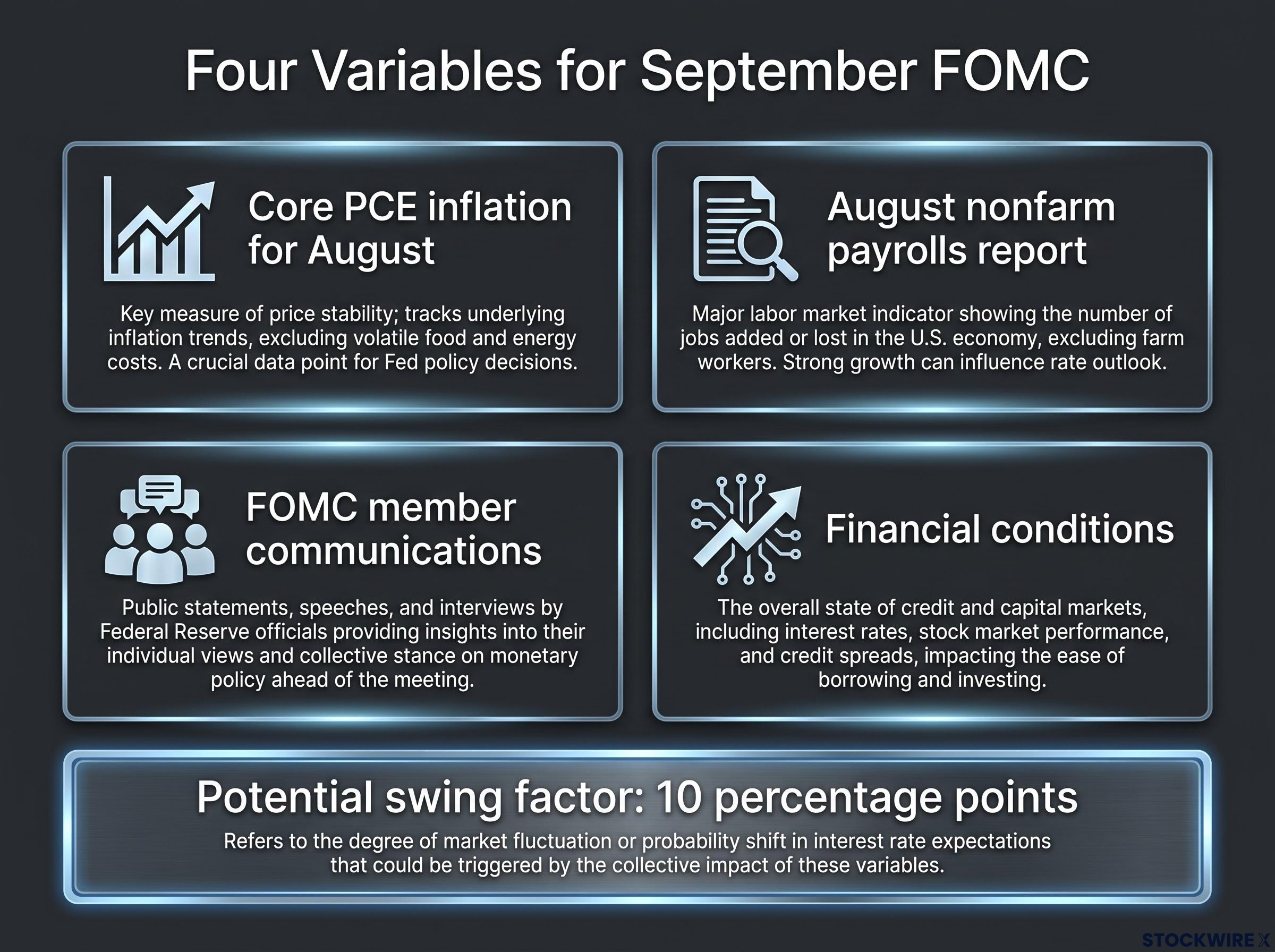
Each of these is a potential swing factor that could move September hike odds by 10 percentage points or more in either direction. Tracking them is the difference between anticipating the next repricing and reacting to it.
What the repricing changes, and what it does not
The durable shift from Jackson Hole is clear. Warsh’s debut established a hawkish baseline for the Fed’s posture heading into autumn, and the burden of proof for a September hold has increased. At 57%, a September hike is now the market’s base case rather than a tail risk.
What remains genuinely open is the data. A meaningful deterioration in core PCE progress or a sharp weakening in employment would change the calculus. The two releases that matter most, core PCE and August payrolls, have not landed yet. The outcome is not locked in.
For rate-sensitive positioning, that distinction between “base case” and “certainty” is what allows proportionate rather than reactive decisions. This is not a moment for panic repositioning. It is a moment for reviewing exposure to real estate, utilities, and long-duration bonds in the context of a Fed that views itself as not yet done.
Rate transmission into REIT valuations operates through four distinct channels, including the discount rate effect on future cash flows and yield competition with government bonds, meaning a shift from a 36% to a 57% implied hike probability affects the sector through mechanisms that move simultaneously rather than sequentially.
The data between now and the September meeting will tell you whether Warsh’s hawkish signal becomes policy action or remains posture. What it will not do is erase the signal itself. The chair has spoken, and the direction is clear.
This article is for informational purposes only and should not be considered financial advice. Investors should conduct their own research and consult with financial professionals before making investment decisions. These statements are speculative and subject to change based on market developments and economic data.