Chipmakers powered US stocks higher for a second straight session on Tuesday, with a chip gauge up 3.6% and the semiconductor ETF up 3.91%, while the Dow Jones Industrial Average barely moved. The semiconductor stocks rally came hours before the Federal Reserve decision and ahead of earnings from tech giants collectively worth more than $10tn.
The index headline hides a split market. Technology climbed, while energy, real estate and consumer staples sank.
The backdrop is less comfortable than the chip charts suggest. The 10-year Treasury yield sits at about 4.99%, a whisker below the 5% line, so the bond market could still turn on this rally.
The session raises three questions: whether the chip rebound can hold, what the Fed could change on Wednesday, and what strategists expect once the 3 November midterms are out of the way.
Why is the chip rally running while staples and the Dow lag?
The S&P 500 closed at 7,723, up 0.60%. The Nasdaq gained 1.18% to 26,478 and the Russell 2000 rose 1.16%, while the Dow added just 0.03% to 52,378. The VIX volatility gauge fell 4.73% to 17.52. All the major indices finished below their session highs.
The sector scoreboard shows where the money went.
| Sector | Move |
|---|---|
| Information Technology | +1.49% |
| Consumer Discretionary | +1.36% |
| Financials | -0.27% |
| Consumer Staples | -0.90% |
| Energy | -2.20% |
Three forces pulled chips off the floor:
- Oversold conditions after the iShares Semiconductor ETF (SOXX) lost nearly 12% in a single week, before jumping 3.6% in premarket trade on 19 October
- Lower yields and easing oil prices, which Reuters linked to that rebound
- Ongoing AI infrastructure demand, the longer-term case that JPMorgan frames around whether hyperscalers (the giant cloud operators) can earn a return on AI spending and whether adoption spreads across industries
Sentiment can flip fast. On 22 October, an AI-led selloff turned into a sharp Treasury rally and a chip rebound within one session.
The SOXX slide and rebound highlight how differently semiconductor ETF structures behave, since concentration limits, weighting methods and fees shape how much of a chip swing a fund captures.
Staples were among the weakest groups on Tuesday, yet they remain on track for their best month in nearly five years. Carson Group’s Ryan Detrick has pointed to strength in selected non-tech and consumer-sensitive groups. Investors are trading exposure, not abandoning chips.
A flat Dow beside a surging chip index tells you the S&P 500 level overstates how broad this advance is. Check how much of your own portfolio rides on that one theme.
Can a hawkish Fed under Warsh and 5% yields derail the rally?
Markets are calm about Wednesday’s decision itself. The worry sits in what Chair Kevin Warsh says next.
What the bond market is pricing
The consensus is a hold at 3.75%-4.00% this week, then a 25 basis point hike in December. A basis point is one-hundredth of a percentage point.
Reuters poll, 20 October: 94 of 100 economists expected an October hold. All 100 expected a December hike.
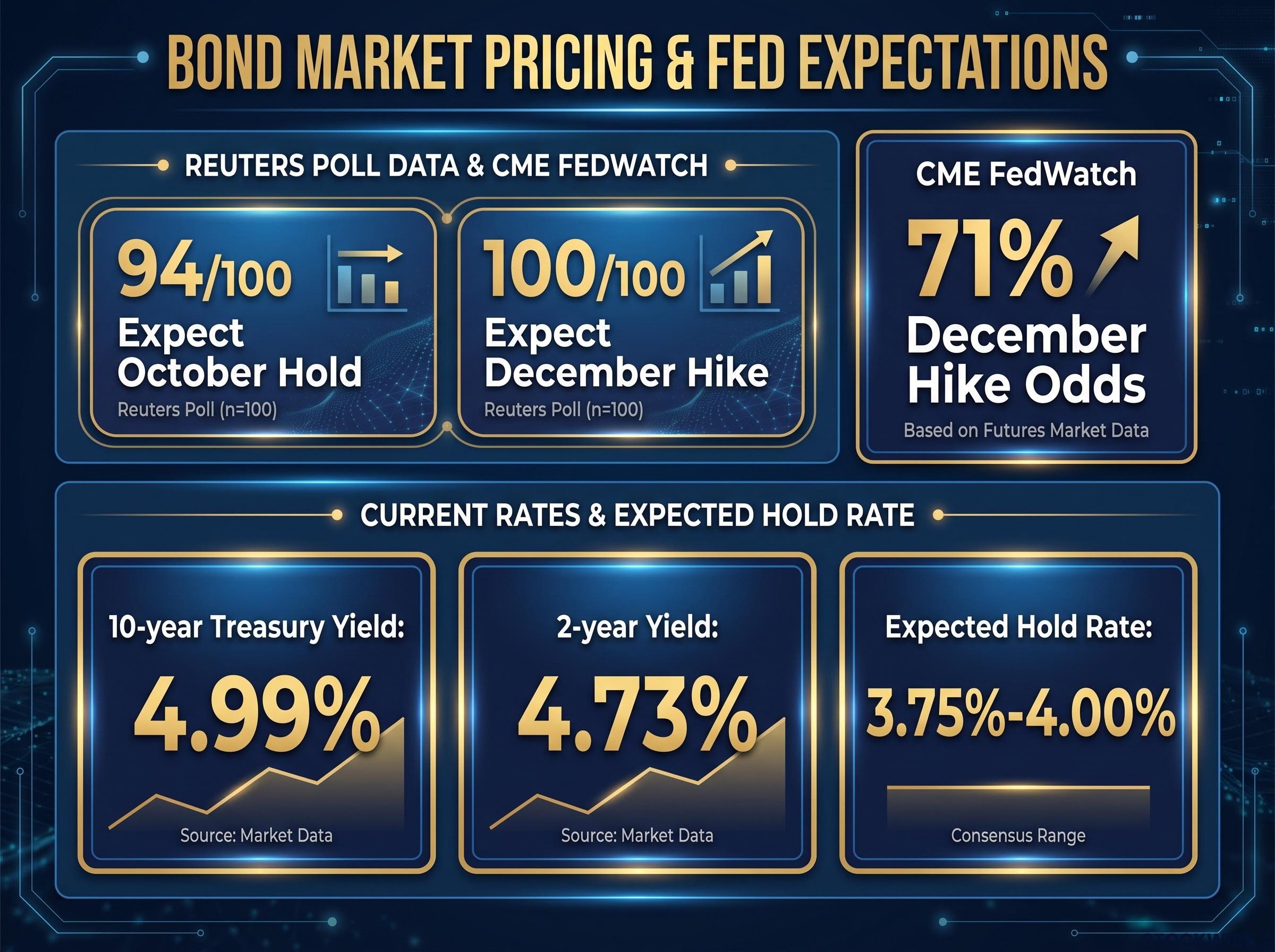
CME FedWatch puts December hike odds at about 71%. Estimates of a move this week vary, from roughly 10% to negligible, but a hold is the strong base case. Odds briefly jumped to about 50% from 20% after hotter inflation data on 14 October.
The 2-year yield closed at 4.73% and the 10-year at 4.99%. Bloomberg expects Warsh to stress data dependence rather than endorse a December hike, and a dissent in favour of hiking is possible.
- Data-dependent, no December commitment: likely read as neutral to mildly supportive for growth stocks
- Data dependence read as permission for December: could lift the 2-year yield and pressure tech
- A hawkish dissent: may strengthen bets on further hikes
The wording matters more to you than the hold. A message heard as a green light for December would hit the richly valued growth names that led Tuesday’s gains.
Why 5% may matter less than assumed
Higher yields raise the return hurdle for every asset, hitting companies whose profits sit far in the future hardest. But JPMorgan says the link between yields and equities became less predictable after 2021.
A 10-year yield hovering just under 5% reflects the four forces behind the yield surge, from hotter inflation data to fiscal deficit anxiety and AI spending uncertainty.
The precedent backs that up. After the 16 September hike, the Fed’s first since 2023, the 10-year briefly topped 5.3% and stocks absorbed it.
What do earnings, Meta’s funding and the midterms say about what comes next?
What the earnings say about the consumer
| Company | Result | Share move | Read-through |
|---|---|---|---|
| Boeing | Q3 adjusted loss 34c vs 21c expected | -10.6% | 52-per-month rate pushed to second half of next year |
| UPS | 2026 revenue forecast raised to about $92.6bn from $91.2bn | About +6% | Q4 volume still expected to fall year over year |
| Coca-Cola | Adjusted EPS $0.91, revenue $13.4bn | About -1.5% | Outlook raised, North American demand slowing |
Boeing logged its worst day since April 2025. Consumer confidence rose 7.5 points to 91.7, its first gain in four months. The consumer is holding up but hunting for value.
Meta’s raise and the AI funding test
Meta upsized its equity raise to nearly $98bn: $25bn of common stock at $625 (a 2.7% discount), about $12.5bn of mandatory convertible preferred shares, and an at-the-market programme of up to $60bn starting after Q1 2027. The common offering was about five times oversubscribed, with Nvidia investing $3bn.
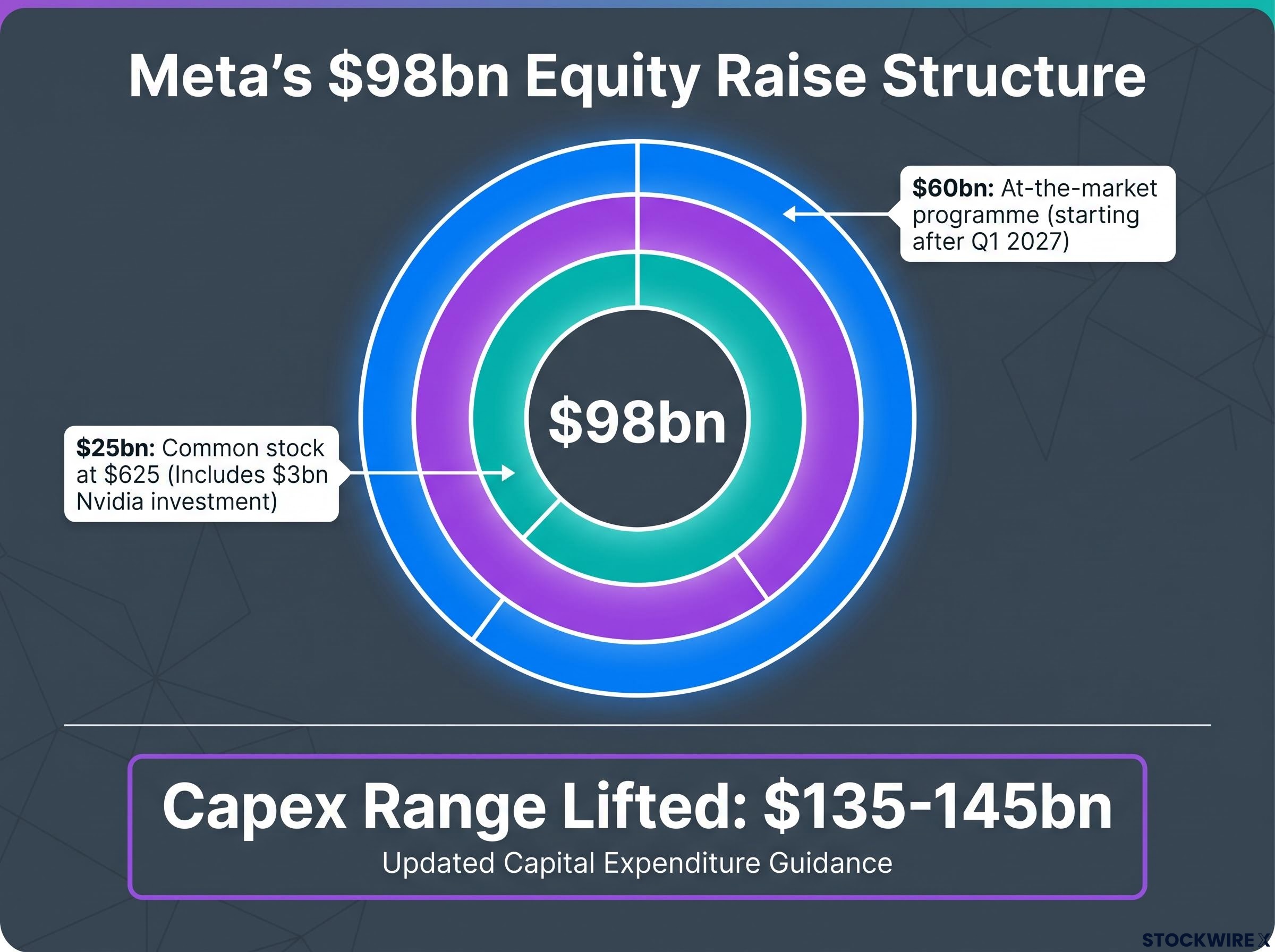
Meta lifted its capex range to $135-145bn, yet free cash flow turned negative and its credit-default-swap spread, the cost of insuring its debt, hit a record. Chip suppliers buying into a major customer raises circular-financing concerns. The AI trade now runs on cash generation and funding costs, not just enthusiasm.
Meta’s negative free cash flow of $2.12 billion, set against $34.91 billion of quarterly capex, explains why the market now treats funding as the central AI question.
The midterm debate
Morgan Stanley’s Mike Wilson expects a post-election relief rally and holds an 8,000 S&P 500 year-end base case, tied to clarity on AI financing, the midterms and the Fed’s path.
Bond skeptics are less convinced that gridlock brings fiscal discipline. A Bloomberg survey found more than half of respondents expect lower yields under a Democratic sweep, versus 36% under a split Congress. Treat the midterm bounce as a possibility to weigh, not a certainty to bank on.
These statements are speculative and subject to change based on market developments and company performance.
What the session changes, and what it does not
The chip move is real but narrow. The Fed’s tone is the near-term swing factor, and the midterm rally call depends on AI financing, policy and fiscal assumptions all lining up.
Watch three things, in order: the Fed statement and any dissent on Wednesday, where the 10-year settles relative to 5%, and what megacap earnings reveal about AI capex. If all three cooperate, the rally has room. If one breaks, the narrowness of Tuesday’s gains becomes the risk.
This article is for informational purposes only and should not be considered financial advice. Investors should conduct their own research and consult with financial professionals before making investment decisions. Past performance does not guarantee future results.