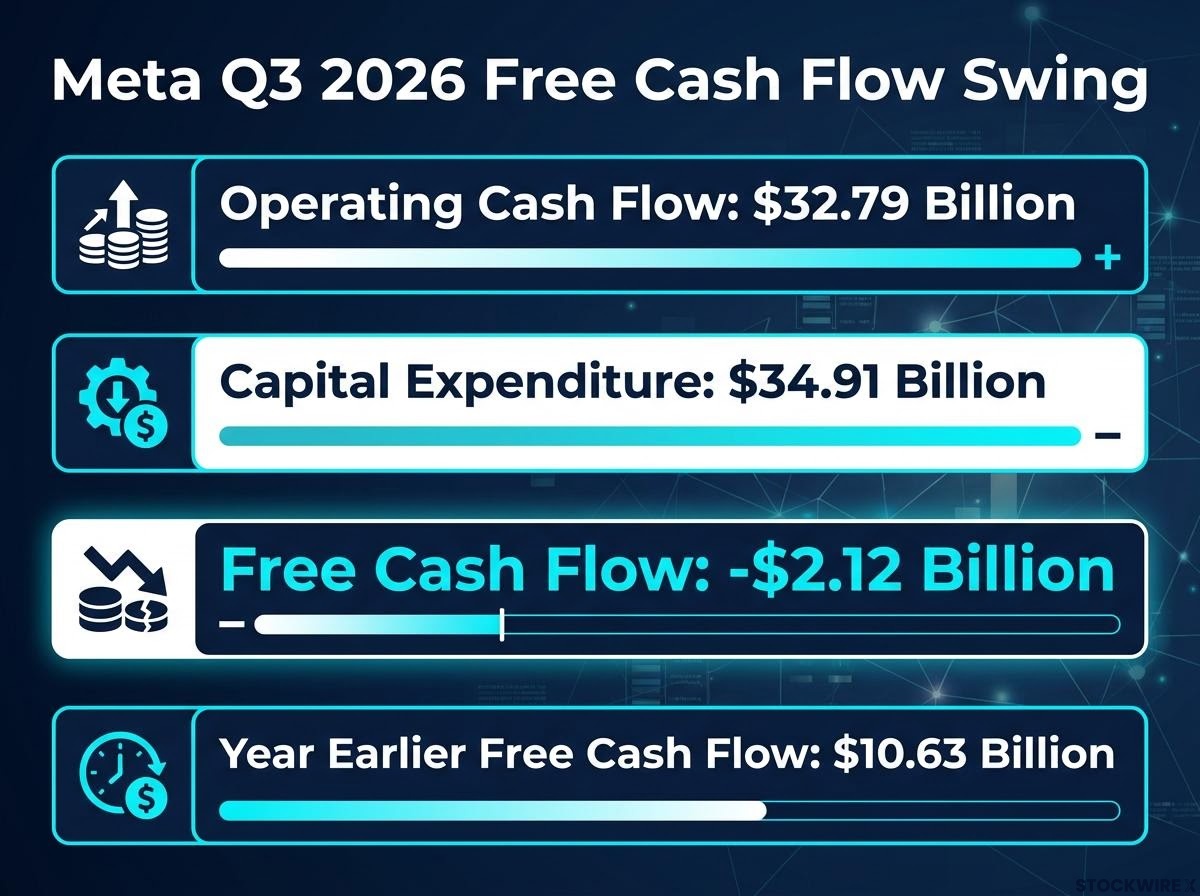
Meta spent $34.91 billion on capital expenditure in its September quarter. Over the same three months, its operations generated $32.79 billion in cash. The gap pushed Meta’s free cash flow negative to $2.12 billion, against a positive $10.63 billion a year earlier.
That figure points to a change many investors may be missing. For two years the market asked whether AI would make money. Now it is asking who pays before it does.
Meta released its results on 21-22 October 2026, and revenue was strong. The stock still fell roughly 7-8%. A sell-off after good revenue tells you the price reaction was about funding, not growth.
Here is a way to read funding risk across Big Tech. It covers what Meta’s proposed Class C shares do and do not mean for existing shareholders, and what to watch as earnings season continues.
Why did Meta’s cash flow turn negative, and why did the market care more than usual?
Start with the arithmetic. Free cash flow is the cash a company has left after paying for its operations and its investment in physical assets such as data centres. Meta had produced positive free cash flow consistently since its IPO.
In Q3 2026, spending on infrastructure overtook the cash engine.
| Metric | Q3 2026 | Year earlier | Change |
|---|---|---|---|
| Operating cash flow | $32.79B | Not yet confirmed | Below capex for the quarter |
| Capital expenditure | $34.91B | Not yet confirmed | Exceeded operating cash |
| Free cash flow | -$2.12B | $10.63B | Swing of $12.75B |
Management then raised the floor on spending. Meta now expects 2026 capex of $135-$145 billion, lifting the low end from $130 billion. It gave no 2027 figure, saying only that it still plans to invest aggressively.
The share price traced the market’s thinking in real time. Meta rose about 6% after hours as investors absorbed the revenue numbers, then reversed and fell about 7% overnight once the funding detail sank in. Meta’s five-year credit default swap spread, the annual cost of insuring its debt against default, reached a reported record.
The funding focus Goldman Sachs analyst Eric Sheridan said Meta’s Muse AI agent showed promising signs of eventual monetisation, but the market was concentrating on the capital required before returns arrive. Morningstar’s Brian Colello called Meta’s future funding plans a “key focus”.
Neither analyst abandoned the monetisation thesis. The order of questions changed. Meta still holds about $82.45 billion in cash and marketable securities, and it is now consuming more than it generates. If the best-resourced AI spender has crossed that line, the funding mix matters to every shareholder, not just to credit desks.
Goldman Sachs estimates hyperscalers need about $300 billion of annual AI revenue to break even, a hurdle that explains why Meta’s AI spending is drawing more scrutiny than its strong ad growth.
When big ASX news breaks, our subscribers know first
What do Class C shares and equity issuance actually mean for shareholders?
The headline that worried many holders was Meta’s new share class. The common reading is that Meta is selling stock to fund AI. That is not what happens in January.
What the dividend does and does not change
Meta plans to distribute one new non-voting Class C share for every existing Class A and Class B share, effective 19 January 2027. Because every holder receives the same proportion, your share of Meta’s economics stays identical. Meta expects the market-price effect to resemble a two-for-one split on Class A shares.
The real issue comes later. Meta listed the uses for the new class: raising capital, funding AI infrastructure, paying employees, financing acquisitions and general flexibility. Each time Class C shares are sold for cash or handed out as pay or deal currency, your slice of future earnings shrinks unless the money creates offsetting value. That is dilution.
The non-voting design keeps Mark Zuckerberg’s voting control intact. Meta can expand its economic share count without adding outside votes, a structure other tech firms have long used to preserve founder control. For you, that means the January distribution is a non-event; your exposure is to future issuance decisions.
The Class C discount to Class A is the number to watch once trading begins, because a wider gap forces Meta to issue more shares per dollar raised, and that is where economic dilution would actually show up for you.
Equity versus debt versus off-balance-sheet
Each funding route moves cost to a different place.
| Route | Dilution | Control impact | Key risk | Current example |
|---|---|---|---|---|
| Equity | Yes, when shares are issued | None if non-voting | Smaller share of future earnings; pressure on stock | Oracle’s $20B at-the-market programme |
| Debt | No | None | Interest, refinancing, weaker credit metrics | Alphabet, Amazon and Oracle bond sales |
| Off-balance-sheet | No | None | Hidden obligations through leases and guarantees | Leases, purchase commitments, project finance |
An at-the-market programme lets a company sell new shares gradually into the open market at prevailing prices. Debt avoids dilution, but with free cash flow already negative and the CDS spread at a record, more borrowing looks expensive.
Off-balance-sheet routes are not a free option either. S&P Global’s Himanshu Habib warned that hyperscalers may guarantee data centre construction or support smaller AI firms, creating exposure beyond reported debt. Through what S&P calls interconnected financing structures, the risk shifts rather than disappears.
Is Meta an outlier, or is the whole sector facing the same funding question?
It is tempting to treat this as a Meta story. The peer numbers suggest otherwise. Fiscal calendars and definitions differ, so treat these figures as directional rather than directly comparable.
| Company | Capex | Financing route | Free cash flow signal |
|---|---|---|---|
| Microsoft | ~$115.95B (fiscal 2026) | No comparable jumbo bond sale | Financing outlier |
| Alphabet | $175-$185B (2026 guidance) | Borrowings ~$98.2B, up from $46.5B | Leaning on debt |
| Amazon | ~$30.12B quarterly | Bond sales, including $15B in November 2025 | Trailing ~-$7.6B |
| Oracle | ~$28.5B | Equity programme plus bonds | Trailing ~-$5.4B |
The commitments run even deeper than the spending. Meta’s future obligations, including leases and contracts, climbed to about $825 billion from nearly $700 billion in July. Schwab cited $349.3 billion of noncancelable contractual commitments plus $279 billion of lease commitments, while Alphabet reported $811 billion in purchase commitments.
Much of the exposure sits in filing footnotes rather than headline debt, with legally binding hyperscaler obligations estimated above $2.6 trillion against roughly $700 billion of reported borrowings.
In aggregate, one financing analysis put the five major hyperscalers’ combined 2026 capex at roughly $780-$820 billion, above their combined operating cash flow. Goldman estimated just over $800 billion in 2026 and about $1.1 trillion in 2027.
The sector is split on what this means:
- Healthy cycle: Deutsche Bank’s Benjamin Black argued Meta’s AI spending is already lifting ad performance and engagement, making compute a revenue-generating asset rather than a pure cost. Meta also remains a large, profitable advertiser that may simply be front-loading investment.
- Funding strain: S&P has flagged circular financing, where links between hyperscalers, AI developers and data centre projects can make demand look stronger than end-user economics justify. Leases and commitments can become durable liabilities if revenue arrives late.
The downside scenario The International Monetary Fund’s (IMF) Jason Wu warned that if AI monetisation disappoints, equity could lose value, debt could become hard to service and expected revenue commitments might not materialise.
The read you should take from this: spending totals no longer separate the winners. The funding mix does. Microsoft, spending heavily without jumbo borrowing, sits in a different category from peers running negative trailing free cash flow and tapping bond markets repeatedly.
What should you watch as earnings season tests the funding story?
Meta was not the only stock punished for good news this week. Moderna fell 17.6% at the close, and as much as about 25% intraday, after results from its personalised mRNA melanoma vaccine with Merck.
The data were clinically positive. The Phase 3 INTerpath-001 trial reported a 42% reduction in the risk of recurrence or death versus Keytruda alone, and a 38% reduction in distant metastasis or death. Two-year recurrence-free survival was about 82% against 70%.
So why the collapse? The results leaked early on Oncology Central ahead of their scheduled ESMO presentation, following a substantial prior rally. The original strategist commentary also argued the results raised doubts about Moderna’s broader multi-cancer ambitions. Merck, with far less riding on one programme, fell only about 1.7-1.8%.
| Factor | Meta | Moderna |
|---|---|---|
| Headline result | Strong revenue | Positive Phase 3 data |
| Share fall | ~7-8% | 17.6% close, ~25% intraday |
| Main driver | Funding and spending repricing | Expectation reset after rally and leak |
| Story type | Sector-wide funding question | Single-asset concentration |
The common thread is a market regime. When the payoff is already priced in, or the cost of reaching it rises, a beat on revenue or earnings per share no longer protects a stock. Your position sizing and expectations matter as much as the results themselves.
Gerry Sparrow of Sparrow Capital Management expects earnings reactions to stay mixed. Schwab says investors will scrutinise capex, debt and off-balance-sheet commitments across the Magnificent Seven, and Saxo has flagged Meta’s 2027 capex outlook. Watch these five signals:
- Cash conversion: How much operating cash flow survives after capex.
- Capex guidance: Whether ranges rise again, especially any first look at 2027.
- Funding costs: Bond pricing, CDS spreads and the pace of new issuance.
- Off-balance-sheet growth: Movement in lease and purchase commitments.
- Forward returns: Concrete ad, cloud or agent revenue tied to the spending.
Reading the funding question without overreacting to it
Meta’s negative free cash flow is a signal about sequencing, not proof that AI monetisation has failed. It does raise the bar for evidence.
Separate the structural from the cyclical. The multiyear buildout of data centres, power and chips is structural and will not reverse quickly. Higher rates, crowded positioning and stretched expectations are amplifiers that can make each reaction sharper.
The decision point is which signals arrive first. Rising cash conversion, agent revenue and steady credit spreads would strengthen the healthy-cycle reading. Repeated Class C issuance, widening spreads and swelling commitments without matching revenue would confirm the funding-strain view.
This article is for informational purposes only and should not be considered financial advice. Investors should conduct their own research and consult with financial professionals before making investment decisions. Past performance does not guarantee future results. Financial projections are subject to market conditions and various risk factors.