
Truist raised its Meta target to $1,000. Barclays downgraded Dell, a stock that has gained well over 200% this year. Both calls rest on the same technology, yet they point in opposite directions. That split is the signal in this week’s analyst ratings on AI stocks: “AI exposure” no longer works as an investment thesis on its own.
The pattern extended beyond those two names. Bank of America upgraded Salesforce two notches to Buy, while HSBC and Wells Fargo both cut Adobe.
Barclays strategist Emmanuel Cau describes an AI trade that is maturing. In his view, investors should expect more dispersion between winners and losers and closer scrutiny of valuation and revenue visibility. Meta’s Q3 report, expected on 21 October (some calendars list 28 October), is the next live test.
Here is a three-part lens for judging any AI holding you own: valuation, monetisation visibility and disruption risk. You will also see how each of this week’s calls fits that lens.
Which AI stocks did analysts upgrade and downgrade this week?
Start with the raises. Truist’s Youssef Squali kept a Buy on Meta Platforms and lifted his target to $1,000 from $763, matching Wells Fargo for the highest on Wall Street. His base case assumes $28.5 billion of incremental annual revenue from the Muse AI agent by 2030. Meta shares have risen 21% since Muse launched on 8 September, compared with about 2% for the S&P 500.
BofA’s Tal Liani moved Salesforce from Underperform straight to Buy and raised his target to $285 from $160. A double upgrade does not adjust a view. It replaces one.
Now the cuts. Barclays’ Tim Long lowered Dell Technologies to Equal Weight and trimmed its target to $574 from $603. Barclays also cut Hewlett Packard Enterprise (HPE) and NetApp to Equal Weight. HSBC and Wells Fargo both downgraded Adobe.
| Company | Firm | Action | New target | Core reason |
|---|---|---|---|---|
| Meta | Truist | Buy maintained | $1,000 (from $763) | Early Muse adoption |
| Salesforce | BofA | Underperform to Buy | $285 (from $160) | AI may deepen platform reliance |
| Dell | Barclays | Overweight to Equal Weight | $574 (from $603) | Valuation, thin margins, memory effects |
| HPE / NetApp | Barclays | Overweight to Equal Weight | $77 (from $83) / $219 (kept) | No enterprise-AI inflection yet |
| Adobe | HSBC / Wells Fargo | Buy to Hold / Overweight to Underweight | $267 (from $310) / $225 (from $270) | Disruption risk at the user layer |
A few caveats on the data:
- The primary sell-side notes were not publicly accessible, so these figures come from published coverage.
- Current share prices and latest results for Salesforce, Dell and Adobe were not consistently available, so they are not quoted here.
Line the calls up and a sorting pattern appears. Companies that can turn AI into their own revenue moved up. Hardware suppliers passing through costs, and software that sits at the user-facing layer, moved down. For your portfolio, a stock’s AI label tells you little until you know which side of that line it sits on.
When big ASX news breaks, our subscribers know first
Why is Wall Street paying for Meta and Salesforce but not for Dell and Adobe?
The bullish and bearish cases mirror each other. The question in both is the same: who keeps the money AI generates?
The case for Meta and Salesforce
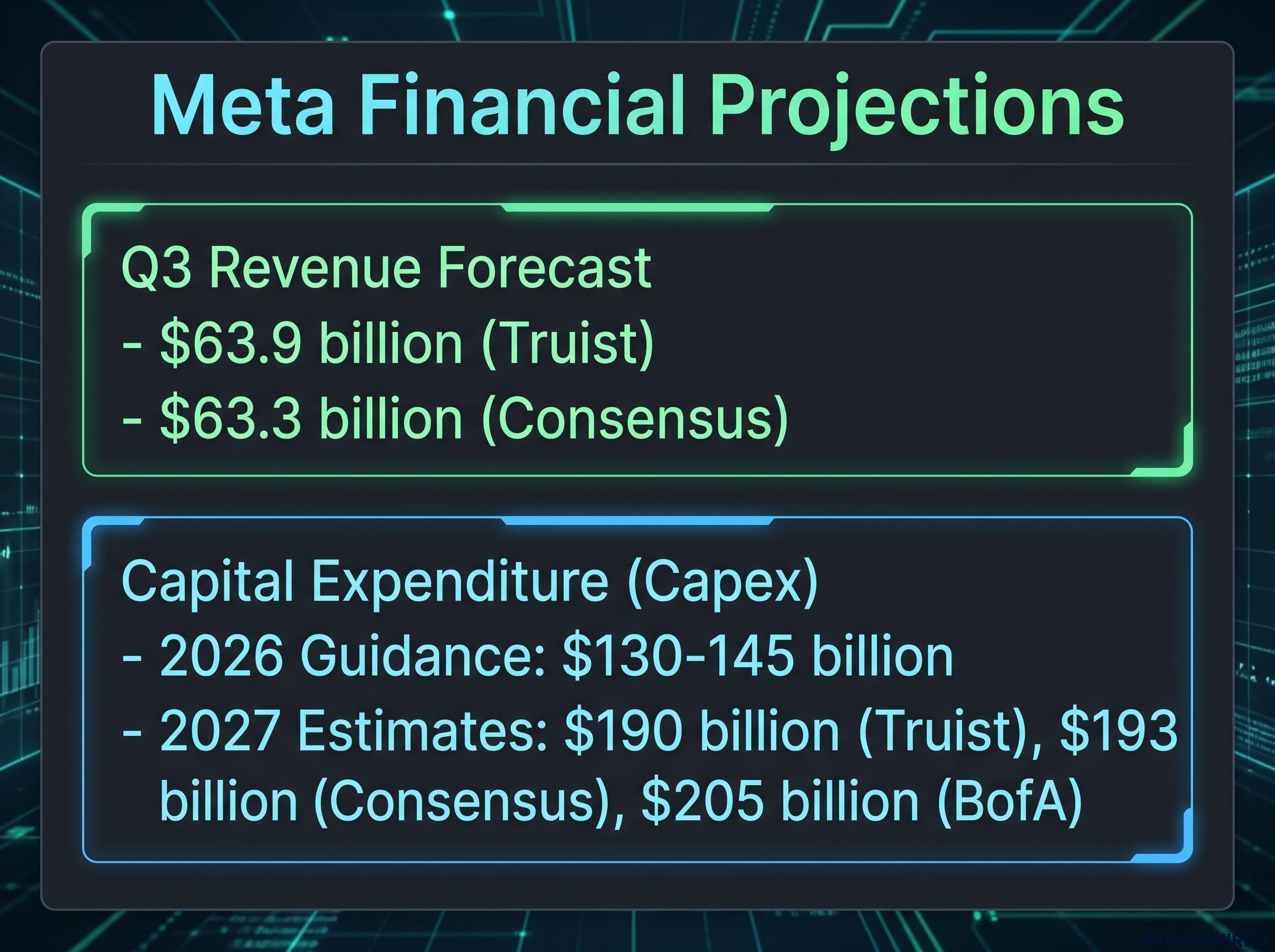
Meta buys AI infrastructure, and it can also earn from it through ads, recommendation systems and Muse. Truist forecasts Q3 revenue of $63.9 billion, up 25%, slightly above consensus of about $63.3 billion. Squali also expects another double-digit rise in ad pricing.
The payback burden is large, though. Meta guides to 2026 capital expenditure (capex) of $130-145 billion. Capex is money spent on long-term assets such as data centres. Estimates for 2027 diverge: Truist projects $190 billion, consensus sits at $193 billion, and BofA estimates about $205 billion.
Salesforce’s case rests on four layers: a governed data layer, applications such as Sales Cloud, the Agentforce agent layer, and Slack with Claudeforce for natural-language interaction. Liani argues that AI agents built on this foundation strengthen the platform rather than route around it. BofA raised its subscription growth forecasts for fiscal 2028 and 2029 to 10.4% and 10.5%. Salesforce’s AI revenue remains small, however, and slow adoption is the main risk.
Liani’s thesis rests on the idea that agents need authoritative data, which makes systems of record more entrenched rather than less. That logic explains why BofA moved so decisively on Salesforce while others stayed cautious.
The case against Dell, HPE, NetApp and Adobe
Barclays’ argument against Dell has five parts:
- Rising memory prices push server prices higher without matching growth in unit demand.
- That tailwind reverses if memory prices normalise or fall.
- Only about 5% of IT budgets go to AI, and roughly a quarter of enterprise-AI spending goes to hardware.
- Dell’s AI-server operating margin is estimated at about 5%.
- There is no meaningful enterprise-AI spending inflection yet.
Long still models Dell’s AI server revenue tripling to $75 billion this fiscal year. Revenue is clearly growing; the issue is how much of it Dell keeps. The seven enterprise-exposed stocks Barclays covers are up about 140% on average this year, against 12% for the S&P 500, and trade near 21x 2027 earnings compared with a five-year average close to 15x.
Adobe’s problem sits at the opposite end of the stack. HSBC’s Stephen Bersey points to ArtCraft, a small firm that has released an auto-coded clone of Creative Cloud. He expects the impact to fall mainly on freemium and open-source users, and he cut revenue estimates by only about 1%.
Valuation gap Adobe trades at 9x estimated 2027 adjusted earnings, against a sector median of 20.7x. Bersey calls the discount warranted.
A cheap multiple like Adobe’s, or a surging share price like Dell’s, does not settle the question by itself. What matters is whether the revenue lasts and who captures it.
How to evaluate AI exposure: valuation, monetisation visibility and disruption risk
Two distinctions sit underneath every call this week. A system of record is the software where a company stores its core data, rules and workflows. An interface layer is the screen or tool people use on top of that data, which makes it easier for a cheaper rival to replace. In the same way, real AI demand means customers buying more because of AI, while cost pass-through means revenue rises only because component costs went up.
The analysts’ own criteria turn those distinctions into three questions:
- Valuation: Does the price already reflect years of growth? Cau favours proven models, strong cash flow and reasonable valuations.
- Monetisation visibility: Can you see AI revenue arriving, separate from memory inflation (Long’s test) and in proportion to capex (BofA strategist Sebastian Raedler‘s test)?
- Disruption risk: Does the company own a defensible system of record, and do agents reinforce it or bypass it (Liani’s test)?
Raedler’s warning shows why the second question matters. BofA estimates that 12-month forward hyperscaler capex expectations rose from about $330 billion in early 2025 to $1 trillion.
Raedler’s warning echoes a broader debate, where three tests for judging valuations focus on capex against free cash flow, depreciation assumptions and whether current AI demand is subsidised. Each test asks whether spending is earning its keep.
| Lens | Question to ask | Meta | Salesforce | Dell/Adobe |
|---|---|---|---|---|
| Valuation | Is growth already priced in? | Debated given capex | Not flagged as stretched | Dell stretched; Adobe discounted |
| Monetisation | Is AI revenue visible? | Ads and early Muse | Still small | Dell partly pass-through |
| Disruption | Do agents reinforce or bypass? | Owns distribution | Reinforce, per BofA | Adobe exposed at the user layer |
The same stock can pass one test and fail another. Salesforce looks strong on disruption risk, but its AI revenue remains modest. Morningstar has also lowered its moat ratings for both Adobe and Salesforce. A moat rating is Morningstar’s assessment of how well a company can protect its profits from competitors. Separately, Wells Fargo’s Michael Turrin cites surveys showing that front-office software is more exposed to budget reallocation.
BofA’s Liani now believes AI will increase enterprises’ reliance on their platforms rather than displace them.
Apply the three questions to your own holdings. A stock should look favourable on at least two before its AI label justifies a position. Failing the valuation test still matters even when the technology works.
Is the AI trade really maturing, or is this just a pullback?
These calls landed during a rough patch for AI stocks. Several things went wrong at once:
- Hotter-than-expected US CPI and PPI inflation readings
- Brent crude reaching record highs
- A chip-sector selloff that Reuters described as “brutal”
- Worries about competition in the memory market
- Firmus shelving a planned $5 billion IPO, and Barclays noting two Asian data-centre firms delaying listings
Cau separates this noise from the underlying thesis. He says the best of the AI trade may be over, but he attributes most of the weakness to positioning rather than to fundamentals. He is less concerned about memory competition, given demand guidance from ASML and TSMC, and he points to Europe as a diversifier with less AI concentration.
Maturing, not over: the competing views
| Voice | Stance | Key argument |
|---|---|---|
| Emmanuel Cau, Barclays | Selective | More volatility, dispersion and scrutiny |
| Sebastian Raedler, BofA | Cautious | Investors can lose money even if the technology works, as with dot-com-era infrastructure |
| Gene Munster, Deepwater | Bullish | Only the “third inning” of the cycle |
| Dan Ives | Bullish | The capex boom is running at full speed |
The weight of these views points to one conclusion. A maturing trade is not a finished trade, but it is a more selective one. Each bullish call carries risks that could undo it:
- Capex payback lagging spending
- Concentration in a small group of names
- Analyst herding, where ratings follow price moves already underway
- Slow AI monetisation in software
- A reversal in the memory cycle
If analysts are partly following momentum, treat these calls as evidence of where scrutiny is heading, not as proof of future returns. Meta’s report, with consensus near $63.3 billion in revenue and about $6.7 in EPS, comes first. Other mega-cap results follow in the weeks after. These statements are speculative and subject to change based on market developments and company performance.
Investors weighing whether this is a pullback or something larger can read our deep-dive into four bubble frameworks, which tests Minsky and Kindleberger models against current AI valuations.
What these analyst calls change, and what they leave open
This week’s calls change one thing. The market is now rewarding visible monetisation and control of enterprise data, and it is marking down stretched valuations and exposed interface layers.
Plenty remains unresolved. Salesforce’s AI revenue is still small. Meta faces a large capex payback burden. Dell’s gains depend on a memory cycle that could reverse, and the real-world damage to Adobe from AI rivals is still unproven.
Meta’s Q3 report and the mega-cap earnings that follow will start to test these views. Before then, run your own AI holdings through the three questions on valuation, monetisation and disruption risk.
This is analysis, not personalised advice. Past performance does not guarantee future results. Financial projections are subject to market conditions and various risk factors.
This article is for informational purposes only and should not be considered financial advice. Investors should conduct their own research and consult with financial professionals before making investment decisions.